Recruiters have always had to answer the same question after candidates enter a hiring process: who should receive more attention?
The difficulty is scale. A recruiter reviewing 30 applicants can study each profile carefully. A team receiving hundreds or thousands of applications cannot spend the same amount of time on every person. The problem becomes even more difficult when recruiters are also managing sourced candidates, referrals, previous applicants, and people entering through several recruiting channels.
AI candidate screening is designed to reduce this early-stage review work.
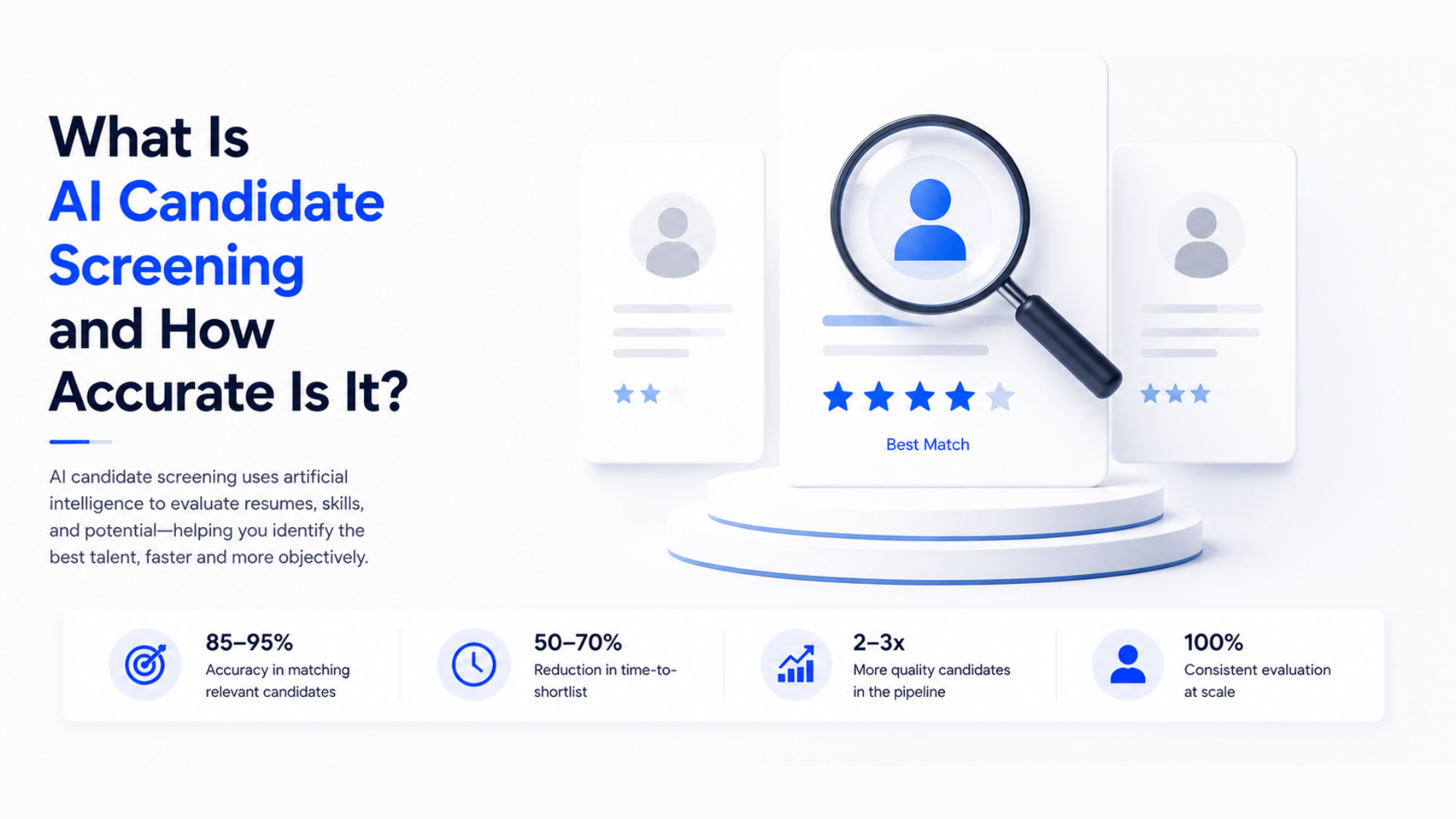
AI candidate screening is the use of artificial intelligence to analyze candidate information, compare it with job requirements, and help determine which candidates should receive further recruiter attention or move to the next stage of a hiring process.
The technology can review resumes, applications, screening responses, skills, work histories, and other permitted information. Depending on the system, it may summarize candidate experience, identify required qualifications, compare profiles with a role, rank potential matches, flag missing information, or recommend a next step.
The difficult question is not whether AI can screen candidates faster than a recruiter.
It can.
The more important question is whether it can screen them accurately.
There is no universal accuracy percentage for AI candidate screening. A system can perform well on one role and poorly on another. Accuracy depends on what the system is being asked to predict, the quality of the job requirements, the candidate information available, the model being used, the validation process, and how the employer uses the output.
This is why claims that AI screening is simply “more accurate than humans” or “too biased to use” are both incomplete. AI candidate screening can be useful, but its reliability has to be evaluated in the context of the specific task and workflow.
What Is AI Candidate Screening?
AI candidate screening uses software to evaluate candidate information during the early stages of recruitment.
The process can begin after someone applies for a job, but it is not limited to applicants. An outbound recruiting team may also use AI to review sourced candidates before deciding who should be contacted or qualified further.
Traditional screening is mostly manual. A recruiter opens a resume, compares it with the job description, looks for relevant experience, checks basic requirements, and decides whether the candidate deserves further review.
AI screening attempts to support or automate parts of this process.
A simple system may check whether required qualifications appear in the candidate’s information. A more advanced system may analyze the meaning of a person’s experience, identify transferable skills, summarize career history, compare multiple signals with the role, and explain why the candidate appears more or less relevant.
Some systems stop at recommendation.
Others can trigger the next stage of the workflow. A candidate who meets defined requirements may receive additional screening questions, move to an AI screening interview, or be sent to a recruiter for review.
This creates an important distinction. AI candidate screening is not one specific technology. The term can describe everything from automated resume filtering to a conversational system that asks candidates questions and structures the answers for a recruiter.
Those systems should not be assumed to have the same accuracy simply because they all use AI.
How Does AI Candidate Screening Work?
Most AI screening workflows begin with the role.
The system needs some definition of what the company is looking for. This may come from a job description, recruiter instructions, structured requirements, hiring manager input, screening questions, or a combination of these sources.
The AI then evaluates candidate information against that requirement.
Older systems often relied heavily on exact keywords and rules. If a role required a particular skill, title, degree, or number of years of experience, the system searched for those signals and applied predefined logic.
Modern AI systems can interpret more context.
A candidate may have relevant experience without using the exact words found in the job description. Two companies may use different titles for similar work. A person may have developed a required capability through an adjacent role rather than the expected career path.
AI can attempt to recognize these relationships.
For example, a company may need someone who has helped a software business move from founder-led sales to a repeatable enterprise sales process. That experience may not appear as one exact keyword on a resume. It may be visible through company stage, career progression, responsibilities, customer types, and achievements.
A contextual screening system can consider those signals together.
The output might be a match score, ranking, recommendation, structured summary, explanation, or set of concerns for a recruiter to review.
The quality of that output depends heavily on the information that enters the system.
If the role is poorly defined, the screening criteria can also be poor.
AI Resume Screening vs. AI Candidate Screening
AI resume screening and AI candidate screening are often used as though they mean the same thing, but candidate screening can be broader.
Resume screening focuses on information contained in the resume or profile. The system extracts experience, education, skills, titles, dates, and other details, then compares those signals with the role.
Candidate screening can include additional information.
A candidate may answer knockout questions, complete a structured questionnaire, participate in a text or voice screening conversation, submit a work sample, or provide clarification about experience that is difficult to understand from the resume alone.
This can improve the quality of the screening process because resumes are incomplete representations of people.
A candidate may have relevant experience but describe it poorly. Another may have a polished resume that creates a stronger impression than their actual capabilities. Some requirements are also difficult to evaluate from career history alone.
The broader the screening process becomes, however, the more important validation becomes.
A system summarizing a resume is doing something different from a system recommending whether a person should continue in a hiring process. The consequences are different, so the standard of evidence should also be different.
How Accurate Is AI Candidate Screening?
The most accurate answer is that it depends on what “accurate” means.
A company might define accuracy as identifying candidates a recruiter would also select. Another might measure whether screened candidates perform well in later interviews. Another might ask whether the system predicts eventual job performance. These are different outcomes.
A system can agree closely with historical recruiter decisions without proving that those decisions were good.
It can predict interview progression without proving that it identifies the strongest employees.
It can rank candidates consistently without proving that the ranking is fair.
This is why one universal accuracy number is not meaningful.
The Society for Industrial and Organizational Psychology’s recommendations for AI-based assessments emphasize the importance of validation rather than assuming that an AI system is useful simply because it produces a score. AI-based selection methods should be evaluated against the purpose for which they are being used.
In practical terms, AI screening can be accurate when the task is clear, relevant information is available, the criteria reflect the real job, and the system has been properly tested. Accuracy becomes weaker when the role is ambiguous, candidate data is incomplete, the AI relies on irrelevant proxies, or the employer treats a general-purpose model as an expert hiring system without sufficient validation.
The right question is therefore not, “How accurate is AI screening?”
It is, “How accurate is this screening system for this role, this candidate population, and this decision?”
What Makes AI Screening More Accurate?
The first factor is the quality of the hiring requirement.
If a hiring manager says they want a “rockstar marketer from a top company,” the AI has little objective information to work with. The system may rely on company prestige, job titles, or other visible proxies that do not necessarily predict success.
A clearer requirement produces a better screening task. The team may define the types of problems the person needs to solve, which skills are essential, what evidence would demonstrate those skills, and which requirements are genuinely flexible.
The second factor is candidate information.
A resume provides only a partial view. It may show where someone worked and what they claim to have done, but it rarely captures every capability relevant to a role. Screening quality can improve when the system is allowed to ask structured follow-up questions rather than making every judgment from a static document.
The third factor is task design. AI tends to be more useful when the screening objective is specific. Checking whether a candidate has legal authorization required for a role is a clearer task than predicting whether the person will become a great leader.
The fourth factor is validation. The employer needs evidence that the system works for the purpose for which it is being used. A model that performs well in one hiring environment should not automatically be assumed to perform equally well for every role, geography, or candidate population.
The fifth factor is review. Recruiters need ways to examine why a candidate was recommended, correct weak assumptions, and identify situations where the system is uncertain.
Accuracy is not created by adding AI to the process.
It is created by designing a better screening process and testing whether the AI improves it.
Where AI Candidate Screening Can Perform Well
AI screening is often strongest when the recruiter needs to process a large amount of information consistently.
A human reviewer can become tired, rushed, or inconsistent after reading many similar applications. Software can apply the same structured process repeatedly without fatigue.
AI can also help identify relationships that exact keyword filters miss. A candidate may have an adjacent title, transferable skill, or unusual career path that still fits the underlying requirement.
Another useful application is summarization.
Instead of asking recruiters to read every resume from the beginning, AI can extract relevant information and present it in a consistent structure. The recruiter can then focus on the evidence most relevant to the role.
Conversational screening can also fill gaps that resumes leave behind. If a candidate’s experience is unclear, the system can ask a defined follow-up question rather than rejecting the person because a keyword is missing.
These use cases are different from allowing an AI system to make an irreversible hiring decision.
The closer the system moves toward consequential rejection or selection, the stronger the need for validation, monitoring, explainability, and human responsibility.
Where AI Candidate Screening Can Fail
AI screening can fail when it evaluates the wrong thing very consistently.
Imagine that a company historically hired most of its successful employees from a small group of companies. A system trained to reproduce those decisions may learn that employer names are strong signals.
The result may appear accurate because the AI matches historical hiring patterns.
But the system may simply be reproducing a narrow talent strategy.
Another failure happens when the job description contains unrealistic requirements. If the AI follows those requirements perfectly, it can still reject strong candidates.
Incomplete data creates another problem. A candidate cannot be evaluated on information the system does not have. Absence of evidence on a resume is not always evidence that the candidate lacks a skill.
General-purpose AI can also produce inconsistent judgments. Small changes in prompts, resume wording, or context may affect recommendations. A model that sounds confident can still misunderstand experience.
NIST warns that AI systems can increase the speed and scale of harmful biases, which is particularly relevant when one screening system evaluates large numbers of candidates. A weak human decision affects one review. A weak automated rule can affect thousands.
This is why speed should never be treated as proof of screening quality.
AI can make a good process faster.
It can also make a bad process faster.
Can AI Candidate Screening Be Biased?
Yes.
AI candidate screening can produce biased outcomes, just as human screening can.
The sources of bias can be different.
Historical data may reflect previous hiring patterns. Training data may contain broader social biases. Job requirements may include unnecessary criteria. Candidate information may contain signals that correlate with protected characteristics. A model may behave differently across groups even when the employer did not intentionally design it to do so.
The U.S. Equal Employment Opportunity Commission’s AI and algorithmic fairness initiative was created around the principle that employment technologies must comply with existing anti-discrimination laws. The agency has specifically highlighted that automated systems can affect recruiting, screening, and hiring decisions.
The U.S. Department of Labor’s AI and Inclusive Hiring Framework similarly focuses on helping employers reduce discrimination risks and make AI-powered hiring technology more inclusive, including for disabled job seekers.
The practical lesson is that employers should not ask whether a vendor claims its AI is unbiased.
They should ask how the system has been tested, what outcomes are monitored, whether different groups are affected differently, and what happens when problems appear.
Human Screening Is Not a Perfect Baseline
Discussions about AI accuracy often compare the technology with an imaginary human recruiter who is perfectly consistent, fully informed, and completely unbiased.
That recruiter does not exist.
Human screening has its own weaknesses. Recruiters can become fatigued. Different reviewers can interpret the same requirement differently. First impressions can influence later judgment. Familiar companies and conventional career paths can receive more attention.
This does not mean AI is automatically better.
It means the correct comparison is between real processes.
A company should compare its AI-supported workflow with the actual screening process it would otherwise use. Does the system improve consistency? Does it identify qualified candidates who would have been missed? Does it reduce irrelevant progression? Does it create unequal outcomes? Does it save time without damaging candidate quality?
The goal should not be to prove that machines are better than people.
The goal should be to build a screening process that is better than the one the company had before.
Should AI Automatically Reject Candidates?
Automatic rejection is one of the highest-risk uses of AI candidate screening.
Some rejection decisions are based on clear requirements. A role may legally require a particular license. A candidate may confirm that they cannot work in the required location. The job may require a schedule that the candidate explicitly says they cannot accept.
Other decisions are much more subjective.
Is the candidate experienced enough?
Is their career progression strong?
Does their background demonstrate leadership?
Could an adjacent skill transfer to the role?
The more ambiguous the question becomes, the more dangerous it is to treat an AI recommendation as an unquestionable decision.
This is why many teams should use AI to prioritize and structure review rather than create a completely invisible rejection gate.
A system can identify candidates who appear highly relevant, surface uncertain cases, summarize evidence, and ask additional questions. Recruiters can then focus their attention where judgment is most valuable.
Human oversight alone is not a complete safeguard, however. If recruiters automatically accept every AI recommendation, the human is present without meaningfully reviewing the system.
Useful oversight requires the ability and willingness to disagree.
What Is Human-in-the-Loop AI Screening?
Human-in-the-loop screening means that AI supports the process while people remain involved in defined decisions.
The exact design can vary.
AI may summarize every candidate while the recruiter decides who moves forward. It may rank candidates while requiring review before rejection. It may automatically progress candidates who meet clear criteria but escalate uncertain cases. It may conduct a structured screening conversation and provide the recruiter with evidence rather than making the final decision.
The best design depends on the risk of the decision.
Low-risk administrative tasks can often tolerate more automation.
Consequential judgments require stronger controls.
A useful human-in-the-loop process also needs visibility. Recruiters should understand what information the system considered, where uncertainty exists, and how they can correct the workflow.
Simply adding an approval button does not create meaningful human oversight.
The person needs enough information to make an independent judgment.
AI Screening Interviews and Conversational Screening
One of the most important changes in candidate screening is the move beyond the resume.
Instead of making a decision from a static document, AI can conduct a structured screening conversation.
The system may ask about experience, role-specific skills, availability, location, compensation expectations, or other approved topics. Candidate responses can then be summarized and organized for recruiter review.
This approach can solve a genuine problem.
A resume often creates more questions than answers. Recruiters may reject candidates because important information is missing, even though a short follow-up question could have clarified the issue.
Conversational screening can collect that information at scale.
The quality still depends on the questions.
If the system asks irrelevant questions, the process becomes consistently irrelevant. If the scoring criteria are weak, a longer conversation does not automatically produce a better decision.
The advantage is not that AI interviews candidates.
The advantage is that the system can gather more job-relevant evidence before a recruiter makes a decision.
AI Screening vs. Traditional Resume Filtering
Traditional resume filters are often rules-based.
A recruiter defines keywords, qualifications, locations, years of experience, or other criteria. Candidates who match move forward, while others receive less attention.
This approach is predictable but rigid.
A candidate can be missed because they use a different job title. Another may have the required capability without using the expected keyword.
AI screening can be more contextual.
It can interpret related experience, compare broader career information, and recognize that different language may describe similar work.
That flexibility can improve candidate discovery.
It can also create more uncertainty because the logic is less simple than a fixed rule.
A keyword filter can explain that a required term was absent.
A complex AI model may need stronger systems for explaining why it interpreted one candidate as more relevant than another.
The tradeoff is between rigidity and interpretation.
The best system depends on the decision being made.
How AI Screening Fits Into the Wider Recruiting Workflow
Candidate screening is only one stage of recruiting.
Before screening, the company needs candidates.
In inbound recruiting, those people may apply directly. In outbound recruiting, recruiters need to find and engage them first.
After screening, qualified candidates need to move toward recruiter conversations, interviews, assessments, scheduling, and hiring decisions.
When screening operates as an isolated tool, the recruiter still needs to connect all of these stages.
Candidate information may be copied from a sourcing platform into an outreach tool. Interested people may then be moved into a screening system. Results may later be transferred into an ATS.
The candidate experiences one hiring process.
The recruiter operates several disconnected systems.
This is why AI screening is increasingly becoming part of broader recruitment automation rather than remaining a standalone feature.
The most useful workflow preserves context.
The reason a candidate was sourced should inform engagement. What the candidate says during outreach should not disappear before screening. Screening results should continue into recruiter review.
The value comes from continuity, not simply from automating one stage.
Where Huntlo Fits Into AI Candidate Screening
Huntlo approaches candidate screening as part of a connected recruiting workflow.
This is especially important in outbound recruiting.
A recruiter may first need to identify a potential candidate, create a relevant reason to engage, manage the response, and then collect enough information to decide whether the person should move forward.
If every stage uses a separate system, the recruiter becomes responsible for moving the candidate and the context manually.
Huntlo’s agentic AI recruiting infrastructure is designed around connecting candidate sourcing, engagement, screening, and workflow execution. The purpose of AI screening in this model is not to create an unexplained score that replaces recruiter judgment.
It is to help collect and structure relevant candidate information so recruiters can spend less time on repetitive early-stage work and more time on the decisions that require human attention.
This connects directly with Huntlo’s broader approach to outbound recruiting. Candidate discovery is not the final result. The system needs to help move relevant people toward qualified conversations.
The same principle applies to screening.
The objective is not to reject candidates faster.
It is to identify relevant candidates more efficiently without losing the context and judgment required for a good hiring process.
How to Evaluate an AI Candidate Screening Tool
The first question should be what the system is actually evaluating.
“AI screening” is too broad. A tool summarizing resumes, a system ranking candidates, and an AI conducting screening conversations are performing different tasks.
The second question is how success is measured.
Does the vendor measure agreement with recruiters? Interview progression? Quality of hire? Time saved? Candidate experience? Fairness across groups?
The third question is validation.
The Society for Industrial and Organizational Psychology recommends scientifically grounded validation and appropriate use of AI-based assessments rather than assuming that new technology is automatically suitable for employee selection.
The fourth question is control. Recruiters should know which actions happen automatically, which decisions require approval, and how uncertain cases are handled.
The fifth question is bias monitoring and governance. Employers need to understand what data is used, how outcomes are evaluated, and what happens when the system performs differently across groups.
Finally, the team should examine workflow connectivity. If AI screening saves five minutes but creates another manual handoff, the overall process may not improve much.
The best screening system is not the one that produces the most scores.
It is the one that helps the recruiting team make better early-stage decisions with less unnecessary work.
The Future of AI Candidate Screening
AI candidate screening is moving away from simple resume filtering.
The first generation of automation focused on rules and keywords. Modern systems can interpret more context, ask questions, structure unorganized information, and support more dynamic workflows.
The next stage will be more conversational and connected.
Instead of rejecting a candidate because information is missing, the system can ask for clarification.
Instead of giving every person one fixed screening process, the workflow can collect the information relevant to the specific role.
Instead of producing a score with no context, the system can present evidence, uncertainty, and the reason a recruiter may want to review a candidate.
The strongest systems will not try to pretend that hiring is perfectly predictable.
They will help recruiters manage uncertainty better.
That is a more realistic goal for AI candidate screening than replacing human judgment with one number.
Conclusion: AI Screening Can Be Accurate, but Accuracy Is Not Automatic
AI candidate screening uses artificial intelligence to analyze candidate information, compare it with hiring requirements, and support early-stage recruiting decisions.
It can process information faster than manual screening.
It can apply a structured process consistently.
It can identify relationships that rigid keyword filters miss.
It can ask follow-up questions and help recruiters understand candidates beyond the resume.
But there is no universal accuracy percentage.
A screening system is only as useful as the task it is given, the information available, the quality of the hiring criteria, and the way its performance is tested.
AI can reproduce poor historical decisions.
It can misinterpret incomplete information.
It can create biased outcomes.
It can produce confident recommendations that recruiters trust too easily.
This does not make AI candidate screening useless.
It makes validation and workflow design essential.
The best use of AI is not to create a faster rejection machine. It is to reduce repetitive review, gather better evidence, surface relevant candidates, and help recruiters focus their judgment where it matters most.
AI screening should not remove responsibility from hiring.
It should make the process more informed.
Frequently Asked Questions
What is AI candidate screening?
AI candidate screening is the use of artificial intelligence to analyze candidate information, compare it with job requirements, and help recruiters determine who may deserve further review.
How accurate is AI candidate screening?
There is no universal accuracy rate. Performance depends on the specific system, role, data, screening criteria, validation process, and outcome being predicted.
Is AI resume screening better than human screening?
Not automatically. AI can improve speed and consistency, while humans provide context and judgment. The better approach is to compare the performance of the complete AI-supported process with the real manual process it replaces.
Can AI screening reject qualified candidates?
Yes. Qualified candidates can be missed because of incomplete information, poor hiring criteria, model errors, unusual career paths, or biased signals.
Is AI candidate screening biased?
It can be. Bias may come from historical data, model training, job requirements, proxy signals, or the way the employer uses the system.
Should AI automatically reject candidates?
Automatic rejection is higher risk when decisions depend on subjective or ambiguous judgments. Many teams should use AI to prioritize, summarize, clarify, and support review rather than treat every recommendation as final.
What is human-in-the-loop candidate screening?
It is a workflow in which AI supports screening while people remain responsible for defined decisions and can review, correct, or override the system.
Can AI conduct screening interviews?
Yes. Conversational AI can ask structured questions and organize candidate responses for recruiter review. The quality depends on the relevance of the questions, scoring method, validation, and oversight.
Related Topics
Learn why over-automating recruiting outreach can hurt employer brand when efficiency is prioritized over candidate relevance.
See what comes after sourcing automation as recruiting technology moves toward connected sourcing, engagement, screening, and workflow execution.