Most recruiting starts too late.
A role opens.
The hiring manager asks for candidates.
The recruiter begins searching.
Potential candidates need to be identified, contacted, qualified, and convinced to consider the opportunity.
The company is already waiting.
Talent pipelining changes the starting point.
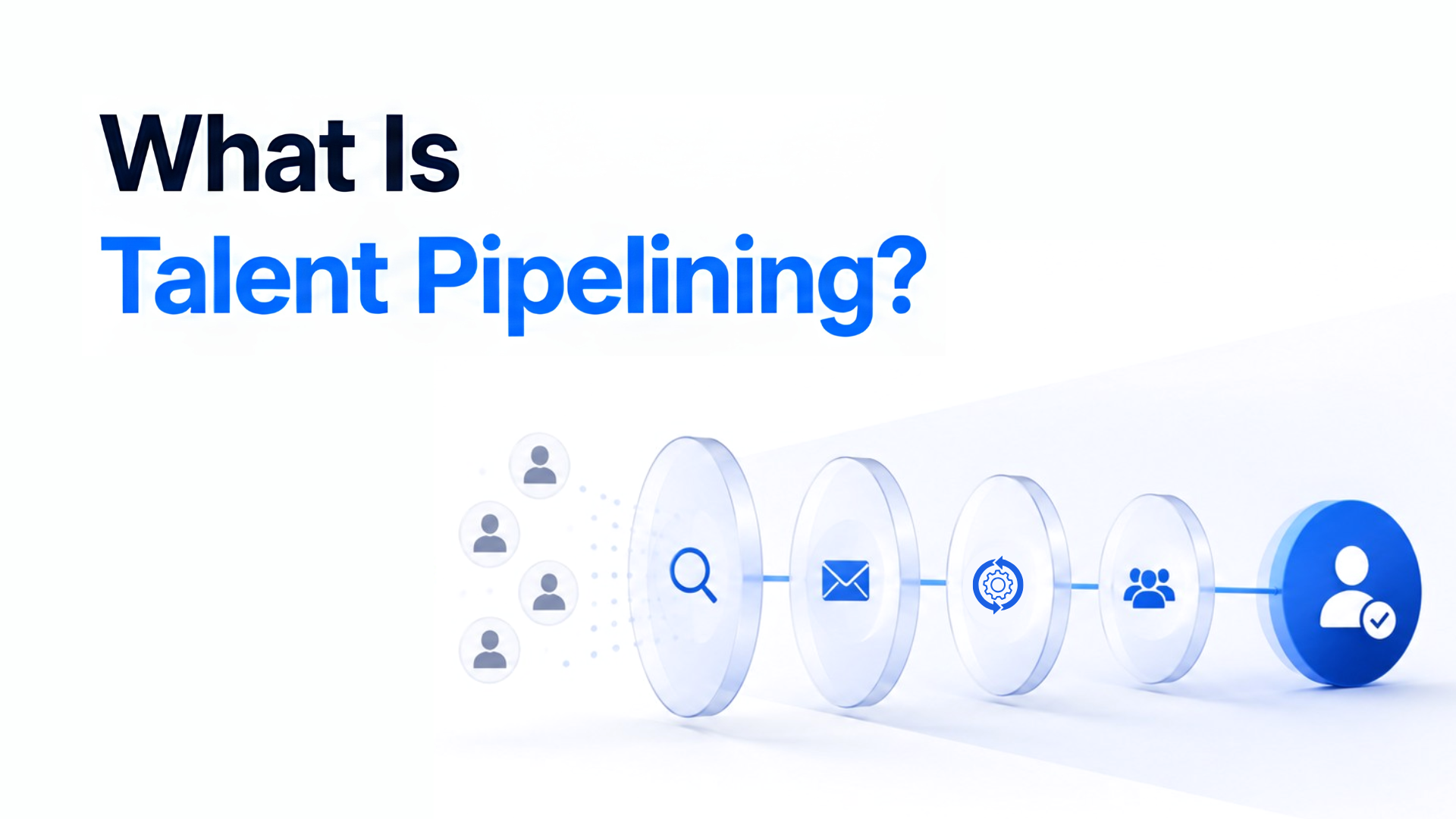
Talent pipelining is the ongoing process of identifying, organizing, engaging, and maintaining relationships with potential candidates before an immediate hiring need exists.
Instead of beginning every search from zero, recruiters build relationships with people who may be relevant to future roles.
Some candidates may have applied previously.
Others may have been sourced but were not ready to move.
A previous finalist may have lost to another strong candidate.
An employee may refer someone before a suitable role exists.
A recruiter may identify promising talent months before the company plans to hire.
Talent pipelining gives these people somewhere to go.
The objective is not to collect as many profiles as possible.
It is to create a group of relevant candidates who can be engaged over time and reconsidered when the right opportunity appears.
This makes talent pipelining one of the most important ideas in proactive recruiting.
The company stops treating every vacancy as a completely new search.
It begins building talent before the vacancy exists.
What Is Talent Pipelining?
Talent pipelining is a proactive recruiting strategy in which companies identify and develop relationships with potential candidates for future hiring needs.
The process usually begins before a specific vacancy needs to be filled.
Recruiters may identify roles that are hired frequently, skills that are difficult to find, positions with predictable turnover, or capabilities the company expects to need in the future.
They then begin discovering relevant people.
Some candidates may be ready for a conversation immediately.
Others may be satisfied in their current jobs.
Some may be interested in the company but waiting for a different role, location, compensation level, or career stage.
The recruiter keeps these relationships useful over time.
When a relevant position opens, the company does not need to begin with an empty search.
It already knows people who may deserve consideration.
This can reduce the distance between a hiring requirement and a qualified candidate conversation.
That is the central value of talent pipelining.
It creates recruiting readiness.
How Does a Talent Pipeline Work?
A talent pipeline begins with future demand.
The recruiting team needs to understand which types of people the company is likely to hire.
This may be based on workforce plans, historical hiring patterns, expected growth, difficult-to-fill roles, or recurring recruitment needs.
The team then identifies potential candidates.
These people may come from outbound sourcing, previous applications, employee referrals, events, communities, former finalists, recruiting CRM records, or other channels.
Candidates are then organized according to relevant hiring needs.
But organization alone does not create a pipeline.
The company needs to maintain the relationship.
A recruiter may share relevant company updates, reconnect when circumstances change, invite candidates to appropriate events, discuss future opportunities, or simply maintain enough context to continue the conversation later.
When a role opens, the pipeline can be reviewed.
Candidates whose experience, interest, and timing appear relevant can be contacted before the company begins another broad search.
A talent pipeline therefore connects future hiring demand with ongoing candidate relationships.
Why Is Talent Pipelining Important?
Traditional recruiting is reactive.
The hiring need appears first.
The candidate search begins second.
This creates pressure.
The recruiter is trying to understand the market while the hiring manager is already waiting for a result.
The company may then prioritize speed over long-term recruiting quality.
Talent pipelining moves some of this work earlier.
Recruiters can understand the talent market before the vacancy becomes urgent.
They can identify strong candidates without needing to force an immediate conversation.
They can learn what motivates people in the market.
They can discover whether the company’s expectations are realistic.
They can build relationships that may become useful later.
This is particularly valuable for roles that are difficult to fill.
A company that repeatedly hires the same type of engineer, salesperson, healthcare professional, or operations specialist should not necessarily restart the search every time a position opens.
The talent market already exists.
The recruiting relationship can exist too.
Talent Pipeline vs. Candidate Pool
Talent pipelines and candidate pools are closely related, but they are not exactly the same.
A candidate pool is a group of people who may be relevant to current or future hiring needs.
The pool organizes potential talent.
A talent pipeline usually implies more movement and relationship development.
The candidates are not simply stored.
The recruiting team understands where they may fit, how interested they are, what previous conversations have happened, and what the next appropriate action may be.
A candidate pool can exist without active engagement.
A talent pipeline should be more dynamic.
Imagine a company has 500 software engineers saved in a database.
That is not automatically a talent pipeline.
Many profiles may be outdated.
Some candidates may no longer be relevant.
Others may have declined previous contact.
The company may have no understanding of their current interests.
The database contains people.
The pipeline contains recruiting context.
This distinction is important because many companies believe they have strong talent pipelines when they actually have large candidate databases.
For a deeper explanation of candidate organization, see What Is a Candidate Pool and How Do You Build One?.
Talent Pipeline vs. Recruitment Pipeline
The phrase recruitment pipeline often refers to candidates moving through an active hiring process.
A candidate may begin as an applicant or sourced prospect.
They move into screening.
Then interviews.
Then final evaluation.
Then an offer.
This is an active recruitment pipeline.
Talent pipelining can begin much earlier.
The candidate may not be applying for anything.
There may not even be an open role.
The company is building a relationship because the person may become relevant later.
The difference is mainly timing.
An active recruitment pipeline helps fill a current vacancy.
A talent pipeline prepares the company for future vacancies.
The two can connect.
When a role opens, relevant people from the talent pipeline may enter the active recruitment process.
Talent Pipelining vs. Candidate Sourcing
Candidate sourcing is the process of finding potential candidates.
Talent pipelining is broader.
Sourcing can identify a person.
Pipelining determines what happens after that person is found.
A recruiter may discover a strong candidate who is not interested in changing jobs today.
A sourcing-only workflow may end there.
The candidate declined.
The search continues.
A talent-pipelining workflow asks a different question.
Could this person become relevant later?
If the answer is yes, the recruiting team may preserve the relationship and reconnect at a more appropriate time.
This is why What Is Candidate Sourcing Automation? is closely connected to talent pipelining.
Faster sourcing can create more candidate signals.
But the company still needs a system for deciding which relationships deserve to continue.
Sourcing finds potential talent.
Pipelining preserves future opportunity.
Talent Pipelining vs. Passive Candidate Sourcing
Passive candidate sourcing focuses on finding professionals who are not actively applying for jobs.
Talent pipelining often includes passive candidates because many strong future hires are not ready to move immediately.
A recruiter may identify someone who appears relevant but learns that the person has just started a new role.
Another candidate may be interested in the company but not the current position.
Someone else may want to reconsider opportunities after completing a major project.
These are not failed recruiting conversations.
They are future signals.
A talent-pipelining strategy gives recruiters a way to preserve those signals.
The candidate can be re-engaged when the timing becomes more appropriate.
This makes pipelining particularly valuable for outbound recruiting.
Cold outreach should not be treated as one attempt to create an immediate application.
Sometimes the most valuable result is a relationship that becomes useful six months later.
Learn more in What Is Passive Candidate Sourcing?.
Who Should Be Added to a Talent Pipeline?
Not every person a recruiter finds belongs in a talent pipeline.
A useful pipeline should contain candidates who have a credible connection to future hiring demand.
Previous finalists are one important group.
The company has already invested time in evaluating these people. A candidate may have performed well but lost to someone with slightly more relevant experience.
That person should not disappear simply because one vacancy closed.
Silver-medalist candidates can become strong future hires.
Previous applicants can also be useful when their experience matches new opportunities.
Sourced candidates may enter a pipeline even when the first outreach does not lead to an immediate hiring process.
Employee referrals can be added before the right role exists.
Former employees may also become future candidates.
People discovered through communities, events, professional networks, and individual referrals can enter the same environment.
The important requirement is relevance.
A talent pipeline should not become a storage location for every profile the company has ever encountered.
More candidates do not automatically create more hiring readiness.
Which Roles Benefit Most From Talent Pipelining?
Talent pipelining can support many types of hiring, but it is especially valuable when demand is predictable.
If a company regularly hires the same type of salesperson, engineer, customer-success professional, healthcare worker, or operational employee, it can begin building relationships before the next vacancy appears.
Difficult-to-fill roles also benefit.
The smaller the relevant talent market, the less useful it is to restart discovery every time.
Strategic roles can benefit as well.
A company may know that it will eventually need a senior leader or specialized expert even when the exact hiring date is uncertain.
High-growth companies have another reason to pipeline talent.
Recruiting demand can increase faster than the internal team can build candidate relationships.
A company planning major expansion should not wait until every role is formally approved before understanding the talent market.
The strongest opportunities for pipelining usually appear where hiring demand is recurring, difficult, strategic, or predictable.
How to Build a Talent Pipeline
A useful talent pipeline begins with a specific hiring need.
Recruiting teams should first identify the roles, skills, locations, or talent markets where future demand is likely.
A pipeline called “good candidates” is difficult to use.
A pipeline for enterprise account executives in a specific market is much more actionable.
The next step is candidate discovery.
Recruiters can combine inbound applicants, outbound sourcing, referrals, previous finalists, existing CRM records, events, communities, and other relevant sources.
Candidates should then be organized around meaningful hiring context.
Why might this person be relevant?
What experience stands out?
When was the last interaction?
What did the candidate say?
What might make them consider a future opportunity?
When would it be appropriate to reconnect?
These questions turn candidate records into recruiting relationships.
The final requirement is maintenance.
A pipeline that is built once and ignored will become outdated.
People change jobs.
Skills develop.
Career priorities change.
Interest changes.
The pipeline needs a process for deciding when candidates should be reviewed, updated, engaged, or removed.
Why Most Talent Pipelines Fail
Many companies have candidate databases.
Far fewer have functioning talent pipelines.
The most common problem is that candidates are collected but not maintained.
Recruiters add profiles to a project, spreadsheet, ATS, or CRM.
The hiring need disappears.
The list remains.
Months later, another recruiter discovers the same people again.
The company pays repeatedly for candidate discovery while ignoring talent it already knows.
Another problem is missing context.
A candidate record may contain a name, resume, and email address but no explanation of what happened.
Did the person decline?
Were they interested but unavailable?
Did they complete interviews?
Did they ask to reconnect later?
Was the compensation wrong?
Without context, the next recruiter cannot continue the relationship.
They have to restart it.
Duplicate records create another problem.
The same person may exist in the ATS, CRM, sourcing platform, and several spreadsheets.
Each record contains a different piece of the relationship.
The company has candidate data.
It does not have candidate memory.
Talent Pipelining and the Recruiting CRM
A recruiting CRM is one of the most important systems for talent pipelining.
An ATS is generally designed around active hiring processes.
A recruiting CRM is designed to help teams manage candidate relationships before and between applications.
This makes it useful for long-term talent engagement.
The system can help recruiters organize candidates into relevant groups, preserve communication history, record interests, manage follow-ups, and reconnect when new opportunities appear.
The key value is continuity.
A candidate may speak with one recruiter today and another recruiter next year.
The second conversation should not begin as if the first one never happened.
This is especially important for larger recruiting teams, agencies, and RPO providers.
Candidate relationships belong to the recruiting organization, not only to one recruiter’s memory.
For a deeper explanation, see What Is a Recruiting CRM? Definition and Key Features.
Talent Pipelining and the ATS
The ATS still plays an important role.
Candidates who enter an active hiring process need to move through applications, screening, interviews, offers, and other formal hiring stages.
The challenge is the space before and after that process.
A strong candidate may exist before a vacancy opens.
A previous applicant may become relevant after the original role closes.
A finalist may be worth reconsidering next year.
A sourced candidate may ask the company to reconnect later.
Traditional ATS workflows can struggle with these long-term relationships because they are often organized around current requisitions.
The strongest recruiting environment connects the two needs.
The talent pipeline preserves future candidate relationships.
The ATS manages active hiring.
When a relevant opportunity appears, the candidate can move from one context to the other without losing previous history.
Talent Pipelining and Outbound Recruiting
Outbound recruiting and talent pipelining naturally support each other.
Outbound recruiting begins with proactive candidate discovery.
The recruiter does not wait for applications.
They identify people who may fit and start conversations.
But not every good candidate is ready at the same moment.
A person may like the company but dislike the current role.
They may be interested but unable to move for six months.
They may want a different location.
They may be waiting for a promotion.
They may simply need more time.
Without a pipeline, these conversations become lost opportunities.
The recruiter returns to the market later and starts again with strangers.
A stronger outbound model preserves relevant relationships.
The company can continue building familiarity instead of repeatedly rebuilding the top of the funnel.
Learn more about this proactive model in What Is Outbound Recruiting (And How Is It Different From Inbound)?.
Candidate Engagement in a Talent Pipeline
Talent pipelining does not mean sending regular automated emails to everyone in the database.
That can quickly become spam.
Candidate engagement should have a reason.
A recruiter may reconnect because a genuinely relevant role has opened.
The company may share an important update that changes the opportunity.
A candidate may have asked to be contacted after a specific period.
An event may be useful to a particular professional community.
The communication should match the relationship.
Someone who previously completed final interviews should not receive the same message as a person who has never spoken with the company.
Someone who asked to reconnect in six months should not be placed in a generic weekly campaign.
The pipeline should improve context.
It should not create more messages.
This is where What Is Multi-Channel Recruiting Outreach? becomes relevant.
Recruiters may communicate through email, professional networks, phone, SMS, WhatsApp, or other appropriate channels.
The important capability is preserving one candidate relationship across those interactions.
How Often Should Recruiters Engage Talent Pipelines?
There is no universal schedule.
The right timing depends on the candidate, role, relationship, and reason for communication.
A previous finalist who asked to reconnect after completing a project may need one specific future follow-up.
A candidate interested in the company but waiting for a senior position may need occasional, highly relevant contact.
A large group of early-career candidates may engage through events or broader talent-community activity.
The mistake is treating every candidate as part of the same sequence.
Talent pipelining should be based on context rather than a fixed message calendar.
The best question is not:
“How often should we email the pipeline?”
It is:
“What has changed that makes another conversation useful?”
This creates a better candidate experience and protects the company from turning long-term relationship building into repetitive marketing.
How AI Is Changing Talent Pipelining
AI can improve talent pipelining because the traditional process contains several difficult manual tasks.
Recruiters need to discover relevant people.
They need to understand why each person may fit.
They need to organize candidate information.
They need to remember previous interactions.
They need to know when a new role matches someone already in the system.
They need to decide who should be re-engaged.
Most recruiting teams cannot do all of this consistently at scale.
AI can help interpret hiring requirements, surface relevant candidates, compare new roles with existing talent, summarize previous interactions, organize candidate responses, and recommend appropriate next actions.
The most important change is candidate rediscovery.
When a new role opens, the first question should not always be:
“Where can we find new candidates?”
It can be:
“Who do we already know?”
AI makes that question easier to answer.
AI Makes Candidate Rediscovery More Useful
Candidate databases grow quickly.
A company may have thousands or millions of previous applicants, sourced candidates, referrals, and past conversations.
The problem is not always a lack of talent.
It is an inability to find the right person again.
Traditional rediscovery often depends on keywords and filters.
A recruiter needs to know which terms were used in the old candidate record.
AI can compare the new hiring requirement with existing candidate information and surface people whose experience appears relevant.
This can make talent pipelines more useful over time.
A candidate who was wrong for one role may be strong for another.
A junior candidate may have gained several years of experience.
A previous finalist may now match a more senior vacancy.
The value of the database increases when the system can understand how candidate relevance changes.
Without rediscovery, a talent pipeline can become a digital archive.
With better matching, it can become a source of active hiring opportunities.
AI Can Help Maintain Candidate Context
One of the hardest parts of talent pipelining is remembering what happened.
A candidate may have exchanged several emails with a recruiter.
They may have completed an initial call.
They may have explained that the timing was wrong.
Another recruiter may later inherit the relationship.
Manually reviewing every interaction is difficult.
AI can help summarize candidate history.
The system may identify previous interest, objections, timing preferences, relevant conversations, and recruiting outcomes.
This does not replace the original record.
It makes the history easier to understand.
The recruiter can enter the next conversation with context.
That is a major improvement over treating the candidate as a new profile every time a role opens.
AI Can Help Prioritize Talent Pipelines
Large pipelines create another problem.
Who deserves attention?
A company may have thousands of potentially relevant people.
Recruiters cannot maintain active relationships with all of them.
AI can help compare future or current hiring requirements with the existing pipeline.
Candidates whose experience appears most relevant can be surfaced for review.
Previous engagement can also provide useful context.
A candidate who expressed interest six months ago may deserve different attention from someone who repeatedly declined communication.
Timing can matter.
Career changes can matter.
New skills can matter.
The objective is not to let AI autonomously decide which people deserve employment opportunities.
The objective is to help recruiters identify where human attention may be most useful.
The Risk of Automating Talent Pipelining
AI can make talent pipelines larger.
That is not automatically an improvement.
If recruiters can discover and store candidates more quickly, the system may simply create a larger database of neglected people.
Automated engagement can create another problem.
A candidate who asked to reconnect later may receive irrelevant campaigns.
Someone who declined may continue receiving messages.
A previous finalist may be treated like a cold prospect.
The value of a talent pipeline depends on context.
Automation should preserve that context rather than erase it.
Recruiting teams need clear rules around candidate communication, data retention, consent, privacy, and the use of AI-supported recommendations.
The objective should be better relationships.
Not a larger number of automated touchpoints.
How to Measure Talent Pipelining
A talent pipeline should be measured by hiring value, not database size.
The number of profiles stored can be misleading.
A company may have 100,000 candidates and still begin every search from zero.
More useful measures include how many new roles produce relevant candidates from existing pipelines, how quickly pipeline candidates move into qualified conversations, how often previous finalists or sourced candidates are reconsidered, and how much external sourcing can be avoided through rediscovery.
Teams can also look at candidate engagement.
Are people responding when relevant opportunities appear?
Are recruiters reconnecting at appropriate times?
Are duplicate outreach and repeated discovery decreasing?
The strongest measure is simple.
Does the pipeline make future hiring easier?
If the company still needs to rebuild the talent market for every vacancy, the pipeline is not working.
Where Huntlo Fits Into Talent Pipelining
Huntlo approaches talent pipelining as part of a connected outbound recruiting workflow.
The problem with many pipelines is not candidate discovery.
It is what happens after discovery.
A recruiter finds someone.
The profile is saved.
The candidate may be contacted through another tool.
Replies arrive somewhere else.
Screening happens in another system.
When the role closes, the candidate context becomes difficult to reuse.
Months later, another recruiter starts the search again.
Huntlo’s agentic AI recruiting infrastructure is designed around reducing this fragmentation.
AI can support candidate discovery.
Relevant people can be organized around hiring needs.
Outreach and follow-ups can be coordinated.
Candidate responses can influence the next action.
Interested people can move toward qualification.
Candidates who are not ready today can remain useful for future opportunities.
The larger goal is not simply to build a bigger talent database.
It is to make candidate relationships more actionable over time.
This is particularly important for outbound recruiting teams, recruitment agencies, and RPO providers.
These teams repeatedly operate in the same talent markets.
Every relevant candidate discovered today can potentially reduce future sourcing work if the relationship and context are preserved.
Talent Pipelining in an Agentic AI Recruiting Workflow
Traditional recruiting systems often treat each action separately.
A sourcing tool finds the candidate.
A CRM stores the person.
An outreach tool sends the message.
An ATS manages the active process.
The recruiter connects everything.
Agentic AI recruiting changes the model.
The system can help coordinate more of what happens between major recruiting decisions.
A future hiring need can trigger candidate discovery or rediscovery.
Relevant people can be reviewed.
The appropriate candidates can enter engagement.
Responses can change the next action.
Candidates who are interested later can remain connected to future workflows.
The recruiter still controls important decisions.
But they spend less time manually moving candidate information between disconnected steps.
This makes talent pipelining more operational.
The pipeline is not simply waiting for a recruiter to remember it exists.
It becomes part of how future hiring work begins.
Talent Pipelining for Recruitment Agencies and RPO Providers
Talent pipelining can be particularly valuable for recruiting service businesses.
Agencies and RPO providers repeatedly hire across similar talent markets.
A recruiter may speak with a strong candidate who is wrong for one client but relevant to another.
A finalist may become suitable for a future assignment.
A passive candidate may not be ready today but may move later.
If every search begins from zero, the firm repeatedly pays for the same discovery work.
A strong talent pipeline creates compounding value.
The more useful candidate relationships the provider develops, the less dependent future searches become on completely new sourcing.
AI can strengthen this model through rediscovery, candidate matching, communication support, and workflow coordination.
This connects directly with What Is an RPO Model and How Does AI Change It?.
As AI increases recruiter capacity, the ability to reuse existing candidate relationships becomes an important part of the economics.
How to Build a Better Talent-Pipelining Strategy
The first requirement is focus.
Choose talent markets that matter.
Do not begin by creating one giant pipeline for every possible future employee.
The second requirement is context.
Every important candidate relationship should preserve why the person matters and what happened previously.
The third is ownership.
Someone needs to be responsible for keeping the pipeline useful.
The fourth is rediscovery.
New hiring requirements should be compared with existing talent before every search begins externally.
The fifth is appropriate engagement.
Candidates should be contacted because there is a reason, not because an automated campaign needs another recipient.
The sixth is measurement.
Teams should understand whether the pipeline produces qualified conversations and hires.
A talent pipeline becomes valuable through repeated use.
If it is only created, it will eventually become another database.
The Future of Talent Pipelining
Talent pipelining is moving from static candidate storage toward more active recruiting intelligence.
Traditional systems required recruiters to remember which people might become relevant.
Future systems can help identify those relationships automatically.
A new role can be compared with existing candidates.
Previous conversations can be summarized.
Changes in candidate experience can affect relevance.
The system can recommend people worth reconsidering.
Appropriate follow-ups can be coordinated.
This makes the talent pipeline more responsive.
The recruiter does not need to remember every person ever discovered.
The system can help surface the right context at the right time.
But human judgment remains important.
A candidate relationship is not simply a data record.
People change their priorities.
They make career decisions.
They develop new interests.
The future of talent pipelining will combine better machine memory with better human conversations.
Conclusion: Talent Pipelining Means Recruiting Before the Vacancy Becomes Urgent
Talent pipelining is the ongoing process of identifying, organizing, engaging, and maintaining relationships with potential candidates before an immediate hiring need exists.
The objective is to reduce the need to restart recruiting from zero every time a role opens.
A strong pipeline can include previous finalists, sourced candidates, referrals, former applicants, passive talent, and other people who may become relevant later.
But storing profiles is not enough.
The company needs context.
Why is this person relevant?
What happened previously?
When should the relationship continue?
Which future role might make sense?
This is what separates a talent pipeline from a candidate database.
AI can make pipelining more useful.
It can improve candidate discovery.
It can help rediscover people the company already knows.
It can summarize previous interactions.
It can help identify which candidates may match new hiring needs.
It can support appropriate follow-ups and reduce manual workflow coordination.
The goal is not to create the largest possible database.
It is to create recruiting readiness.
When the next role opens, the strongest starting point may not be another search.
It may be a relationship the company has already built.
Frequently Asked Questions
What is talent pipelining?
Talent pipelining is the ongoing process of identifying, organizing, engaging, and maintaining relationships with potential candidates before an immediate hiring need exists.
What is a talent pipeline?
A talent pipeline is a group of potential candidates who may be relevant to future hiring needs and whose recruiting context or relationship is maintained over time.
What is the difference between a talent pipeline and a candidate pool?
A candidate pool organizes potential candidates. A talent pipeline generally implies more active relationship management, context, prioritization, and movement toward future hiring opportunities.
What is the difference between talent pipelining and candidate sourcing?
Candidate sourcing focuses on finding potential candidates. Talent pipelining includes what happens after discovery, particularly maintaining relevant candidate relationships for future hiring.
What is the difference between a talent pipeline and a recruitment pipeline?
A recruitment pipeline usually tracks candidates through an active hiring process. A talent pipeline can exist before a specific vacancy opens.
Who should be included in a talent pipeline?
Potential pipeline candidates can include previous finalists, sourced candidates, former applicants, employee referrals, passive candidates, former employees, and other people relevant to future hiring needs.
Why is talent pipelining important?
Talent pipelining can reduce the need to begin every search from zero, preserve previous recruiting investment, improve hiring readiness, and help companies build relationships before vacancies become urgent.
How does AI improve talent pipelining?
AI can support candidate discovery, candidate rediscovery, matching, interaction summaries, prioritization, engagement, and workflow coordination.
Is a large candidate database the same as a strong talent pipeline?
No. A large database may contain outdated or disconnected profiles. A strong talent pipeline preserves relevance, candidate context, previous interactions, and appropriate future actions.
Can talent pipelining reduce time to hire?
It can. When a relevant role opens, recruiters may already know candidates who deserve consideration instead of beginning with a completely new search.
Related Topics
Learn how potential candidates are organized in What Is a Candidate Pool and How Do You Build One?
Understand how recruiters find talent before candidates apply in What Is Passive Candidate Sourcing?
Explore how proactive hiring works in What Is Outbound Recruiting (And How Is It Different From Inbound)?
See how long-term candidate relationships are managed in What Is a Recruiting CRM? Definition and Key Features
.