Finding the right candidate does not guarantee that the candidate will respond.
A recruiter may identify someone with exactly the experience a company needs, send one email, receive no reply, and move on. The candidate may never have seen the message. It may have arrived in a crowded inbox, reached an old email address, or appeared on a channel the person rarely checks.
Multi-channel recruiting outreach is designed to reduce that dependency on one communication method.
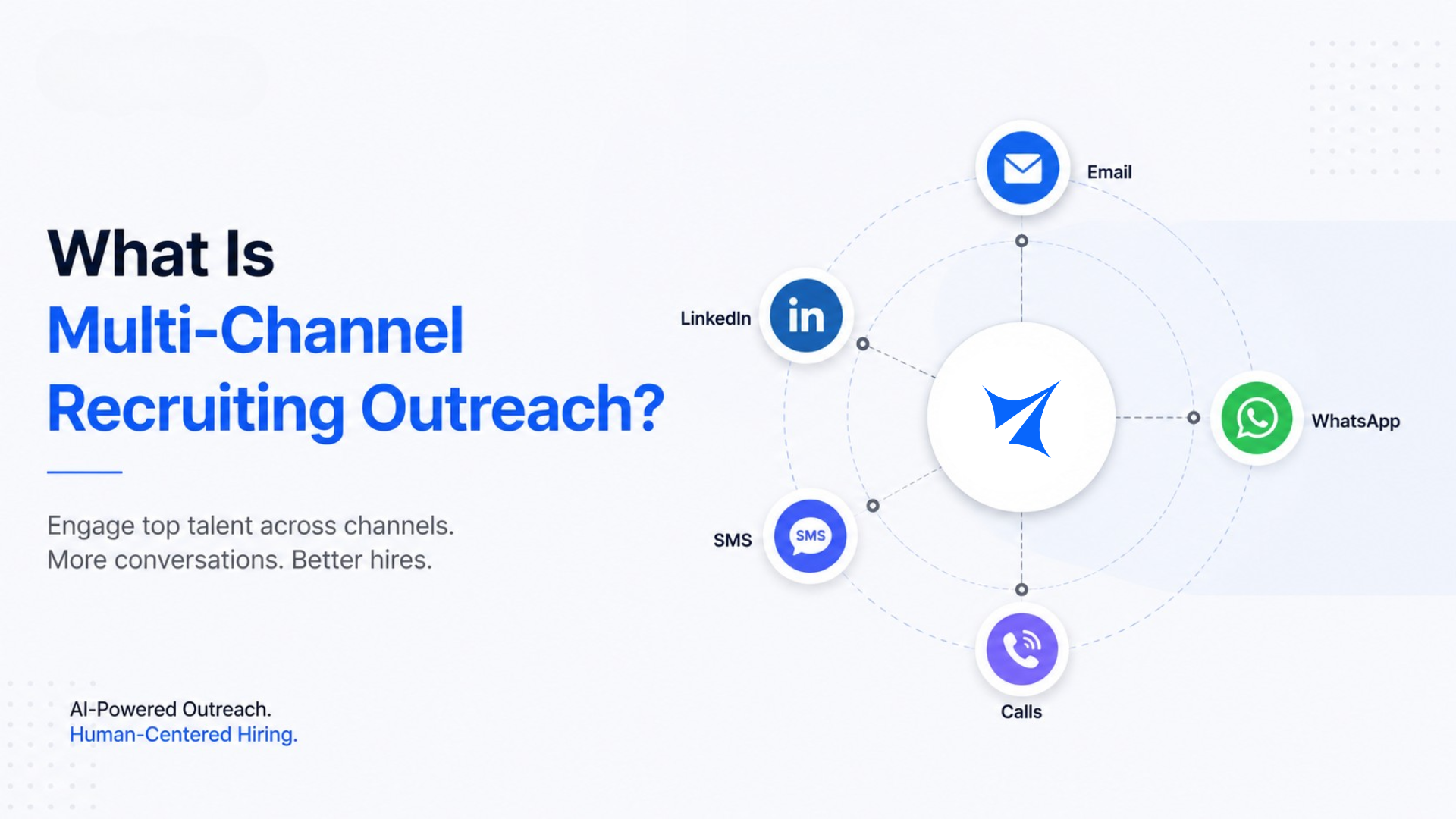
Multi-channel recruiting outreach is the practice of engaging candidates through more than one communication channel as part of a coordinated recruiting process. Those channels may include email, LinkedIn or other professional networks, SMS, phone calls, WhatsApp, recruiting platforms, or other appropriate communication methods.
The key word is coordinated.
Sending the same message to the same candidate through five channels at once is not a strong multi-channel strategy. It is repetition.
Good multi-channel outreach uses different channels for different purposes, preserves the context of previous interactions, respects candidate preferences, and stops or changes the sequence when the candidate responds.
The objective is not to surround candidates with more messages.
It is to create more appropriate opportunities for a relevant conversation.
What Is Multi-Channel Recruiting Outreach?
Multi-channel recruiting outreach is a candidate engagement strategy in which recruiters use two or more communication channels to contact and follow up with potential candidates.
A simple workflow might begin with a personalized email. If the candidate does not respond, the recruiter may later connect through LinkedIn. Another follow-up may return to email. For a candidate who has already expressed interest, SMS or WhatsApp may be used for quicker coordination if appropriate and permitted.
The exact channel mix depends on the candidate, role, geography, recruiting model, and stage of the relationship.
An executive search consultant may rely heavily on email and phone calls. A recruiter hiring technical professionals may combine email with LinkedIn. A high-volume recruiting team may use SMS for scheduling and reminders after candidates have entered the process. In some markets, WhatsApp may be a common communication channel.
The strategy should follow the candidate journey.
A cold message to a passive candidate is different from an interview reminder. A first introduction is different from reconnecting with someone the company already knows.
Multi-channel recruiting works when the channel fits the context.
Why One Recruiting Channel Is Often Not Enough
Candidates do not all communicate in the same way.
Some professionals check LinkedIn frequently but rarely respond to cold emails. Others have inactive professional-network accounts but maintain a closely monitored work or personal inbox. Some candidates prefer a phone conversation once interest has been established. Others would rather coordinate quickly through text.
A single-channel strategy assumes that every candidate is reachable in the same place.
That assumption can create false negatives.
A recruiter may decide that a candidate is not interested when the real problem is that the person never saw the message.
This is especially relevant in passive candidate sourcing. Passive candidates are not actively monitoring every recruiting channel because they are not looking for a job. A relevant opportunity may need to reach them in a place they actually use.
The answer is not to contact every candidate everywhere.
It is to use channels more intelligently.
Indeed’s guidance on candidate communication notes that different formats are appropriate for different situations and recommends considering candidates’ preferred communication methods whenever possible. That principle is central to multi-channel recruiting: the best channel is not always the one most convenient for the recruiter.
Multi-Channel Outreach vs. Sending More Messages
Multi-channel outreach is often misunderstood as a volume strategy.
A recruiter sends an email.
Then a LinkedIn message.
Then a text.
Then another email.
Then a call.
If all of these actions happen without context, the workflow can quickly become intrusive.
A real multi-channel strategy coordinates the communication.
The second message should understand that the first message happened. The system should stop automatic follow-ups when the candidate responds. A channel change should have a reason rather than simply increasing pressure.
For example, a recruiter may begin with email because it allows enough space to explain the opportunity. A later LinkedIn interaction may create professional context. Once the candidate responds and agrees to continue, a faster channel such as SMS may be useful for scheduling.
The channels support different stages of the relationship.
The purpose is not maximum contact frequency.
It is continuity.
Which Channels Are Used in Recruiting Outreach?
Email remains one of the most common recruiting outreach channels because it gives recruiters space to explain the role, personalize the message, share relevant information, and manage follow-ups.
Professional networks such as LinkedIn are also central to outbound recruiting because candidate discovery and communication can happen in the same environment. Recruiters can understand a person’s professional background before starting the conversation.
LinkedIn’s own guidance on recruiter outreach emphasizes showing candidates why their specific experience is relevant rather than sending a generic opportunity message. That principle matters across every channel: channel choice may improve visibility, but relevance still determines whether the conversation is worth continuing.
SMS can be useful when speed and brevity matter. It is often better suited to candidates who have already established a relationship with the company, particularly for scheduling, reminders, quick updates, and time-sensitive coordination.
Phone calls can create a more direct conversation but require careful timing. They may be appropriate when a candidate has shown interest, when the recruiter has a strong reason to believe a call is welcome, or when the relationship already exists.
WhatsApp can also be important in markets where it is a normal professional communication channel. As with SMS, recruiters need to consider consent, candidate expectations, local practices, platform rules, and applicable privacy requirements.
The strongest outreach strategy does not ask, “Which channel has the highest response rate?”
It asks, “Which channel is appropriate for this candidate at this point in the relationship?”
Email in Multi-Channel Recruiting
Email is often the foundation of recruiting outreach because it is flexible.
A recruiter can introduce the opportunity, explain why the candidate appears relevant, provide context about the company, and create a clear next step without requiring an immediate response.
Email also supports structured follow-up sequences.
The weakness is competition.
Candidates may receive many recruiting emails, especially in highly sought-after talent markets. Generic subject lines and templated messages can disappear quickly.
This makes targeting and relevance more important than the number of emails sent.
A strong email should help the candidate answer three questions quickly.
Why are you contacting me?
Why might this opportunity matter?
What are you asking me to do next?
The message does not need to explain the entire job description.
It needs to create enough relevance for the next conversation.
LinkedIn and Professional-Network Outreach
Professional networks combine candidate discovery with communication.
A recruiter can review a person’s career history, identify relevant experience, understand professional context, and begin outreach through the same platform.
This makes LinkedIn particularly useful for passive candidate sourcing.
The risk is familiarity.
Candidates who receive frequent recruiter messages quickly recognize generic templates. A message that could have been sent to anyone is easy to ignore.
LinkedIn Talent Solutions recommends keeping outreach focused and demonstrating why the candidate’s background is suited to the specific opportunity. Its research has also repeatedly emphasized the value of concise and personalized messages.
The lesson extends beyond LinkedIn.
Personalization should explain selection.
The candidate should understand why this recruiter chose to contact this particular person.
SMS and Text Recruiting
Text messages have different strengths from email.
They are short, direct, and often seen quickly.
That can make them useful for interview reminders, scheduling changes, quick confirmations, and communication with candidates who have already agreed to use the channel.
They can be more sensitive for cold outreach.
A candidate may view an unsolicited text as more personal or intrusive than an email. Recruiters should consider how the contact information was obtained, whether the message is appropriate, what permissions or legal requirements apply, and whether the candidate has expressed a communication preference.
Indeed’s guidance on texting candidates recommends concise and professional communication and notes that frequency, tone, and wording reflect directly on the employer.
This is why SMS should not simply become another automatic step added to every sequence.
The more personal the channel feels, the more carefully it should be used.
Phone Calls in Recruiting Outreach
A phone call can create something that asynchronous channels cannot: an immediate conversation.
This can be valuable when a candidate is interested and wants to understand the opportunity quickly.
It can also be disruptive when the person has no context.
Cold calling still has a place in some recruiting models, particularly staffing, executive search, and relationship-driven recruitment. But it should not be treated as the default escalation after someone ignores an email.
A phone call works best when the recruiter has a clear reason for the conversation and the candidate is likely to understand why the call is happening.
Multi-channel outreach can make the call more contextual.
A candidate may first see an email, respond through LinkedIn, and then agree to speak by phone.
The channels build toward the conversation rather than competing for attention.
WhatsApp in Recruiting Outreach
WhatsApp is an important recruiting channel in many markets because candidates already use it for everyday communication.
It can be useful for quick coordination, interview updates, reminders, and ongoing conversations after a relationship has been established.
However, the informality of the platform can create problems.
Recruiters may send messages at inappropriate times, use overly casual language, or contact candidates who never expected the company to reach them there.
A strong WhatsApp recruiting workflow needs boundaries.
The team should consider candidate preference, consent, local privacy requirements, communication timing, record keeping, and how the conversation connects with the rest of the recruiting process.
WhatsApp can improve responsiveness.
It should not reduce professionalism.
What Is a Multi-Channel Recruiting Sequence?
A multi-channel recruiting sequence is a planned series of candidate touchpoints across more than one channel.
The sequence defines what happens after the first outreach attempt.
For example, the recruiter may begin with a personalized email. After an appropriate period, the candidate may receive a professional-network follow-up. A later message may return to email with additional context.
The exact sequence should depend on the role and candidate relationship.
A senior executive should not necessarily receive the same sequence as a high-volume hourly candidate. A person who already knows the company should not be treated like a cold prospect. A previous finalist should not receive a generic introduction.
Good sequences are therefore conditional.
If the candidate responds, the sequence stops or changes.
If the person asks to reconnect later, the relationship moves into a future follow-up workflow.
If the candidate declines, the system records the outcome.
If one channel is inappropriate or unavailable, the workflow should not force it.
The sequence is a framework.
It should not remove judgment.
Why Timing Matters Across Channels
A multi-channel strategy can become annoying very quickly if the timing is poor.
Sending an email and then messaging the candidate on LinkedIn ten minutes later may feel less like thoughtful outreach and more like pursuit.
Spacing gives the candidate time to see and consider the first message.
Timing also depends on the channel.
A professional email may be appropriate during normal working hours. A text message can feel more intrusive outside reasonable times. A phone call requires even more awareness of location and schedule.
The candidate’s response should also change timing.
Someone who asks for more information should not remain inside a generic automated sequence.
Someone who says the timing is wrong should not receive another follow-up two days later.
Multi-channel recruiting requires more than a calendar of messages.
It requires the workflow to understand what happened.
Personalization Across Multiple Channels
Multi-channel outreach does not mean writing five completely different messages for every candidate.
It means preserving one coherent reason for the conversation across the channels used.
The first email may explain why the candidate appears relevant.
A later LinkedIn message can be shorter because the context already exists.
A text message used after the candidate responds may focus only on scheduling.
The communication changes because the relationship changes.
This is where many outreach systems fail.
Each channel operates independently.
The email tool does not know what happened on LinkedIn. The recruiter sends a text without seeing that the candidate already declined. Another team member starts a separate sequence.
The result is not multi-channel engagement.
It is fragmented communication.
A strong system should maintain one candidate context across every appropriate channel.
Multi-Channel Outreach and Passive Candidates
Multi-channel outreach is particularly useful for passive candidate sourcing.
Passive candidates are not waiting for recruiter messages.
They may not monitor the inbox or platform where the first outreach appears.
Using more than one appropriate channel can create another opportunity for the candidate to notice a relevant conversation.
But passive candidates also have the lowest tolerance for poor outreach.
They did not apply.
They may be satisfied in their current roles.
They can ignore the entire process without losing anything.
This makes restraint important.
A passive candidate should not receive more messages simply because automation makes them cheap to send.
The recruiter needs a credible reason for the conversation.
Multi-channel outreach can improve reach.
It cannot repair a weak opportunity or irrelevant candidate selection.
Multi-Channel Outreach and Recruiting CRM
A recruiting CRM helps preserve the relationship across channels and over time.
Without a shared system, candidate communication can become fragmented.
One recruiter sends an email.
Another sends a LinkedIn message.
A third person calls.
Nobody has the complete context.
The CRM can help maintain a history of previous interactions, candidate preferences, campaign activity, and outcomes.
This is particularly important when the relationship continues beyond one hiring process.
A candidate may not be interested today but ask the recruiter to reconnect in six months. The company should not keep sending the current outreach sequence. The relationship should move into a different workflow.
Multi-channel outreach works best when it is connected to candidate relationship management.
The system should remember not only where the company contacted the person, but what happened.
Multi-Channel Outreach and the ATS
The applicant tracking system usually becomes more important once a candidate enters an active hiring process.
Before that point, much of the outreach may happen in sourcing platforms, recruiting CRMs, email systems, professional networks, or separate engagement tools.
This creates a handoff problem.
A candidate may have exchanged several messages with a recruiter before entering the ATS. If that context disappears, the formal hiring process begins with incomplete information.
The candidate may be asked to repeat what they already explained.
The recruiter may not see concerns or preferences discussed earlier.
The hiring team may treat the person like a new applicant even though a relationship already exists.
The strongest recruiting workflow preserves relevant context as the candidate moves from outreach into screening and interviews.
The ATS can remain the system of record.
But the candidate journey begins before the ATS for many outbound hires.
How AI Is Changing Multi-Channel Recruiting Outreach
AI can support multi-channel outreach in several ways.
It can help recruiters understand why a candidate appears relevant, prepare personalized messaging, adapt communication for different channels, organize responses, and recommend or trigger appropriate next actions.
The most important opportunity is coordination.
Traditional automation follows fixed rules.
Send email one.
Wait three days.
Send LinkedIn message.
Wait four days.
Send email two.
AI-supported workflows can potentially respond more intelligently to what happens.
A candidate may reply with interest.
Another may ask about remote work.
Someone may say the timing is wrong.
Another may ask the recruiter to speak with a colleague instead.
These outcomes should not lead to the same next step.
AI can help interpret the response and move the candidate into the appropriate workflow, subject to the controls defined by the recruiting team.
This is where multi-channel outreach begins to move from message automation toward recruiting workflow automation.
The Risk of Over-Automating Multi-Channel Outreach
Multi-channel automation can make bad recruiting much worse.
A poorly targeted candidate may receive an irrelevant email, a LinkedIn message, a text, and a call.
The company has not created four opportunities for engagement.
It has multiplied one targeting mistake across four channels.
This is why automation should begin with candidate relevance.
The team needs to understand why the person belongs in the search and why the opportunity may matter before deciding how many channels to use.
The workflow also needs stopping rules.
A reply should stop irrelevant follow-ups.
A decline should be respected.
A request to reconnect later should change the sequence.
A communication preference should influence future contact.
The purpose of automation is to reduce repetitive coordination.
It should not remove awareness of the candidate.
How to Build a Better Multi-Channel Outreach Strategy
A strong strategy begins with the candidate and the recruiting context.
The team should decide which channels are appropriate for the talent market, not simply activate every channel the software supports.
The first message should establish relevance.
Later touchpoints should add context or create another reasonable opportunity to respond rather than repeating the same sentence.
Recruiters should also define how responses change the workflow.
What happens when the candidate is interested?
What happens when they ask a question?
What happens when the timing is wrong?
What happens when they decline?
What happens when they do not respond?
These outcomes should be connected to clear next actions.
The team also needs shared visibility.
If several recruiters can contact the same talent market, the system should reduce duplicate outreach and preserve candidate history.
Finally, success should be measured beyond message volume.
The objective is not to send more touchpoints.
It is to create more qualified conversations.
How to Measure Multi-Channel Recruiting Outreach
Open rates and reply rates can be useful, but they should not be the only measures.
A channel can generate many responses that do not become meaningful recruiting conversations.
Teams should look at positive response rates, qualified candidate conversations, progression into screening, interview conversion, candidate experience, and eventual hiring outcomes.
Channel performance should also be examined by context.
Email may work well for one talent market.
LinkedIn may perform better for another.
SMS may be effective after candidates enter the process but inappropriate for cold outreach.
The team should also monitor negative signals.
Are candidates opting out?
Are duplicate messages being sent?
Are recruiters contacting people after they decline?
Are automated sequences continuing after the context changes?
A successful multi-channel strategy does not simply maximize response.
It improves the path from relevant candidate discovery to meaningful engagement.
Where Huntlo Fits Into Multi-Channel Recruiting Outreach
Huntlo approaches candidate outreach as part of a connected outbound recruiting workflow.
The challenge is not simply sending a message through more channels.
The recruiting team first needs to identify relevant candidates, understand why they fit, create appropriate engagement, manage follow-ups, interpret responses, qualify interest, and move the right people toward interviews.
When these activities happen across separate tools, the recruiter becomes the connection between them.
A candidate is found in one system.
Contact information comes from another.
Outreach happens elsewhere.
Replies arrive in different inboxes.
Interested candidates are then moved into screening and the ATS.
Huntlo’s agentic AI recruiting infrastructure is designed around reducing that manual orchestration. The objective is to connect candidate discovery, engagement, communication, screening, and interview coordination as parts of one recruiting process.
Multi-channel outreach matters in this model because candidates do not all respond in the same place or at the same time.
But channel count is not the main value.
The more important capability is understanding the candidate context and coordinating what should happen next.
Huntlo’s guide to AI sourcing tools for recruitment team leads highlights multi-channel engagement, automated communication workflows, and response tracking as important parts of the modern sourcing workflow.
The same principle appears in what comes after sourcing automation: finding a candidate creates limited value if engagement, follow-ups, qualification, and workflow execution remain disconnected.
Multi-Channel Outreach vs. Omnichannel Recruiting
The terms multi-channel and omnichannel are sometimes used interchangeably.
A useful distinction is that multi-channel recruiting uses several communication channels, while omnichannel recruiting attempts to create one continuous experience across them.
A company can be multi-channel but fragmented.
The recruiter sends email, LinkedIn messages, and texts, but each system has a separate history.
An omnichannel approach attempts to preserve the context across those interactions.
The candidate can move from one channel to another without the recruiting process forgetting what happened before.
In practice, most recruiting teams should focus less on the terminology and more on continuity.
Do recruiters know which messages have already been sent?
Does a candidate response stop the correct follow-ups?
Can communication preferences be respected?
Does relevant context move into screening and interviews?
The quality of the experience matters more than the label.
The Future of Multi-Channel Recruiting Outreach
Multi-channel recruiting is moving away from fixed sequences toward more adaptive workflows.
Traditional outreach automation is based on schedules.
The system sends a message, waits, and sends another.
Future systems will increasingly respond to candidate behavior and context.
The candidate’s response can change the channel.
The question they ask can change the next action.
A request to reconnect later can create a future workflow.
A positive response can move the person toward screening.
A decline can stop the process.
This does not mean recruiters should surrender control to autonomous systems.
Teams still need to define which channels are appropriate, what communication is permitted, when human review is required, and how candidate preferences are respected.
The opportunity is to remove the repetitive coordination between those decisions.
The future of multi-channel outreach is not more messages in more places.
It is better continuity across the candidate relationship.
Conclusion: Multi-Channel Recruiting Is About Coordination, Not Volume
Multi-channel recruiting outreach is the practice of engaging candidates through more than one communication channel as part of a coordinated recruiting process.
Those channels may include email, LinkedIn, SMS, phone, WhatsApp, and other appropriate communication methods.
The value comes from flexibility.
Candidates do not all respond in the same place.
Different channels are also better suited to different stages of the relationship.
Email can introduce the opportunity.
Professional networks can add context.
SMS can support quick coordination.
Phone calls can create deeper conversations.
WhatsApp can be useful in markets where it is an expected professional channel.
But using more channels does not automatically improve recruiting.
Poor targeting multiplied across several channels creates a worse candidate experience.
The strongest strategy begins with relevance, uses each channel for a reason, preserves context, respects candidate preferences, and changes the workflow when the candidate responds.
AI can help coordinate this process.
It can support personalization, organize responses, adapt next actions, and reduce the manual work required to manage communication across the candidate journey.
The goal should not be to reach every candidate everywhere.
It should be to create the right conversation through the right channel at the right time.
Frequently Asked Questions
What is multi-channel recruiting outreach?
Multi-channel recruiting outreach is the practice of contacting and engaging candidates through more than one communication channel as part of a coordinated recruiting process.
Which channels are used in recruiting outreach?
Common channels include email, LinkedIn and other professional networks, SMS, phone calls, WhatsApp, recruiting platforms, and other appropriate communication methods.
Is multi-channel recruiting better than email-only outreach?
It can improve candidate reach because people have different communication habits. However, success depends on targeting, relevance, timing, channel appropriateness, and coordination.
What is a multi-channel recruiting sequence?
It is a planned series of candidate touchpoints across two or more channels. The sequence should change or stop when the candidate responds.
Is SMS appropriate for recruiting outreach?
SMS can be useful for quick and time-sensitive communication, particularly after a relationship has been established. Recruiters should consider candidate expectations, consent, privacy requirements, and communication preferences.
Can recruiters use WhatsApp for candidate outreach?
Yes, especially in markets where WhatsApp is commonly used for professional communication. Recruiters should still consider consent, privacy, timing, professionalism, and local requirements.
Can AI automate multi-channel recruiting outreach?
AI can help prepare personalized messages, coordinate follow-ups, organize responses, and recommend next actions. Recruiters should maintain controls over targeting, channel use, and consequential interactions.
What is the difference between multi-channel and omnichannel recruiting?
Multi-channel recruiting uses several channels. Omnichannel recruiting emphasizes continuity across those channels so the candidate context and communication history remain connected.
Related Topics
Explore what recruitment team leads should prioritize in AI sourcing tools and why multi-channel engagement should connect with response tracking and workflow automation.
Learn when over-automating outreach can hurt employer brand and why adding more channels should never become an excuse to increase irrelevant contact.
Explore what comes after sourcing automation as recruiting systems connect candidate discovery, engagement, qualification, and workflow execution.