Recruiters have always known that generic candidate outreach performs poorly.
The message arrives with familiar language.
The recruiter says they came across the candidate’s impressive profile. The company has an exciting opportunity. The candidate appears to be a great fit. The recruiter asks whether they are available for a quick call.
The message may contain the candidate’s first name.
It may mention their current employer.
Technically, it is personalized.
The candidate can still tell that the same message was sent to hundreds of people.
Artificial intelligence appears to offer a solution to this problem.
An AI recruiting system can analyze candidate profiles, job requirements, career histories, skills, companies, and other professional signals before generating a message for each person. Instead of requiring a recruiter to spend several minutes researching every candidate, the technology can create individualized outreach at a much larger scale.
The obvious question is whether candidates actually respond better.
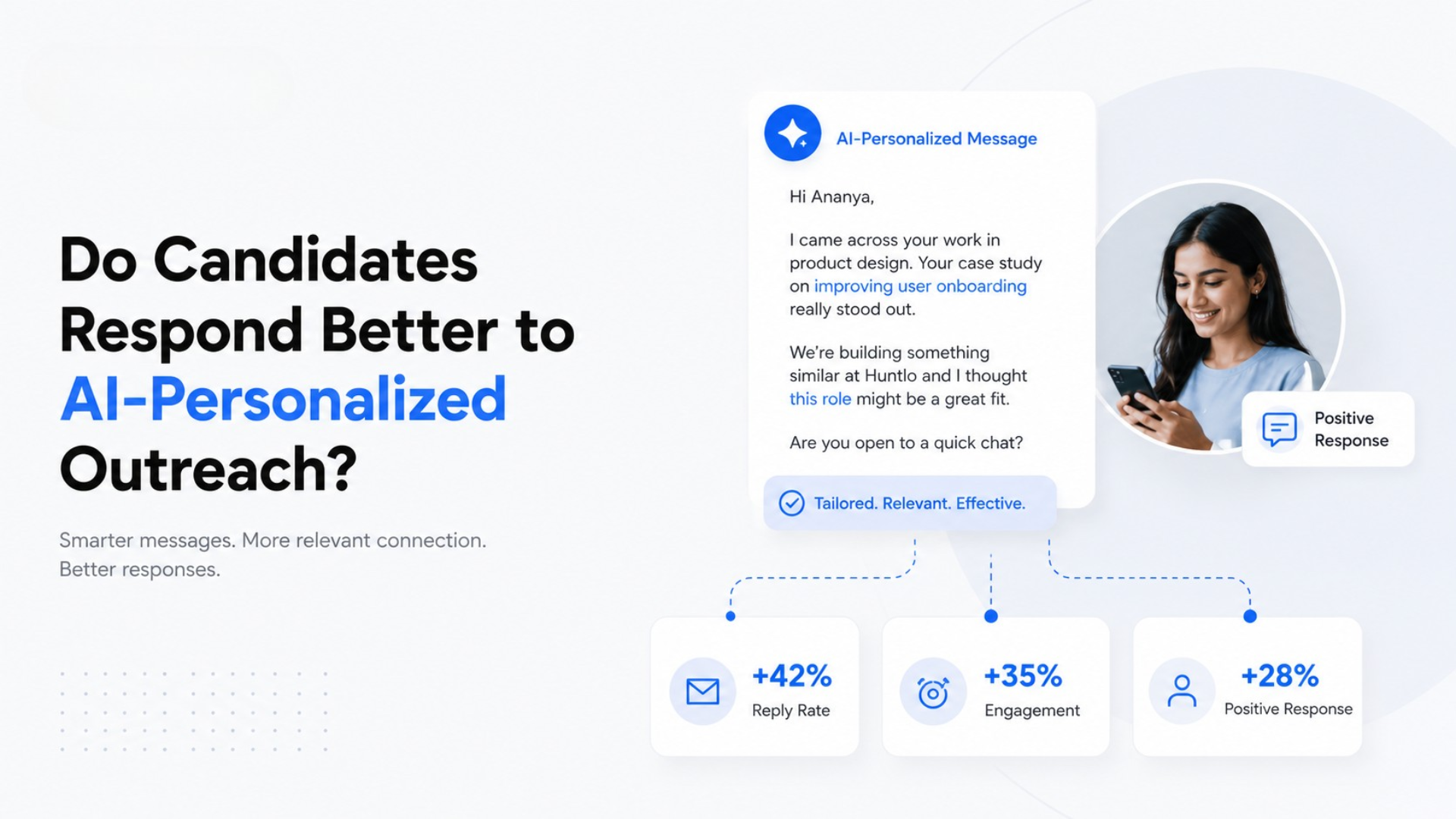
Candidates generally respond better when AI personalization makes recruiting outreach more relevant, specific, and credible. However, AI-generated personalization does not automatically improve response rates. The benefit comes from showing why a particular opportunity may matter to a particular candidate, not from adding more personal details to an otherwise generic message.
This distinction is becoming increasingly important.
AI has made personalized text inexpensive.
A few years ago, a recruiter who referenced a specific project, career move, or professional achievement probably spent time researching the candidate.
Today, an AI system can generate thousands of messages that appear individually written.
Candidates are beginning to recognize the patterns.
The competitive advantage is therefore moving away from personalization alone.
The stronger advantage is relevance.
A message needs to answer a question the candidate is already asking, even if they never say it directly.
Why are you contacting me?
Why does this role make sense for my background?
Why might this opportunity be worth my attention now?
AI can help answer these questions at scale.
It can also generate confident but meaningless messages that damage candidate trust.
The difference depends on how the recruiting workflow uses the technology.
What Is AI-Personalized Recruiting Outreach?
AI-personalized recruiting outreach uses artificial intelligence to adapt candidate messages based on information about the person, the role, and the hiring context.
The simplest form may include basic variables.
The candidate’s name changes.
Their current company appears in the message.
Their job title is inserted.
This is not necessarily meaningful AI personalization.
Traditional mail-merge systems have performed this kind of substitution for years.
More advanced AI personalization can interpret the relationship between the candidate and the opportunity.
The system may identify that the candidate has experience selling enterprise software into financial institutions.
The open role may require someone to build enterprise accounts in the same market.
The message can explain that connection.
Another candidate may have built a data platform at a fast-growing startup.
The hiring company may be facing a similar scaling challenge.
The outreach can focus on that experience.
A third candidate may have recently moved from an individual contributor role into management.
The opportunity may involve building a new team.
The message can explain why that career progression appears relevant.
The difference is not the number of candidate facts included.
The difference is whether the message creates a credible connection.
AI personalization works best when it helps the recruiter explain why the candidate was selected.
What Does the Evidence Say About Personalized Outreach?
The available recruiting evidence generally supports the idea that personalization can improve candidate engagement, although exact response rates vary significantly by audience, role, channel, message quality, sender reputation, and market conditions.
A 2025 email outreach benchmark report from hireEZ analyzed more than 2.7 million recruiting emails. The report found that subject lines using candidate and company context produced stronger engagement, while messages using several personalized variables performed better than generic outreach. The broader result is useful because it suggests that candidates respond when outreach reflects more than a mass template.
The important limitation is that personalization and AI personalization are not automatically the same thing.
A human recruiter can write a highly personalized message.
An AI system can generate a generic message.
The technology used to produce the text does not determine whether the message is relevant.
AI changes the economics of personalization.
It allows recruiting teams to research and adapt outreach across larger candidate pools.
The performance improvement still depends on what the system notices and how that information is used.
This is why recruiting teams should be cautious with claims that AI alone increases response rates by a specific percentage.
The real question is whether the AI improves candidate targeting and message relevance.
Why Generic Recruiting Outreach Gets Ignored
Passive candidates receive many messages that look almost identical.
The recruiter introduces themselves.
The company is growing.
The opportunity is exciting.
The candidate appears to have an impressive background.
The recruiter requests 15 minutes.
Nothing in the message explains why this particular person received it.
The candidate has to perform the work.
They need to open the job description.
They need to understand the company.
They need to decide whether their experience is relevant.
They need to imagine why the opportunity might be better than their current situation.
Most candidates will not do this work for a stranger.
Generic outreach fails because it transfers the entire burden of relevance to the candidate.
Strong personalization reduces that burden.
The recruiter explains the connection.
The candidate can quickly decide whether the opportunity deserves attention.
AI can make this explanation easier to create.
That is the real source of potential response improvement.
Basic Personalization Is Becoming Less Powerful
Using a candidate’s first name once felt personal.
Now it is expected.
Mentioning the current employer can create the same problem.
Candidates know that software can insert these fields automatically.
A message that says, “I saw your experience at Microsoft and thought you would be a great fit,” provides little evidence that the recruiter actually understands the candidate.
The message could be sent to almost anyone at the company.
The same problem appears when AI generates generic compliments.
“Your impressive career journey caught my attention.”
“Your exceptional expertise in technology is remarkable.”
“Your unique background stood out to me.”
These sentences sound personalized because they refer to the candidate.
They contain no useful information.
As AI-generated writing becomes more common, candidates are likely to become less impressed by polished language alone.
The message needs evidence.
What specifically created the connection?
Why does it matter for this opportunity?
A shorter message with one accurate observation can feel more personal than a long AI-generated paragraph containing several vague compliments.
Relevance Is More Important Than Personalization
Recruiting teams often use the words relevance and personalization as if they mean the same thing.
They do not.
A message can be highly personalized and completely irrelevant.
Imagine a recruiter notices that a software engineer recently spoke at a conference.
The AI creates a detailed message praising the presentation.
The open role has little connection with the candidate’s expertise.
The personalization may be accurate.
The outreach is still weak.
Another message may contain less personal information but create a stronger professional connection.
“You have spent the last three years building fraud-detection systems for high-volume payments. We are building a team around the same problem as transaction volume expands across Southeast Asia.”
This message is relevant because it connects candidate evidence with the actual work.
The candidate can immediately understand why the recruiter reached out.
The best AI personalization therefore begins before the message is written.
It begins with candidate selection.
If the wrong person is being contacted, better copy will not fix the workflow.
Huntlo’s guide to how AI candidate matching actually works explains how AI can compare candidate evidence with hiring requirements before outreach begins.
Strong personalization depends on strong matching.
AI Can Personalize the Reason for Contact
The most valuable part of candidate outreach is often the reason for contact.
A recruiter should be able to explain why this candidate was selected.
AI can support this by comparing the hiring requirement with candidate information.
The system may identify a relevant skill.
It may notice experience with a particular customer segment.
It may identify a similar technical problem.
It may recognize a career pattern connected with the opportunity.
This information can become the foundation of the message.
The outreach should not simply say that the candidate is a good fit.
It should show the evidence.
The difference is important.
“You look like a great fit for our sales role” is a conclusion.
“You have spent four years selling security software into enterprise banks, and this role is building the same customer segment across India” is a reason.
Candidates can evaluate reasons.
They are more likely to distrust unsupported conclusions.
AI Can Personalize the Opportunity Angle
The same role may appeal to different candidates for different reasons.
One person may be interested in greater responsibility.
Another may care about technical complexity.
Another may want to enter a new market.
Another may be attracted to building a team.
Another may value remote flexibility.
Traditional recruiting outreach often sends the same value proposition to everyone.
AI can help adapt the angle.
Suppose a company is hiring a senior product leader.
One candidate has spent years inside large organizations and may be interested in greater ownership.
Another has worked mainly in early-stage startups and may be attracted to the scale of the company’s user base.
The role is the same.
The relevant reason for considering it may be different.
The AI should not invent motivation.
It cannot know that the first candidate wants more ownership.
It can identify a potentially relevant opportunity characteristic and frame it carefully.
The message should create a possibility rather than pretending to know the candidate’s private intentions.
This is an important boundary.
Good AI personalization uses evidence.
Bad AI personalization makes psychological assumptions.
AI Can Personalize Around Career History
Career history contains useful signals.
A candidate may have moved repeatedly toward larger teams.
Another may have specialized more deeply over time.
Another may have experience across several startups.
A professional may have spent most of their career in one industry.
AI can identify these patterns more quickly than a recruiter manually reviewing hundreds of profiles.
The outreach can then connect the opportunity with the candidate’s professional direction.
However, career history should be interpreted carefully.
The system should not assume that past decisions reveal future intentions.
A candidate who has always worked at startups may want to join a large company.
A person who has moved every two years may now want stability.
A professional who became a manager may want to return to individual contribution.
AI can identify what happened.
It should be cautious about claiming why it happened.
The safest personalization is grounded in observable professional evidence.
AI Can Use Company and Industry Context
Candidate experience becomes more meaningful when the system understands the companies behind the profile.
A title alone provides limited information.
A Head of Sales at a 20-person startup may have different responsibilities from a Head of Sales at a global enterprise.
AI recruiting tools can use company size, industry, business model, customer type, growth stage, and other professional context to improve personalization.
A recruiter may be hiring someone to build a new function from the beginning.
Candidates who have worked in early-stage environments may have relevant experience.
The message can focus on building.
Another role may involve operating at significant scale.
The outreach can focus on the candidate’s experience with complex systems or large teams.
This is more useful than simply mentioning the company name.
The candidate wants to know why their experience there matters.
AI Can Personalize Around Skills Without Keyword Stuffing
Skills are one of the easiest forms of personalization.
They are also easy to use badly.
A weak message lists several technologies from the candidate’s profile.
“I noticed your experience with Python, AWS, Kubernetes, Docker, PostgreSQL, and machine learning.”
The candidate already knows their skills.
The list does not explain the opportunity.
A stronger message connects one or two relevant capabilities with the work.
“Your experience scaling Kubernetes infrastructure for high-traffic systems stood out because this team is rebuilding the platform for a much larger transaction volume.”
The skill becomes part of a reason.
AI can help identify which skill matters most.
This is more useful than inserting every matching keyword into the message.
Personalization should reduce noise.
It should not create a mini-resume inside the recruiter’s email.
AI Can Help Recruiters Research Candidates Faster
Manual personalization creates a scaling problem.
A recruiter can spend ten minutes researching one candidate.
For ten candidates, this may be reasonable.
For hundreds, it becomes difficult.
The recruiter eventually faces a trade-off.
Send a small number of carefully researched messages.
Or send a large number of generic messages.
AI can reduce this trade-off.
The system can review available professional information, compare the candidate with the role, identify relevant signals, and draft a message.
The recruiter can then review the output.
This changes the role of human effort.
Instead of beginning with a blank screen, the recruiter evaluates whether the AI found the right connection.
The strongest use of AI is therefore not automatic message generation alone.
It is research compression.
The technology can reduce the time required to understand why a candidate may be relevant.
Why AI Personalization Can Feel More Robotic
AI can create personalized messages at enormous scale.
This creates a paradox.
More messages can contain personal details.
Candidates may feel that outreach is becoming less personal.
The problem appears when every message follows the same structure.
The AI opens with a compliment.
It mentions one profile detail.
It connects the detail with an exciting opportunity.
It ends with a polished call to action.
The facts change.
The pattern remains identical.
Candidates who receive frequent recruiting outreach begin to recognize the pattern.
The message feels manufactured.
This is why AI personalization should not be evaluated only at the individual-message level.
Recruiting teams should review the complete campaign.
Do all messages sound the same?
Are the observations genuinely useful?
Does the language feel natural?
Is the message longer than necessary because the AI was asked to “make it personalized”?
AI can generate more words easily.
Candidates do not necessarily want more words.
Inaccurate Personalization Is Worse Than No Personalization
AI systems can misunderstand professional information.
A candidate may have mentioned a technology without being an expert.
A company may be incorrectly classified.
A job change may be outdated.
The system may attribute a team achievement directly to the candidate.
The AI may infer a responsibility that was never stated.
When this information appears in outreach, the personalization fails immediately.
The candidate notices that the recruiter did not understand their background.
The message may feel more careless than a generic email.
This is one reason AI-generated outreach should remain connected with source evidence.
The recruiter or system should be able to understand which profile information created the message.
A useful personalization workflow needs confidence.
Strong evidence can be used directly.
Uncertain information should be avoided or framed carefully.
The goal is not to create the most detailed message possible.
The goal is to create the most credible relevant message.
AI Should Not Pretend to Know the Candidate Personally
One of the worst forms of AI personalization occurs when the system creates artificial familiarity.
The message may say that the recruiter has been following the candidate’s career.
It may claim that a project was inspiring.
It may describe the candidate’s professional journey as fascinating.
If the recruiter has not actually followed the person, the message creates false intimacy.
Candidates can recognize exaggerated language.
AI should help recruiters become more relevant.
It should not help them pretend to have a relationship that does not exist.
A simple statement is often stronger.
“I found your profile while looking for people who have built enterprise security products.”
The recruiter explains the context truthfully.
The candidate understands why they were discovered.
Trust begins with accuracy.
Candidates Respond to Opportunities, Not Personalization Tricks
A perfectly personalized message cannot rescue an unattractive opportunity.
The role may offer no meaningful career advantage.
The compensation may be wrong.
The location may be unsuitable.
The company may have a weak reputation.
The candidate may simply be happy where they are.
Recruiting teams sometimes focus heavily on message optimization because it is easier than improving the opportunity.
They test subject lines.
They change opening sentences.
They add more personalization.
The fundamental candidate value proposition remains weak.
Response rates depend on the complete offer.
Personalization helps the candidate understand the opportunity.
It cannot manufacture value that does not exist.
This is particularly important with passive candidates.
They already have a job.
The recruiter needs to provide a reason for them to consider changing something.
Huntlo’s guide to how to source passive candidates who are not job-searching explains why candidate discovery is only the beginning of passive recruiting.
The outreach needs to answer why the opportunity deserves attention.
Message Length Matters Less Than Message Density
Recruiters often ask for the perfect outreach length.
There is no universal number.
A short message can be irrelevant.
A longer message can be useful.
The better question is how much of the message helps the candidate decide whether to respond.
Every paragraph should earn its place.
The candidate usually needs to understand who is contacting them, why they were selected, what the opportunity involves, why it may be relevant, and what the next step requires.
AI can help compress this information.
It can also make messages unnecessarily long.
Large language models often produce complete explanations when a candidate only needs one clear connection.
The recruiter should optimize for information density.
One specific reason is better than four generic compliments.
One meaningful role detail is better than a paragraph of company marketing.
One simple question is better than several calls to action.
The First Message Should Not Try to Close the Candidate
A passive candidate does not need to decide whether to accept the job.
They need to decide whether the conversation is worth continuing.
Recruiting outreach often asks for too much too early.
The message contains the complete job description.
The recruiter asks for a resume.
They request availability.
They include several scheduling links.
The candidate has not yet decided whether they care.
AI personalization works better when it supports the correct stage of the relationship.
The first message should create enough relevance for a reply.
The next conversation can provide more information.
This is why outbound recruiting should be understood as a workflow rather than one message.
Huntlo’s guide to what outbound recruiting is and how it differs from inbound recruiting explains why proactively contacted candidates need a different engagement process from applicants.
The candidate did not enter the funnel.
The recruiter is asking them to begin a conversation.
Follow-Ups Also Need Context
Many candidate responses happen after the first message.
Follow-ups are therefore important.
The mistake is sending the same reminder repeatedly.
“Just following up.”
“Bumping this to the top of your inbox.”
“Wanted to check whether you saw my previous message.”
These follow-ups add no new reason to respond.
AI can help create contextual follow-ups.
The second message may introduce a different part of the role.
The third may provide a relevant detail about the team.
The system can keep the sequence connected with the original reason for contact.
The goal is not to generate increasingly creative reminders.
Each message should add useful context.
The workflow should also stop when the candidate responds.
A candidate who replies on one channel should not continue receiving automated follow-ups somewhere else.
Multi-Channel Personalization Can Improve Timing
Candidates do not use every communication channel in the same way.
One person may respond to email.
Another may notice a professional networking message.
Another may prefer WhatsApp after a conversation has already begun.
Multi-channel recruiting can improve the chance that a relevant message is seen.
It can also create spam when channels are not coordinated.
AI can help maintain candidate context across the workflow.
The system should know which message was sent, whether the candidate responded, and whether the relationship changed.
Huntlo’s guide to multi-channel recruiting outreach explains why several communication channels should operate as one candidate conversation.
Personalization should continue across channels.
The candidate should not receive one carefully tailored email followed by a completely generic message somewhere else.
AI Personalization Works Best After Candidate Matching
The sequence matters.
A weak workflow begins with a huge candidate list.
AI generates a personalized message for everyone.
The company sends at scale.
A stronger workflow begins with the hiring requirement.
AI helps identify relevant candidates.
Candidate evidence is compared with the role.
The strongest connection is identified.
Contact details are found where appropriate.
The message is created around the reason for relevance.
The recruiter reviews important cases.
Outreach begins.
This sequence improves the quality of personalization because the message is built on actual candidate-role fit.
Huntlo’s guide to how AI recruiting tools find verified contact details explains the next operational step after candidate discovery.
A relevant candidate needs an appropriate route for contact.
The message then needs to justify why that route is being used.
Personalization Should Continue After the Reply
Recruiting teams often think of personalization as an outreach feature.
The candidate receives a personalized first message.
They respond.
The workflow becomes generic.
A stronger system preserves context.
The candidate should not need to explain their entire background again.
The recruiter should know why the person was sourced.
The screening process should build on available information.
The next message should reflect what the candidate already said.
This is where an AI Hiring OS becomes more useful than an isolated message generator.
Huntlo’s guide to how an AI Hiring OS connects sourcing, screening, and interviews explains how candidate information can influence the next stage of the workflow.
The strongest personalization is continuity.
The system remembers what already happened.
Where Huntlo Fits Into AI-Personalized Outreach
Huntlo approaches personalization as part of the wider outbound recruiting workflow.
The process begins with the hiring requirement.
AI can help identify candidates whose professional experience appears connected with the role.
Candidate matching creates the foundation for personalization.
The system can understand why a particular professional may be relevant rather than beginning with a generic contact list.
Approved candidates can move toward enrichment and outreach.
Available professional contact information can support engagement through appropriate channels, including email and WhatsApp.
The message can be grounded in the candidate-role connection.
Responses can influence what happens next.
Interested candidates can move toward qualification.
AI voice capabilities can support initial screening.
Qualified candidates can move toward interview scheduling.
This connected approach matters because the value of personalization does not end when the message is sent.
A candidate reply should change the workflow.
The system should stop unnecessary follow-ups.
Candidate context should continue into screening.
The recruiter should not need to rebuild the relationship at every stage.
Huntlo’s AI Hiring OS model is therefore less about generating the most creative recruiting message.
The objective is to connect relevance, engagement, and next actions.
AI helps create scale.
Candidate context keeps the scale useful.
Why Human Review Still Matters
AI can identify professional signals and draft messages quickly.
Recruiters still understand context that may not appear in the data.
A candidate may be especially important.
The role may be highly senior.
The professional relationship may require careful communication.
The AI may find an unusual profile detail that is technically accurate but inappropriate to mention.
Human review is most valuable where the cost of a bad message is high.
This does not mean recruiters need to manually rewrite every AI-generated email.
The workflow can use different levels of review.
High-confidence, lower-risk messages may require lighter oversight.
Strategic candidates may deserve deeper recruiter attention.
The objective is to use human judgment selectively.
AI should reduce repetitive research.
It should not remove accountability for the communication.
How to Test Whether AI Personalization Improves Responses
Recruiting teams should not assume that AI personalization works because the messages look impressive.
They should test the results.
The first measure is reply rate.
Do personalized messages receive more responses than the previous approach?
The second is positive reply rate.
A campaign can generate many responses from candidates asking recruiters to stop contacting them.
The third is qualified response rate.
Are the people who reply actually relevant to the role?
The fourth is conversion.
Do responses become screening conversations and interviews?
The fifth is recruiter time.
Does AI reduce the time required to research and write outreach?
The sixth is error rate.
How often does the AI mention incorrect or misleading information?
The seventh is candidate feedback.
Do candidates appear to understand why they were contacted?
These measures provide a more complete picture.
The best outreach system does not maximize replies at any cost.
It creates more relevant candidate conversations with less unnecessary recruiter work.
Why A/B Testing Needs More Than Subject Lines
Recruiting teams often test small message changes.
One subject line against another.
A short message against a long message.
One call to action against another.
These tests can be useful.
The larger variables often matter more.
Candidate relevance.
Opportunity quality.
Reason for contact.
Sender credibility.
Timing.
Channel.
A highly personalized message sent to the wrong candidate will still perform poorly.
A generic message about an unusually attractive opportunity may perform well.
Testing should therefore happen across the workflow.
Teams can compare generic outreach with role-based personalization.
They can test one candidate signal against several signals.
They can compare AI-generated drafts with recruiter-edited versions.
They can measure whether more personalization actually improves positive responses.
The objective is learning.
AI makes message generation faster.
Recruiting teams should use that speed to improve the process rather than simply increase volume.
Common Mistakes With AI-Personalized Outreach
The first mistake is confusing name insertion with meaningful personalization.
The second is contacting poorly matched candidates and expecting AI copy to solve the relevance problem.
The third is using too many candidate details in one message.
The fourth is allowing AI to invent motivations or personal opinions.
The fifth is using exaggerated compliments that create false familiarity.
The sixth is sending inaccurate profile observations.
The seventh is making every AI-generated message follow the same recognizable structure.
The eighth is personalizing the first message while making every follow-up generic.
The ninth is continuing automated outreach after the candidate responds through another channel.
The tenth is measuring total replies without separating positive, negative, and qualified responses.
The final mistake is optimizing the message while ignoring the opportunity.
Candidates respond to relevant career possibilities.
Personalization helps them recognize those possibilities faster.
Will Candidates Eventually Ignore AI Personalization?
Candidates will probably become better at recognizing shallow AI-generated outreach.
This does not mean personalization will stop working.
It means the standard will rise.
Basic variables are already expected.
Generic AI compliments are becoming easier to detect.
Profile summaries will become less impressive.
The remaining advantage will come from better candidate understanding.
Why is this person relevant?
Why might this opportunity matter?
What specific problem connects their experience with the role?
What information should be included?
What should be left out?
These are reasoning questions.
AI can help answer them.
The recruiting team still needs a good hiring requirement, good candidate data, a credible opportunity, and a responsible workflow.
As AI-generated communication becomes more common, accurate relevance may become more valuable than polished writing.
Conclusion: Candidates Respond Better to Relevance, Not AI
Candidates can respond better to AI-personalized outreach.
The improvement does not happen because artificial intelligence wrote the message.
It happens when AI helps the recruiter create a more relevant conversation.
The technology can analyze candidate profiles.
It can compare professional experience with a hiring requirement.
It can identify useful connections.
It can reduce manual research.
It can adapt outreach across a larger candidate pool.
These capabilities can improve response rates.
They can also create a new generation of automated spam.
A message that mentions the candidate’s company is not automatically personal.
A message that praises their impressive background is not automatically credible.
A message generated uniquely for one person is not automatically relevant.
The strongest outreach answers a simple question.
Why me?
The candidate should understand why they were selected and why the opportunity may deserve attention.
AI can help recruiters answer that question more consistently.
The best systems will not use AI to make every message longer, more flattering, or more complicated.
They will use AI to make candidate selection stronger, research faster, connections clearer, and follow-up more contextual.
Candidates do not respond to personalization because they admire the technology behind it.
They respond when the message gives them a reason to care.
That is the standard AI recruiting outreach needs to meet.
Frequently Asked Questions
Do candidates respond better to personalized recruiting messages?
Personalized messages can improve candidate engagement when the personalization creates genuine relevance. Simply adding a candidate’s name or employer does not guarantee a better response.
Does AI improve recruiting outreach response rates?
AI can improve response rates when it helps recruiters identify relevant candidate signals and create more specific messages. AI-generated text alone does not guarantee better results.
What is AI-personalized recruiting outreach?
AI-personalized outreach uses candidate, role, company, and professional-context information to adapt recruiting messages for individual candidates or candidate segments.
What kind of personalization works best?
The strongest personalization usually explains why the candidate’s specific experience connects with the opportunity. Relevance is generally more useful than generic compliments or long lists of profile details.
Can candidates tell when recruiting messages are written by AI?
Candidates may recognize repeated structures, exaggerated language, generic compliments, and inaccurate observations. The more AI outreach becomes common, the less impressive shallow personalization is likely to become.
Is mentioning a candidate’s company enough personalization?
Usually not. Mentioning the employer becomes more useful when the recruiter explains why the candidate’s experience there matters for the role.
Can AI personalize outreach to passive candidates?
Yes. AI can help identify relevant professional evidence and connect it with an opportunity. The message still needs to respect the fact that the candidate did not apply.
Should recruiters review every AI-generated message?
The appropriate level of review depends on the workflow and candidate. Strategic, senior, unusual, or high-value candidates may deserve closer human review.
How should recruiters measure AI outreach performance?
Teams should measure total reply rate, positive reply rate, qualified responses, screening conversion, interview conversion, recruiter time saved, and personalization errors.
Can too much personalization reduce response rates?
Yes. Excessive detail can feel invasive, artificial, or unnecessary. One strong professional connection can be more effective than several weak personal references.
Related Topics
Learn how strong outreach begins with candidate-role relevance in How Does AI Candidate Matching Actually Work?.
Explore how recruiters can find and engage professionals who are not actively applying in How to Source Passive Candidates Who Aren’t Job-Searching.
Understand how proactive candidate engagement differs from waiting for applications in What Is Outbound Recruiting (And How Is It Different From Inbound)?.