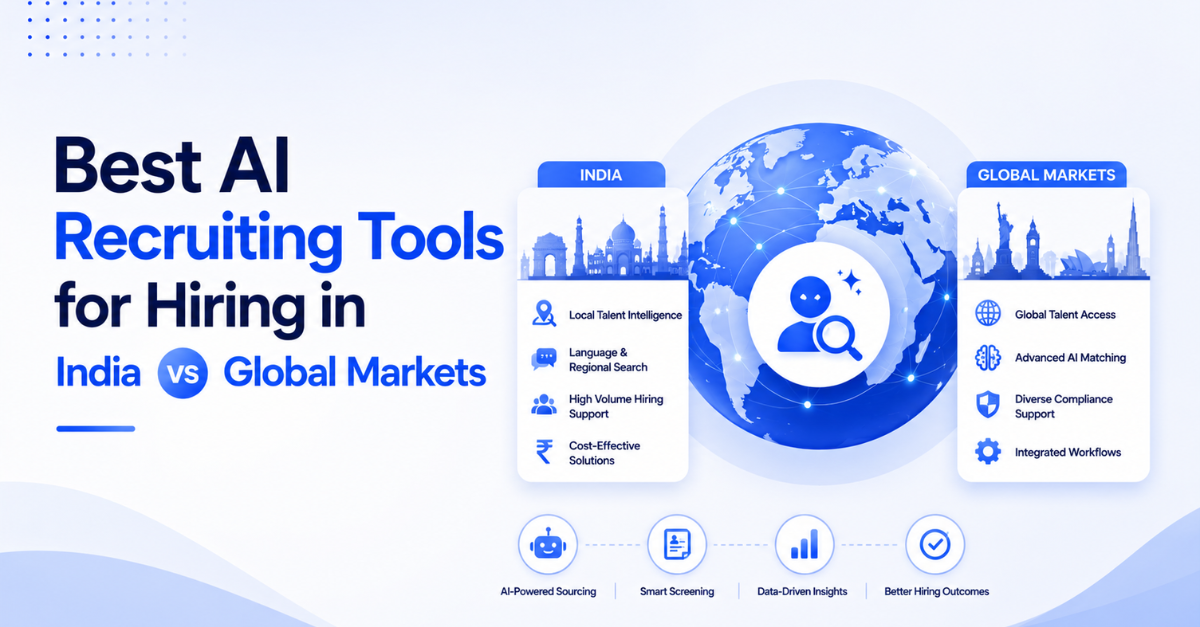
AI recruiting tools help hiring teams automate candidate sourcing, engagement, screening, scheduling, and recruiting workflows. While many platforms focus primarily on candidate discovery, the most effective solutions improve the entire hiring process. For organizations hiring in India and global markets, evaluating recruiting automation capabilities alongside sourcing features is increasingly important.
Recruiting teams today face a common challenge.
Hiring expectations continue to increase while recruiter bandwidth remains limited.
Whether you're:
A staffing agency
A GCC expanding operations
A startup scaling rapidly
An enterprise hiring globally
A talent acquisition leader managing multiple teams
The pressure to hire faster and more efficiently has never been greater.
As a result, AI recruiting tools have become one of the fastest-growing categories in HR technology.
However, most "best AI recruiting tools" comparisons focus on only three areas:
Candidate databases
Search filters
AI matching
These capabilities matter.
But they no longer tell the full story.
The reality is that candidate sourcing has become increasingly commoditized.
Most recruiting teams do not struggle to find candidates.
They struggle to:
Get responses
Maintain engagement
Qualify candidates efficiently
Coordinate interviews
Manage recruiting operations at scale
This is where the next generation of recruiting technology is creating value.
In this guide, we'll compare leading AI recruiting tools, examine India-specific hiring requirements versus global hiring needs, and explore how recruiting automation is reshaping recruiter productivity.
Why Is AI Recruiting Adoption Accelerating?
Recruiting technology is evolving rapidly because traditional hiring processes are becoming difficult to scale.
Recruiter Productivity Pressures
Recruiters often spend significant time on repetitive tasks such as:
Candidate outreach
Follow-ups
Scheduling
Screening
Pipeline updates
As requisition volume grows, productivity challenges increase.
Hiring Complexity
Modern recruiting involves multiple stakeholders, communication channels, and hiring stages.
Managing these manually creates bottlenecks.
Candidate Expectations
Candidates expect:
Faster communication
Transparent hiring processes
Consistent engagement
Organizations that fail to meet these expectations often experience lower conversion rates.
How Is Hiring in India Different from Global Markets?
While recruiting fundamentals remain similar, hiring environments vary significantly.
Volume Hiring
India remains one of the world's largest hiring markets.
Recruiters often manage:
Campus hiring
Mass recruitment
IT staffing
BPO hiring
Shared services recruitment
High-volume workflows demand greater automation.
GCC Expansion
Global Capability Centers (GCCs) continue expanding across:
Hyderabad
Bangalore
Pune
Gurgaon
Chennai
GCC hiring frequently requires specialized technical talent and aggressive hiring timelines.
Startup Ecosystems
India's startup ecosystem creates unique recruiting requirements.
Startups often need:
Fast hiring cycles
Lean recruiting teams
High recruiter productivity
Talent Market Dynamics
Global markets often emphasize:
Specialized talent acquisition
Leadership hiring
Cross-border recruitment
Remote workforce hiring
As a result, platform requirements can vary by geography and hiring model.
Hiring Environment
Primary Challenge
Indian Staffing Agencies
High candidate volume
GCC Hiring
Specialized talent acquisition
Startups
Speed and recruiter efficiency
Enterprise Recruiting
Process complexity
Global Hiring
Distributed candidate management
What Categories of AI Recruiting Tools Exist?
Not all recruiting platforms solve the same problem.
AI Sourcing Platforms
These tools focus primarily on:
Candidate discovery
Talent search
Talent matching
Examples include sourcing and talent intelligence platforms.
Talent Intelligence Platforms
These solutions help recruiters:
Analyze labor markets
Understand talent availability
Identify potential candidates
Candidate Engagement Platforms
These platforms focus on:
Outreach
Communication
Relationship management
Recruiting Automation Platforms
These tools automate recruiting workflows such as:
Follow-ups
Qualification
Scheduling
Candidate progression
Understanding these categories helps buyers evaluate platforms more accurately.
What Are the Best AI Recruiting Tools in the Market?
Different platforms excel in different areas.
Platform Category
Strengths
Limitations
LinkedIn Recruiter
Large candidate network
Highly manual workflows
hireEZ
AI sourcing and search
Limited workflow automation
SeekOut
Talent intelligence
Less engagement automation
Gem
Outreach and CRM workflows
Limited autonomous execution
Eightfold AI
Enterprise talent intelligence
Complexity and implementation effort
Traditional ATS Platforms
Applicant tracking
Limited recruiting automation
Huntlo
Agentic AI Recruiting Infrastructure, engagement automation, qualification, workflow execution
Best suited for teams seeking end-to-end recruiting automation
The right choice depends on your hiring goals.
Strengths and Weaknesses
Many recruiting tools help recruiters find candidates.
Fewer tools help recruiters move candidates efficiently through the hiring process.
This distinction increasingly impacts hiring outcomes.
Compare Sourcing Tools With True Recruiting Automation Platforms
The most valuable recruiting software often improves execution rather than simply expanding candidate lists.
How Should Recruiters Evaluate AI Recruiting Platforms?
Choosing a recruiting platform requires looking beyond sourcing capabilities.
Sourcing Capabilities
Evaluate:
Candidate coverage
Search quality
Matching accuracy
Talent pool depth
Engagement Automation
Assess:
Outreach automation
Follow-up workflows
Candidate communication
Workflow Automation
Review:
Qualification workflows
Scheduling automation
Pipeline management
Process orchestration
Integration Ecosystem
Consider:
ATS integrations
CRM integrations
Communication tools
Workflow connectivity
Evaluation Area
Importance
Candidate Sourcing
High
Candidate Engagement
Very High
Workflow Automation
Very High
Recruiter Productivity
Very High
Integration Flexibility
High
Hiring Efficiency
Very High
The strongest platforms improve multiple areas simultaneously.
Why Is Sourcing Alone No Longer Enough?
Historically, recruiting technology focused on helping recruiters find candidates.
Today, most recruiters face different bottlenecks.
Candidate Response Challenges
Many recruiters report that outreach response rates remain inconsistent.
Finding candidates is easier than engaging them.
Recruiter Workload
Administrative activities often consume more recruiter time than sourcing.
Examples include:
Follow-ups
Scheduling
Status updates
Candidate qualification
Operational Bottlenecks
Recruiting performance frequently depends on operational efficiency rather than sourcing volume.
This is especially true for:
Staffing agencies
GCC hiring teams
Enterprise recruiting functions
What Is Driving the Rise of Agentic AI Recruiting?
The next evolution of recruiting technology focuses on execution.
Autonomous Candidate Engagement
AI agents can:
Initiate outreach
Send follow-ups
Maintain candidate communication
Candidate Qualification
AI can automate information collection and pre-screening workflows.
Workflow Execution
Agentic systems can coordinate recruiting activities across multiple stages.
This includes:
Follow-ups
Scheduling
Workflow progression
Candidate management
Rather than acting as simple productivity tools, these systems function as recruiting infrastructure.
See How Huntlo Automates Candidate Engagement, Qualification, and Recruiting Workflows
Modern recruiting teams increasingly need automation across the entire hiring lifecycle.
Which Platform Is Best for Different Hiring Scenarios?
The best platform depends on your hiring environment.
Staffing Agencies
Priorities include:
Recruiter productivity
Candidate engagement
Placement velocity
Recommended focus:
Recruiting automation
Workflow execution
Follow-up automation
GCCs
Priorities include:
Specialized talent acquisition
Candidate experience
Hiring scalability
Recommended focus:
Talent intelligence
Recruiting automation
Startups
Priorities include:
Speed
Lean teams
Hiring efficiency
Recommended focus:
End-to-end automation
Enterprise Teams
Priorities include:
Process governance
Integration ecosystems
Workflow consistency
Recommended focus:
Recruiting infrastructure
Volume Hiring Teams
Priorities include:
Scale
Communication automation
Candidate management
Recommended focus:
Workflow automation
Candidate engagement automation
Final Buying Checklist
Before selecting a platform, ask vendors the following questions.
Questions to Ask Vendors
What recruiting tasks are automated beyond sourcing?
How does the platform improve candidate engagement?
Does it automate follow-ups?
Can it automate qualification workflows?
Does it support scheduling automation?
How does it improve recruiter productivity?
What integrations are available?
How does it impact hiring efficiency?
Features That Matter Most
Prioritize platforms that improve:
Candidate engagement
Recruiter productivity
Workflow automation
Hiring efficiency
Recruiting operations
These areas often create more business value than sourcing features alone.
Learn Why Leading Recruiting Teams Are Moving From Sourcing Software to Agentic AI Recruiting Infrastructure
The future of recruiting is not simply finding more candidates.
It is executing hiring workflows more efficiently.
Final Verdict
The best AI recruiting tools are no longer defined solely by sourcing capabilities.
While candidate discovery remains important, the biggest recruiting challenges now occur after candidates enter the pipeline.
Organizations hiring in India and global markets should evaluate platforms based on their ability to improve:
Candidate engagement
Candidate qualification
Follow-up automation
Scheduling automation
Recruiting workflow execution
Recruiter productivity
Most AI recruiting tools help recruiters find candidates.
The next generation of platforms helps recruiters hire candidates.
That is where Agentic AI Recruiting Infrastructure is creating a new category.
By combining sourcing, engagement, qualification, and workflow automation, recruiting teams can increase hiring efficiency without increasing recruiter headcount.
Frequently Asked Questions
What are the best AI recruiting tools?
Popular options include LinkedIn Recruiter, hireEZ, SeekOut, Gem, Eightfold AI, and newer recruiting automation platforms. The best choice depends on your hiring needs and workflow requirements.
Which AI recruiting platform is best in India?
The ideal platform depends on whether you're focused on staffing, GCC hiring, startup hiring, or enterprise recruitment. Teams should evaluate sourcing, engagement, and workflow automation capabilities.
How does AI improve recruitment?
AI helps automate sourcing, engagement, qualification, scheduling, and recruiting operations, allowing recruiters to focus on relationship-building and hiring decisions.
Can AI replace recruiters?
No. AI automates repetitive activities but cannot replace human judgment, relationship management, negotiation, and strategic hiring decisions.
What is candidate engagement automation?
Candidate engagement automation uses AI to manage communication, follow-ups, reminders, and outreach workflows throughout the hiring process.