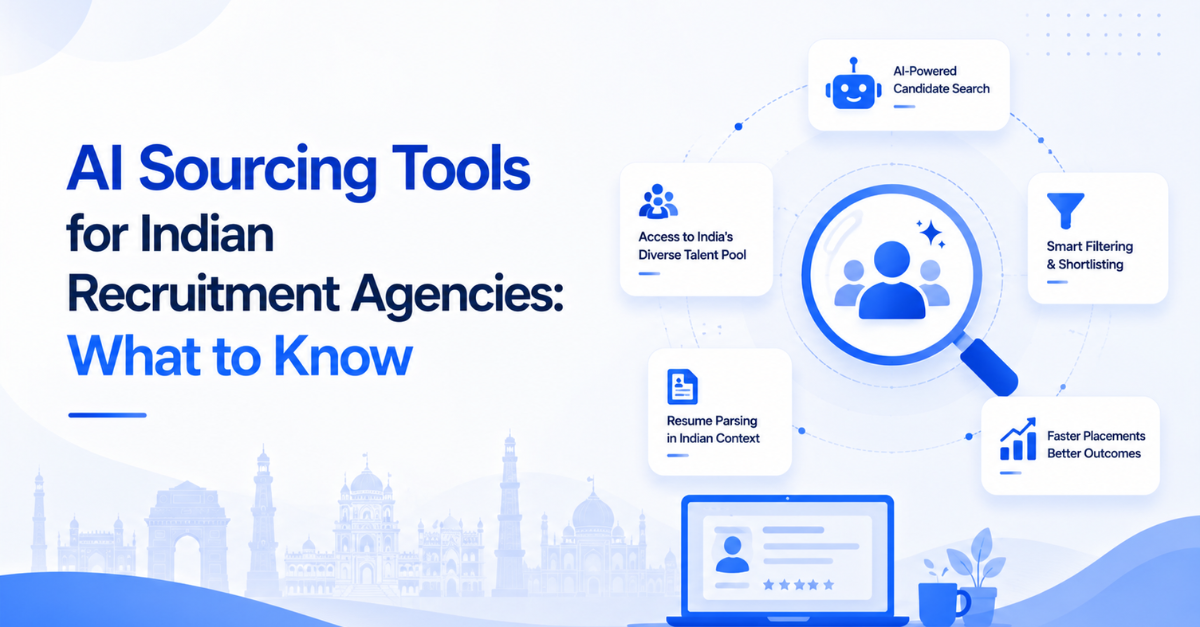
AI sourcing tools can help Indian recruitment agencies find candidates faster, expand talent pipelines, and reduce manual sourcing effort. However, sourcing is rarely the biggest recruiting bottleneck. Agencies achieve the greatest ROI when they automate candidate engagement, qualification, follow-ups, scheduling, and recruiting workflows alongside sourcing.
India has one of the world's largest and fastest-growing recruitment markets.
From IT staffing firms in Bangalore to executive search agencies in Mumbai, GCC hiring specialists in Hyderabad, and startup recruiters in Gurgaon, agencies are under constant pressure to deliver more placements with limited recruiter bandwidth.
As hiring demand continues to increase, recruiters are turning to AI sourcing tools, staffing software, recruitment automation platforms, and AI recruiting solutions to improve efficiency.
The challenge is that many agencies evaluate technology using the wrong criteria.
They ask:
"Which tool helps us find more candidates?"
A more important question is:
"Which platform helps recruiters consistently convert candidates into placements?"
Because sourcing is only the first stage of the recruiting lifecycle.
Placements happen when recruiters successfully engage, qualify, follow up with, coordinate, and manage candidates through hiring processes.
This distinction is becoming increasingly important as recruiting technology evolves beyond candidate discovery and toward recruiting execution.
Why Are Indian Recruitment Agencies Adopting AI?
Recruitment firms across India face growing operational pressures.
Growing Hiring Demand
Indian agencies support hiring across:
IT staffing
Non-IT staffing
GCC recruitment
Startup hiring
Executive search
Contract staffing
Permanent staffing
Volume hiring
Many recruiters manage dozens of open roles simultaneously.
Traditional sourcing methods struggle to keep pace.
Recruiter Productivity Challenges
Recruiters often spend significant time on repetitive activities such as:
Candidate searches
Outreach
Follow-ups
Scheduling
Qualification
Pipeline management
As candidate volume increases, recruiter workload increases as well.
Competitive Staffing Market
Agencies compete aggressively for both clients and candidates.
The ability to move candidates through hiring processes efficiently has become a major competitive advantage.
This is driving interest in AI recruiting software and staffing agency automation.
What Do AI Sourcing Tools Actually Do?
Before evaluating solutions, it's important to understand what sourcing software is designed to solve.
Candidate Discovery
AI sourcing tools help recruiters identify candidates based on:
Skills
Experience
Job titles
Industry expertise
Location
Education
This reduces manual searching across multiple platforms.
Talent Matching
Most AI sourcing platforms use machine learning algorithms to match candidates against job requirements.
This helps recruiters prioritize relevant profiles.
Search Automation
Many tools automate:
Candidate recommendations
Similar profile discovery
Talent pool generation
Search optimization
This improves sourcing efficiency.
AI Sourcing Capability
Recruiter Benefit
Candidate Discovery
Faster talent identification
Talent Matching
Improved candidate relevance
Search Automation
Reduced manual effort
Talent Recommendations
Better sourcing productivity
Pipeline Building
Larger talent pools
These capabilities deliver meaningful value.
However, sourcing only addresses one part of the recruiting process.
Popular AI Sourcing Tools Used by Agencies
Recruitment agencies commonly evaluate platforms such as:
LinkedIn Recruiter
hireEZ
SeekOut
Gem
Talent intelligence platforms
AI recruiting software vendors
While these solutions differ in capabilities, most focus heavily on candidate discovery.
Strengths of AI Sourcing Tools
Common benefits include:
Faster candidate search
Expanded talent pools
Better matching capabilities
Reduced manual sourcing effort
Limitations of AI Sourcing Tools
Most platforms provide limited support for:
Candidate engagement
Follow-ups
Scheduling
Qualification workflows
Recruiting operations
This creates operational gaps for agencies trying to scale.
See How Huntlo Helps Recruitment Agencies Automate Far More Than Candidate Sourcing
Modern recruiting requires more than finding candidates. It requires moving candidates efficiently through the hiring lifecycle.
The Benefits of AI Sourcing for Recruitment Firms
AI sourcing provides several clear advantages.
Faster Sourcing
Recruiters spend less time searching and more time engaging candidates.
Larger Talent Pools
AI can uncover candidates who may not appear in traditional search methods.
Reduced Manual Search Effort
Automated sourcing improves consistency and productivity.
Better Recruiter Efficiency
Recruiters can manage larger pipelines without increasing sourcing workload.
Benefit
Business Impact
Faster Candidate Discovery
Reduced sourcing time
Larger Talent Pools
Increased candidate availability
Automated Search
Higher recruiter productivity
Better Matching
Improved candidate quality
Pipeline Expansion
Greater recruiting capacity
These gains are valuable but incomplete.
Where Most AI Sourcing Tools Fall Short
Many agencies discover that sourcing isn't their biggest challenge.
Candidate Engagement
Candidates rarely respond after a single outreach attempt.
Recruiters must maintain ongoing communication.
Follow-Ups
Manual follow-ups consume a significant portion of recruiter time.
Missed follow-ups frequently result in lost placements.
Scheduling
Interview coordination remains one of the most repetitive recruiting activities.
Pipeline Management
As candidate volume grows, managing pipelines becomes increasingly complex.
Recruiting Activity
AI Sourcing Impact
Candidate Discovery
High
Talent Matching
High
Candidate Engagement
Limited
Follow-Ups
Limited
Scheduling
Limited
Pipeline Management
Limited
This explains why agencies often continue experiencing productivity challenges despite investing in sourcing software.
Why Recruitment Agencies Need More Than Sourcing
Candidate discovery alone does not generate revenue.
Placements generate revenue.
Placement Velocity
The speed at which candidates move through hiring processes directly impacts agency performance.
Recruiter Productivity
Recruiters create more value when they spend time building relationships rather than performing administrative tasks.
Candidate Conversion Rates
Higher conversion rates often matter more than larger candidate databases.
A smaller pipeline that converts efficiently can outperform a much larger pipeline with poor engagement.
Increase Placements Without Increasing Recruiter Headcount
The most successful agencies focus on recruiting execution, not just candidate discovery.
AI Sourcing vs Recruiting Automation
Understanding the difference is essential.
Finding Candidates
AI sourcing focuses on:
Candidate search
Talent matching
Pipeline generation
Managing Candidate Journeys
Recruiting automation focuses on:
Outreach
Engagement
Qualification
Follow-ups
Scheduling
Workflow execution
Capability
AI Sourcing Tools
Recruiting Automation
Candidate Discovery
Yes
Limited
Talent Matching
Yes
Limited
Candidate Outreach
Partial
Yes
Follow-Up Automation
Limited
Yes
Candidate Qualification
Limited
Yes
Scheduling Automation
Limited
Yes
Recruiting Workflow Automation
No
Yes
Recruiting Operations Automation
No
Yes
This is where the recruiting technology market is evolving.
What Indian Recruitment Agencies Should Automate First
The highest ROI opportunities typically exist beyond sourcing.
Candidate Outreach
Consistent communication improves response rates.
Candidate Qualification
Automating early-stage screening reduces recruiter workload.
Follow-Up Workflows
Follow-up automation prevents candidates from slipping through the cracks.
Interview Coordination
Scheduling automation removes repetitive administrative tasks.
Recommended Automation Priorities
Candidate Outreach
Candidate Qualification
Follow-Up Automation
Interview Coordination
Candidate Sourcing
This sequence often delivers the greatest productivity gains.
How Should Agencies Choose the Right AI Recruiting Platform?
Technology decisions should focus on outcomes rather than features.
Key Evaluation Framework
Ask:
Does the platform reduce recruiter workload?
Does it improve candidate engagement?
Does it increase placement velocity?
Does it automate repetitive workflows?
Does it improve recruiter productivity?
Questions Agencies Should Ask Vendors
What recruiting activities are automated beyond sourcing?
How does the platform improve candidate response rates?
Can it automate qualification workflows?
Does it support interview coordination?
How does it improve recruiter productivity?
These questions often reveal more value than sourcing feature comparisons.
Discover How Agentic AI Recruiting Infrastructure Improves Recruiter Productivity Across the Entire Hiring Lifecycle
The future of agency recruiting is not simply better search. It is automated execution across the recruiting process.
The Future of Recruitment Technology in India
The next generation of recruiting software extends beyond sourcing.
From Sourcing Tools to Recruiting Infrastructure
Historically, recruiting software focused on helping recruiters find candidates.
Today, agencies increasingly need systems capable of:
Engaging candidates
Qualifying candidates
Managing communication
Coordinating interviews
Automating recruiting operations
This shift is creating demand for Agentic AI Recruiting Infrastructure.
Rather than simply generating candidate lists, these systems help recruiters execute recruiting workflows.
For agencies facing recruiter capacity constraints and increasing hiring demands, that operational capability may become the most important competitive advantage.
Final Verdict
AI sourcing tools can significantly improve recruiter productivity.
They help agencies find candidates faster, expand talent pools, and reduce manual search effort.
However, sourcing alone does not solve the biggest challenges facing recruitment firms.
Most agencies struggle with:
Candidate engagement
Follow-ups
Qualification workflows
Scheduling
Recruiting operations
The future of agency recruiting is not simply sourcing more candidates.
It is combining candidate discovery with recruiting automation.
AI sourcing helps recruiters find talent.
Agentic AI Recruiting Infrastructure helps recruiters place talent.
That distinction is becoming increasingly important as recruitment agencies scale operations without increasing headcount.
Frequently Asked Questions
What are the best AI sourcing tools for recruitment agencies in India?
Popular options include LinkedIn Recruiter, hireEZ, SeekOut, Gem, and emerging AI recruiting platforms. The best choice depends on whether your priority is sourcing, engagement, or workflow automation.
How do Indian staffing agencies use AI?
Staffing agencies use AI for sourcing, talent matching, candidate engagement, qualification, follow-ups, and recruiting workflow automation.
Can AI replace recruiters?
No. AI can automate repetitive tasks, but relationship building, client management, and hiring decisions still require human recruiters.
How much time do AI sourcing tools save?
The exact savings vary, but AI sourcing tools can significantly reduce manual candidate search effort and pipeline-building activities.
What recruiting tasks should agencies automate first?
Most agencies see the greatest ROI from automating outreach, qualification, follow-ups, scheduling, and recruiting workflows before expanding sourcing efforts.