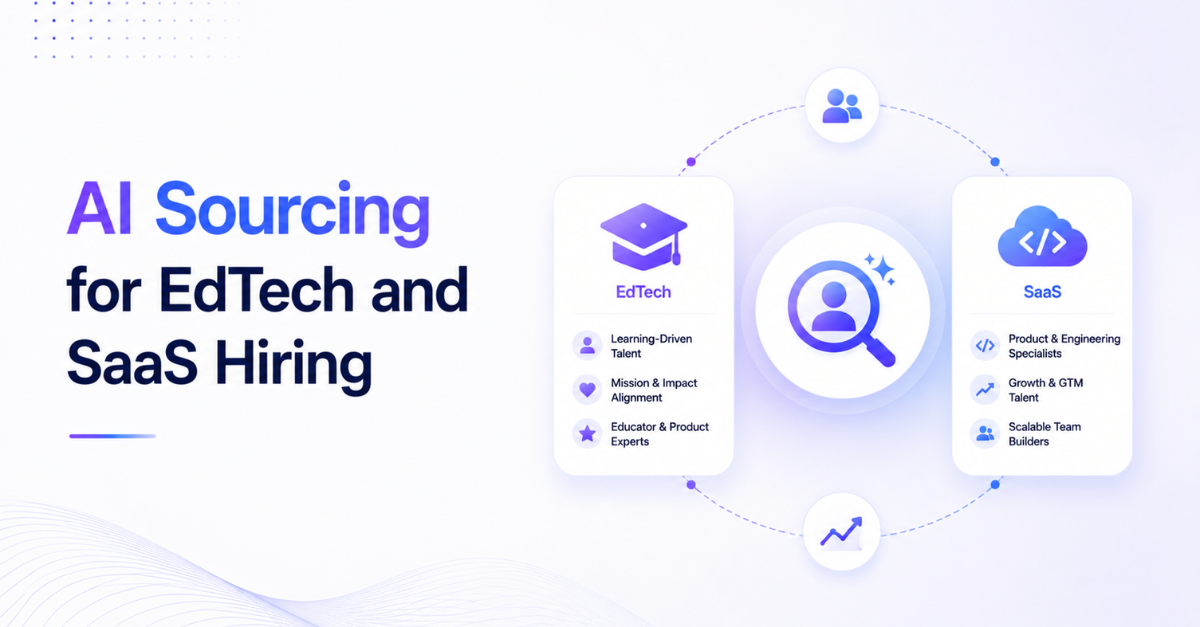
AI sourcing can significantly improve hiring efficiency for EdTech and SaaS companies by helping recruiters identify relevant candidates faster. However, candidate discovery is only part of the hiring challenge. The real opportunity lies in automating engagement, qualification, follow-ups, and recruiting workflows to improve hiring velocity and recruiter productivity.
Recruiting in high-growth SaaS and EdTech companies is uniquely challenging.
These organizations often need to scale teams rapidly while competing against well-funded startups, enterprise companies, and global employers for the same talent pools.
Whether hiring:
Software engineers
Product managers
SDRs
Account executives
Customer success managers
Growth marketers
Operations professionals
Recruiters face increasing pressure to fill roles faster without compromising quality.
As a result, many organizations are turning to AI sourcing tools and recruiting automation platforms to improve hiring outcomes.
But sourcing more candidates isn't always the answer.
Most high-growth hiring teams can generate candidate lists.
Their biggest challenge is converting candidate interest into interviews and hires while managing limited recruiter capacity.
This is where the conversation shifts from AI sourcing to recruiting automation.
Why Are EdTech and SaaS Companies Adopting AI Sourcing?
The demand for talent continues to outpace recruiter bandwidth.
Competitive Talent Markets
EdTech and SaaS companies frequently compete for the same candidate pools.
These candidates are often:
Already employed
Actively approached by recruiters
Difficult to engage consistently
Evaluating multiple opportunities simultaneously
This makes traditional sourcing increasingly inefficient.
Aggressive Hiring Goals
High-growth companies often need to scale quickly.
A SaaS startup expanding its sales team or an EdTech company launching into new markets may need to hire dozens of employees within a short period.
Recruiters are expected to deliver results without proportional increases in team size.
AI sourcing tools help address this challenge by reducing manual search effort.
The Unique Hiring Challenges in EdTech and SaaS
While these industries share common hiring needs, they also face distinct recruiting challenges.
High Demand for Specialized Talent
SaaS organizations commonly hire for:
SDR hiring
Account executive hiring
Customer success recruitment
Product management hiring
Software engineering recruitment
EdTech companies frequently recruit:
Education sales professionals
Student success managers
Learning technology specialists
Instructional designers
Product and engineering talent
These candidates are often highly sought after and difficult to attract.
Limited Recruiter Capacity
Many startups and growth-stage businesses operate with lean recruiting teams.
A single recruiter may manage:
Multiple open roles
Candidate outreach
Screening
Scheduling
Hiring manager coordination
This creates operational bottlenecks.
Candidate Engagement Challenges
The problem isn't simply finding candidates.
It's getting them to respond.
Most qualified candidates receive frequent outreach from competing employers.
Without consistent engagement and follow-up, opportunities are lost.
See How High-Growth Hiring Teams Automate Candidate Engagement and Recruiting Workflows With Huntlo
Finding candidates is important. Converting them into hires is what drives business growth.
What AI Sourcing Does Well
AI sourcing has become a valuable tool for modern recruiting teams.
Candidate Discovery
AI sourcing platforms help recruiters identify relevant candidates based on:
Skills
Experience
Job titles
Industry expertise
Location preferences
This dramatically reduces manual search effort.
Talent Matching
Many AI recruiting platforms use machine learning to surface candidates who align with role requirements.
This helps recruiters prioritize outreach efforts.
Pipeline Expansion
AI sourcing enables teams to build larger talent pipelines more efficiently.
AI Sourcing Capability
Benefit
Candidate Discovery
Faster talent identification
Talent Matching
Improved candidate relevance
Search Automation
Reduced manual sourcing effort
Pipeline Expansion
Larger candidate pools
Talent Recommendations
Faster recruiter workflows
These benefits can significantly improve sourcing productivity.
However, sourcing alone doesn't solve hiring challenges.
Where AI Sourcing Falls Short
Most sourcing tools stop at candidate discovery.
The remaining hiring process remains largely manual.
Candidate Engagement
Finding candidates doesn't guarantee responses.
Recruiters still need to:
Personalize outreach
Manage conversations
Maintain engagement
Qualification
Candidates must be screened and evaluated before progressing.
Qualification requires:
Information gathering
Requirement validation
Initial assessments
Scheduling
Interview coordination remains one of recruiting's most repetitive tasks.
Follow-Up Management
Consistent follow-ups are critical for maintaining candidate momentum.
Without automation, many opportunities fall through the cracks.
Recruiting Activity
AI Sourcing Impact
Candidate Discovery
High
Candidate Matching
High
Candidate Engagement
Limited
Qualification
Limited
Scheduling
Limited
Follow-Up Management
Limited
This is why many recruiters discover that sourcing isn't their biggest bottleneck.
The Real Bottlenecks in SaaS and EdTech Hiring
High-growth companies rarely struggle because they cannot find candidates.
They struggle because they cannot move candidates through the hiring funnel efficiently.
Response Rates
Candidates are overwhelmed with recruiter outreach.
Improving response rates often requires multiple personalized touchpoints.
Recruiter Workload
Recruiters spend significant time on:
Follow-ups
Scheduling
Qualification
Pipeline management
These tasks reduce capacity for strategic recruiting activities.
Hiring Velocity
Slow recruiting processes create:
Candidate drop-offs
Lost opportunities
Increased time-to-hire
Hiring velocity becomes a competitive advantage.
Finding Candidates Is Only the First Step. Discover How Huntlo Automates Qualification, Follow-Ups, and Coordination.
The most effective recruiting systems focus on execution, not just discovery.
AI Sourcing vs Recruiting Automation
Understanding this distinction is critical.
Finding Candidates
AI sourcing focuses on:
Candidate search
Talent matching
Pipeline generation
Moving Candidates Through the Funnel
Recruiting automation focuses on:
Candidate engagement
Qualification
Follow-ups
Scheduling
Workflow execution
Capability
AI Sourcing Tools
Recruiting Automation
Candidate Discovery
Yes
Limited
Talent Matching
Yes
Limited
Candidate Outreach
Partial
Yes
Follow-Up Automation
Limited
Yes
Candidate Qualification
Limited
Yes
Scheduling Automation
Limited
Yes
Workflow Execution
No
Yes
This is where recruiting technology is evolving.
How Agentic AI Is Changing Startup Hiring
Traditional recruiting software assists recruiters.
Agentic AI recruiting systems execute recruiting work.
Automated Candidate Engagement
AI agents can manage candidate conversations at scale.
This ensures timely communication and consistent follow-ups.
Autonomous Qualification
AI can collect and evaluate candidate information before recruiter involvement.
This reduces manual screening effort.
Interview Coordination
Scheduling automation eliminates a major administrative burden.
Recruiters spend less time coordinating calendars and more time building relationships.
For startups and high-growth organizations, this translates into increased hiring capacity without increasing recruiter headcount.
What High-Growth Companies Should Automate First
Not all recruiting activities deliver equal automation ROI.
The highest-impact areas are typically:
1. Follow-Ups
Automating follow-ups improves candidate response rates while reducing manual work.
2. Candidate Qualification
AI can handle early-stage qualification and information collection.
3. Scheduling
Scheduling automation removes repetitive administrative tasks.
4. Recruiting Workflows
Workflow automation ensures candidates continue progressing through hiring processes efficiently.
Recommended Automation Priorities
Candidate Follow-Ups
Candidate Qualification
Interview Scheduling
Recruiting Workflow Management
Candidate Sourcing
This order often delivers the fastest productivity gains.
Learn How SaaS and EdTech Teams Increase Hiring Capacity Without Increasing Recruiter Headcount
Modern hiring challenges require more than better sourcing.
They require recruiting infrastructure capable of executing workflows at scale.
The Future of EdTech and SaaS Recruiting
Recruiting technology is moving beyond sourcing.
From Sourcing Tools to Recruiting Infrastructure
Candidate discovery is increasingly becoming a commodity.
What differentiates high-performing hiring teams is their ability to:
Engage candidates consistently
Qualify candidates efficiently
Coordinate interviews quickly
Move candidates through the funnel without delays
This shift is driving demand for Agentic AI Recruiting Infrastructure.
Rather than simply helping recruiters find candidates, these systems help recruiters execute recruiting workflows.
For high-growth SaaS and EdTech companies, that operational advantage may become one of the most important factors in hiring success.
Final Verdict
AI sourcing is valuable for EdTech and SaaS hiring.
It improves candidate discovery, expands talent pipelines, and reduces manual sourcing effort.
However, sourcing alone does not solve the biggest hiring challenges facing high-growth organizations.
The real bottlenecks are:
Candidate engagement
Qualification
Follow-ups
Scheduling
Recruiting operations
The future of recruiting belongs to organizations that automate both discovery and execution.
AI sourcing finds talent.
Agentic AI Recruiting Infrastructure helps companies hire talent.
That distinction is becoming increasingly important as hiring demands continue to grow.
Frequently Asked Questions
What is AI sourcing in recruitment?
AI sourcing uses artificial intelligence to identify and recommend candidates based on skills, experience, and job requirements.
How do SaaS companies use AI sourcing?
SaaS companies use AI sourcing to identify sales, customer success, product, engineering, and operations talent more efficiently.
Is AI sourcing effective for EdTech hiring?
Yes. AI sourcing helps EdTech recruiters discover specialized candidates, including education sales professionals, learning technology experts, and instructional designers.
Can AI replace recruiters?
No. AI can automate repetitive recruiting tasks, but hiring decisions, relationship building, and stakeholder management still require human involvement.
What recruiting tasks can AI automate?
AI can automate candidate sourcing, engagement, qualification, follow-ups, scheduling, and workflow management.