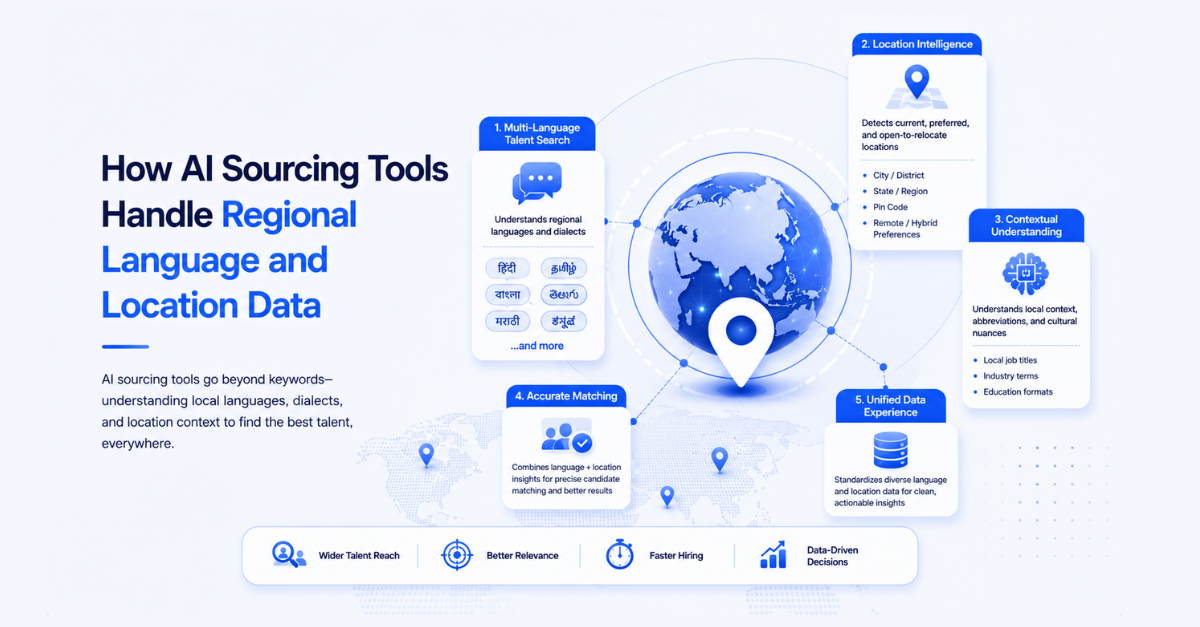
AI sourcing tools use natural language processing (NLP), location intelligence, and machine learning to analyze candidate profiles, resumes, skills, languages, and geographic information. Modern recruiting platforms increasingly rely on regional language understanding and location data to improve candidate matching, hiring efficiency, and recruiter productivity across diverse talent markets.
Recruiting is becoming more geographically distributed than ever before.
Organizations no longer hire from a single city, region, or language group.
A recruiter may source:
Software engineers in Bangalore
Manufacturing talent in Coimbatore
BFSI professionals in Mumbai
GCC candidates in Hyderabad
Sales professionals across Tier-2 cities
In countries like India, recruiting complexity increases further because hiring often spans multiple languages, local labor markets, and regional talent ecosystems.
This creates a challenge that many recruiters underestimate.
Finding candidates is only one part of hiring success.
Recruiters must also understand:
Regional language preferences
Geographic talent clusters
Candidate mobility
Local hiring trends
Communication behavior
While many AI sourcing tools focus heavily on skills matching and candidate discovery, the most effective recruiting systems understand candidate context as well.
In this guide, we'll explore how AI sourcing tools handle regional language and location data, where current technologies perform well, where limitations still exist, and why recruiting execution often matters more than candidate matching alone.
Why Do Language and Location Matter in Recruiting?
Candidate fit is influenced by much more than skills and experience.
Language preferences and location data often play a significant role in recruiting outcomes.
Local Hiring Dynamics
Different regions have unique talent markets.
For example:
Region
Typical Hiring Characteristics
Bangalore
Technology, SaaS, startups
Hyderabad
GCCs, IT services, product engineering
Mumbai
BFSI, consulting, media
Pune
Engineering, manufacturing, IT
Chennai
Automotive, technology, shared services
Coimbatore
Manufacturing, industrial hiring
AI recruiting systems that understand these patterns can improve sourcing accuracy.
Candidate Communication Preferences
Communication styles often vary by region.
Some candidates prefer:
English communication
Regional language outreach
WhatsApp interactions
Email-first communication
Engagement strategies can significantly influence response rates.
Regional Talent Ecosystems
Every hiring market operates differently.
The same sourcing strategy that works in Bangalore may not produce similar results in smaller regional markets.
Understanding local talent ecosystems improves recruiting effectiveness.
How Do AI Sourcing Tools Process Candidate Data?
Modern AI recruiting systems analyze large amounts of candidate information.
Resume Parsing
AI sourcing platforms extract information such as:
Skills
Experience
Education
Certifications
Location
Languages
This process converts unstructured resumes into searchable data.
Skills Extraction
Machine learning models identify relationships between:
Job titles
Technical skills
Industry expertise
Career progression
This allows recruiters to search beyond exact keyword matches.
Location Intelligence
Location data provides context beyond simple city names.
Advanced platforms may analyze:
Candidate proximity
Regional talent density
Hiring market activity
Relocation likelihood
This helps recruiters prioritize relevant candidates more effectively.
Can AI Understand Regional Languages?
To a growing extent, yes.
However, capabilities vary significantly across platforms.
Natural Language Processing (NLP)
Modern NLP systems can process multiple languages and language variants.
This helps AI identify:
Skills
Job titles
Qualifications
Professional terminology
even when candidates use different languages.
Multilingual Candidate Profiles
Candidates increasingly maintain professional information across multiple languages.
Examples include:
English resumes
Hindi profiles
Tamil resumes
Telugu professional summaries
Kannada employment records
Advanced recruiting systems can interpret multilingual information more effectively than traditional keyword search tools.
Current Limitations
Despite significant progress, AI still faces challenges with:
Regional dialects
Informal language usage
Local terminology
Industry-specific abbreviations
Human review remains essential for high-stakes hiring decisions.
How Does AI Use Location Data in Recruitment?
Location intelligence is becoming increasingly important for recruiting accuracy.
Geographic Matching
AI can evaluate:
Candidate location
Job location
Commute feasibility
Relocation preferences
This improves match quality.
Talent Clusters
Certain skills tend to concentrate in specific regions.
Examples include:
Talent Category
Common Talent Clusters
SaaS Engineering
Bangalore
GCC Talent
Hyderabad
Financial Services
Mumbai
Manufacturing
Pune, Chennai, Coimbatore
Consulting
Gurgaon, Mumbai
Location-aware sourcing can improve search relevance.
Candidate Mobility
Not all candidates are equally willing to relocate.
Modern systems increasingly consider:
Remote work preferences
Hybrid flexibility
Relocation history
Geographic constraints
These factors influence recruiting outcomes.
What Challenges Exist in Regional Hiring?
Even with AI assistance, regional hiring remains complex.
Language Diversity
India alone supports dozens of major languages and hundreds of dialects.
Recruiters often engage candidates who prefer:
Hindi
Tamil
Telugu
Kannada
Marathi
Bengali
English
Language preferences can influence candidate engagement and conversion rates.
Local Talent Shortages
Some regions experience concentrated talent demand.
This creates:
Increased competition
Longer hiring timelines
Higher compensation pressure
Communication Barriers
Candidate communication often becomes a larger challenge than candidate discovery.
Many recruiting teams struggle with:
Delayed responses
Missed follow-ups
Scheduling coordination
These issues frequently slow hiring progress.
Why Does Candidate Engagement Matter More Than Matching?
Many recruiting teams assume sourcing is the primary bottleneck.
In reality, candidate engagement often determines hiring success.
Response Rates Matter
Finding a candidate is only valuable if they respond.
Recruiters frequently spend significant time:
Sending outreach
Following up
Re-engaging inactive candidates
Personalized Communication
Candidates increasingly expect relevant and timely communication.
Generic outreach often produces lower response rates.
Follow-Up Automation
Consistent follow-up improves candidate conversion.
Automation can help recruiters maintain engagement without increasing workload.
This is particularly important for:
Staffing agencies
GCC hiring teams
Volume recruitment environments
AI Sourcing vs Recruiting Infrastructure
Many recruiters use these terms interchangeably.
They are not the same.
Candidate Discovery
AI sourcing focuses on:
Search
Matching
Talent identification
This solves the discovery problem.
Candidate Engagement
Recruiting success depends heavily on:
Outreach
Follow-ups
Relationship management
Most sourcing tools provide limited support in these areas.
Workflow Execution
Recruiting operations involve:
Candidate qualification
Scheduling
Coordination
Pipeline progression
This is where recruiting infrastructure creates additional value.
How Does Agentic AI Support Multilingual Recruiting?
Agentic AI extends beyond search and matching.
It focuses on recruiting execution.
Automated Communication
AI agents can assist with:
Candidate outreach
Follow-ups
Communication workflows
across diverse recruiting environments.
Intelligent Qualification
AI can collect information and assess candidate fit before recruiter involvement.
This reduces administrative workload.
Recruiting Workflow Automation
Agentic AI can help automate:
Candidate progression
Scheduling coordination
Communication sequences
Recruiting operations
This becomes increasingly valuable in multilingual and geographically distributed hiring environments.
See How Huntlo Helps Recruiting Teams Engage Candidates Across Diverse Regions and Hiring Markets
Huntlo's Agentic AI Recruiting Infrastructure is designed to help recruiting teams automate sourcing, engagement, qualification, follow-ups, and workflow execution across complex hiring environments.
What Are the Future Trends in Regional AI Recruiting?
Recruiting technology continues evolving rapidly.
Hyper-Local Hiring Intelligence
Future systems will increasingly understand:
Regional hiring patterns
Talent supply trends
Labor market dynamics
This will improve sourcing precision.
Multilingual Candidate Experiences
Candidate engagement will become more localized.
Recruiters will increasingly rely on AI to support communication across diverse languages and hiring markets.
From Search to Execution
The next wave of recruiting innovation is unlikely to focus solely on sourcing.
Instead, platforms will increasingly automate:
Candidate engagement
Qualification
Coordination
Workflow management
The future of recruiting is not simply finding candidates.
It is operating recruiting processes efficiently across diverse geographies, languages, and talent ecosystems.
Conclusion
AI sourcing tools have become increasingly sophisticated at understanding skills, resumes, languages, and geographic data.
However, successful recruiting requires more than candidate matching.
Regional language preferences, location intelligence, workforce mobility, and candidate engagement all influence hiring outcomes.
As recruiting becomes more distributed and multilingual, organizations need technology that understands candidate context—not just candidate keywords.
While sourcing remains important, the greatest opportunity increasingly lies in automating engagement, qualification, and recruiting workflows.
That is why many recruiting teams are moving beyond sourcing software toward Agentic AI Recruiting Infrastructure designed for real-world recruiting complexity.
Frequently Asked Questions
Can AI understand regional languages?
Modern AI systems can process many regional languages using natural language processing (NLP). However, accuracy varies depending on the language, dialect, and platform capabilities.
How does AI use location data in recruiting?
AI uses location information to evaluate candidate proximity, relocation potential, talent market availability, and geographic fit for open positions.
What is multilingual recruiting software?
Multilingual recruiting software helps recruiters source, engage, and manage candidates across multiple languages and geographic regions.
Can AI source candidates across different regions?
Yes. AI sourcing tools can identify candidates across cities, states, and countries while considering location-specific hiring requirements.
How accurate is AI candidate matching?
AI matching can be highly effective when evaluating skills, experience, and location data. However, recruiter oversight remains important for final hiring decisions.