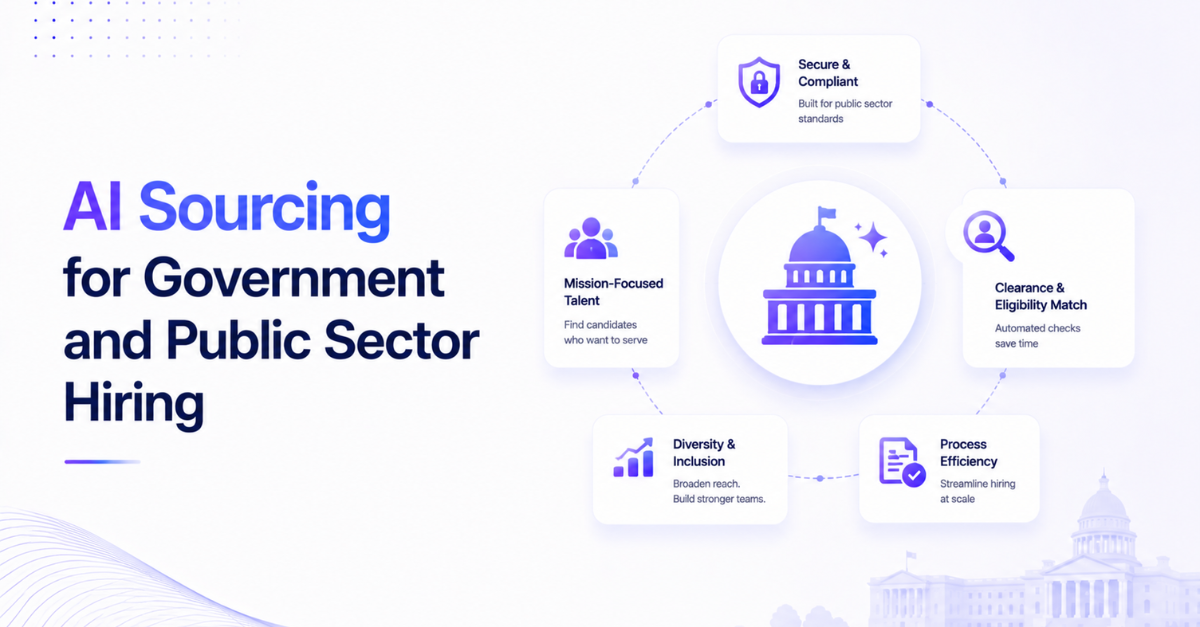
AI sourcing can help government recruiters identify qualified candidates faster, improve workforce planning, and reduce manual search efforts. However, public sector hiring challenges extend far beyond candidate discovery. The greatest opportunities for improvement often come from automating candidate engagement, qualification, interview coordination, and recruiting workflows while maintaining compliance and transparency.
Government hiring is undergoing significant transformation.
Across federal, state, local, and public-sector organizations, recruiting teams face growing pressure to fill critical positions while maintaining fairness, accountability, and regulatory compliance.
Whether hiring for:
Public administration
Healthcare services
Education departments
Infrastructure projects
Law enforcement support roles
Government technology initiatives
Civil service positions
Recruiters often manage complex hiring processes involving multiple stakeholders, extensive documentation, and lengthy approval cycles.
At the same time, workforce shortages and increasing competition for skilled talent have made hiring more challenging than ever.
This has led many public-sector organizations to explore AI sourcing tools, government recruitment software, and recruitment automation technology.
But focusing solely on sourcing may not solve the biggest hiring problems.
Many government agencies already receive large numbers of applications.
The real challenge is efficiently engaging, qualifying, coordinating, and moving candidates through complex hiring processes without overwhelming recruiting teams.
That distinction is becoming increasingly important as governments modernize workforce acquisition strategies.
Why Is Government Hiring Different?
Government recruitment differs significantly from private-sector hiring.
While many hiring goals remain similar, public-sector organizations operate within additional constraints that directly impact recruiting processes.
Compliance Requirements
Government hiring processes must adhere to strict policies and regulations.
These often include:
Equal opportunity hiring practices
Recruitment transparency requirements
Workforce diversity initiatives
Documentation standards
Auditability requirements
Every stage of the recruiting process must be defensible and transparent.
This makes efficiency improvements more complex than simply speeding up hiring.
Large-Scale Hiring Needs
Government agencies frequently recruit for large workforces.
Examples include:
Civil service hiring
Public healthcare recruitment
Education workforce expansion
Infrastructure project staffing
Government technology initiatives
Recruiting teams may need to manage hundreds or thousands of applications for a single hiring campaign.
Public Accountability
Unlike private organizations, government agencies operate under heightened public scrutiny.
Hiring decisions often require extensive documentation and process consistency.
Recruiting technology must support transparency while improving efficiency.
What Are the Biggest Challenges in Public Sector Recruitment?
While candidate sourcing remains important, most public-sector recruiting teams face larger operational challenges.
Long Hiring Timelines
Government hiring processes are often slower than private-sector recruitment.
Common causes include:
Multiple approval layers
Compliance reviews
Documentation requirements
Interview coordination delays
Background verification processes
These factors can significantly extend time-to-hire.
Administrative Workload
Recruiters spend substantial time on repetitive activities such as:
Candidate communication
Application reviews
Interview scheduling
Status updates
Stakeholder coordination
Administrative work often limits recruiter capacity.
Candidate Drop-Offs
Lengthy hiring processes frequently result in candidate attrition.
Candidates may:
Accept alternative opportunities
Lose interest
Stop responding
Withdraw from consideration
Maintaining engagement becomes increasingly important as hiring timelines increase.
See How Public Sector Hiring Teams Automate Candidate Engagement and Recruiting Workflows With Huntlo
Modern workforce acquisition requires more than applicant management. It requires efficient recruiting execution.
How Does AI Sourcing Help Government Recruiters?
AI sourcing provides several valuable capabilities for public-sector recruitment teams.
Candidate Discovery
AI sourcing tools help recruiters identify potential candidates based on:
Skills
Experience
Certifications
Education
Location
Industry background
This reduces manual search effort and accelerates talent identification.
Talent Pipeline Development
Government agencies often hire continuously for recurring roles.
AI sourcing platforms can help recruiters build and maintain talent pipelines for future workforce needs.
Workforce Planning Support
Many sourcing platforms provide labor market insights that support workforce planning initiatives.
Recruiters can better understand:
Talent availability
Geographic talent distribution
Skill supply trends
Competitive hiring conditions
AI Sourcing Capability
Benefit for Government Recruiters
Candidate Discovery
Faster talent identification
Talent Matching
Improved candidate relevance
Workforce Planning
Better hiring forecasts
Talent Pipeline Development
Improved future readiness
Search Automation
Reduced manual effort
These benefits improve recruiting productivity.
However, sourcing addresses only one stage of the hiring process.
Where AI Sourcing Alone Falls Short
Many government hiring challenges occur after candidates have already been identified.
Candidate Engagement
Government candidates often experience long waiting periods during hiring processes.
Maintaining communication requires:
Status updates
Follow-ups
Interview reminders
Process guidance
Most sourcing tools provide limited support for these activities.
Qualification Workflows
Recruiters must verify:
Eligibility requirements
Qualifications
Certifications
Experience criteria
These processes remain highly manual in many organizations.
Interview Coordination
Government hiring often involves multiple reviewers and approval stakeholders.
Scheduling interviews can become operationally complex.
Recruiting Activity
AI Sourcing Impact
Candidate Discovery
High
Talent Matching
High
Candidate Engagement
Limited
Qualification Workflows
Limited
Interview Coordination
Limited
Recruiting Operations
Limited
This explains why sourcing improvements alone rarely transform hiring outcomes.
What Are the Real Bottlenecks in Government Hiring?
Most public-sector hiring delays are operational rather than sourcing-related.
Communication Delays
Candidates often wait extended periods between recruitment stages.
Without consistent communication:
Engagement decreases
Response rates decline
Candidate drop-offs increase
Manual Recruiting Processes
Many recruiting activities remain manual.
Examples include:
Follow-ups
Scheduling
Qualification checks
Status tracking
These activities consume substantial recruiter time.
Workflow Inefficiencies
Recruiting teams frequently struggle with process coordination.
Delays accumulate across:
Candidate reviews
Stakeholder approvals
Interview scheduling
Candidate communication
These inefficiencies often have a greater impact on hiring timelines than candidate availability.
Discover How Huntlo Helps Reduce Administrative Workload While Improving Candidate Communication and Hiring Efficiency
Operational efficiency often determines hiring success more than sourcing volume.
AI Sourcing vs Recruiting Automation
Understanding the distinction between sourcing and automation is critical.
Finding Candidates
AI sourcing focuses on:
Candidate discovery
Talent matching
Pipeline development
Workforce intelligence
Managing Candidates Through the Process
Recruiting automation focuses on:
Candidate engagement
Qualification
Follow-ups
Scheduling
Workflow execution
Capability
AI Sourcing Tools
Recruiting Automation
Candidate Discovery
Yes
Limited
Talent Matching
Yes
Limited
Candidate Engagement
Limited
Yes
Candidate Qualification
Limited
Yes
Follow-Up Automation
Limited
Yes
Scheduling Automation
Limited
Yes
Recruiting Workflow Automation
No
Yes
Recruiting Operations Automation
No
Yes
This distinction is becoming increasingly important as government hiring teams seek measurable efficiency gains.
How Agentic AI Improves Public Sector Recruitment
The next phase of recruiting technology extends beyond sourcing.
Agentic AI systems are designed to execute recruiting workflows rather than simply assist recruiters.
Automated Candidate Engagement
AI agents can manage candidate communication consistently throughout the hiring process.
This helps improve:
Response rates
Candidate experience
Process transparency
Automated Qualification
AI can assist with collecting and validating candidate information before recruiter involvement.
This reduces administrative burden while supporting qualification workflows.
Workflow Execution
Agentic AI can automate repetitive recruiting tasks such as:
Follow-ups
Status updates
Scheduling coordination
Process tracking
This enables recruiters to focus on strategic hiring activities rather than administrative work.
Learn How Agentic AI Recruiting Infrastructure Supports Workforce Acquisition Without Increasing Recruiter Workload
The future of recruiting efficiency lies in workflow execution, not just candidate discovery.
What Should Government Recruiters Automate First?
Recruiters often achieve the highest ROI by automating operational bottlenecks before expanding sourcing efforts.
Candidate Communication
Automated communication helps maintain engagement throughout lengthy hiring processes.
Scheduling
Interview coordination is highly repetitive and well-suited for automation.
Follow-Ups
Automated reminders help reduce candidate drop-offs and improve responsiveness.
Recruiting Operations
Workflow automation improves process consistency and recruiter productivity.
Recommended Automation Priorities
Candidate Communication
Interview Scheduling
Follow-Up Management
Candidate Qualification
Recruiting Workflow Management
These areas typically generate the fastest efficiency gains.
The Future of Public Sector Hiring
Government recruitment is evolving.
From Sourcing Software to Recruiting Infrastructure
Historically, recruiting technology focused on helping recruiters find candidates.
Today, candidate discovery is only part of the hiring challenge.
Modern public-sector organizations increasingly need systems capable of:
Engaging candidates
Qualifying applicants
Coordinating interviews
Managing recruiting workflows
Supporting workforce acquisition operations
This shift is driving demand for Agentic AI Recruiting Infrastructure.
Rather than simply generating candidate lists, these systems help agencies move candidates through hiring processes efficiently and consistently.
For government organizations facing workforce shortages, administrative burdens, and increasing hiring demands, recruiting infrastructure may become far more valuable than sourcing alone.
Final Verdict
AI sourcing can significantly improve government hiring.
It helps recruiters identify talent faster, develop workforce pipelines, and support workforce planning initiatives.
However, sourcing alone does not solve the most significant challenges in public-sector recruitment.
Most government recruiters struggle with:
Candidate engagement
Qualification workflows
Scheduling coordination
Follow-up management
Recruiting operations
The future of government hiring is not simply better sourcing.
It is combining candidate discovery with recruiting automation.
AI sourcing helps agencies find candidates.
Agentic AI Recruiting Infrastructure helps agencies hire candidates.
That distinction is becoming increasingly important as governments modernize workforce acquisition and recruiting operations.
Frequently Asked Questions
Can government agencies use AI for recruiting?
Yes. Many government agencies are exploring AI for candidate sourcing, communication, qualification workflows, and recruiting operations while maintaining compliance and transparency requirements.
Is AI compliant for public sector hiring?
AI can support compliant hiring processes when implemented responsibly. Organizations should ensure transparency, auditability, fairness, and adherence to applicable regulations.
How does AI improve government recruitment?
AI helps reduce manual work, improve candidate engagement, automate repetitive recruiting activities, and increase recruiter productivity.
Can AI automate candidate screening?
AI can assist with qualification workflows, eligibility verification, and information collection. Final hiring decisions should remain subject to organizational policies and human oversight.
What recruiting tasks can AI automate?
AI can automate sourcing, candidate engagement, follow-ups, scheduling, qualification workflows, and recruiting operations.