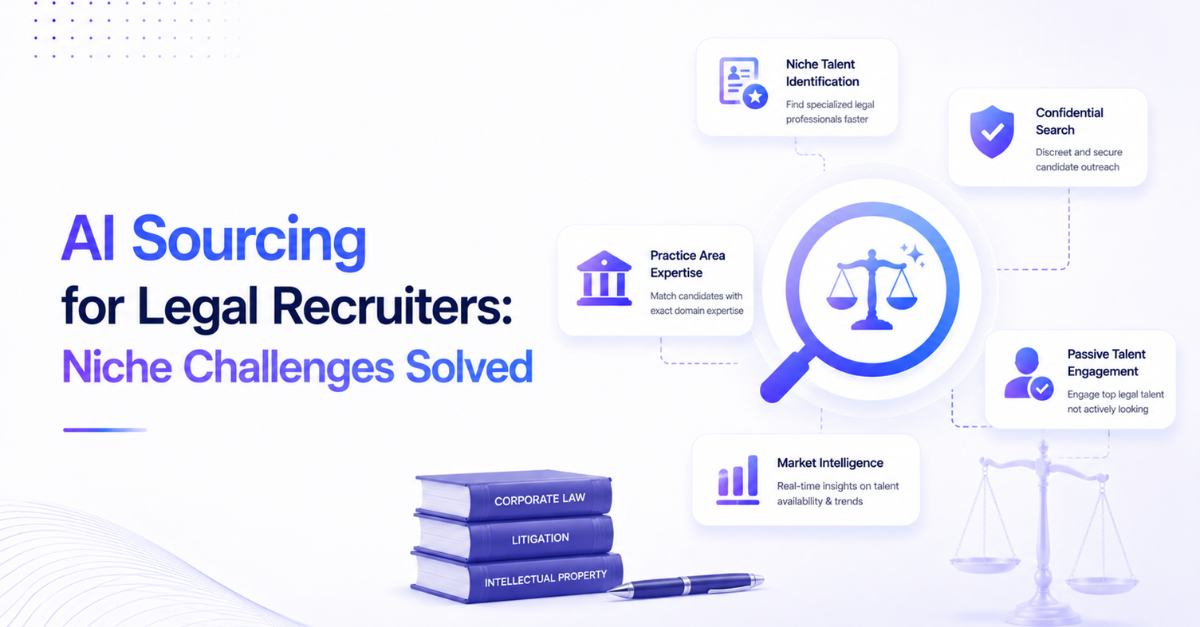
AI sourcing can help legal recruiters identify attorneys faster, map specialized talent pools, and reduce manual candidate search efforts. However, the biggest challenge in legal recruitment is rarely finding attorneys. The real challenge is engaging, qualifying, and moving highly specialized legal talent through complex hiring processes efficiently.
Legal recruitment is one of the most specialized segments within talent acquisition.
Unlike general hiring, legal recruiters must evaluate candidates based on multiple dimensions, including:
Practice areas
Law firm experience
Bar admissions
Court experience
Industry expertise
Geographic licensing requirements
Partner-level networks
Client portfolios
Whether recruiting for a law firm, legal staffing agency, corporate legal department, or global capability center (GCC), finding the right legal professional requires precision.
Because of these complexities, legal recruiters are increasingly exploring AI recruiting tools, attorney sourcing software, and legal recruitment technology.
But many organizations approach the problem from the wrong angle.
They assume the hardest part of legal hiring is finding qualified attorneys.
In reality, most experienced legal recruiters already know where talent exists.
The bigger challenge is consistently engaging candidates, managing follow-ups, coordinating interviews, and maintaining momentum throughout long hiring cycles.
This is where AI sourcing and recruiting automation begin to play different roles.
Why Is Legal Recruitment Different?
Legal hiring operates under unique constraints that make it fundamentally different from many other recruiting functions.
Specialized Candidate Requirements
Legal recruiters are often searching for highly specific combinations of qualifications.
For example:
Corporate attorneys with M&A experience
Intellectual property lawyers with patent litigation expertise
Employment lawyers with multi-jurisdictional experience
Tax attorneys with international structuring backgrounds
Compliance professionals with industry-specific expertise
Finding candidates with these precise qualifications requires targeted sourcing strategies.
Relationship-Driven Hiring
Many legal hires are relationship-based.
Senior attorneys, partners, and in-house counsel are often recruited through trusted networks and long-term professional relationships.
Unlike high-volume recruiting, legal hiring frequently involves extended engagement periods.
Limited Talent Pools
The most qualified legal professionals often belong to small and highly competitive talent pools.
This makes outreach quality and candidate engagement especially important.
The Biggest Challenges Legal Recruiters Face
While sourcing legal talent can be difficult, most recruiters encounter greater challenges after candidates are identified.
Identifying Niche Expertise
Candidate resumes and online profiles don't always reveal the depth of legal specialization.
Recruiters must often evaluate:
Practice area focus
Matter experience
Client exposure
Industry expertise
Regulatory knowledge
This makes qualification highly manual.
Low Attorney Response Rates
Many attorneys receive frequent outreach from recruiters.
As a result:
Response rates can be inconsistent
Outreach fatigue is common
Follow-ups become critical
Simply finding candidates doesn't guarantee engagement.
Long Hiring Cycles
Legal hiring processes often involve:
Multiple interview rounds
Partner evaluations
Conflict checks
Reference checks
Compensation negotiations
These factors can significantly extend hiring timelines.
See How Legal Recruiters Automate Candidate Engagement and Follow-Ups With Huntlo
The most successful legal recruiters focus on candidate conversion, not just candidate discovery.
How AI Sourcing Helps Legal Recruiters
AI sourcing has introduced meaningful improvements to legal recruiting workflows.
Candidate Discovery
AI sourcing platforms help recruiters identify attorneys based on:
Practice areas
Law firm history
Geographic location
Industry specialization
Experience level
This reduces manual search effort.
Practice Area Targeting
Modern AI recruiting tools can surface candidates aligned with highly specialized requirements.
Examples include:
Litigation attorneys
Corporate lawyers
Intellectual property attorneys
Employment lawyers
Compliance professionals
This improves sourcing precision.
Talent Mapping
AI sourcing platforms also support talent mapping initiatives.
Recruiters can analyze legal talent markets and build pipelines for future hiring needs.
AI Sourcing Capability
Benefit for Legal Recruiters
Candidate Discovery
Faster attorney identification
Practice Area Matching
Improved candidate relevance
Talent Mapping
Better pipeline planning
Search Automation
Reduced manual effort
Candidate Recommendations
Increased sourcing efficiency
These capabilities create meaningful productivity gains.
However, sourcing only addresses the beginning of the recruiting process.
Where AI Sourcing Alone Falls Short
Many legal recruiting challenges emerge after candidates enter the pipeline.
Candidate Engagement
Attorneys often require multiple touchpoints before expressing interest.
Recruiters must manage:
Personalized outreach
Relationship building
Candidate nurturing
Follow-up communication
Most sourcing tools provide limited support for these activities.
Screening and Qualification
Every legal candidate must be evaluated carefully.
Recruiters frequently assess:
Practice area expertise
Career progression
Client exposure
Industry experience
Cultural fit
Qualification remains highly manual.
Interview Coordination
Legal hiring often involves multiple stakeholders.
Scheduling interviews across attorneys, partners, hiring managers, and legal leadership can become operationally complex.
Recruiting Activity
AI Sourcing Impact
Candidate Discovery
High
Practice Area Matching
High
Candidate Engagement
Limited
Qualification
Limited
Interview Coordination
Limited
Follow-Up Management
Limited
This is why sourcing alone rarely transforms legal recruiting outcomes.
The Real Bottlenecks in Legal Hiring
The largest obstacles often occur after candidates have already been identified.
Candidate Responsiveness
Many legal professionals are not actively seeking new opportunities.
Recruiters must maintain consistent engagement to keep candidates interested.
Recruiter Workload
Legal recruiters spend significant time on:
Candidate outreach
Follow-ups
Screening
Scheduling
Stakeholder coordination
These activities create operational overhead.
Hiring Process Delays
Extended hiring cycles can lead to:
Candidate drop-offs
Lost opportunities
Reduced conversion rates
Operational efficiency becomes a competitive advantage.
Discover How Huntlo Helps Recruiting Teams Reduce Administrative Workload and Improve Attorney Conversion Rates
The future of legal recruiting depends on execution, not just discovery.
AI Sourcing vs Recruiting Automation
Understanding the distinction is critical.
Finding Legal Talent
AI sourcing focuses on:
Attorney discovery
Candidate matching
Talent mapping
Pipeline generation
Moving Legal Talent Through the Funnel
Recruiting automation focuses on:
Candidate engagement
Qualification
Follow-ups
Scheduling
Workflow execution
Capability
AI Sourcing Tools
Recruiting Automation
Candidate Discovery
Yes
Limited
Talent Matching
Yes
Limited
Candidate Outreach
Partial
Yes
Follow-Up Automation
Limited
Yes
Candidate Qualification
Limited
Yes
Scheduling Automation
Limited
Yes
Workflow Execution
No
Yes
Recruiting Operations Automation
No
Yes
The distinction between discovery and execution is becoming increasingly important for legal recruiting teams.
How Agentic AI Supports Legal Recruitment
The next phase of recruiting technology extends beyond sourcing.
Automated Candidate Engagement
AI agents can manage candidate communication at scale.
This helps maintain engagement while reducing manual workload.
Candidate Qualification
AI can gather preliminary information and support early-stage qualification workflows.
This allows recruiters to focus on deeper evaluation and relationship building.
Follow-Up Automation
Consistent follow-ups are critical in legal recruitment.
Automation ensures candidates receive timely communication throughout the hiring process.
Learn How Agentic AI Recruiting Infrastructure Helps Legal Recruiters Focus on Relationships Instead of Repetitive Tasks
The highest-value recruiter activities should involve strategic conversations—not administrative work.
What Legal Recruiters Should Automate First
Legal recruiters often see the greatest ROI by automating repetitive workflows.
Candidate Outreach
Automated outreach helps maintain consistent communication.
Follow-Ups
Follow-up automation improves response rates and reduces candidate drop-offs.
Scheduling
Scheduling automation eliminates one of the most time-consuming recruiting tasks.
Recruiting Operations
Workflow automation ensures candidates move through hiring processes efficiently.
Recommended Automation Priorities
Candidate Outreach
Follow-Ups
Interview Scheduling
Candidate Qualification
Recruiting Workflow Management
These areas typically generate the fastest productivity improvements.
The Future of Legal Recruiting
Legal recruitment is evolving.
From Sourcing Tools to Recruiting Infrastructure
Historically, recruiting technology focused on helping recruiters find candidates.
Today, candidate discovery is only part of the challenge.
Modern recruiting teams increasingly need systems capable of:
Engaging candidates
Qualifying candidates
Coordinating interviews
Managing recruiting operations
Reducing administrative workload
This shift is driving demand for Agentic AI Recruiting Infrastructure.
Rather than simply identifying legal talent, these systems help recruiters move candidates through the hiring process efficiently.
For law firms, legal staffing agencies, and corporate legal teams, that operational capability may become the most important recruiting advantage over the next decade.
Final Verdict
AI sourcing can significantly improve legal recruitment.
It helps recruiters identify attorneys faster, target specialized practice areas, and build stronger talent pipelines.
However, sourcing alone does not solve the biggest challenges in legal hiring.
Most legal recruiters struggle with:
Candidate engagement
Follow-up management
Qualification workflows
Interview coordination
Recruiting operations
The future of legal recruiting is not simply better search.
It's combining candidate discovery with recruiting automation.
AI sourcing helps recruiters find attorneys.
Agentic AI Recruiting Infrastructure helps recruiters hire attorneys.
That distinction is becoming increasingly important as legal hiring grows more competitive and operationally complex.
Frequently Asked Questions
Can AI recruit attorneys effectively?
Yes. AI can help identify, engage, qualify, and manage attorney candidates throughout the hiring process while improving recruiter productivity.
How do legal recruiters use AI?
Legal recruiters use AI for candidate sourcing, talent mapping, outreach automation, qualification workflows, and recruiting operations.
What is legal recruitment automation?
Legal recruitment automation uses technology to automate repetitive recruiting activities such as engagement, follow-ups, screening, scheduling, and workflow management.
Can AI improve attorney response rates?
Yes. Consistent outreach and automated follow-ups can help improve candidate engagement and response rates.
What recruiting tasks can AI automate?
AI can automate sourcing, candidate engagement, qualification, scheduling, follow-ups, and recruiting workflow management.