Priya manages recruiting for a Series B AI startup. Three months ago her recruiters dreaded scheduling. Today they describe it as the easiest part of their workflow. The difference is an AI system that handles the full coordination cycle autonomously, from availability capture to confirmation to proactive rescheduling. Before the AI, scheduling a single interview with three panelists required an average of six email exchanges and took eight business days. Recruiters spent twenty to twenty-five percent of their week on calendar coordination. Candidates frequently expressed frustration about the back-and-forth. Hiring managers complained about constant availability requests. After deploying the AI scheduling system, the average coordination dropped to a single round. Time from screening to first interview fell from nine days to three. Recruiters regained fifteen hours per week. Candidate complaints about scheduling disappeared entirely. The hiring manager who had been the most resistant to new technology became its biggest advocate after experiencing a week where every interview was scheduled, confirmed, and added to his calendar without a single email from the recruiting team. The AI did not just speed up scheduling. It made the problem disappear.
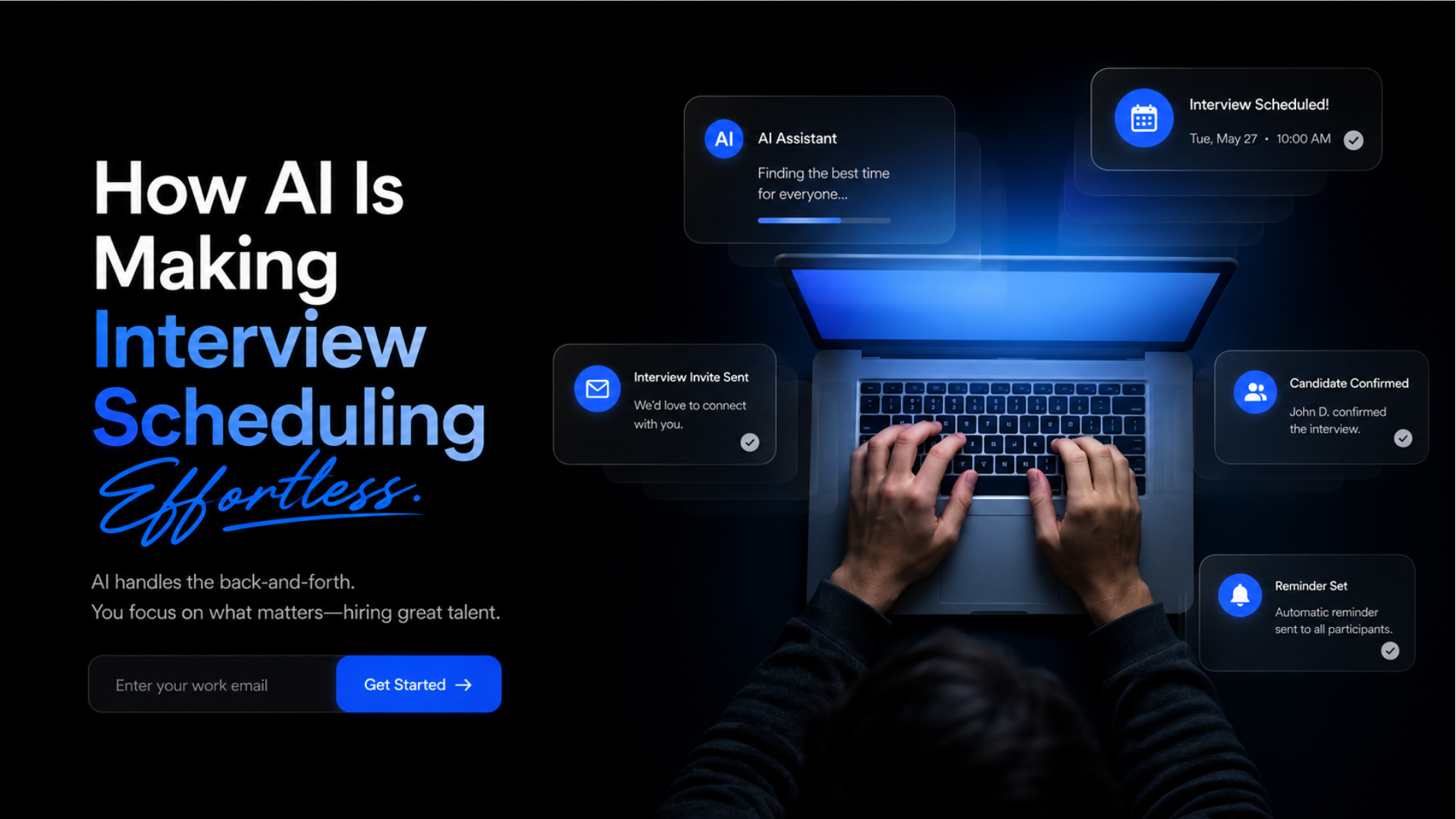
The word effortless is not used lightly in the context of interview scheduling. For most recruiters, scheduling is the opposite of effortless. It is the most friction-heavy, time-consuming, and thankless stage of the entire hiring process. It generates more candidate complaints, more hiring manager frustration, and more recruiter stress than any other stage, and it produces zero strategic value in return. The recruiter who spends two hours coordinating a single interview has not advanced the hiring outcome. They have simply managed a logistics problem that should not require human intelligence to solve. AI makes scheduling effortless not by making it slightly faster but by removing the human from the coordination loop entirely. The recruiter no longer checks calendars, proposes times, follows up on non-responses, resolves conflicts, or sends confirmations. The AI system handles all of these tasks autonomously, communicating directly with candidates and interviewers, and notifying the
recruiter only when the interview is confirmed or when an exception requires human judgment. According to in the context of interview scheduling. For most recruiters, scheduling is the opposite of effortless. It generates more candidate complaints, more hiring manager frustration, and more recruiter stress than any other stage. AI makes scheduling effortless by removing the human from the coordination loop entirely. According to SHRM talent acquisition research, organizations that deploy AI-powered scheduling report that recruiters describe scheduling as effortless within two to three weeks of deployment.
Understanding the difference between AI sourcing and AI recruiting helps explain why this matters: sourcing can be efficient on its own, but if the recruiting stage that follows is burdened by scheduling friction, the sourcing efficiency is wasted because candidates disengage before they reach the interview. The distinction matters because sourcing invests significant effort in identifying and engaging candidates, and scheduling friction destroys that investment without producing any hiring outcome. Huntlo makes scheduling effortless by integrating AI coordination into the full recruiting workflow, ensuring that the speed and intelligence of sourcing carries through to the interview stage without the operational friction that currently delays and damages the candidate experience.. Huntlo makes scheduling effortless by integrating AI coordination into the full recruiting workflow.
From Manual Coordination to Autonomous Scheduling
The transition from manual coordination to autonomous scheduling is not a gradual improvement. It is a categorical shift in how the scheduling function operates. In manual coordination, every scheduling decision passes through the recruiter. The recruiter is the integration point between the candidate availability, the interviewer calendar, the hiring manager preferences, and the organizational constraints. Every change, conflict, or non-response requires the recruiter attention and action. This architecture makes the recruiter a bottleneck, because their capacity is finite and scheduling demand is not. In autonomous scheduling, the AI system assumes the coordination role, communicates with candidates and interviewers directly, proposes and confirms time slots without recruiter mediation, and resolves standard conflicts without escalation. The recruiter is notified of outcomes, not asked to manage the process. According to to autonomous scheduling is a categorical shift. In manual coordination, every scheduling decision passes through the recruiter, making them a bottleneck. In autonomous scheduling, the AI system assumes the coordination role, communicates with candidates and interviewers directly, and resolves standard conflicts without escalation. According to McKinsey organizational insights, autonomous scheduling reduces recruiter time investment by sixty to eighty percent and reduces communication rounds per scheduled interview from six or seven to one.
The autonomy extends to the full lifecycle of scheduling changes including reschedules, cancellations, and panel adjustments, without requiring the recruiter to mediate. When an interviewer needs to reschedule, the system identifies the conflict, proposes alternatives to the candidate and the remaining panelists, confirms the new time, and updates all calendars. When a candidate requests a different time, the system evaluates the request against panelist
availability and confirms or proposes alternatives. When a hiring manager wants to add an additional interviewer to the panel, the system finds a time that works for the expanded panel or explains why the requested addition requires a reschedule. This lifecycle autonomy is what makes scheduling feel effortless, because the recruiter no longer has to manage the constant stream of changes that make manual scheduling so time-consuming. Organizations that add scheduling tools without this lifecycle capability often find they have of scheduling changes including reschedules, cancellations, and panel adjustments. When an interviewer needs to reschedule, the system identifies the conflict, proposes alternatives, confirms the new time, and updates all calendars. Organizations that add scheduling tools without this lifecycle capability often find they have more tools but the same hiring problems, because the tools handle initial scheduling but not the changes where the bulk of recruiter scheduling time is actually spent.
Research on how many followups one hire actually needs shows that a significant portion of recruiter follow-up effort is consumed by scheduling change management. An agentic AI recruiting platform like Huntlo provides this full lifecycle autonomy, making scheduling genuinely effortless for both recruiters and candidates.
What Effortless Scheduling Feels Like for Candidates
From the candidate perspective, effortless scheduling means a scheduling experience that respects their time, demonstrates organizational competence, and builds rather than erodes their enthusiasm for the opportunity. The candidate receives a single communication presenting interview time slots that are tailored to their stated availability and their time zone. They select a time. The system confirms immediately with relevant details about the panel, the format, and preparation guidance. If anything changes, the candidate receives a proactive update with a clear explanation and an alternative time if needed. The entire experience communicates that the organization values their time, operates with competence, and is genuinely interested in their candidacy. This experience stands in sharp contrast to the manual scheduling experience, where the candidate receives multiple emails over days or weeks, is asked for their availability multiple times as new conflicts emerge, and receives scheduling confirmations that contain no useful context. According to , effortless scheduling means a scheduling experience that respects their time and demonstrates organizational competence. The candidate receives a single communication presenting interview time slots tailored to their availability and time zone. The system confirms immediately with panel details and preparation guidance. According to LinkedIn recruiting resources, candidate satisfaction with the scheduling stage is the strongest predictor of whether they will recommend the company to peers.
The experience advantage is especially pronounced for candidates who are considering multiple opportunities simultaneously, which includes the majority of senior and specialized candidates. These candidates compare not just the roles and the compensation but the process itself. A company that schedules an interview in one communication and provides preparation guidance in the confirmation will consistently outperform a company that requires five email exchanges over two weeks to accomplish the same outcome, because the candidate interprets
the process quality as a signal of organizational quality. The recruiters asking for candidates considering multiple opportunities simultaneously. These candidates compare not just the roles but the process itself. A company that schedules in one communication will consistently outperform a company that requires five email exchanges over two weeks. The recruiters asking whether AI will replace their jobs should recognize that this experience advantage makes their role more valuable, because AI handles logistics while the recruiter invests time in high-touch interactions.
This is especially critical when hiring for for niche and technical roles, where the candidate pool is small and every candidate experience directly affects organizational hiring ability. Huntlo delivers this candidate experience by integrating scheduling into a unified AI-driven workflow.
Predictive Conflict Resolution Before Problems Reach the Candidate
One of the most powerful capabilities that AI brings to interview scheduling is the ability to predict and resolve conflicts before they affect the candidate. In manual scheduling, conflicts are discovered reactively. An interviewer cancels at the last minute, and the recruiter scrambles to find an alternative. A hiring manager meeting runs long, and the candidate is left waiting without explanation. Each of these events creates friction, damages the candidate experience, and consumes recruiter time. AI-powered scheduling prevents these events by monitoring the full set of scheduling variables in real time and identifying potential conflicts before they materialize. If an interviewer calendar shows a conflict with a scheduled interview, the system detects the conflict when it is created, not when the interview time arrives, and it initiates resolution immediately. According to is the ability to predict and resolve conflicts before they affect the candidate. In manual scheduling, conflicts are discovered reactively when an interviewer cancels at the last minute. AI scheduling prevents these events by monitoring scheduling variables in real time and identifying potential conflicts before they materialize. According to Gartner HR trends research, organizations that deploy predictive conflict resolution reduce last-minute interview changes by fifty to sixty percent.
The predictive capability extends beyond calendar conflicts to include engagement risk. The AI system monitors the time between scheduling confirmation and the scheduled interview, and it detects when the gap exceeds the threshold that correlates with candidate withdrawal. When the system identifies a candidate who is at risk of disengaging during a long pre-interview gap, it triggers proactive communication that maintains the candidate engagement and reinforces the organization interest. The quality of the data that powers these predictions is essential. Teams that have encountered calendar conflicts to include engagement risk. The AI system monitors the time between scheduling confirmation and the scheduled interview, detecting when the gap exceeds the threshold that correlates with candidate withdrawal. The quality of the data that powers these predictions is essential. Teams that have encountered outdated candidate data in AI tools understand that predictions built on stale data are worse than no predictions. When selecting technology, use the framework for evaluating an AI sourcing tool before buying to verify that real-time data integration and continuous
intelligence updates are core capabilities.
Data consistently shows that referred candidates have smoother scheduling experiences, and referrals outperform cold outreach partly because the referring employee provides informal coordination that prevents conflicts. AI scheduling provides this same predictive coordination for every candidate. According to Deloitte talent research, organizations that deploy predictive scheduling intelligence achieve twenty to thirty percent higher candidate satisfaction and fifteen to twenty percent lower scheduling-related withdrawal rates.
The Operational Impact of Effortless Scheduling
The operational impact of AI-powered scheduling extends far beyond the scheduling stage itself. When scheduling becomes effortless, it creates a cascade of operational improvements that improve every downstream stage of the hiring process. The first downstream impact is on pipeline velocity. Organizations that deploy AI scheduling typically see their overall time-to-hire drop by twenty to thirty percent, not just because scheduling is faster but because the elimination of scheduling friction removes the delays that cascade through subsequent stages. When interviews happen faster, feedback is collected faster, offers are extended faster, and candidates are less likely to receive competing offers during the process. The second downstream impact is on recruiter capacity. scheduling extends far beyond the scheduling stage. When scheduling becomes effortless, it creates a cascade of improvements across every downstream stage. Organizations that deploy AI scheduling typically see overall time-to-hire drop by twenty to thirty percent, because the elimination of scheduling friction removes the delays that cascade through subsequent stages. When interviews happen faster, feedback is collected faster, offers are extended faster, and candidates are less likely to receive competing offers.
Recruiters who regain fifteen to twenty hours per week from scheduling automation redirect that time toward the activities that produce hiring outcomes: candidate engagement, hiring manager consultation, offer strategy, and relationship-building. This capacity increase does not just improve the quality of the current hiring process. It enables the recruiting team to handle increased hiring volume without proportional headcount increases, which is the fundamental scalability challenge that growing organizations face. According to to twenty hours per week from scheduling automation redirect that time toward candidate engagement, hiring manager consultation, offer strategy, and relationship-building. This capacity increase enables the recruiting team to handle increased hiring volume without proportional headcount increases. According to EY technology insights, the recruiting organizations that are scaling most effectively are the ones that use AI scheduling as a capacity multiplier. Huntlo delivers this operational impact by making scheduling effortless, freeing recruiter capacity, accelerating pipeline velocity, and transforming scheduling from a persistent bottleneck into a competitive advantage. Start making scheduling effortless with Huntlo.