Elena had three candidates in final-stage conversations for a senior engineering role. All three had passed the technical screen, met the hiring manager, and expressed genuine interest. Over the following two weeks, one candidate stopped responding after a five-day gap in communication. Another accepted an offer from a competitor who had maintained daily contact throughout their process. The third accepted Elena's offer but only after she personally intervened with three calls in two days to rekindle an engagement that had been fading for a week. She closed one of three, and it required extraordinary effort that she could not sustain across her other open roles. Elena did not lose those positions because the offers were bad or the candidates were uncommitted. She lost them because the follow-up between the interview and the close was inconsistent, generic, and too slow. The closing conversation went fine. The follow-up system that should have kept the candidates engaged until the closing conversation did not exist.
The conventional view of closing in recruiting focuses on the offer stage: compensation negotiation, benefits presentation, and the final persuasion that converts a candidate into a hired employee. This view is incomplete. Closing is not a single stage. It is the cumulative result of every interaction from the first message to the start date, and the follow-ups that occur between the major milestones are where most positions are actually won or lost. A candidate who receives fast, personalized, and relevant follow-ups throughout the process arrives at the offer stage already convinced, already trusting the recruiter, and already inclined to accept. A candidate who has been left waiting, received generic messages, and experienced inconsistent communication arrives at the offer stage skeptical, uncertain, and comparing your opportunity against others that treated them better. The difference in offer acceptance rates between these two types of candidates is not marginal. It is enormous, and it is driven almost entirely by the quality of follow-up that preceded the offer. According to SHRM's talent acquisition
research, the quality of pre-offer engagement accounts for more variance in offer acceptance than compensation, role scope, or employer brand, making it the single most powerful lever a recruiter has for improving close rates.
Closing Starts Long Before the Offer
The most effective closers in recruiting are not the recruiters who are best at negotiation. They are the recruiters who have maintained the strongest candidate engagement throughout the entire process, so that by the time the offer conversation begins, the candidate is already psychologically committed. This commitment is built through a series of small, consistent follow-up interactions that demonstrate the recruiter's attentiveness, the organization's professionalism, and the opportunity's relevance to the candidate's specific career goals. Each follow-up that references a prior conversation, provides new and relevant information, or proactively addresses a concern the candidate raised adds a brick to the foundation of trust that the offer will rest on. Each follow-up that is late, generic, or ignores the candidate's expressed priorities removes a brick. The recruiters who understand this dynamic treat every follow-up as a closing activity, not just the messages that happen after the interview feedback comes in. The first follow-up after initial contact is a closing activity, because it determines whether the candidate engages at all. The follow-up after the screening call is a closing activity, because it determines whether the candidate invests in interview preparation. The follow-up between interviews is a closing activity, because it determines whether the candidate maintains momentum or starts exploring alternatives.
This reframing of follow-up as a closing activity rather than an operational necessity changes how recruiters approach every stage of the process. When follow-up is treated as an operational task, it gets delegated to whatever time is available after higher-priority activities, which means it gets delayed, shortened, and generic. When follow-up is treated as a closing activity, it gets protected time, full attention, and the same quality standard that the recruiter would apply to an offer negotiation. The practical challenge is that treating every follow-up as a closing activity requires more time and attention than manual processes can support across a full candidate pipeline. This is exactly the gap that AI-powered follow-up systems fill. An agentic AI recruiting platform can generate personalized, context-aware follow-up recommendations for every candidate at every stage, enabling the recruiter to deliver closing-quality communication throughout the process rather than only at the end. The recruiters who understand the difference between AI sourcing and AI recruiting see this clearly. Sourcing fills the pipeline. AI-powered follow-up closes it, by maintaining the engagement that converts pipeline candidates into hired employees. According to McKinsey's organizational insights organizations that invest in follow-up quality at every stage see thirty to forty-five percent higher close rates than those that invest primarily in the offer stage, because the foundation of trust and engagement that drives acceptance has been built over weeks rather than attempted in days.
The Follow-Up Gaps That Cost You Hires
Every hiring process has follow-up gaps, the periods between interactions where the candidate is not receiving any communication from the recruiter. These gaps are not empty space. They are active risk periods where candidate engagement decays, competing opportunities gain ground, and the candidate's initial enthusiasm converts into doubt or indifference. The most damaging gaps occur at three specific points in the hiring process. The first is between the initial response and the screening call, where a delay of more than forty-eight hours can reduce the probability of a successful call by fifty percent or more. The second is between the screening call and the first interview, where the candidate has invested time but has not yet experienced the role or team firsthand, making them especially vulnerable to competing opportunities that offer faster progress. The third is between the final interview and the offer, where the candidate is making their most important evaluation of the opportunity and any silence or uncertainty from the recruiter amplifies existing concerns and creates new ones. These three gaps are where the majority of hiring failures occur, and they are all entirely within the recruiter's control to address through timely, relevant follow-up.
The reason these gaps persist despite their obvious cost is structural. The recruiter's workload is distributed across multiple candidates at multiple stages, and the operational demands of scheduling, feedback collection, and hiring manager coordination consume the time that should be spent on candidate follow-up. The result is that follow-up happens when the recruiter has time rather than when the candidate needs it, creating gaps that are measured in days rather than hours. For teams competing for niche and technical roles, these gaps are particularly costly because the candidate pool is small, competition is intense, and the candidates have multiple options moving in parallel. Understanding how many followups one hire actually needs is useful, but the timing of each follow-up matters more than the count. A well-timed follow-up that arrives during the candidate's peak engagement window preserves momentum. The same follow-up arriving three days late, after the window has closed, may have no effect at all. The teams that simply add more tools without restructuring their follow-up timing often discover they have more tools but the same hiring problems, a pattern explored in the analysis of organizations with more tools but the same hiring problems. Closing more positions requires not more follow-ups but follow-ups that arrive at the right moment, and that requires a fundamentally different approach to how follow-up timing is determined and executed.
How AI Follow-Ups Maintain Engagement at Every Stage
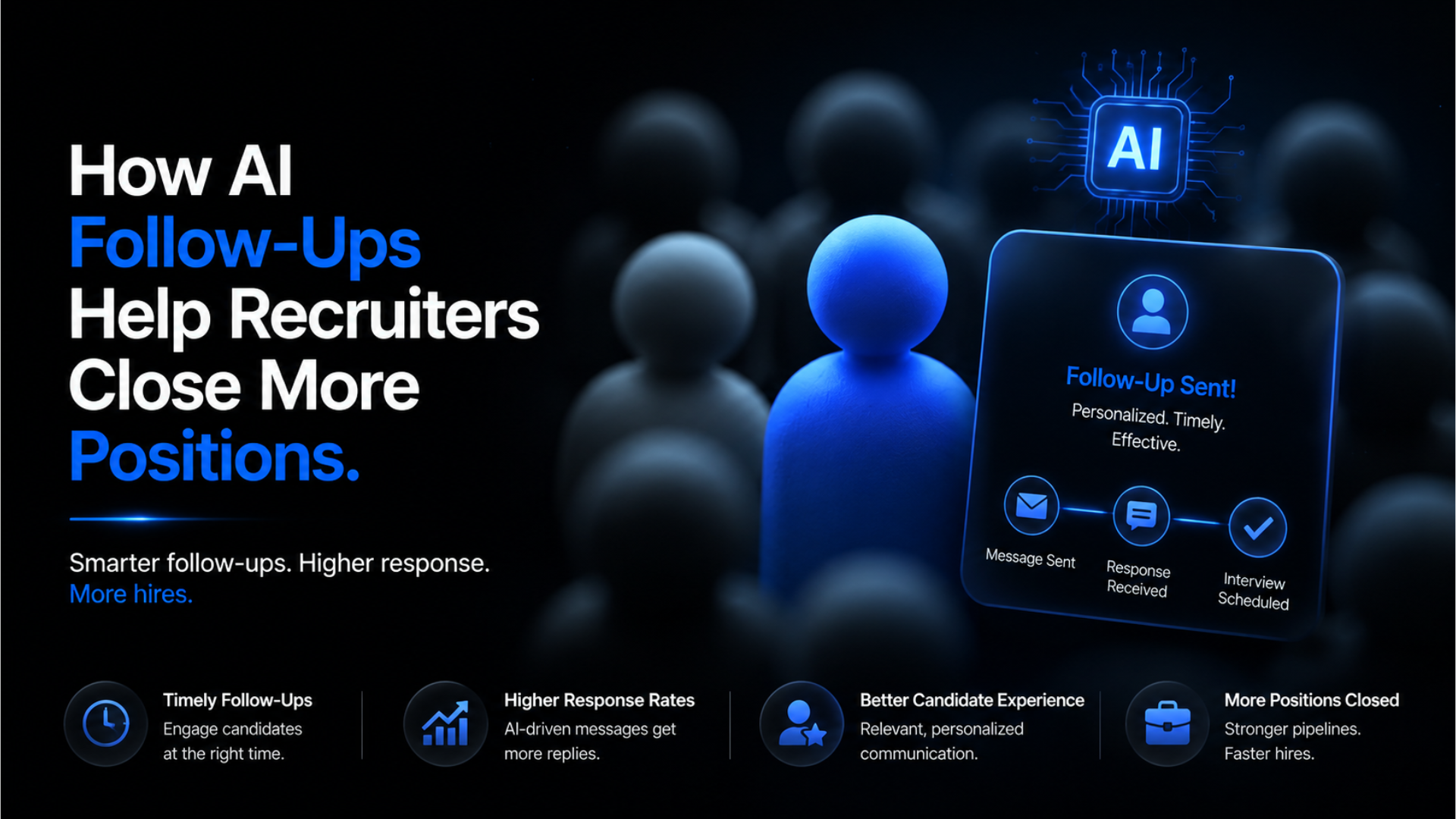
AI-powered follow-up systems maintain engagement through three capabilities that manual processes cannot deliver consistently across a full candidate pipeline. The first capability is signal-based timing. The AI monitors each candidate's engagement signals, email open patterns, response times, platform activity, and application behavior, and uses these signals to determine the optimal moment for each follow-up. This is fundamentally different from
schedule-based follow-up, where messages are sent on predetermined intervals regardless of candidate behavior. Signal-based timing ensures that the follow-up arrives when the candidate is most receptive, maximizing the probability of a response and the quality of the engagement that follows. A candidate who has just opened a previous email and visited the company careers page is signaling high receptivity, and the AI will recommend an immediate follow-up. A candidate who has not engaged with any communication for several days is signaling declining interest, and the AI will recommend a high-value re-engagement touchpoint rather than a routine check-in.
The second capability is contextual personalization. The AI maintains a detailed profile of every candidate's interactions, including the topics they have discussed, the concerns they have raised, the information they have requested, and the career priorities they have expressed. When generating a follow-up recommendation, the AI draws on this profile to create a message that references specific prior conversations and provides information relevant to the candidate's individual situation. This level of personalization is what makes referred candidates so much easier to close, because the referring employee provides the context that enables personalized communication. AI-powered follow-up aims to give every candidate the referral experience. This is why referrals outperform cold outreach so dramatically and why AI personalization is the key to closing candidates who come through cold channels at similar rates. The third capability is adaptive cadence. Rather than applying a fixed follow-up schedule to every candidate, the AI adjusts the frequency, channel, and content of follow-ups based on the candidate's individual engagement trajectory. A highly engaged candidate may receive fewer but more substantive touchpoints. A candidate showing signs of disengagement may receive more frequent, lower-friction touchpoints designed to maintain connection without creating pressure. According to LinkedIn's recruiting resources AI-powered follow-up systems that combine all three capabilities are achieving fifty to sixty percent improvements in stage-to-stage conversion rates, because the follow-ups are consistently arriving at the right time, with the right content, for each individual candidate.
From Pipeline to Offer: The AI Follow-Up Advantage
The cumulative impact of AI-powered follow-up across the entire hiring process is a pipeline that converts at a significantly higher rate than one managed with manual follow-up alone. Consider the mathematical effect. If each stage of the hiring process has a seventy-five percent conversion rate with manual follow-up, a twenty-five percent improvement from AI-powered follow-up at each stage compounds dramatically. A five-stage process with seventy-five percent conversion at each stage converts approximately twenty-four percent of initial candidates to offer. A five-stage process with ninety-four percent conversion at each stage, a twenty-five percent relative improvement, converts approximately seventy-three percent of initial candidates to offer. The same candidates, the same roles, the same compensation, but three times more candidates reaching the offer stage because the follow-up system maintained their engagement at every transition point instead of losing them in the gaps. This compounding effect is why AI-powered follow-up has such a dramatic impact on close rates.
It is not that any single follow-up is transformative. It is that every follow-up is measurably better than the manual alternative, and those small improvements compound across the entire funnel.
The organizations seeing the greatest impact from AI follow-up on close rates are those that have integrated the technology across the entire candidate journey rather than deploying it at a single stage. Deploying AI follow-up only at the post-interview stage, for example, misses the opportunity to maintain engagement during the earlier stages where the foundation of trust is built. Similarly, deploying AI follow-up only for outbound sourcing misses the opportunity to maintain engagement with candidates who have already expressed interest and are moving through the pipeline. Full-journey integration ensures that every candidate, regardless of how they entered the pipeline or where they are in the process, receives consistent, intelligent follow-up. The recruiters who ask whether AI will replace their jobs should note that the AI's role in this full-journey model is to ensure that the recruiter's engagement quality does not degrade at any point in the process, not to replace the recruiter's judgment or relationship skills. The AI handles the timing, research, and drafting. The recruiter handles the strategic personalization, concern resolution, and relationship management that no AI can replicate. However, all of this depends on having accurate, current candidate data. Teams that have struggled with outdated candidate data in AI tools know that even the most sophisticated AI follow-up system will produce suboptimal results if it is operating on stale information. When evaluating platforms, use the framework for evaluating an AI sourcing tool before buying to ensure data freshness and signal detection are core capabilities.
Real Results: What the AI Follow-Up Data Shows
The data on AI-powered follow-up and closing outcomes is now substantial enough to draw firm conclusions about its impact. Organizations that have deployed intelligent follow-up systems are reporting consistent improvements across every closing metric. Offer acceptance rates increase by fifteen to thirty percent, because candidates who have received consistent, personalized communication throughout the process are significantly more likely to accept when the offer arrives. Time to fill decreases by twenty to thirty-five percent, because faster follow-up eliminates the gaps that extend the hiring timeline and cause candidates to explore alternatives. Candidate dropout rates between stages decrease by forty to sixty percent, because the engagement that AI-powered follow-up maintains prevents the disengagement that leads to ghosting. And perhaps most significantly, the quality of hire improves, because the candidates who complete the process are those who were most genuinely engaged with the opportunity rather than those who simply endured the process longest. These are not marginal improvements. They represent a fundamental shift in what recruiting teams can achieve when they eliminate the follow-up gaps that have historically limited their closing effectiveness. According to Gartner's HR trends research the organizations achieving the highest closing rates are not those with the most aggressive offer strategies or the largest compensation budgets. They are the ones that have the most consistent, intelligent, and personalized follow-up systems sustaining candidate engagement from first contact to offer acceptance.
The compounding nature of these improvements is particularly noteworthy. Teams that close positions faster have more recruiter capacity available for the next round of hiring, creating a positive feedback loop that accelerates the entire talent acquisition function. Teams that close positions with higher acceptance rates spend less time on re-sourcing and more time on building relationships with the next cohort of candidates. Teams that reduce candidate dropout free up resources that can be reinvested in sourcing quality rather than sourcing quantity. These compounding benefits mean that the ROI of AI-powered follow-up extends far beyond the individual hires it directly influences, improving the performance of the entire recruiting operation. EY's technology insights report that enterprises with mature AI follow-up systems are achieving twenty to thirty percent lower cost per hire in addition to higher close rates, because the efficiency gains from faster closing compound across the entire recruiting operation. Deloitte's talent research concludes that AI-powered follow-up is no longer an experimental capability. It is a proven, high-ROI investment that directly addresses the most costly failure point in recruiting, the gap between a qualified candidate and a closed hire, and that the organizations adopting it earliest are building a closing advantage that will be very difficult for slower-moving competitors to overcome.
Every position you fail to close represents wasted sourcing effort, wasted recruiter time, wasted hiring manager energy, and weeks of additional time to fill while the role sits empty and the team stretches to cover the gap. Most of these failures are not caused by bad offers, weak candidates, or competitive compensation. They are caused by follow-up gaps that erode candidate engagement at the exact moments when engagement matters most. AI-powered follow-up eliminates these gaps by maintaining personalized, timely, and relevant communication at every stage of the hiring process, ensuring that every candidate who enters your pipeline receives the consistent engagement they need to stay connected, informed, and motivated from first contact to offer acceptance. The result is more closed positions, faster time to fill, and a recruiting operation that converts pipeline candidates into hired employees at rates that manual follow-up cannot match. Huntlo.ai provides the intelligence layer that makes this possible, from signal-based timing and contextual personalization to adaptive cadence and full-journey engagement coverage. Stop losing positions to follow-up gaps. Close them with intelligence. Close them with Huntlo.