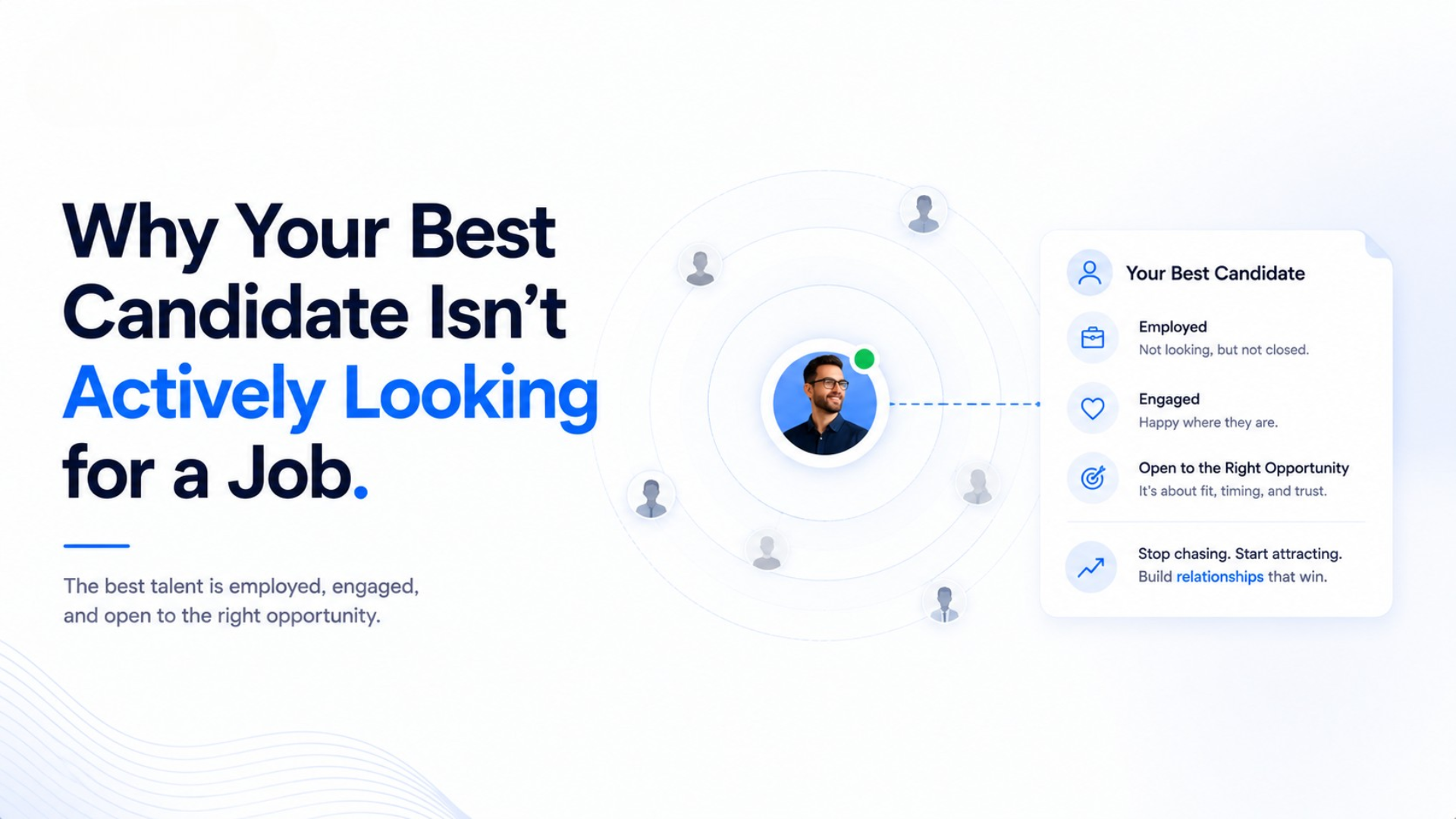
Consider the last five hires your team made. Think carefully about which of those hires turned out to be the strongest performers after twelve months. Now ask yourself: how many of those top performers were actively looking for a job when you found them? For most recruiting teams, the answer is one or none. The best hires, the ones who elevate team performance, who ship faster, who mentor others, and who stay the longest, almost always come from the passive candidate pool. They were not browsing job boards. They were not responding to LinkedIn InMails from strangers. They were doing their jobs well at another company until a recruiter who had already built a relationship with them presented an opportunity that was genuinely better than what they had. The disconnect is staggering: the candidates most likely to transform your team are the ones least likely to be found through conventional search. And yet most recruiting teams spend eighty percent or more of their sourcing time fishing exclusively in the active candidate pool, a pool that every other recruiter is also fishing in, chasing the same limited set of responsive applicants.
According to research from LinkedIn's talent solutions team, approximately seventy to eighty-five percent of the global workforce is classified as passive, meaning they are not actively applying for jobs but would consider the right opportunity. These professionals are not unavailable. They are simply not looking, which is a fundamentally different thing. They are doing excellent work, advancing in their careers, and building expertise. They are precisely
the kind of people you want on your team. The passive candidate recruiting challenge is not that these candidates are unreachable. The challenge is that reaching them requires a completely different approach than the one most recruiters use for active applicants. A passive candidate does not respond to a generic job description sent by a stranger. They respond to a personalized, relevant, and credible message from someone who has taken the time to understand their career, their skills, and their motivations. The passive vs active candidates distinction is not academic. It is the single most important variable in determining the quality of your hiring pipeline.
The Active Candidate Pool Is a Crowded, Low-Yield Market
Active candidates, the people who are currently applying to jobs, browsing job boards, and responding to recruiter outreach, represent a small fraction of the total talent market. And within that small fraction, the quality distribution is heavily skewed toward the lower end. This is not a criticism of active candidates as people. It is a structural reality of how job searching works. The professionals who are most in demand, who are performing at the highest level, who are well-compensated and well-treated by their current employers, have the least incentive to be actively searching. They are not on job boards because they do not need to be. They are not responding to cold InMails because their inbox is full of them and they have learned to ignore the generic ones. According to SHRM's talent acquisition research, the average corporate job posting receives two hundred and fifty applications, but only twelve percent of those applicants meet the basic qualifications for the role. The recruiter then screens those applicants, finds maybe four to six worth interviewing, and ultimately hires one. The hidden talent pool of passive professionals who would be excellent fits but never applied is invisible to this entire process.
The active candidate pool is also the most competitive market in recruiting. Every recruiter with the same role open is pursuing the same active candidates. The same LinkedIn searches return the same profiles. The same job board postings attract the same applicants. The result is a race to the bottom where the recruiter who wins is often the one with the biggest employer brand or the highest salary, not the one with the best understanding of the candidate. Understanding why more tools produce the same hiring problems, the solution is not to search harder in the active pool or to send more messages to the same candidates. The solution is to change the target entirely. The recruiting passive talent approach requires moving away from the crowded active market and investing in relationships with the passive professionals who are not being pursued by every other recruiter. According to McKinsey's people organization insights, organizations that source primarily from passive candidate pools report twenty-five to forty percent higher quality-of-hire scores compared to those that rely on active applicants, because passive candidates are pre-selected for competence by the simple fact that they are already employed and performing.
Why Passive Candidates Outperform Active Ones
The performance advantage of passive candidates is not a recruiting myth. It is a well-documented phenomenon with clear structural causes. The first cause is selection bias in the active pool. People who are actively looking for work include a disproportionate number of people who are unhappy in their current roles, who have been laid off, or who are early in their careers and still exploring options. While there are certainly strong active candidates, the overall quality distribution of the active pool is lower than the passive pool because the passive pool includes all the people who are too busy doing excellent work to be searching. The second cause is motivation alignment. A passive candidate who is presented with a genuinely compelling opportunity and chooses to pursue it is making a positive choice based on growth, impact, or alignment. An active candidate is often making a desperate choice based on necessity. According to Gartner's HR trends research, hires sourced from passive pools have eighteen percent higher twelve-month retention rates than hires from active pools, because the passive hire made a deliberate, motivated decision rather than accepting the first reasonable offer out of urgency.
The third cause is the passive candidate engagement advantage that comes from relationship-based recruiting. When a recruiter approaches a passive candidate through a warm introduction or a prior relationship, the candidate enters the hiring process with a baseline of trust and credibility that an active candidate applying through a careers page does not have. This trust translates into more honest conversations about the role, more realistic expectations, and better mutual fit assessment. The passive candidate is not trying to impress the recruiter. They are having a genuine conversation about whether the opportunity makes sense for their career. This dynamic produces better hiring decisions because both sides are evaluating each other more honestly. Understanding why referrals outperform cold outreach, the same relationship-based trust that makes referrals effective is what makes passive candidate recruiting effective. The mechanism is identical: a pre-existing relationship reduces the candidate skepticism that typically slows down the hiring process.
The Three Signals That a Passive Candidate Is Reachable
Not every passive candidate is equally reachable. The key to passive candidate outreach strategy is identifying the signals that indicate a passive professional may be open to a conversation, even if they are not actively applying for jobs. The first signal is career stagnation. A professional who has been in the same role for four or more years without a promotion, who has hit a ceiling in their current organization, or who has started expressing frustration about lack of growth in their public posts or private conversations, is often receptive to a conversation about new opportunities, even if they have not started formally searching. The second signal is company instability. A professional whose company has recently announced layoffs, lost a major client, undergone leadership changes, or experienced a significant stock price decline may be more open to exploring alternatives, even if they have not updated their resume. Understanding how to evaluate an AI sourcing tool before buying, the ability to detect these company-level signals at scale is one of the key capabilities that separates modern sourcing platforms from legacy tools.
The third signal is professional curiosity. A passive candidate who has started following companies in a new industry, who has recently begun learning a new skill or technology, who has started attending different types of events, or who has changed the focus of their professional content and contributions may be signaling a desire for a career direction change. These candidates are not unhappy in their current roles. They are curious about what else is possible. They are the most exciting passive candidates to engage because they are motivated by growth and opportunity rather than by dissatisfaction or fear. The passive candidate sourcing techniques that work best for these candidates are not job pitches. They are invitations to conversations about the candidate career trajectory, the market, and emerging opportunities. According to Deloitte's talent research, recruiters who lead with insights and industry perspective rather than job descriptions achieve three to four times the engagement rate with passive candidates, because they are offering value before asking for anything in return.
How to Approach a Passive Candidate Without Being Ignored
The reason most passive candidate outreach fails is that recruiters approach passive candidates the same way they approach active ones: with a job description, a list of requirements, and a call to action that asks the candidate to apply or schedule a screening call. This approach works for active candidates because active candidates are already in job-search mode. They expect and accept this kind of communication. Passive candidates are not in job-search mode. When they receive a generic outreach message, it feels irrelevant and intrusive, so they ignore it. The how to reach passive candidates problem is not a messaging problem. It is a context problem. The recruiter has not established enough context for the passive candidate to care about the message. The solution is to lead with the candidate, not the role. The first touchpoint with a passive candidate should not mention a specific job at all. It should demonstrate that the recruiter understands the candidate work, their expertise, and their career trajectory.
A strong passive candidate outreach message might reference a recent project the candidate led, a talk they gave at a conference, an open-source contribution they made, or an article they published. It should connect that specific accomplishment to a broader market trend or opportunity that the recruiter has insight into. And it should close with an invitation to a conversation, not a request to apply. The goal of the first message is not to sell a job. The goal is to earn a reply. Understanding how many follow-ups one hire actually needs, the recruiters who successfully convert passive candidates typically send three to five personalized touchpoints over several weeks before the candidate agrees to a conversation, because passive candidates require more warming than active ones. The recruiting employed professionals approach requires patience, personalization, and a genuine interest in the candidate as a person rather than as a requisition filler. According to LinkedIn's recruiting resources, personalized outreach to passive candidates generates six times the response rate of templated messages, and the response quality is dramatically higher because the candidate feels seen and respected rather than targeted.
The Technology Gap: Why Most Tools Miss Passive Candidates
Most recruiting technology is built for the active candidate workflow. Job boards, applicant tracking systems, and even many AI sourcing tools are designed around the paradigm of a candidate who is actively looking and applying. They optimize for speed and volume in the active pool, not for relationship depth and timing in the passive pool. This means that the recruiters who want to reach passive candidates are often working with tools that were not designed for their use case. The passive talent acquisition strategy requires technology that can monitor passive candidates over time, track their career progression, detect engagement signals, and alert the recruiter when the timing is right for outreach. Understanding why some AI recruiting tools have outdated candidate data, the passive candidate approach is particularly vulnerable to data freshness issues because the signals that indicate reachability, profile updates, career changes, company instability, are time-sensitive. A platform that is working with three-month-old candidate data will miss the signals entirely.
Understanding the difference between AI sourcing and AI recruiting, sourcing passive candidates is fundamentally different from sourcing active ones. Active sourcing is about matching keywords and job titles to open requisitions. Passive sourcing is about understanding career trajectories, detecting readiness signals, and building relationships over time. The technology that enables passive sourcing needs to operate continuously, not on demand. It needs to maintain profiles on thousands of potential candidates, update those profiles as new information becomes available, and surface the right candidates to the recruiter at the right moment. As we have explored in our analysis of what makes an AI recruiting platform agentic vs. just automated, the platforms that provide this continuous, intelligent candidate monitoring are the ones that will define the next generation of recruiting technology, because they are the only platforms that can solve the passive candidate problem at scale. And for recruiters who wonder whether AI will replace their jobs, the answer is that AI will replace recruiters who can only engage active candidates, because recruiters who can build relationships with passive talent and mobilize them at the right moment will always be in higher demand.
How Huntlo.ai Finds the Candidates Who Are Not Looking
Huntlo.ai is specifically designed to solve the passive candidate problem. The platform continuously monitors the talent market, tracking career movements, engagement signals, and professional activity across thousands of potential candidates in your target domains. It does not wait for a requisition to start sourcing. It maintains a living, intelligent pipeline of passive candidates who match your organization hiring patterns and who are showing early signals of receptivity. When a role opens, Huntlo surfaces the most qualified and most reachable passive candidates from this pre-built pipeline, along with the context you need to approach them effectively, recent accomplishments, career trajectory insights, and engagement signal history. You do not send generic messages to strangers. You send informed, personalized outreach to candidates you already understand. The platform also supports AI recruiting for niche and
technical roles, where passive candidate sourcing is especially critical because the best technical talent is almost never actively looking.
For recruiting leaders who are tired of competing for the same active candidates and want to access the seventy to eighty-five percent of the talent market that is not applying to job postings, Huntlo provides the technology to make passive candidate recruiting systematic, scalable, and measurable. The best candidate for your next critical hire is not browsing a job board right now. They are doing great work at another company, waiting for the right recruiter to reach out with the right message at the right time. Huntlo ensures that recruiter is you.