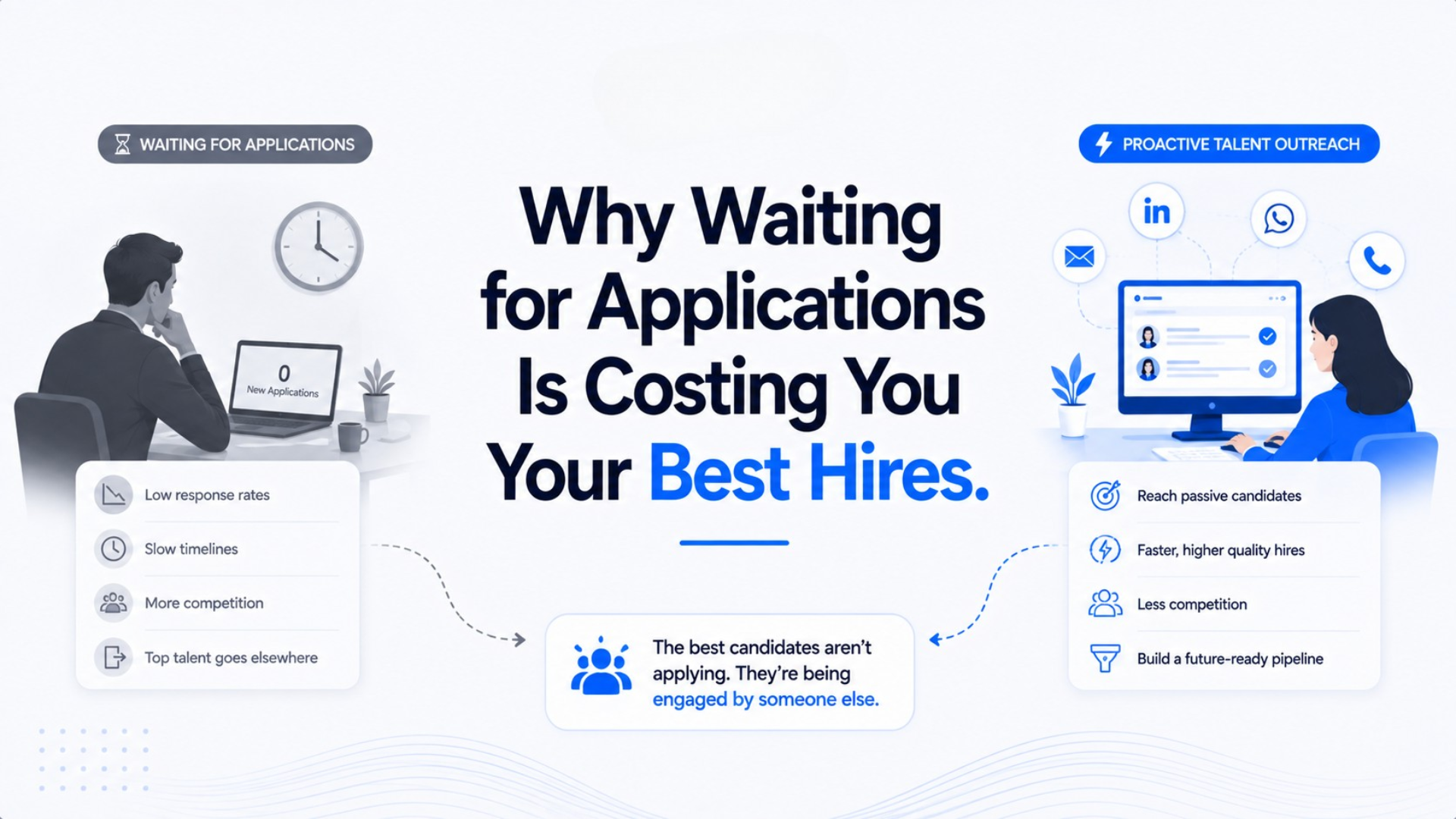
There is a fundamental paradox at the heart of most corporate recruiting strategies. The candidates that hiring managers want most are the ones least likely to apply. Senior engineers with deep expertise, product leaders with proven track records, domain specialists with rare skill combinations— these are the people every company wants. And they are also the people who are almost never scrolling through job boards or filling out application forms. They are productive, well-compensated, and selectively engaged. If they make a move, it is because an opportunity found them, not because they went looking for one. According to SHRM's talent acquisition research, over seventy percent of the global workforce is passive, meaning they are not actively applying for roles. Among high-performers in competitive fields, that figure is even higher. Yet the majority of recruiting budgets, processes, and technology investments are still designed around the assumption that great candidates will somehow find their way to an application form.
This article is not arguing that inbound recruiting has no value. Job postings, career pages, and employer branding all play a role in a complete talent acquisition strategy. The argument is that organizations which treat inbound applications as their primary or sole source of candidates are systematically losing their best hiring opportunities. They are filtering their talent pool down to the subset of people who are actively looking, which is almost by definition not the subset that includes the best available talent. The cost of this approach is measured not just in slower time-to-fill or higher cost-per-hire— it is measured in the quality gap between the candidates you get and the candidates you could have had. And for organizations in competitive markets where talent is the primary driver of business outcomes, that quality gap translates directly into competitive disadvantage.
The Application Pool Is a Filtered Subset of Talent
When you post a job and wait for applications, you are not accessing the full talent market. You are accessing a self-selected subset that has already been filtered by several powerful selection biases. The first filter is activity bias. Only people who are aware of the opportunity, motivated to apply, and willing to invest time in the application process will respond. This immediately excludes the majority of passive candidates who might be perfect fits but have no reason to engage with a job posting. The second filter is confidence bias. Research consistently shows that women and underrepresented minorities are less likely to apply for roles unless they meet one hundred percent of the stated qualifications, while men typically apply when they meet only sixty percent. This means your application pool systematically overrepresents confident applicants and underrepresents qualified candidates who could excel in the role. McKinsey's organizational insights highlight that organizations relying primarily on inbound applications consistently build less diverse and less qualified shortlists than those that combine inbound with proactive outbound sourcing.
The third filter is timing bias. When a candidate applies, they are responding to a specific job posting at a specific moment. If the role requirements change, if the hiring manager's priorities shift, or if a stronger candidate appears a week later, the application pool does not refresh itself. It is a static snapshot captured at a single point in time. By contrast, proactive sourcing creates a dynamic pipeline that can be continuously evaluated and refined as the role evolves. The fourth filter is competition bias. The candidates who do apply are applying to multiple companies simultaneously. The most attractive applicants, who have the most options, tend to receive multiple offers quickly, which means you are competing not just to identify great candidates but to move faster than every other company that has also identified them. LinkedIn's recruiting resources report that the average active candidate applies to between five and twelve positions and receives two to three offers within the first two weeks of their search, compressing the decision window dramatically for companies that are not prepared to act quickly.
The cumulative effect of these four filters is an application pool that represents a narrow, skewed, and highly competitive slice of the available talent. The candidates who remain after all four filters are often competent but rarely exceptional. They are the ones who are active, confident, available right now, and being pursued by multiple employers simultaneously. This is not a recipe for finding your best hire. It is a recipe for finding your most available hire. And there is a critical difference between those two outcomes. The recruiting teams that understand the difference between AI sourcing and AI recruiting recognize that sourcing is about accessing the full talent market proactively, while recruiting is about engaging and closing candidates once identified. Waiting for applications fails at the first step: accessing the full market.
The Hidden Financial Cost of Slow Hiring
Waiting for applications is not just a quality problem— it is a financial problem. Every day a critical role remains unfilled, the organization absorbs a measurable cost in lost productivity,
delayed projects, and overburdened teams. According to industry benchmarks, the average cost of a vacancy for a mid-level professional role ranges from five hundred to one thousand dollars per day when accounting for lost output, team disruption, and the opportunity cost of delayed initiatives. For senior or specialized roles, that figure can be significantly higher. A senior engineering role that takes sixty days to fill through inbound applications might cost the organization thirty thousand to sixty thousand dollars in vacancy costs alone— and that is before accounting for the quality cost of hiring someone who was merely available rather than truly exceptional.
The financial impact compounds when you consider the full hiring cycle. Inbound recruiting is inherently reactive: the requisition is approved, the job is posted, applications trickle in over days or weeks, the recruiter screens and schedules, the hiring manager interviews, and an offer is extended. The total time from requisition to offer for an inbound-first process typically ranges from forty-five to seventy-five days for professional roles. Gartner's HR trends research has found that organizations with proactive, intelligence-driven sourcing strategies reduce average time-to-fill by thirty to forty percent compared to those relying primarily on inbound applications, because they begin engaging candidates before the requisition is even finalized. The financial savings from faster hiring are substantial, but the strategic advantage of having key roles filled by better candidates is worth far more than the direct cost savings.
There is also a less visible but equally important financial cost: the cost of the candidates you lose to competitors. While you are waiting for applications, competitors with proactive sourcing strategies are already engaging the best available talent. By the time your inbound process produces a shortlist, the strongest candidates in the market have often already been identified, engaged, and in some cases hired by organizations that reached out first. This is particularly damaging for niche and technical roles where the qualified candidate pool is small and competition is intense. In these markets, a two-week delay in candidate engagement can mean the difference between hiring a top performer and settling for the best of whoever is still available. The financial cost of that quality difference, measured in productivity, innovation, and team performance over years, dwarfs the cost of any sourcing tool or outbound campaign.
Why the Best Candidates Are Almost Never in Your Inbox
The reasons top performers do not apply are straightforward but frequently ignored by recruiting teams. The first reason is satisfaction. The best candidates are, by definition, people who are performing well in their current roles. They are not unhappy, not underpaid relative to market rates, and not desperate for a change. They may be open to the right opportunity, but they have no urgency to find one. They are not checking job boards on Monday mornings or setting up alerts on career sites. They are focused on their work. The second reason is selectivity. High-performers are protective of their professional reputation and career trajectory. They do not apply to roles indiscriminately because they understand that each application signals something about their career intentions. They are far more likely to engage with a recruiter who approaches them thoughtfully about a specific, relevant opportunity than to throw
their hat into a generic application pool.
The third reason is network reliance. Top performers do not need job boards because they have strong professional networks that bring opportunities to them. When they are ready to explore a move, they talk to trusted colleagues, mentors, and former coworkers. They reach out to their network for recommendations and introductions. This is why referrals outperform cold outreach in conversion rates— because they arrive through a trusted channel with built-in context and credibility. The challenge for recruiting teams is that most organizations do not have enough internal referral volume to fill all of their critical roles, which means they need an outbound strategy that can replicate the trust and relevance of a referral at scale. The fourth reason is simple time scarcity. Senior professionals and top performers are busy. They do not have time to navigate clunky application systems, upload resumes in multiple formats, and answer lengthy screening questionnaires for a role they are only casually interested in. Any friction in the application process disproportionately filters out the best candidates, who have the least tolerance for unnecessary effort.
Understanding these dynamics reveals a fundamental truth about modern talent acquisition: the candidates you most want to hire are the ones whose attention is hardest to capture through traditional inbound channels. They require a fundamentally different approach— one that is proactive, personalized, and intelligent. An agentic AI recruiting platform operates on exactly this principle. Instead of waiting for candidates to signal interest, it identifies high-potential candidates based on comprehensive talent intelligence, monitors their engagement signals, and recommends the optimal moment and approach for outreach. This shifts the recruiter's role from application processor to strategic talent advisor, engaging candidates on their terms rather than waiting for them to show up.
From Reactive to Proactive: Building an Outbound-First Strategy
Transitioning from a reactive, application-dependent model to a proactive, outbound-first strategy does not happen overnight. It requires changes in process, technology, and mindset. The first step is redefining what constitutes a full pipeline. In a reactive model, a full pipeline means having a sufficient number of applications to screen. In a proactive model, a full pipeline means having a pre-built, continuously refreshed list of qualified candidates who have been identified, researched, and prioritized before a requisition even exists. This requires understanding AI sourcing versus AI recruiting as complementary capabilities: sourcing identifies and profiles candidates continuously, while recruiting engages and converts them when the right opportunity arises. The distinction matters because sourcing is an always-on activity, not a requisition-triggered event.
The second step is investing in the intelligence infrastructure that makes proactive sourcing operational. This means adopting a talent intelligence platform that goes beyond resume databases and job boards to include real-time signals from multiple sources. A platform that relies on periodically scraped data will always lag behind the market, which is why understanding why some AI recruiting tools have outdated candidate data is essential before making an
investment. The most effective platforms continuously monitor professional activity, career transitions, and engagement signals, ensuring that the candidate intelligence is current when the recruiter needs it. The third step is retraining the recruiting team to think like prospectors rather than order-takers. Proactive outreach requires different skills than application screening: it requires research ability, message crafting, timing judgment, and persistence. Deloitte's talent research emphasizes that organizations investing in proactive recruiting capabilities see a marked improvement in recruiter engagement and retention, because the work is more strategic and the outcomes are more satisfying than processing applications.
The fourth step is establishing metrics that incentivize proactive behavior. If recruiting success is measured only by applications received and positions filled, the team will naturally default to reactive strategies that optimize for those metrics. Adding metrics like proactive candidate engagement rate, pipeline coverage ratio, and time-to-first-outreach encourages the team to build and maintain candidate relationships before they are urgently needed. This also helps organizations avoid the trap of having more tools but the same hiring problems, where new technology is added to an unchanged process and produces unchanged results. Proactive metrics drive proactive behavior, which in turn produces a qualitatively different pipeline than reactive metrics ever could.
The Role of AI in Eliminating the Wait
Artificial intelligence is the technology that makes proactive outbound recruiting feasible at the scale required by modern organizations. Manual proactive sourcing— researching individual candidates, crafting personalized messages, and managing follow-up sequences— produces excellent results but is labor-intensive and difficult to scale. AI solves this problem by automating the intelligence and personalization layers while preserving the strategic judgment that only human recruiters can provide. An AI-powered platform can continuously scan the talent market, identify candidates who match current and anticipated role requirements, analyze their engagement signals, and recommend the optimal approach and timing for outreach. This is fundamentally different from simply automating mass messaging, which produces volume but not quality.
The intelligence that AI brings to proactive sourcing operates on multiple levels simultaneously. At the candidate level, it builds comprehensive profiles that include skills, career trajectory, professional reputation, and likely motivations. At the market level, it maps talent distribution, competitive hiring activity, and emerging skill trends. At the timing level, it identifies when candidates are most likely to be receptive to outreach based on behavioral signals and career patterns. This multi-layered intelligence means that when a recruiter reaches out to a passive candidate, they are doing so with a level of understanding and context that would take hours of manual research per candidate. Evaluating an AI sourcing tool should include assessing all three intelligence layers, because a platform that excels at candidate matching but lacks market and timing intelligence will still produce suboptimal results compared to one that covers all three dimensions.
AI also transforms the follow-up process, which is where most outreach sequences fail. Research shows that the majority of positive responses from passive candidates come after the second or third touchpoint, yet most recruiters stop after one or two attempts. An AI platform can manage sophisticated multi-touch sequences that adapt based on candidate behavior, delivering different messages at different times with different value propositions. Understanding how many followups one hire actually needs is critical for setting realistic expectations, but the more important insight is that AI can maintain these sequences at scale without requiring the recruiter to manually track each candidate's engagement status. This persistent, intelligent follow-up is what converts passive interest into active conversation, and it is something that no application-based process can replicate. The recruiters who worry about whether AI will replace their jobs should focus on the more relevant question: will recruiters who use AI replace recruiters who do not? The answer is already becoming clear.
Huntlo.ai was built for organizations that are tired of waiting for great candidates to find them. Its intelligence engine continuously monitors the talent market, identifies high-potential passive candidates, and provides the contextual intelligence recruiters need to craft outreach that actually gets responses. Whether you are hiring for niche technical roles or building pipeline for senior leadership positions, Huntlo gives you the ability to engage the best candidates before your competitors do. The cost of waiting for applications is not measured in days or dollars— it is measured in the quality of the hires you never make. Stop waiting. Start finding. Huntlo makes it possible.