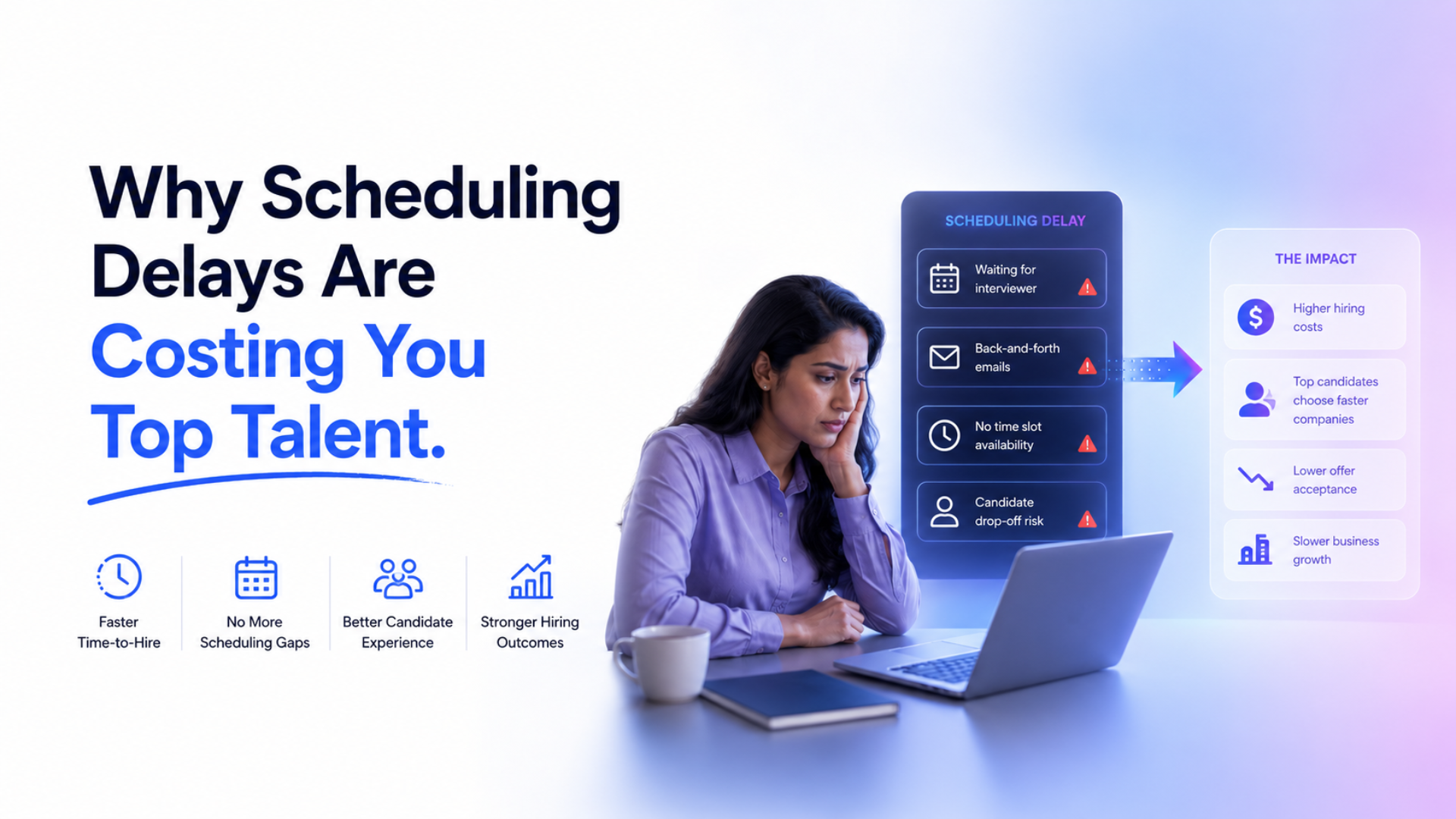
James Okafor, a senior engineering hiring manager at a Series C fintech company, had identified his ideal candidate for a critical senior backend role: a developer with eight years of experience, deep knowledge of distributed systems, and a proven track record at a well-known technology company. The candidate was interested, the compensation package was approved, and the team was eager to move forward. Then scheduling began, and the problems started immediately. Coordinating five interviewers across three time zones took eleven full business days, during which the candidate sent two follow-up emails expressing growing concern about the pace of the process. By the time James finally sent the confirmed schedule, the candidate had already accepted an offer from a competitor who had completed their entire interview process in five days. James did not lose this candidate because of compensation, role fit, or culture. He lost them because of scheduling delays alone. His experience is far from unusual, and it illustrates the central argument of this article: scheduling delays are not an administrative inconvenience but a strategic threat to your ability to attract and hire top talent.
The True Price of a Delayed Interview
The most obvious cost of scheduling delays is the direct and immediate loss of candidates who accept competing offers during the wait. Research published by SHRM shows that the elapsed time between initial contact and first interview is one of the strongest predictors of whether a candidate will complete the hiring process. Every additional day of delay increases the probability of candidate dropout, and the relationship is not linear. The risk accelerates as the delay grows, because candidates who are actively interviewing elsewhere accumulate competing offers and confidence in those alternatives. A three-day scheduling delay might seem minor, but it can represent the difference between a candidate who is still evaluating options and one who has already made a decision. For senior and specialized roles where the candidate pool is small, losing even one qualified candidate to a scheduling delay can add
weeks or months to the search.
Beyond individual candidate losses, scheduling delays inflate the cost of every hire in less visible ways. When coordination drags on, recruiters must send additional follow-up messages to keep candidates engaged, hiring managers must be re-engaged after losing context, and the overall hiring timeline extends, consuming more recruiter capacity per hire. The compounding effect is significant: if scheduling adds five days to every hire and your organization makes two hundred hires per year, that is one thousand days of extended hiring timelines, which translates to slower team scaling, delayed product launches, and increased workload on existing employees. Platforms like Huntlo approach scheduling as part of an agentic workflow where the system resolves conflicts and confirms interviews in minutes, eliminating these cascading costs before they accumulate.
How Scheduling Friction Destroys Candidate Interest
Candidates form impressions of your organization from every single interaction they have with your hiring team, and the scheduling phase is often the very first substantive interaction they experience after the initial recruiter conversation. When that interaction is slow, disorganized, or requires multiple rounds of back-and-forth emails, the candidate draws immediate conclusions about how your company operates on a day-to-day basis. Research from McKinsey has demonstrated that candidate experience during the early stages of the hiring process is one of the strongest determinants of offer acceptance rates, employer brand perception, and whether the candidate would actively recommend your company to their peers and professional network. Scheduling friction, which is entirely within your organization control, is one of the most common and most damaging reasons candidates cite for negative early-stage experiences.
The damage is especially severe for specialized roles, where the candidate pool is inherently limited and each individual represents a significant investment of sourcing effort. When hiring for niche or technical positions, the candidates you are trying to attract are typically evaluating multiple opportunities and have high expectations for how they should be treated. These individuals are not desperate for a job; they are choosing between attractive options, and they will naturally favor the organization that demonstrates respect for their time. A five-day scheduling delay signals that the organization is bureaucratic, slow-moving, and potentially difficult to work with as an employee. The candidate may never articulate this reasoning, but it profoundly influences their decision-making.
Referral candidates, who are often the highest-converting segment of any talent pipeline, are not immune to this dynamic. Even when a trusted employee makes a warm introduction and the candidate enters the process with genuine enthusiasm, the referred candidate still must navigate the same scheduling process as everyone else, and their expectations may actually be higher because of the personal connection. Research on why referrals outperform cold outreach shows that the referral conversion advantage depends on a positive end-to-end experience. When scheduling introduces friction early, it undermines the trust and enthusiasm that the referral was built on, and the candidate may quietly disengage without ever expressing
their frustration directly.
The Compounding Effect on Your Talent Pipeline
Scheduling delays do not just affect individual hires; they systematically weaken your entire talent pipeline over time in ways that compound quarter after quarter. When candidates withdraw from your process because of scheduling friction, they often share that experience publicly on platforms like Glassdoor, Blind, and LinkedIn, where it becomes a permanent part of your employer brand narrative. Glassdoor reviews, social media posts, and conversations within professional networks create a narrative about your hiring process that future candidates encounter before they ever speak to a recruiter. According to LinkedIn data, employer brand perception among candidates has become one of the most important factors in attracting qualified applicants, and scheduling experience is a significant component of that perception. Organizations with reputations for slow, disorganized hiring consistently receive fewer qualified applications and lower response rates to outreach.
The pipeline impact also compounds through recruiter behavior and team dynamics over time. When recruiters spend excessive time on scheduling, they have less time for sourcing, candidate engagement, and strategic pipeline management. This means fewer qualified candidates enter the pipeline in the first place, which reduces the quality and diversity of the candidate pool and creates a downward spiral that becomes increasingly difficult to reverse. Many teams attempt to solve this problem by adding more tools, but additional point solutions often increase fragmentation without addressing the underlying coordination problem. The result is a recruiting function that works harder but produces diminishing returns, a pattern that is both frustrating for recruiters and costly for the organization.
Scheduling delays also inflate follow-up volume across the entire recruiting process, creating a feedback loop that further strains recruiter capacity and extends hiring timelines even further. When interviews are delayed by days, recruiters must send additional messages to maintain candidate engagement, hiring managers must be re-engaged after losing context about the candidate, and the overall hiring cycle lengthens. Analysis of follow-up dynamics in hiring reveals that a substantial portion of recruitment communications are driven by scheduling logistics rather than candidate evaluation. Eliminating these logistical messages through automation would free recruiter capacity for the high-value interactions that actually strengthen the pipeline and improve hiring outcomes.
What Automated Scheduling Changes About the Equation
Automated scheduling fundamentally changes the talent equation by removing the delay that damages candidate interest and weakens pipeline health before the damage becomes irreversible. Instead of days of back-and-forth communication, an automated system evaluates all participant calendars simultaneously, proposes optimal time slots within seconds, and handles confirmations without requiring recruiter intervention. This shift from sequential to parallel coordination is what compresses scheduling from days to minutes. The result is a scheduling
experience that feels fast, organized, and deeply respectful of the candidate time and professional commitments. This is not a marginal improvement; it is a structural change in how the organization competes for talent, because speed and professionalism in scheduling directly influence how candidates perceive the employer brand and whether they choose to continue the process.
A critical advantage of automated scheduling is its ability to maintain data accuracy throughout the process. Systems that rely on outdated candidate or interviewer data will propose invalid slots, triggering rescheduling loops that recreate the very delays the automation was supposed to eliminate. The most effective platforms maintain real-time synchronization with all connected calendars and systems, ensuring that every proposal is based on current availability. This real-time capability is what enables the consistent, predictable scheduling speed that candidates notice and appreciate.
Automation also handles the reschedule and cancellation scenarios that cause disproportionate damage to candidate experience and hiring timelines. When an interviewer becomes unavailable due to illness, conflict, or changing priorities, a manual process requires the recruiter to restart coordination from scratch, often adding several more days of delay to an already extended timeline. An automated system identifies alternative times and re-confirms all participants within minutes, preserving both the schedule and the candidate perception. The connection between scheduling and broader recruiting performance is well established. As explored in discussions about the difference between AI sourcing and AI recruiting, the organizations that achieve the best hiring outcomes are those that maintain momentum across every phase of the pipeline. Gartner has reported that integrated AI hiring platforms deliver measurably faster pipeline velocity and higher candidate satisfaction than fragmented tool stacks.
Protecting Your Talent Brand From Scheduling Damage
Protecting your talent brand from scheduling damage requires both the right technology and the right implementation approach, tailored to your organization specific challenges and existing technology stack. The first step is auditing your current scheduling performance as a distinct metric: measure the average time from interview decision to confirmed slot, track candidate withdrawal rates during the scheduling phase, and compare your performance against industry benchmarks to quantify the gap. Once you have a clear picture of the problem, evaluating solutions becomes much more focused. Guidance on how to evaluate an AI sourcing tool before buying, applies directly to scheduling tools: prioritize real-time calendar integration, multi-participant conflict resolution, timezone handling, and seamless connectivity with your existing applicant tracking system.
A common concern among recruiting leaders is whether automating scheduling will make the hiring process feel impersonal or transactional to candidates. Research on whether recruiters should worry about AI replacing their jobs consistently shows that AI amplifies recruiter effectiveness rather than diminishing it. By eliminating scheduling logistics entirely, automation frees recruiters to invest substantially more time in the candidate conversations,
hiring manager coaching, and strategic pipeline planning that define a truly positive hiring experience. The most successful implementations are those that present automated scheduling to candidates as a seamless convenience rather than a substitute for genuine human interaction, preserving the personal relationship throughout the process while removing the administrative burden that slows everything down.
The business case for eliminating scheduling delays is supported by extensive industry research and by the direct experience of organizations that have made the change. Deloitte analysis of talent acquisition efficiency shows that organizations reducing administrative overhead by even fifteen percent see measurable improvements in quality of hire, time-to-fill, and overall candidate satisfaction. Meanwhile, EY has documented that companies investing in technology-enabled hiring processes report stronger employer branding, higher candidate satisfaction scores, and significantly higher offer acceptance rates across all role types. For hiring leaders like James, the lesson is painfully clear: every day of scheduling delay is a day that top talent is slipping away to competitors who move faster. The cost of inaction is not theoretical. It is measured in lost candidates, extended vacancies, and weakened competitive position.