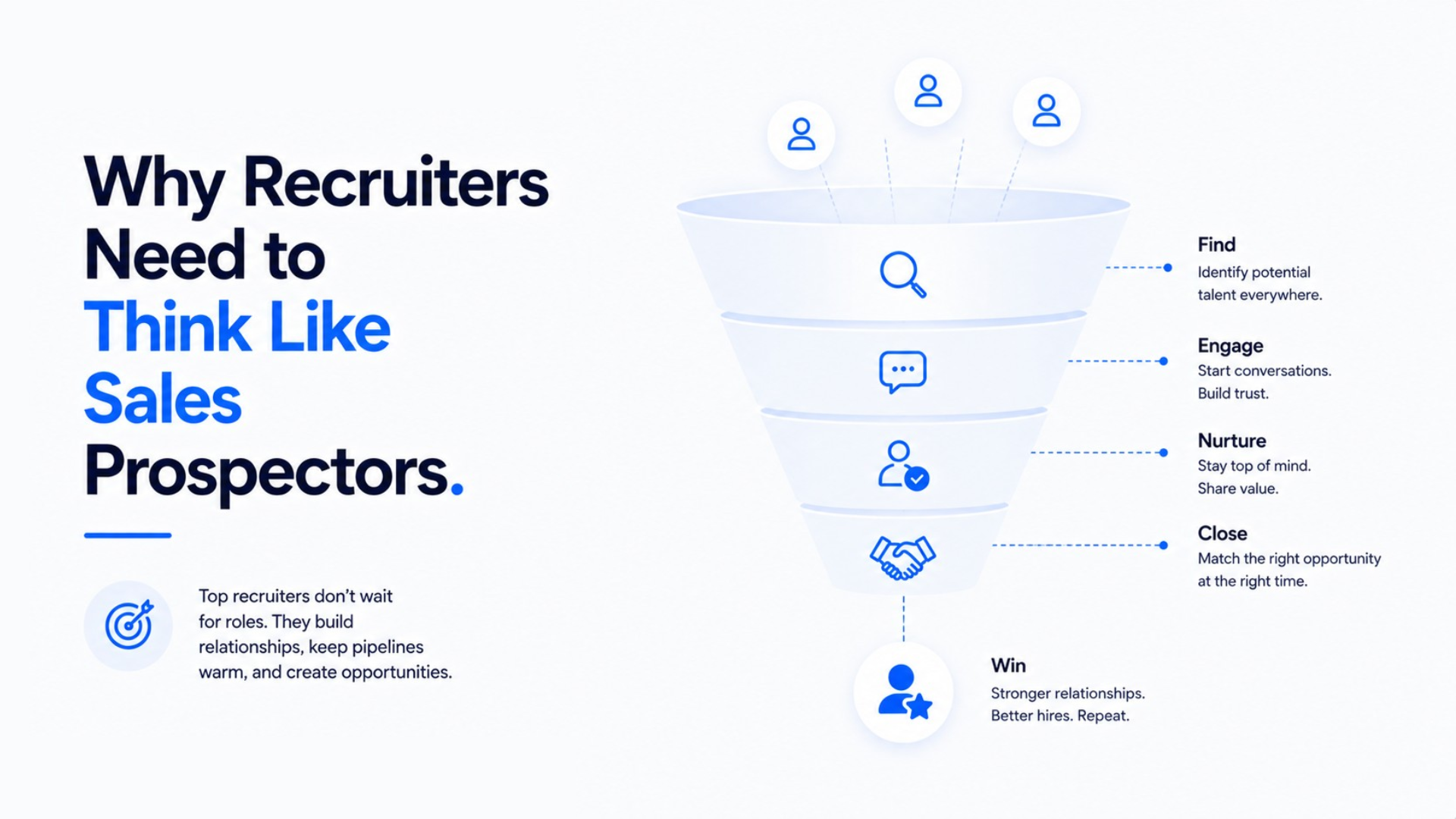
The top-performing sales development representative at a B2B SaaS company has a pipeline of three hundred prospects in various stages of engagement. She has been building this pipeline for eighteen months. She did not wait for marketing to hand her a list of qualified leads and then start calling. She identified her ideal customer profile, researched companies that fit that profile, found the decision-makers at those companies, and began a systematic engagement campaign of providing value before ever asking for a meeting. When a prospect finally takes a call, the conversation is not a cold pitch. It is the natural next step in a relationship that has been building for weeks or months. Now consider the average recruiter. A requisition opens. They search for candidates. They send outreach messages. They hope someone responds. If someone does, they pitch the role. If the timing is right and the candidate is interested, they move forward. If not, they move on to the next name on the list. The difference between the sales prospector and the recruiter is not talent or effort. It is system. The prospector has a system for building relationships before they are needed. The recruiter has a process for responding to needs after they arise. The recruiter who adopts the prospector mindset,
building candidate relationships continuously, providing value before asking for anything, and nurturing prospects through structured engagement stages, will consistently outperform the recruiter who treats every requisition as an isolated emergency. The parallels between great sales prospecting and great recruiting are not coincidental. They are structural, and the recruiters who see the parallel and act on it gain an unfair advantage over those who do not.
The structural parallel between sales and recruiting is straightforward. In both professions, the goal is to move a person from a state of unawareness or indifference to a state of active interest and commitment. In sales, the prospect is unaware of or indifferent to the product. In recruiting, the candidate is unaware of or indifferent to the opportunity. In both cases, the professional who succeeds is the one who builds trust, demonstrates understanding, and provides value before asking for the commitment. According to LinkedIn's talent solutions research, recruiters who adopt structured, relationship-first engagement models, models borrowed directly from sales prospecting best practices, produce forty to fifty percent more hires per quarter than recruiters who rely on transactional, requisition-driven outreach. The sales prospector mindset recruiting is not about making candidates feel like they are being sold to. It is about applying the relationship-building discipline that sales professionals have refined over decades to the challenge of candidate engagement, where the same principles of trust, timing, and value creation produce equally powerful results.
The Prospect Before the Pitch
The single most important principle that recruiters can borrow from sales prospectors is this: the prospecting happens before the pitch. In sales, the prospector does not wait until a quota deadline to start building relationships with potential customers. They cultivate prospects continuously so that when buying intent emerges, they are already the trusted advisor. In recruiting, the equivalent principle means the recruiter does not wait until a requisition opens to start building relationships with potential candidates. They cultivate candidate relationships continuously so that when a hiring need arises, they already have a network of warm, pre-engaged professionals to approach. The nurture before you need approach transforms recruiting from a reactive sprint into a proactive, always-on practice. According to SHRM's talent acquisition research, recruiters who maintain pre-engaged candidate networks fill roles forty-five to sixty percent faster than those who start from scratch for every requisition, because they are mobilizing existing relationships rather than building new ones under time pressure. Understanding why referrals outperform cold outreach, the mechanism that makes pre-nurtured candidates more responsive is the same one that makes referred candidates more responsive: pre-existing trust and credibility. The recruiter who has been providing value to a candidate for months has earned the right to their attention, which means the outreach conversion rate is dramatically higher than cold outreach.
The pre-pitch prospecting model also solves one of the most frustrating problems in recruiting: the timing mismatch. A recruiter sends a brilliant, personalized message to a highly qualified candidate, but the candidate is not ready to move. They like their current role, they are
not thinking about a change, and the message, no matter how well-crafted, arrives at the wrong moment. Three months later, the candidate starts feeling restless, updates their profile, and begins exploring options. But the recruiter has already moved on to other candidates and has no way of knowing that the timing has changed. The recruiting prospecting strategy that borrows from sales solves this problem through continuous relationship maintenance. The recruiter who has been in periodic contact with the candidate over those three months is still in the picture when the timing shifts. They have not moved on. They have been maintaining the relationship, and when the candidate becomes receptive, the recruiter is there, ready to have the conversation at exactly the right moment. Understanding how many follow-ups one hire actually needs, the prospecting approach requires multiple touchpoints over time, which means the recruiter is naturally present when the timing aligns, rather than depending on a single message landing at the perfect moment.
Research Before Outreach: The Prospector Discipline
Great sales prospectors are relentless researchers. Before they ever contact a prospect, they know the company the prospect works for, the challenges that company is facing, the technologies they use, the initiatives they have announced, and the professional background of the individual decision-maker. This research is not optional. It is the foundation of every interaction, because it enables the prospector to demonstrate genuine understanding of the prospect world and to provide value that is specific and relevant rather than generic and obvious. The best recruiters operate with the same discipline. Before they contact a candidate, they understand the candidate current role, the projects they have been working on, the skills they have developed, the career trajectory they are on, and the professional interests they have expressed through their public activity. This research enables outreach that makes the candidate feel seen and understood rather than targeted and processed. According to McKinsey's people organization insights, recruiters who invest in deep candidate research before outreach achieve three to five times the response rate of those who send template-based messages, because the research enables personalization that is specific enough to cut through the noise of generic recruiter messages. The recruiting outreach best practices that produce the highest response rates are the ones where the recruiter demonstrates more knowledge about the candidate than the candidate expects a recruiter to have, which immediately establishes credibility and differentiates the recruiter from the dozens of other recruiters vying for the same candidate attention.
The research discipline also produces a critical strategic advantage: the ability to see candidates that competitors miss. A recruiter who has deeply researched a candidate understands not just what the candidate has done but what they are capable of doing next. They can identify career trajectory inflection points, skill adjacencies, and transferable capabilities that would be invisible to a recruiter relying on keyword matching and job title searches. The recruiting like sales approach at the research stage produces a fundamentally different candidate map than traditional sourcing, one that is broader, deeper, and more nuanced. Understanding why more tools produce the same hiring problems, the research advantage
does not come from having more tools. It comes from using the available information more deeply, which is a skill that sales prospectors have spent decades refining and that recruiters can adopt with the same discipline. Understanding why some AI recruiting tools have outdated candidate data, research is only as good as the data it is based on, which means the prospector discipline also requires access to fresh, continuously updated candidate intelligence rather than static profiles from months ago.
The Value-First Engagement Model
The third principle recruiters can borrow from sales prospectors is the value-first engagement model. In sales, the prospector does not lead with a product pitch. They lead with insight, information, or a connection that provides genuine value to the prospect. They might share a relevant industry benchmark, introduce the prospect to a peer at another company facing a similar challenge, or send a research report that addresses a problem the prospect is known to be working on. Only after establishing credibility through value delivery does the prospector suggest a conversation about how their product might help. The value before asking recruiting model applies this same sequence to candidate engagement. The recruiter does not lead with a job opportunity. They lead with something that provides value to the candidate career or professional development. They might share a relevant article about a technology trend the candidate has been exploring, send a research paper that relates to a project the candidate has been working on, or provide an introduction to a professional contact who could be valuable to the candidate career. According to Gartner's HR trends research, recruiters who lead with value rather than with a job pitch generate four to six times the response rate from passive candidates, because the value-first approach earns the recruiter credibility and differentiates them from the transactional recruiters who only reach out when they need something.
The value-first model also creates a virtuous cycle that compounds over time. Every time the recruiter provides value, the candidate trust and recognition increase. Every interaction strengthens the relationship and makes the next interaction more likely to succeed. After three to five value-driven touchpoints, the candidate perceives the recruiter not as a stranger trying to fill a role but as a trusted professional who has consistently provided useful information and connections. When the recruiter eventually introduces an opportunity, the candidate evaluates it from a position of trust rather than skepticism. The candidate nurturing process that produces the best hiring outcomes is one that treats every interaction as an investment in a long-term relationship, not as a transaction aimed at filling a specific requisition. Understanding what makes an AI recruiting platform agentic vs. just automated, the platforms that support this value-first model do not just send messages. They help the recruiter identify the right value to deliver to each candidate based on their profile, their recent activity, and their demonstrated interests. The best platforms make it possible to provide personalized value at scale, which is the key to maintaining a large pipeline of nurtured candidates without requiring an unsustainable amount of recruiter time. Understanding the difference between AI sourcing and AI recruiting, the value-first model bridges sourcing and recruiting by using intelligence gathered during the sourcing phase to inform more effective engagement during the
recruiting phase.
Structured Pipeline Stages: From Stranger to Hire
Sales prospectors manage their pipeline through clearly defined stages: prospect, engaged, qualified, proposal, and closed. Each stage has specific criteria for entry and exit, and the prospector uses different engagement strategies for prospects at different stages. A prospect who has never been contacted requires a different approach than a prospect who has had three conversations and is evaluating options. The same staging discipline transforms recruiting. The candidate pipeline should have clear stages, such as identified, engaged, warm, and active, with specific criteria for each stage and tailored engagement strategies for candidates at each level. The candidate engagement pipeline that uses structured stages produces more predictable hiring outcomes because the recruiter knows exactly how many candidates are at each stage and can forecast hiring capacity based on pipeline conversion rates. According to Deloitte's talent research, recruiting teams that manage their candidate pipeline through structured stages report thirty-five percent more predictable quarterly hiring outcomes than teams without a staged pipeline, because the stage model provides visibility into pipeline health and enables proactive management of bottlenecks.
The staging model also enables the recruiter to allocate their time more effectively. Candidates in the early stages, identified and engaged, require less personal attention and can be managed with periodic, automated, or semi-automated touchpoints. Candidates in the later stages, warm and active, require deeper personal engagement and more frequent conversation. By matching the level of human effort to the stage of the relationship, the recruiter can maintain a much larger pipeline without becoming overwhelmed. Understanding AI recruiting for niche and technical roles, this staged approach is especially valuable for specialized roles where the candidate pool is small and every relationship is precious, because it ensures that no high-potential candidate falls through the cracks due to inconsistent follow-up. The prospecting discipline for recruiters ultimately comes down to this: treat every candidate interaction as part of a long-term engagement process, not as an isolated event, and manage that process with the same structure and intentionality that sales professionals apply to their prospect pipelines. For organizations evaluating an AI sourcing tool before buying, the ability to support staged pipeline management with automated stage transitions and stage-appropriate engagement recommendations should be a key selection criterion. And for recruiters who wonder whether AI will replace their jobs, the answer is that AI will not replace recruiters who think like prospectors, build relationships before they need them, and manage candidate pipelines with sales-level discipline. It will replace recruiters who treat every requisition as a standalone task and every candidate as a one-time transaction.
How Huntlo.ai Gives Recruiters the Prospector Advantage
Huntlo.ai is built on the prospector principle: build relationships before you need them, engage with intelligence before you pitch, and nurture candidates through structured stages
from identification to hire. The platform continuously monitors the talent market, identifies candidates who match your hiring patterns, and provides the deep candidate intelligence, career context, recent accomplishments, engagement signals, that the prospector discipline requires. It supports value-first outreach by generating personalized message recommendations based on each candidate specific profile and recent activity, enabling the recruiter to provide genuine value at scale. The staged pipeline management system tracks every candidate through identification, engagement, warmth, and active stages, ensuring that no relationship is lost and that the recruiter allocates their time where it has the most impact. The platform also supports AI recruiting for niche and technical roles, where the prospector discipline is most critical because every candidate relationship in a small talent pool is high-stakes and must be managed with care.
For recruiting leaders who want their team to stop acting like order-takers and start operating like sales prospectors, Huntlo provides the intelligence, the workflow, and the pipeline management to make the prospector mindset the default. The best salespeople do not wait for leads. They build a world where leads come to them. The best recruiters should work the same way, and with Huntlo, they can.