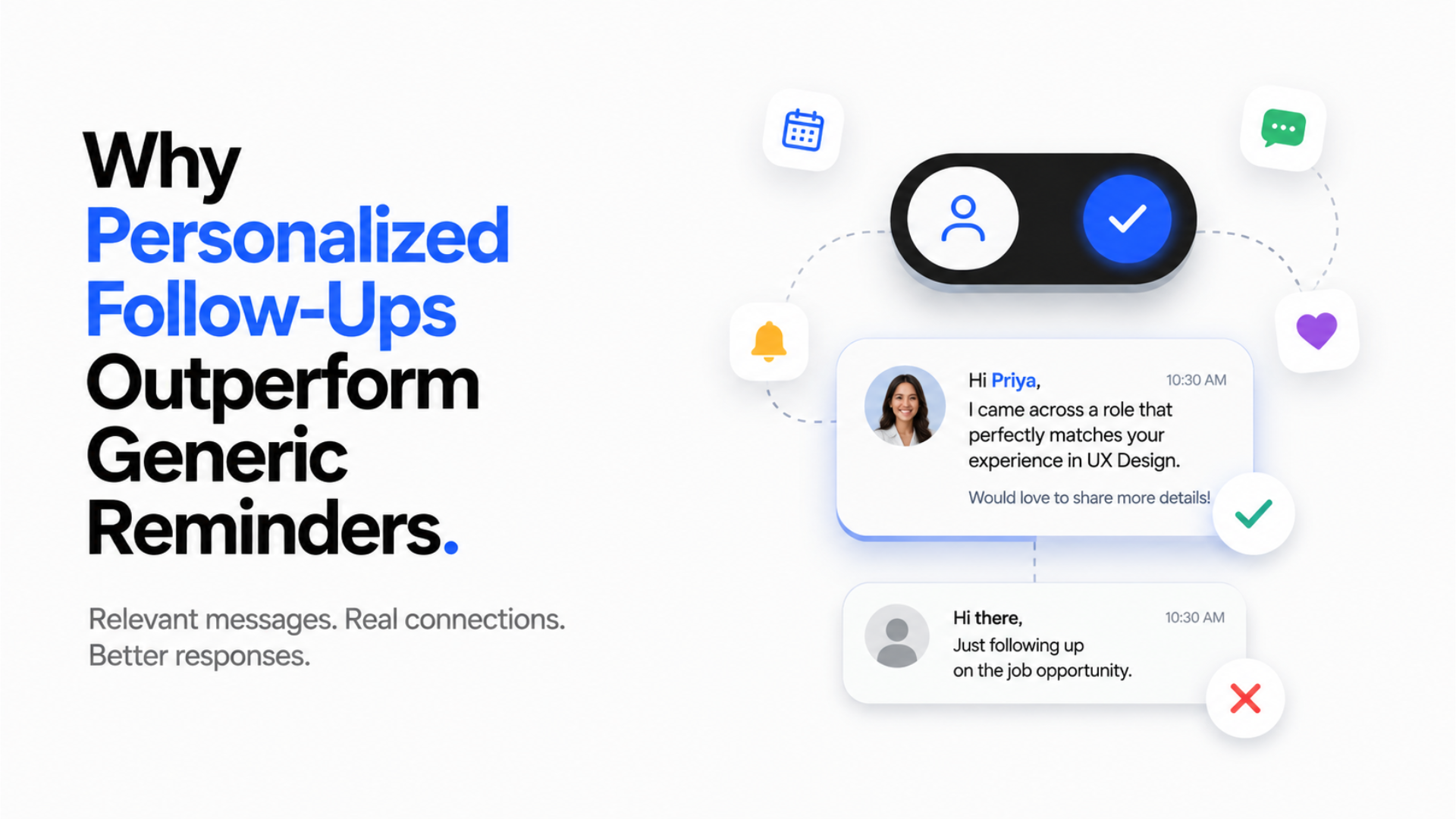
Sofia received two messages from two different recruiters on the same Tuesday morning. Both were about senior product roles at comparable companies. The first message began with her first name, mentioned the role title, and asked if she would be available for a call this week. It was polite, professional, and indistinguishable from the dozens of similar messages she had received that month. She archived it without responding. The second message opened by referencing a talk she had given at a product conference in March, noted that the hiring team was working on a similar challenge she had described in her talk, and asked whether she would be open to a conversation about how her approach might apply to their situation. Sofia responded within two hours. She did not respond because the second company was better or the role was more attractive. She responded because the second recruiter had demonstrated, in a single message, that they understood who she was, what she cared about, and why the opportunity might matter to her specifically. The first recruiter sent a reminder. The second recruiter started a conversation. The difference between a reminder and a conversation is the difference between a message that gets deleted and a message that gets a reply, and that difference is driven entirely by personalization.
The recruiting industry generates an enormous volume of follow-up communication, and the vast majority of it is generic. Templates are sent on fixed schedules with minimal variation, the candidate's name is inserted into a standard framework, and the same basic message is delivered to candidates with vastly different backgrounds, priorities, and engagement levels. This approach is not lazy or incompetent. It is the rational response of recruiters operating under time pressure who must maintain communication with fifteen to twenty-five candidates simultaneously and cannot afford to spend forty-five minutes researching and crafting each individual follow-up. The problem is that candidates can tell the difference, and they respond accordingly. A generic follow-up signals to the candidate that they are one of many, that the
recruiter has not invested time in understanding their specific situation, and that the opportunity is being broadcast rather than offered. The candidate's response is predictable: they prioritize the communications that feel personal and deprioritize or ignore the ones that feel automated. According to SHRM's talent acquisition research, response rates to generic follow-up messages have declined by thirty to forty percent over the past five years as candidates have become more sophisticated at distinguishing personalized communication from template-based outreach. The implication is clear: in a competitive talent market, generic follow-ups are not just less effective. They are increasingly ineffective, and the recruiters who continue relying on them are operating at a growing disadvantage.
The Measurable Response Rate Gap Between Personalized and Generic Follow-Ups
The performance difference between personalized and generic follow-ups is not anecdotal. It is consistently measurable across industries, seniority levels, and candidate segments, and the magnitude of the gap is larger than most recruiters assume. In head-to-head comparisons, personalized follow-ups generate two to four times higher response rates than generic reminders sent to similar candidates at the same stage of the hiring process. A generic reminder sent after a screening call might achieve a fifteen to twenty percent response rate. A personalized follow-up that references specific topics discussed during the call, addresses a concern the candidate raised, or provides information relevant to the candidate's expressed interests typically achieves a forty to sixty percent response rate. This is not a marginal improvement. It is a transformational one that changes the economics of the entire hiring funnel. When each follow-up is two to three times more likely to generate a response, the number of follow-ups needed to maintain pipeline momentum drops dramatically, freeing recruiter time for higher-value activities. When stage-to-stage conversion rates improve because candidates feel understood and valued, the number of candidates needed at the top of the funnel to produce a single hire drops as well, reducing sourcing costs and accelerating time to fill. According to McKinsey's organizational insights the cumulative effect of personalized follow-up across a full hiring process is a twenty-five to forty percent reduction in time to fill and a fifteen to twenty-five percent increase in offer acceptance rates, because the personalization builds trust and engagement that compound at every stage. The recruiters who understand the difference between AI sourcing and AI recruiting see this dynamic clearly. Sourcing is a volume activity where some degree of templating is acceptable because the initial message is a starting point, not a relationship. Follow-up is a relationship-deepening activity where personalization is not optional, because the candidate has already invested time in the process and expects the communication to reflect that investment. Huntlo's platform addresses this by maintaining a contextual memory layer that captures the specifics of every candidate interaction, ensuring that every follow-up generated by the system is grounded in the actual conversation history rather than a generic template.
The response rate gap is even more pronounced for senior and specialized candidates, the
candidates who are most in demand and most likely to be evaluating multiple opportunities simultaneously. These candidates receive large volumes of recruiter messages, and they have developed sophisticated filters for distinguishing messages that deserve attention from those that do not. A generic reminder from a recruiter they spoke to once is easily dismissed. A personalized follow-up that demonstrates the recruiter remembers their conversation, understands their career priorities, and can connect the opportunity to their specific goals stands out immediately and earns a response. The practical implication is that personalization is not equally important for all candidates. It is most important for the candidates who matter most, the high-potential, high-demand talent that every recruiter is competing for. For these candidates, generic follow-ups are not just ineffective. They are counterproductive, because they signal that the recruiter and the organization behind them do not value the candidate enough to invest in a genuine, informed communication. This signal can damage the relationship permanently, making it harder to re-engage the candidate later even with better communication. Understanding how many followups one hire actually needs is useful for calibrating volume, but for high-priority candidates, the quality of each follow-up matters far more than the quantity. A single well-crafted, deeply personalized follow-up will outperform five generic reminders, because the personalized message earns a response while the generic messages earn silence. The challenge, of course, is that crafting deeply personalized follow-ups for every candidate at every stage is beyond what manual processes can sustain, which is why the teams that simply add more tools without upgrading to intelligent systems often find they have more tools but the same hiring problems, a pattern explored in the analysis of organizations with more tools but the same hiring problems. The solution is not to hire more recruiters to write more personalized messages. It is to deploy AI-powered systems that can generate personalized follow-ups at scale.
Why Generic Reminders Feel Like Spam to Candidates
The candidate experience of receiving a generic follow-up is functionally identical to receiving a marketing email from a brand they barely recognize. The message may contain their name, it may reference the role they applied for or discussed, and it may be grammatically correct and professionally formatted. But it lacks the one quality that distinguishes a genuine communication from an automated blast: evidence that the sender has thought about the recipient as an individual. This distinction is not subtle. Candidates process it instantly, in the same way they process the difference between a LinkedIn connection request that references a shared interest and one that uses the default text. The default text request feels like spam even though it is technically personalized with the recipient's name. The same dynamic operates in recruiting follow-ups. A message that says "Hi [Name], just checking in on the [Role] position" is processed as spam regardless of whether the name and role are correct, because it contains no evidence that the sender has any understanding of the recipient beyond what a database lookup provides. The candidate's emotional response is not anger or offense. It is indifference, which is far more damaging to the recruiter's objectives. An angry candidate might at least respond. An indifferent candidate simply deletes the message and moves on,
and the recruiter has no way of knowing whether the silence means the candidate is busy, uninterested, or has already accepted another offer.
The spam-like quality of generic follow-ups is compounded by their frequency. Because generic reminders are easy to produce, recruiters and automated systems tend to send more of them, creating a volume of low-quality communication that trains candidates to ignore the recruiter's messages entirely. A candidate who receives three generic reminders over two weeks, none of which reference their specific situation or provide any new information, will begin to filter all future messages from that recruiter as low-priority, including any subsequent messages that might actually be personalized and valuable. This filtering effect is the hidden cost of generic follow-ups that most recruiters do not measure. They track the response rate to each individual message, which may be low but not zero. What they do not track is the cumulative effect of generic messages on the candidate's overall engagement with the recruiting process, which degrades with each low-quality touchpoint. The candidates who have the most options, and who are therefore the most valuable, are the most sensitive to this degradation, because they have the least tolerance for communication that wastes their time. This is especially true for candidates being pursued for niche and technical roles, where the talent pool is small and candidates know their value in the market. Sending these candidates generic reminders is not just ineffective. It is actively harmful, because it signals that the recruiter does not understand or respect the candidate's position. The alternative is to invest the time in crafting personalized follow-ups that demonstrate genuine understanding of the candidate's situation. But this investment, when done manually, is only feasible for a small number of high-priority candidates, which means the majority of the pipeline receives generic communication that erodes their engagement. Huntlo's AI-powered platform solves this by generating contextually personalized follow-ups for every candidate, not just the top three, ensuring that every message contains evidence that the sender understands the recipient as an individual. This is why referred candidates consistently outperform cold-sourced candidates in engagement metrics. Research confirms that referrals outperform cold outreach because the referring employee provides the context that enables genuinely personalized communication from the very first interaction. Huntlo's platform aims to give every candidate this referral-quality experience regardless of how they entered the pipeline.
What Real Personalization Actually Looks Like in Practice
Personalization in recruiting follow-ups is commonly misunderstood as name insertion, company name referencing, or other surface-level customizations that can be achieved with mail merge. These techniques are not personalization. They are variable substitution, and candidates perceive them as such. Real personalization in follow-up communication operates at three levels, each of which provides a progressively deeper signal to the candidate that the sender understands their individual situation. The first level is conversational continuity. The follow-up references specific topics, questions, or concerns that were raised in prior conversations. If the candidate mentioned during the screening call that they were hesitant about a long commute, the follow-up might reference the company's flexible work policy. If the
candidate expressed excitement about a particular aspect of the role, the follow-up might provide additional detail about that aspect. This level of personalization requires the sender to remember and reference prior conversation content, which signals attentiveness and respect for the candidate's time and input. The second level is career contextualization. The follow-up connects the opportunity to the candidate's specific career trajectory, goals, and priorities as they have been expressed or inferred from their profile and interactions. If the candidate's background shows a progression from individual contributor to team lead, the follow-up might reference the leadership opportunities the role provides. If the candidate's recent projects suggest an interest in a particular technology or methodology, the follow-up might connect that interest to the team's current work. This level of personalization requires understanding not just what the candidate said but what their career history suggests about their motivations and aspirations.
The third level is anticipatory relevance. The follow-up provides information or addresses concerns that the candidate has not yet explicitly raised but that are likely to be relevant based on their profile, stage in the process, and common patterns among similar candidates. A candidate at the offer stage who has not yet asked about the team structure might receive a follow-up that proactively introduces the team composition and reporting relationships. A candidate who is about to enter a multi-week interview process might receive a follow-up that sets expectations about the timeline and what each stage involves. This level of personalization is the most powerful because it demonstrates not just that the sender remembers what the candidate said, but that the sender understands what the candidate needs, often before the candidate has articulated it themselves. It is this anticipatory quality that makes referred candidates so responsive, because the referring employee naturally provides this level of contextual understanding. According to LinkedIn's recruiting resources candidates who receive follow-ups demonstrating all three levels of personalization, conversational continuity, career contextualization, and anticipatory relevance, are four to five times more likely to respond than those receiving generic reminders, and their progression through the hiring process is thirty to forty percent faster. The recruiters asking whether AI will replace their jobs should note that all three levels require human judgment to execute well. The AI provides the research, signal detection, and draft generation. The recruiter provides the strategic understanding of the candidate's motivations, the empathy that shapes how concerns are addressed, and the authenticity that makes the communication feel genuinely human rather than algorithmically generated. Huntlo delivers this as an agentic AI recruiting platform that observes each candidate's engagement signals, maintains a rich contextual profile of every interaction, and generates follow-up recommendations grounded in all three levels of personalization. The recruiter reviews, refines, and sends, ensuring that every candidate receives communication that feels personal and genuine even though the research and drafting time has been reduced from forty-five minutes to five.
The Data on Personalization and Hiring Outcomes
The impact of personalized follow-up on hiring outcomes extends well beyond response
rates. Organizations that have systematically invested in follow-up personalization are reporting improvements across every meaningful recruiting metric, and the consistency of these improvements across different organization types and hiring contexts makes it clear that personalization is not a nice-to-have enhancement but a fundamental driver of recruiting performance. The most direct impact is on pipeline velocity. Personalized follow-ups that reference prior conversations and provide relevant information accelerate the candidate's progression through each stage, because the candidate does not need to ask follow-up questions or request information that should have been provided proactively. A candidate who receives a post-screening follow-up that addresses their concerns, provides information about the next stage, and connects the role to their stated career goals is ready to move forward immediately. A candidate who receives a generic "thanks for your time, we will be in touch" message must either wait passively or actively chase information that should have been volunteered. The velocity difference compounds across stages. According to Gartner's HR trends research organizations with high follow-up personalization scores fill positions twenty to thirty percent faster than those with low scores, because the personalized communication eliminates the friction and delays that generic follow-ups create at every transition point.
The second major impact is on offer acceptance rates. Candidates who have received personalized, context-aware communication throughout the hiring process arrive at the offer stage with a fundamentally different relationship to the opportunity and the organization than candidates who have received generic reminders. They feel understood, valued, and informed, which means they have fewer unanswered questions, fewer unresolved concerns, and less uncertainty about whether the opportunity is the right fit. This pre-offer engagement makes the offer conversation significantly easier and significantly more likely to result in acceptance. The third impact is on candidate experience and employer brand. Candidates who receive personalized communication share their positive experience with their networks, creating organic employer brand advocacy that no marketing budget can replicate. Candidates who receive generic communication share that experience too, with the opposite effect. In competitive talent markets, this experience-driven brand perception can be the difference between a strong candidate pipeline and a weak one, because the candidates you lose today tell their peers, and those peers become harder to recruit tomorrow. However, the quality of personalized follow-up depends entirely on the quality of the candidate data that informs it. Teams that have experienced the frustration of outdated candidate data in AI tools understand that personalization based on stale information will miss the mark, referencing projects the candidate left years ago or interests they have since outgrown. This kind of inaccurate personalization is worse than no personalization at all, because it signals that the recruiter's information is outdated, which undermines trust. When evaluating platforms, use the framework for evaluating an AI sourcing tool before buying to ensure data freshness and contextual accuracy are core capabilities. EY's technology insights report that enterprises with mature AI-powered personalization systems are achieving fifty to sixty percent higher candidate satisfaction scores alongside faster fills and higher acceptance rates, because every candidate interaction reinforces the perception that the organization values them as an individual. Deloitte's talent
research concludes that follow-up personalization is no longer a differentiator. It is a baseline expectation, and the organizations that fail to deliver it are not just underperforming relative to their competitors. They are failing to meet the minimum standard that candidates now apply to evaluate recruiting professionalism. Every generic follow-up you send is a signal to the candidate that they are not worth your time. Huntlo ensures they always feel like they are. Build personalization at scale with Huntlo.