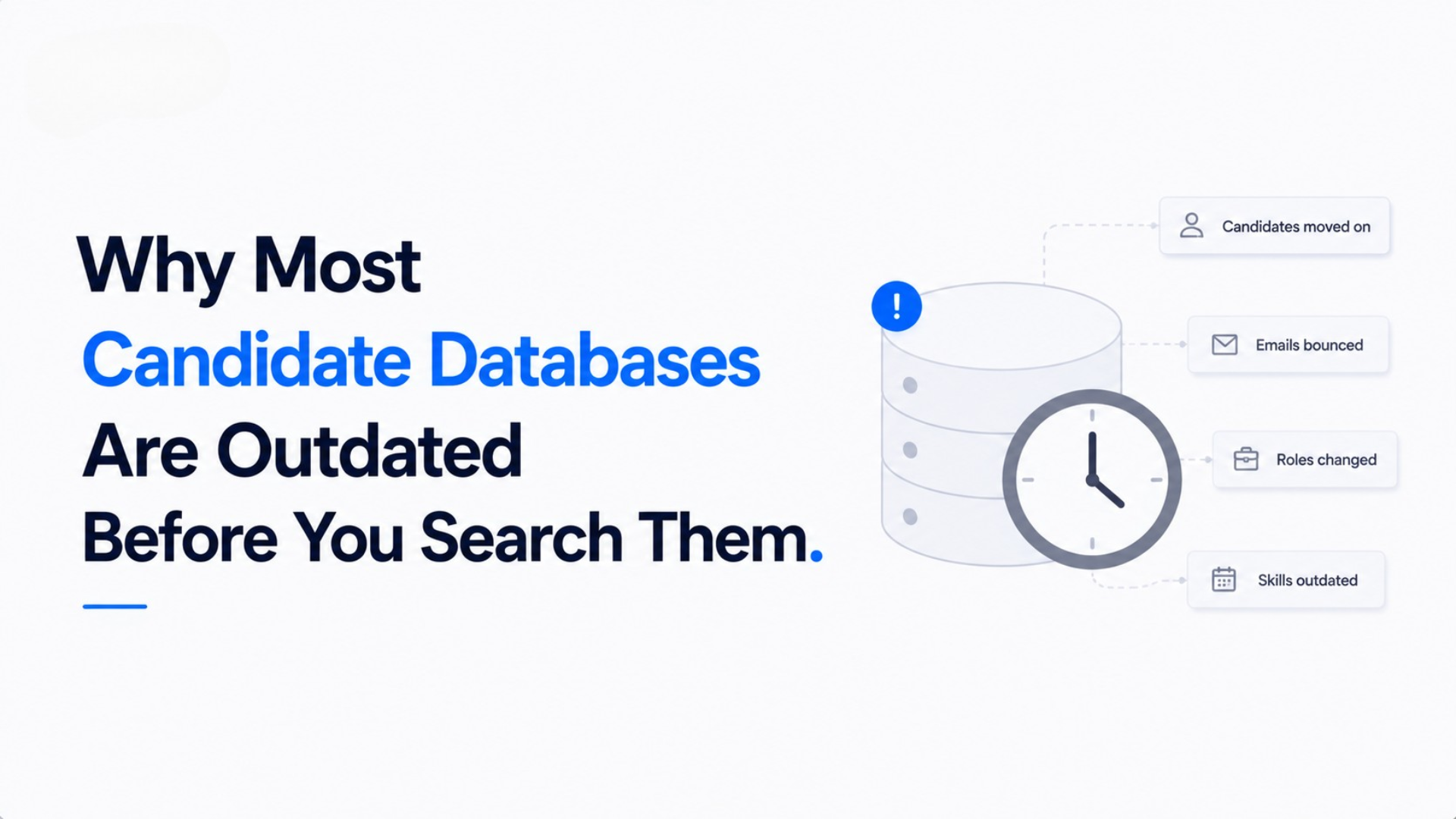
A recruiter pulls a list of fifty candidates from the company ATS for a senior backend engineering role. They spend an afternoon reviewing profiles and select twelve to contact. They send personalized messages to all twelve. Four messages bounce back because the candidates have changed employers and their work email is no longer valid. Two candidates reply to say they started a new role last month and are no longer interested. One candidate says the skills listed in their profile are from two years ago and they have since moved into a management track. Of the twelve candidates contacted, only five are still accurate, and the recruiter spent four hours on outreach that was largely wasted. This is not a rare occurrence. It is the normal outcome of using a database that was compiled months ago and has not been updated since. Candidate data decays at a rate that most recruiting teams dramatically underestimate. Every week, professionals change jobs, update their skills, relocate, adjust their availability, and shift their career interests. A database that was accurate on the day it was built becomes progressively less accurate with every passing day, and most recruiting databases are weeks or months old by the time a recruiter searches them.
The problem of database decay is not new, but it has become dramatically more acute as the pace of career movement has accelerated. According to data from LinkedIn's talent solutions
research, the average professional now changes employers every three to four years, and within the technology sector, the average tenure is closer to two years. But data decay is not just about job changes. It includes skill updates, title changes, location changes, certification additions, project completions, and shifts in career interests. A candidate who was open to relocating six months ago may have since decided to stay put. A candidate whose profile listed Java as their primary language may have spent the last year working exclusively in Go. The stale candidate data problem affects every dimension of candidate information, not just employment status, which means even databases that track current employers are likely to be wrong about skills, availability, and interests. Understanding why some AI recruiting tools have outdated candidate data, the root cause is structural: most candidate databases are built through periodic data pulls rather than continuous data monitoring, which means they capture a snapshot of the talent market at a single point in time and then degrade from there.
The Math of Data Decay
To understand why database decay is such a serious problem, it helps to quantify it. Research on information decay in professional databases suggests that candidate records decay at a rate of approximately two to three percent per month across all fields combined, meaning that after six months, roughly twelve to eighteen percent of the records in a database contain at least one significant inaccuracy, and after twelve months, the figure rises to twenty-five to thirty-five percent. But these aggregate numbers understate the problem for individual fields. Employment status, the most critical field for recruiter outreach, decays much faster than the aggregate rate because job changes are concentrated in certain sectors and experience levels. In the technology sector, where median tenure is approximately two years, the employment status of a candidate database decays at roughly four to five percent per month, meaning that a database that is six months old will have incorrect employer information for twenty-five to thirty percent of its records. The candidate data decay rate in high-mobility sectors like technology, consulting, and startup ecosystems is so rapid that databases older than three months are actively misleading more often than they are helpful. According to SHRM's talent acquisition research, recruiting teams that rely on databases older than ninety days report that thirty to forty percent of their outreach efforts are wasted on candidates who are no longer in the position or location listed in their record.
The decay problem is compounded by the fact that the most valuable candidates, the ones who are highly skilled and in demand, change jobs and update their profiles more frequently than average candidates. This means the candidates you most want to reach are the candidates whose data is most likely to be wrong. A senior engineer who receives five recruiter messages a week is also the engineer most likely to have changed roles recently, because high-demand professionals have more opportunities and more incentive to make career moves. The candidate information decay rate is inversely correlated with candidate quality: the better the candidate, the faster their data degrades. This is a cruel paradox for recruiting teams, because it means the portion of the database that matters most is the portion that is least reliable. Understanding why more tools produce the same hiring problems, the solution is not to pull
data from more sources, because pulling data more frequently from static sources still produces periodic snapshots rather than continuous intelligence. The database freshness recruiting problem requires a fundamentally different approach: continuous monitoring that tracks candidate changes in real time rather than periodic data pulls that capture a moment in time.
Why Most Databases Are Built to Be Stale
The reason most candidate databases are outdated is not that recruiting teams are negligent. It is that the databases themselves are designed in a way that makes staleness inevitable. Most ATS platforms, candidate relationship management tools, and recruiting databases operate on a batch-update model. Data is imported in bulk on a periodic basis, whether that is weekly, monthly, or quarterly, and the database is static between imports. This model was designed for an era when candidate data changed slowly and recruiting operated on longer timelines. A candidate who stayed at the same company for ten years and updated their skills annually could be accurately represented in a quarterly-updated database with minimal inaccuracy. But that era is over. The modern professional updates their digital footprint continuously, through LinkedIn activity, GitHub contributions, conference presentations, publications, and project launches. A database that only updates quarterly is systematically missing the most recent and most relevant signals about candidate status and readiness. The ATS data degradation problem is a design problem, not a usage problem. The database architecture itself assumes a rate of data change that no longer reflects reality. According to McKinsey's people organization insights, organizations that continue to rely on batch-updated candidate databases spend thirty to forty percent of their total sourcing effort on candidates whose data is no longer accurate, which translates directly into wasted outreach, wasted recruiter time, and slower time-to-fill.
The batch-update model also creates a false sense of confidence. A database that was accurate when it was last updated three months ago looks and feels reliable. The records are complete, the formatting is consistent, and the data fields are populated. But the accuracy is an illusion. The database accurately represents the talent market as it existed three months ago, not as it exists today. The recruiter who searches this database has no way of knowing which records are still current and which have decayed, because the database provides no freshness indicators or last-verified timestamps for individual fields. The recruiting database accuracy problem is invisible to the recruiter, which makes it far more dangerous than a problem that produces obvious errors. A database that returns obviously wrong results will be distrusted and supplemented with other sources. A database that returns plausible but subtly wrong results will be trusted and acted upon, leading to outreach that is personalized and well-crafted but directed at candidates who are no longer accurately represented by their record. Understanding the difference between AI sourcing and AI recruiting, stale data undermines both sourcing accuracy and recruiting effectiveness, because even the best engagement strategy fails when it is based on an outdated understanding of the candidate.
The Hidden Costs of Stale Data
The costs of outdated candidate data extend far beyond the immediate waste of outreach effort. The first hidden cost is opportunity cost. Every hour a recruiter spends contacting a candidate whose data is outdated is an hour they are not spending on a candidate whose data is current and who is genuinely available and qualified. In a competitive talent market, this opportunity cost is enormous. The candidate who would have been a perfect hire may accept another offer while the recruiter is chasing ghosts in a stale database. The second hidden cost is reputation damage. When a recruiter sends a message that references a job the candidate left six months ago, or a skill the candidate no longer uses, or a location the candidate no longer lives in, the recruiter does not just fail to engage the candidate. They actively damage their credibility. The candidate perceives the outreach as careless and generic, which makes them less likely to respond to future messages from the same recruiter or organization. The sourcing data quality problem directly damages the recruiter reputation and the employer brand, which has long-term consequences that far outweigh the cost of a single wasted message. According to Gartner's HR trends research, candidates who receive outdated or inaccurate outreach are sixty percent less likely to respond to future messages from the same organization, and they are forty percent more likely to share their negative experience with peers in their professional network.
The third hidden cost is decision-making corruption. When hiring managers and recruiting leaders make strategic decisions based on pipeline data from stale databases, those decisions are systematically biased toward the past rather than the present. A hiring plan based on a six-month-old assessment of the available talent pool may overestimate the availability of certain skill sets and underestimate the competition for others. A pipeline report that counts candidates who are no longer available inflates the apparent strength of the pipeline and delays the decision to invest in additional sourcing channels. The candidate database maintenance problem is not just an operational annoyance. It is a strategic risk that distorts the information recruiting leaders use to make decisions about hiring timelines, budget allocation, and team capacity. Understanding how many follow-ups one hire actually needs, stale data also inflates follow-up volume because recruiters follow up with candidates who would have responded to the first message if it had been accurate, but who did not respond because the message was irrelevant to their current situation. According to Deloitte's talent research, organizations that implement continuous data refresh processes for their candidate databases reduce their outreach waste by fifty to sixty percent and improve their pipeline reporting accuracy by forty percent.
What Real-Time Candidate Intelligence Looks Like
The alternative to periodic, batch-updated databases is continuous, real-time candidate intelligence. In this model, candidate records are not snapshots imported on a schedule. They are living profiles that are continuously updated as new information becomes available. When a candidate changes their LinkedIn headline, the record updates within hours. When a candidate starts following a new company on LinkedIn, the engagement signal is captured in real time. When a candidate publishes a new article, contributes to an open-source project, or
presents at a conference, those activities are added to their profile immediately. The real-time candidate data model eliminates the decay problem entirely because the database is never more than hours or days behind the current state of the talent market, rather than weeks or months. Understanding what makes an AI recruiting platform agentic vs. just automated, the platforms that provide this level of continuous intelligence are not just automating data collection. They are maintaining a living, real-time model of the talent market that evolves as the market itself evolves.
Real-time intelligence also enables capabilities that are impossible with stale databases. A platform that monitors candidates continuously can detect when a previously passive candidate begins showing engagement signals, such as updating their profile, increasing their platform activity, or following new companies, and alert the recruiter in real time. This signal-based outreach is dramatically more effective than outreach based on stale profile data because it reaches the candidate at the moment of maximum receptivity. The fresh talent intelligence model also provides the recruiter with confidence. When they reach out to a candidate, they know the information in the profile is current, which means their outreach is relevant and their personalization is accurate. This confidence translates into better messages, better conversations, and better hiring outcomes. Understanding why referrals outperform cold outreach, the mechanism that makes fresh-data outreach effective is the same one that makes referrals effective: relevance and credibility. A message that references the candidate current role, recent accomplishments, and present career interests demonstrates that the recruiter has done their homework, which earns the candidate attention and trust. Understanding AI recruiting for niche and technical roles, real-time data is especially critical for specialized roles where the candidate pool is small, because in a small pool, every piece of stale data represents a proportionally larger loss of sourcing coverage. For organizations evaluating an AI sourcing tool before buying, the data refresh frequency and the mechanisms used to maintain freshness should be among the top evaluation criteria, because a platform that identifies the right candidates but serves stale data about them is ultimately less useful than a simpler platform with continuously fresh data. And for recruiters who wonder whether AI will replace their jobs, the answer is that AI will replace recruiters who make decisions based on stale data, because recruiters with access to real-time intelligence will always make better sourcing decisions.
How Huntlo.ai Keeps Candidate Data Continuously Fresh
Huntlo.ai is built on a fundamentally different data architecture than traditional candidate databases. Instead of periodic batch imports, Huntlo maintains a continuously updated intelligence layer that monitors the talent market in real time and refreshes candidate profiles as new information becomes available. Every candidate profile in the Huntlo platform is a living document that reflects the candidate current employment status, recent activities, skill evolution, and engagement signals. When a recruiter searches for candidates on Huntlo, the results are based on data that is hours or days old, not weeks or months. This means the outreach the recruiter sends is relevant, the personalization is accurate, and the candidate experience is
positive. The platform also supports AI recruiting for niche and technical roles, where the small size of the candidate pool makes every stale record a significant loss of coverage, and where continuous monitoring is the only way to maintain an accurate picture of available talent.
For recruiting leaders who recognize that stale data is silently undermining their sourcing performance, Huntlo provides the continuously fresh candidate intelligence that makes every outreach message relevant, every pipeline report accurate, and every hiring decision based on the talent market as it is today, not as it was three months ago. Your database should work for you, not against you.