Meera is a senior recruiter at a late-stage logistics startup. Last month she spent thirty-two hours coordinating interview schedules across forty-seven candidates and twelve hiring managers. Three candidates withdrew during scheduling alone. One of them was her top pick for a staff engineer role. He had been enthusiastic after the screening call, asked detailed questions about the tech stack, and told her he was cancelling two other interviews to prioritize this opportunity. Then the scheduling back-and-forth began. The hiring manager was available only on Tuesday and Thursday mornings. The candidate was available only on Wednesday and Friday afternoons. The second interviewer, a principal engineer based in a different time zone, had conflicting commitments for two straight weeks. By the time Meera found a slot that worked for all four participants, eleven days had passed since the screening call. The candidate had accepted another offer. Meera did not lose this hire because of compensation, culture, or competition. She lost it because of a calendar.
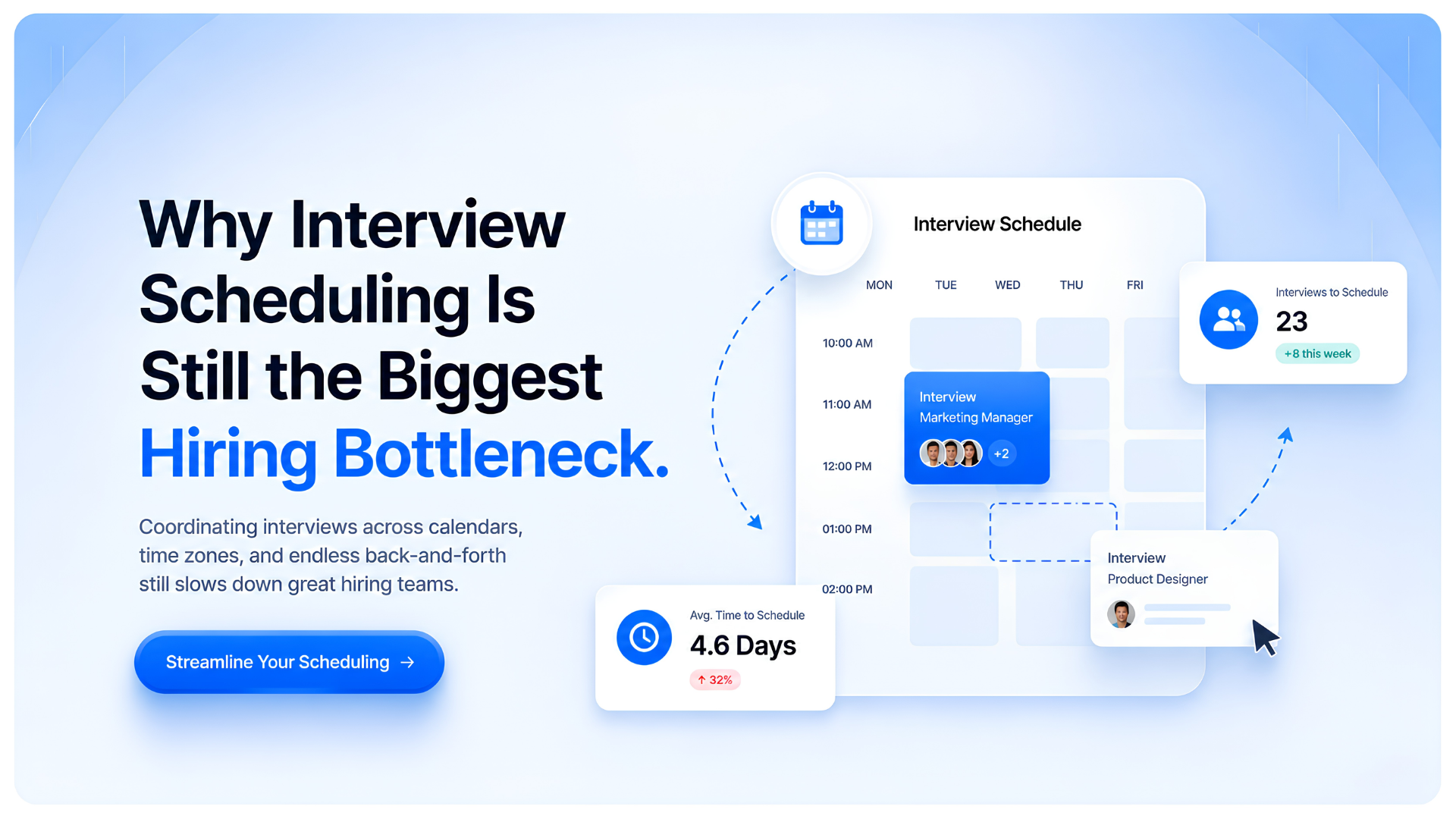
Interview scheduling is the single most time-consuming stage in the recruiting process, and it is the stage most likely to cause candidate withdrawal, yet it receives the least strategic attention of any stage in the hiring funnel. The reason is revealing: scheduling is perceived as an administrative task, not a strategic one. Recruiting leaders invest heavily in sourcing strategy, interview training, and offer negotiation, but they treat scheduling as a problem that should simply be managed rather than solved. The result is a stage that consumes twenty to thirty percent of a recruiter's total time, generates the highest volume of back-and-forth communication, and creates the longest delays between candidate interactions, all while producing zero strategic value. According to SHRM's talent acquisition research, scheduling delays are the leading cause of candidate withdrawal between the screening and interview stages, accounting for more withdrawals than compensation concerns, role misalignment, or negative interview feedback. The distinction between sourcing and recruiting is important here.
Understanding the difference between AI sourcing and AI recruiting makes clear that sourcing identifies candidates efficiently, but the scheduling bottleneck sits squarely in the recruiting phase, where operational friction between identification and evaluation destroys the momentum that sourcing created. Huntlo's platform addresses this by integrating scheduling intelligence into the recruiting workflow, eliminating the calendar friction that turns enthusiastic candidates into withdrawn candidates.
The True Scale of the Scheduling Problem
The scale of the scheduling problem is larger than most recruiting leaders recognize, because the visible costs, the hours recruiters spend on coordination and the candidates who explicitly withdraw, represent only a fraction of the total damage. The invisible costs are far greater. The first invisible cost is candidate experience degradation. Every round of scheduling back-and-forth signals to the candidate that the organization is disorganized, which reduces their enthusiasm and their perception of the company as a well-run operation. A candidate who receives five emails over eleven days just to find a single interview time does not evaluate the role on its merits. They evaluate the organization on its apparent inability to coordinate a simple meeting, and they project that inability onto every aspect of how the company operates. The second invisible cost is hiring manager frustration. Hiring managers who are asked for their availability, then asked again because the candidate was not available, then asked a third time because a second interviewer was added, become frustrated with the recruiting process and start to view recruiting coordination as a burden rather than a partnership. This frustration erodes the collaboration between recruiting and hiring teams that is essential for making good hiring decisions. According to McKinsey's organizational insights, hiring manager frustration with scheduling is the second most common source of tension between recruiting and the business, after disagreements about candidate quality, and it directly reduces the quality of hiring manager participation in the interview process itself.
The third invisible cost is pipeline velocity loss. In a competitive talent market, the speed of the hiring process is a direct competitive advantage. A company that can move a candidate from screening to final interview in ten days will consistently outperform a company that takes twenty-five days, because the faster process captures candidates before competing offers arrive. Scheduling is the primary driver of process duration. The actual interview conversations take hours. The scheduling coordination takes weeks. Organizations that accumulate more tools without solving the scheduling problem often discover they have more tools but the same hiring problems, because each new tool adds its own scheduling requirement without reducing the underlying coordination burden. The problem compounds as the organization grows. A startup with five interviewers and ten open roles can manage scheduling through manual effort and informal coordination. A company with fifty interviewers and forty open roles cannot, because the combinatorial complexity of matching candidate availability with interviewer availability across multiple time zones and multiple interview rounds creates a coordination burden that exceeds any human's capacity to manage efficiently. This complexity is especially severe when hiring for niche and technical roles, where the interview
panel often includes senior engineers or domain experts whose calendars are the most constrained and whose participation is the most difficult to schedule. Research on how many followups one hire actually needs shows that a significant portion of those follow-ups are scheduling-related, meaning the recruiter is spending follow-up effort on coordination rather than on relationship-building or candidate engagement. Each scheduling follow-up is a wasted touchpoint that could have been used to advance the candidate's experience rather than managing calendars.
Why Scheduling Has Stayed Broken for So Long
The persistence of the scheduling bottleneck is not a technology problem. Calendar tools, scheduling links, and coordination platforms have existed for years. The persistence is a systems problem, rooted in three structural failures that technology alone has not addressed. The first structural failure is fragmentation. The typical interview scheduling process involves the recruiter, the candidate, the hiring manager, and two to four additional interviewers, each with their own calendar, their own time zone, and their own scheduling preferences. No single tool owns the full coordination problem. The recruiter uses email to communicate with the candidate, a calendar tool to check interviewer availability, a different tool to send calendar invitations, and often a spreadsheet or ATS note to track the scheduling status. Each tool solves a piece of the problem, but the integration between them is manual, which means the recruiter is still the system of record and the coordination engine, manually transferring information between tools. According to LinkedIn's recruiting resources, recruiters who use fragmented scheduling tools report higher coordination effort and lower candidate satisfaction than recruiters who use unified platforms, because the fragmentation creates information gaps that lead to double-bookings, missed availability windows, and scheduling conflicts that require additional rounds of coordination.
The second structural failure is the misalignment of incentives. In most organizations, no single person is accountable for scheduling efficiency. The recruiter is accountable for filling the role, not for minimizing scheduling time. The hiring manager is accountable for making a good hire, not for responding to availability requests promptly. The interviewers are accountable for providing feedback, not for keeping their calendars current. When no one owns the scheduling process, it deteriorates to the lowest common denominator of effort, which is the recruiter sending emails and hoping for timely responses. The third structural failure is the absence of intelligence. Current scheduling tools operate on availability matching, which is necessary but insufficient. They find a time when all participants are free, but they do not consider the strategic factors that determine whether a given time slot is actually optimal. An intelligent scheduling system would consider the candidate's engagement level and risk of withdrawal, prioritizing faster scheduling for candidates who are actively considering competing offers. It would consider the interviewer's performance history, ensuring that the strongest evaluators are assigned to the highest-priority candidates. It would consider the time zone context, avoiding slots that require the candidate to take an interview at an unreasonable hour. An agentic AI recruiting platform like Huntlo goes beyond availability matching to
provide this strategic intelligence, treating scheduling not as an administrative task but as a candidate experience and hiring quality lever. Recruiters who ask whether AI will replace their jobs should understand that AI scheduling does not replace the recruiter. It replaces the hours of manual coordination that prevent the recruiter from doing the work that actually requires human judgment.
What AI-Powered Scheduling Actually Looks Like
AI-powered interview scheduling operates on three capabilities that transform it from a calendar-matching tool into a strategic recruiting asset. The first capability is unified availability intelligence. The AI system maintains real-time awareness of every participant's calendar, including the candidate's stated availability, the interviewers' actual calendar commitments, the hiring manager's scheduling preferences, and the organization's interview room or video conferencing capacity. This unified awareness eliminates the information fragmentation that causes double-bookings and scheduling conflicts, and it allows the system to propose interview times that are genuinely available for all participants rather than times that appear available but turn out to have hidden conflicts. The second capability is autonomous coordination. The AI system communicates directly with participants to resolve scheduling conflicts, propose alternatives, and confirm selections, without requiring the recruiter to act as an intermediary for every exchange. The candidate receives a single communication that presents available time slots tailored to their stated preferences. The interviewers receive automated requests that respect their calendar constraints and their preferred interview times. The recruiter receives a notification when the interview is confirmed, rather than a series of messages requiring their manual mediation. According to Gartner's HR trends research, organizations that deploy AI-powered scheduling reduce their scheduling coordination time by sixty to seventy percent and their time-to-interview by forty to fifty percent, primarily because the autonomous coordination eliminates the back-and-forth that consumes the bulk of the scheduling effort.
The third capability is candidate experience integration, which is the capability that transforms scheduling from a process bottleneck into a competitive advantage. The AI system uses the scheduling interaction as an opportunity to advance the candidate's engagement rather than degrading it. It sends personalized confirmation messages that include relevant information about the interview panel, the role, and the team. It provides proactive updates if an interviewer's availability changes, preventing the last-minute cancellations and reschedules that frustrate candidates and signal disorganization. It maintains communication between the scheduling confirmation and the actual interview, ensuring the candidate does not experience the silence that creates doubt about whether the interview is actually happening. This experience integration is what distinguishes AI scheduling from tool-based scheduling. A calendar link finds a time. An AI scheduling system finds a time, confirms it, and uses the confirmation to strengthen the candidate's relationship with the organization. The quality of the data that feeds the scheduling intelligence matters enormously. Teams that have encountered outdated candidate data in AI tools understand that scheduling built on stale availability data creates
conflicts that are worse than manual coordination, because the candidate experiences a system that appears to work but repeatedly fails. When evaluating platforms, use the framework for evaluating an AI sourcing tool before buying to ensure that real-time data integration and availability intelligence are core capabilities. Data consistently confirms that candidates who are referred by existing employees have higher engagement throughout the process, and referrals outperform cold outreach in part because the referring employee provides informal scheduling guidance that smooths the coordination. AI scheduling provides this same coordination benefit for every candidate, regardless of whether they have an internal connection. Huntlo delivers unified availability intelligence, autonomous coordination, and candidate experience integration in a single platform, making interview scheduling a strategic advantage rather than a persistent bottleneck.
The Compounding Cost of Leaving Scheduling Broken
The cost of leaving the scheduling bottleneck unsolved compounds over time in ways that are not visible in standard recruiting metrics but that materially affect the organization's ability to hire. The first compounding cost is employer brand erosion. Candidates who experience slow, fragmented scheduling do not differentiate between the scheduling process and the organization. They attribute the frustration to the company itself and share that frustration in their networks, on review platforms, and in conversations with peers who are considering opportunities at the same company. This brand erosion reduces the effectiveness of future sourcing efforts, because the organization is competing against its own reputation for disorganization. The second compounding cost is hiring manager disengagement. Hiring managers who experience scheduling as a burden become less willing to participate actively in the recruiting process. They take longer to provide availability. They are less flexible about accommodating candidate schedules. They delegate interview participation to colleagues rather than prioritizing it themselves. This disengagement reduces the quality of the interview process, which reduces the quality of hiring decisions, which increases the cost of bad hires. According to Deloitte's talent research, organizations with the most efficient scheduling processes have thirty to forty percent higher hiring manager satisfaction scores, which directly correlates with higher-quality interview feedback and better hiring outcomes, because engaged hiring managers invest more effort in the interview conversation and the evaluation.
The third compounding cost is recruiter attrition. Scheduling coordination is the single most cited source of recruiter frustration in surveys of recruiting professionals. It is the task that recruiters describe as the least valuable use of their time and the most difficult to automate through the tools their organizations currently provide. When recruiters spend twenty to thirty percent of their day on scheduling, they have less time for the relationship-building, candidate engagement, and strategic advising that make the role professionally fulfilling. This imbalance drives attrition, and recruiter attrition is one of the most expensive costs a recruiting organization can bear, because each departing recruiter takes their candidate relationships, their hiring manager partnerships, and their institutional knowledge with them. According to EY's technology insights, the recruiting organizations that are reducing recruiter attrition
most effectively are the ones that use AI to automate the operational tasks, including scheduling, that consume the time recruiters want to spend on relationship-building and strategic work. Huntlo's platform eliminates the scheduling bottleneck by unifying availability intelligence, automating coordination, and integrating scheduling into the candidate experience, giving recruiters their time back and giving candidates a process that feels fast, organized, and respectful of their time. Interview scheduling does not have to be the biggest hiring bottleneck. With Huntlo, it becomes the stage where candidates feel most confident in the organization's competence. Start eliminating scheduling bottlenecks with Huntlo.