David Okafor, a vice president of engineering at a high-growth SaaS company, blocked two hours on Tuesday afternoon for final-round interviews with three candidates for a senior backend engineer position. By Monday evening, the recruiter had emailed him twice about availability conflicts. One panelist had a client emergency. Another was traveling to a conference. The candidate had limited availability because of a counteroffer deadline from her current employer. David spent his Tuesday morning resolving scheduling conflicts instead of preparing interview questions. When the interviews finally happened on Thursday, two days later than planned, the candidate had already accepted the counteroffer. David lost a qualified hire not because of compensation, culture, or role fit, but because scheduling consumed the precise window of opportunity he had to make the hire. His frustration was not with the recruiter, who had worked diligently to coordinate the panel. It was with a process that required a vice president of engineering to spend hours on calendar logistics when the decision that mattered was whether the candidate was the right fit for the team. That decision never got made because the scheduling process consumed the time and the opportunity.
The Hidden Tax on Hiring Manager Time
David Okafor, a vice president of engineering at a high-growth SaaS company, reviewed his weekly calendar and realized that interview scheduling had consumed nearly six hours of his week. Three back-and-forth email threads with recruiters about availability conflicts. Two rescheduled panels because an interviewer had a last-minute client emergency. One canceled interview because the candidate could not accommodate the only time slot that worked for all five panelists. David was not managing the hiring process. The hiring process was managing him. His experience is far from unusual. Research published by SHRM on hiring manager
productivity has found that interview scheduling and coordination consume an average of four to seven hours per week for hiring managers at companies with active hiring programs. For managers leading large teams with multiple open roles, the time investment is even higher. This is time that is not spent on engineering leadership, product strategy, or team development. It is time that is effectively taxed away by an administrative process that could be handled by intelligent automation in a fraction of the time.
The impact on hiring manager engagement extends beyond the hours consumed. When scheduling is slow and disorganized, hiring managers begin to view recruiting as an operational burden rather than a strategic activity. They become less responsive to recruiter requests, less prepared for interviews, and less invested in candidate evaluation quality. This disengagement has measurable consequences: research has consistently shown that hiring manager engagement is one of the strongest predictors of hiring outcome quality, including offer acceptance rates, new hire performance, and retention. When scheduling friction reduces hiring manager engagement, it does not merely slow the process. It degrades the quality of every hiring decision that follows. The irony is that hiring managers are often the primary advocates for better hiring within their organizations, yet the scheduling process systematically undermines their ability to participate effectively in the very process they are advocating for. An agentic AI recruiting platform that handles scheduling as an autonomous workflow can reverse this dynamic by eliminating the administrative burden that drives disengagement and restoring hiring manager focus to the candidate evaluation and team-building activities that actually determine hiring success.
The financial cost of hiring manager time spent on scheduling is substantial and frequently underestimated. A vice president of engineering at a technology company might have a fully loaded cost of two hundred dollars per hour or more. If that vice president spends five hours per week on scheduling across forty hiring weeks per year, the annual cost exceeds forty thousand dollars per hiring manager. For an organization with twenty hiring managers, the total annual cost of scheduling-driven hiring manager time exceeds eight hundred thousand dollars. This is not an abstract figure. It is a direct, measurable cost that appears on the operating budget in the form of manager salaries allocated to administrative work rather than revenue-generating or product-delivering activities. And it is a cost that intelligent scheduling technology can reduce by eighty to ninety percent, freeing hundreds of thousands of dollars of managerial capacity for work that actually drives business outcomes.
How Scheduling Friction Damages Hiring Quality
The relationship between scheduling efficiency and hiring quality is not immediately obvious, but it is well documented and logically straightforward. When scheduling takes days or weeks, several damaging dynamics emerge. First, the candidate pool degrades over time because the most qualified candidates, who are typically the most in-demand, accept competing offers during the scheduling delay. By the time a slow scheduling process delivers a confirmed interview slot, the best candidates have often already moved on. Second, hiring managers lose context and enthusiasm during extended scheduling timelines. A hiring manager
who was excited about a candidate profile on Monday may have largely forgotten the specifics by the time the interview actually takes place two weeks later, leading to less focused and less effective evaluation. Research from McKinsey on hiring decision quality has found that interviewer preparation and engagement are among the strongest predictors of assessment accuracy, and that both deteriorate significantly when the interval between candidate identification and interview exceeds five business days.
Third, scheduling friction creates information loss that affects hiring decisions. When a hiring manager reviews a candidate profile in anticipation of an interview scheduled for the following week, and then that interview is rescheduled twice before finally occurring three weeks later, the manager must re-familiarize themselves with the candidate materials each time. This repeated context-switching reduces the depth of preparation and increases the likelihood that the manager will rely on superficial impressions rather than thorough evaluation. The problem is particularly severe for niche or technical roles where effective evaluation requires the hiring manager to prepare specific technical questions and assessment criteria tailored to the candidate background and experience. When scheduling delays disrupt this preparation cycle, the quality of the technical assessment suffers, and the organization risks making hiring decisions based on incomplete or shallow evaluation rather than rigorous analysis of candidate capability.
Fourth, scheduling-driven delays extend the overall hiring timeline, which has a direct and well-documented impact on team productivity and business performance. Every week that a critical role remains unfilled, the existing team absorbs additional workload, project timelines slip, and revenue targets are missed. The hiring manager, who is typically the person most accountable for these operational consequences, experiences the scheduling delay not as an administrative inconvenience but as a direct threat to their ability to deliver business results. This creates frustration and urgency that further degrades the hiring process, because frustrated hiring managers are more likely to make rushed decisions, lower their standards, or disengage from the process entirely. Many organizations attempt to address these symptoms by adding more tools to the recruiting stack, but without an integrated approach to scheduling, additional tools typically increase complexity and do not address the root cause of the delays that damage hiring quality.
What Smarter Scheduling Looks Like for Hiring Managers
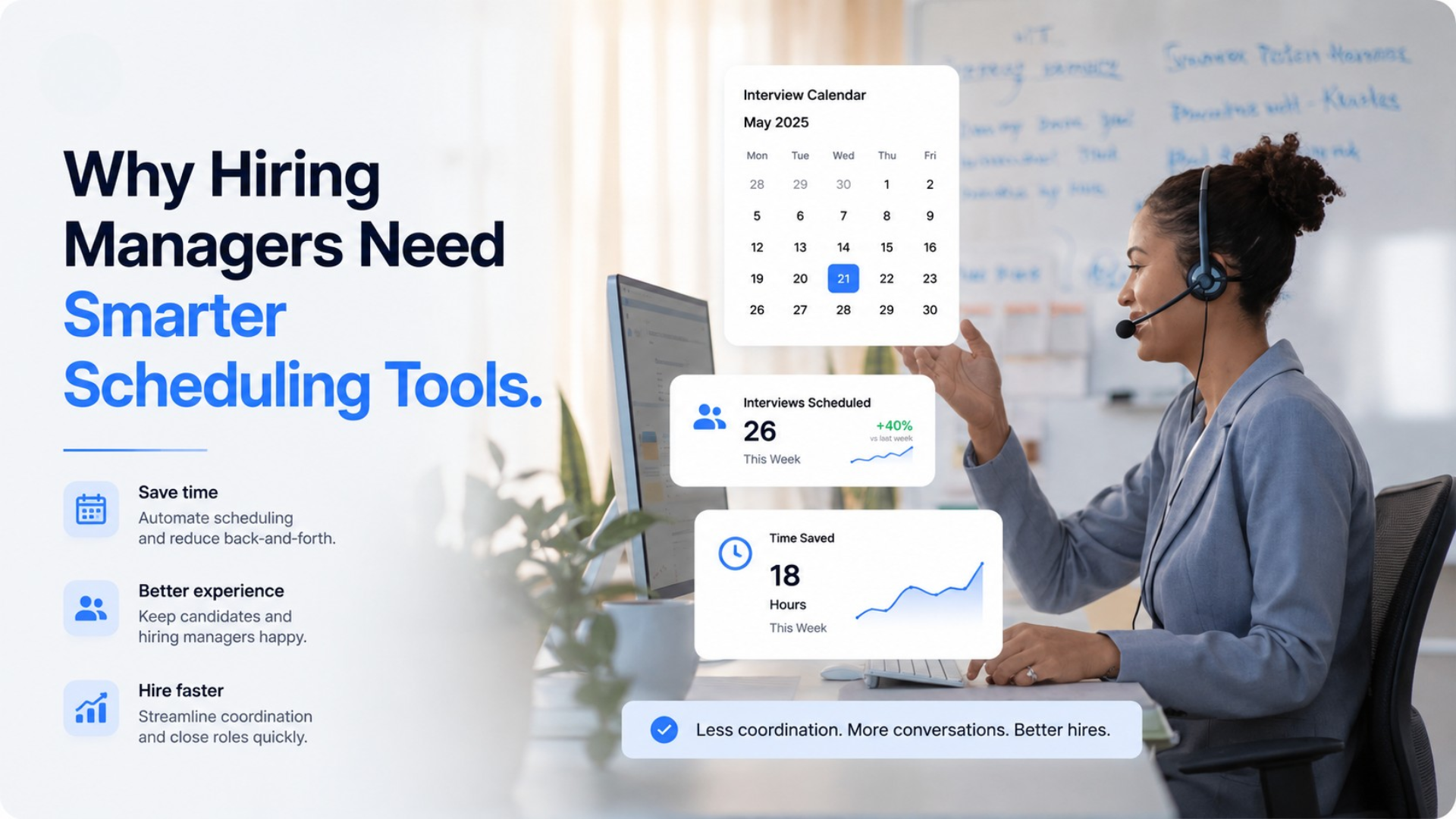
Smarter scheduling for hiring managers means removing them from the coordination loop entirely while keeping them informed and in control of the decisions that require their input. The ideal experience works as follows. The recruiter identifies a candidate and initiates the scheduling process. The scheduling system evaluates the availability of all interview participants, including the hiring manager, and proposes validated time slots. The hiring manager receives a notification with one or two proposed options and can confirm with a single click. If the manager needs to propose alternative times, they do so through a simple interface that immediately re-evaluates all participant availability and generates new options. No email threads. No back-and-forth. No context-switching. According to LinkedIn talent solutions
research, hiring managers who have access to this type of streamlined scheduling experience report significantly higher satisfaction with the recruiting process, greater willingness to participate in multiple interview rounds, and stronger overall engagement with talent acquisition as a business priority.
Behind the simplicity of the hiring manager experience, the scheduling system handles the full complexity of multi-participant coordination. It accounts for timezone differences, enforces organizational policies such as minimum notice periods and buffer times, synchronizes with the manager calendar in real time to prevent conflicts, and automatically handles rescheduling when participants become unavailable. The key technical requirement that makes this possible is real-time data integration. When scheduling systems rely on outdated candidate or interviewer data, the proposed times are often invalid, which defeats the purpose of automation and forces the hiring manager back into manual coordination. The most effective systems maintain continuous synchronization with all connected calendar platforms, ensuring that every option presented to the hiring manager is based on current and accurate availability. This real-time capability is what enables the one-click confirmation experience that hiring managers consistently rate as the most valuable feature of any scheduling tool.
Smarter scheduling also means intelligent conflict resolution that respects hiring manager priorities. When two interviews compete for the same time slot, the system should be able to evaluate which interview has higher urgency based on factors such as candidate availability windows, hiring priority, and stage in the hiring process. It should present this context to the hiring manager along with the proposed resolution, enabling the manager to make informed trade-offs without spending time investigating the conflicts manually. This level of intelligence transforms the scheduling system from a passive calendar tool into an active hiring assistant that helps the manager allocate their interview time more effectively. The connection between scheduling intelligence and broader recruiting effectiveness is highlighted in discussions about the difference between AI sourcing and AI recruiting, because the same principle applies: the best outcomes come from systems that make intelligent decisions within a well-defined workflow rather than simply automating individual tasks in isolation. Research on why referrals outperform cold outreach further demonstrates that when every touchpoint in the hiring process is fast and professional, the cumulative effect on candidate engagement and hiring manager satisfaction is transformative.
The ROI of Smarter Scheduling for Hiring Managers
The return on investment for smarter scheduling tools can be measured across three dimensions: time savings, hiring quality improvement, and business impact. The time savings are the most immediately quantifiable. If a hiring manager currently spends five hours per week on scheduling and a smart scheduling system reduces that to thirty minutes, the recovered time is four and a half hours per week, or roughly nine full working weeks per year per hiring manager. For an organization with fifteen hiring managers, that is over a hundred and thirty weeks of recovered managerial capacity annually. This is time that can be redirected to engineering leadership, product development, team mentoring, and strategic planning, all
activities that generate measurable business value far exceeding the cost of the scheduling technology. According to Gartner, organizations that implement AI-powered scheduling for hiring managers report average time savings of seventy to eighty-five percent on scheduling-related activities, with the largest savings occurring for managers involved in multiple concurrent hiring processes.
The hiring quality improvement is harder to quantify but arguably more valuable. When scheduling is fast and seamless, hiring managers are more engaged, better prepared, and more focused during interviews. Candidates experience a professional process that reflects positively on the employer brand. The best candidates are less likely to withdraw during scheduling delays, which means the hiring manager is evaluating a stronger candidate pool. These improvements compound over time as the organization develops a reputation for efficient, respectful hiring processes that attract higher-quality applicants. Analysis of follow-up dynamics in hiring has shown that organizations with fast scheduling processes have significantly lower candidate withdrawal rates and higher offer acceptance rates, both of which directly improve the return on every dollar invested in sourcing and recruitment marketing. The quality dimension also extends to the hiring manager relationship with the recruiting function. When scheduling is effortless, managers view recruiters as strategic partners rather than administrative coordinators, which strengthens the collaboration that is essential for effective hiring. Guidance on how to evaluate an AI sourcing tool before buying emphasizes that the best scheduling investments are those that improve both efficiency and relationship quality, because the combination of faster processes and stronger partnerships delivers compounding returns over time.
The business impact dimension captures the downstream effects of faster, higher-quality hiring on team performance and business outcomes. Every week that a critical role remains unfilled, the existing team operates under capacity. Projects are delayed. Deadlines are missed. Customer satisfaction suffers. These costs are real, measurable, and far larger than the cost of scheduling technology. A common concern among hiring managers is whether AI scheduling will reduce their influence over the hiring process or make their role feel less important. Research on whether recruiters should worry about AI replacing their jobs consistently shows the opposite effect: automation amplifies the value of human judgment by eliminating the administrative tasks that consume time without requiring judgment. For hiring managers, this means more time for the candidate evaluation, team composition planning, and offer decision-making that actually require their expertise and authority. The scheduling tool handles the logistics. The hiring manager handles the decisions that determine whether the right person joins the team.
Making the Case for Smarter Scheduling in Your Organization
Building the business case for smarter scheduling tools requires framing the investment in terms that resonate with both recruiting leadership and the hiring managers who will benefit most directly. The first step is quantifying the current cost. Survey hiring managers about how many hours per week they spend on interview scheduling and coordination. Multiply by the
number of hiring managers and their average hourly cost to produce an annual figure. In most organizations, this calculation produces a number large enough to command executive attention. The second step is measuring the hidden costs: candidate withdrawal rates during scheduling, average time-to-interview, and hiring manager satisfaction with the recruiting process. These metrics establish a baseline against which improvement can be measured and demonstrate that the scheduling problem extends beyond hiring manager convenience into candidate experience and hiring outcomes. Deloitte analysis of talent acquisition investment decisions has found that organizations with clear baseline metrics and quantified cost data are significantly more successful in securing approval and budget for hiring technology investments.
The third step is selecting a scheduling solution that meets the specific needs of hiring managers. The tool must integrate with the calendar platforms that managers already use, provide a simple confirmation interface that requires minimal time and effort, and handle rescheduling automatically without requiring manager intervention. The most effective implementations are those that feel like a natural extension of the manager existing workflow rather than a new system they must learn and maintain. EY research on technology adoption by senior leaders has found that the single strongest predictor of adoption success is whether the tool reduces friction in the manager existing workflow rather than introducing new steps or interfaces. When the scheduling tool simply makes the manager existing calendar work better for hiring, adoption is rapid and sustained because the value is immediate and obvious.
The fourth step is phased deployment with visible results. Start with a single team or department where the hiring manager is a vocal advocate for better tools. Measure the impact on scheduling time, hiring manager satisfaction, and candidate experience. Share the results with other hiring managers to build demand and momentum for broader adoption. This approach leverages peer influence rather than top-down mandates, and it is far more effective in driving adoption among senior leaders who value autonomy and resist being told how to work. For hiring managers like David, the case for smarter scheduling is ultimately personal. It is about reclaiming the hours that administrative coordination steals from the work they are most qualified to do and most passionate about. The technology to deliver this transformation exists today. The organizations that deploy it will have hiring managers who are more engaged, more prepared, and more effective. The ones that do not will continue to watch their best candidates accept offers from competitors who move faster, not because they have better roles or higher compensation, but because they respect the hiring manager time enough to make scheduling effortless.