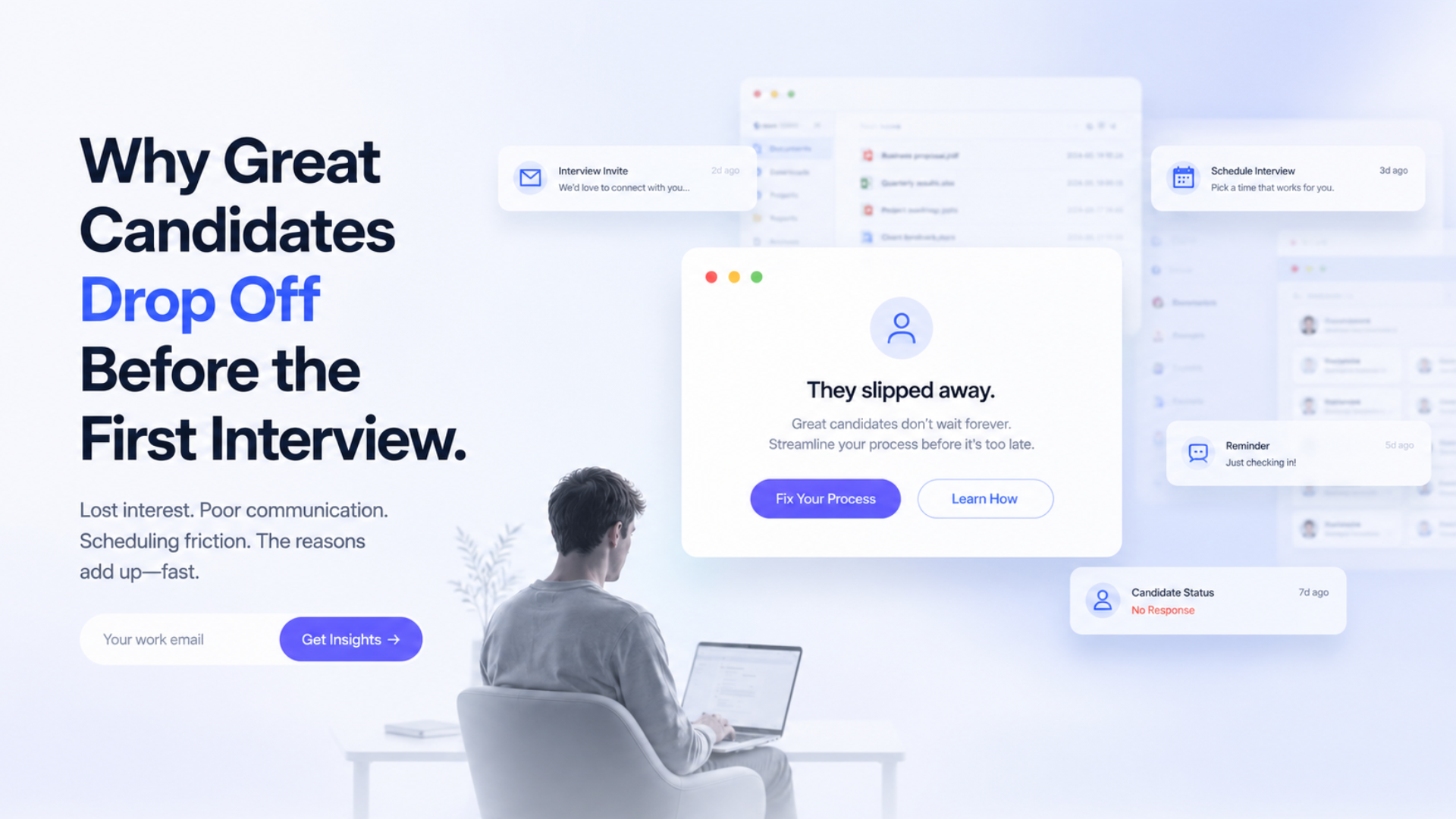
David is a VP of Talent at a Series C healthtech company. Last quarter his team sourced eight hundred candidates, screened two hundred, and scheduled first-round interviews with sixty-two. Only forty-one showed up. Twenty-one candidates, a third of those scheduled, dropped off before the first conversation. Five of them were David's top ten picks for a critical principal engineer role. He did not lose them to competing offers. He lost them to silence. The average time between screening and scheduled interview was thirteen business days. During those thirteen days, candidates received no communication from the recruiting team beyond the initial scheduling confirmation. No updates on the panel composition. No preparation guidance. No expression of continued interest. When David investigated the drop-off pattern, he found that eighty percent of the candidates who withdrew had received only one communication, the scheduling confirmation, between their screening call and their scheduled interview date. The remaining twenty percent had received two or more, but the communications were generic template messages that added no value. The candidates did not withdraw because they lost interest in the role. They withdrew because the silence between screening and interview convinced them that the company had lost interest in them.
Pre-interview drop-off is the most damaging and least measured stage of the recruiting funnel. Organizations obsess over offer acceptance rates and time-to-hire, but they rarely track how many candidates they lose between the screening stage and the first interview, because those candidates do not show up in offer metrics and they do not generate rejection feedback that would make their absence visible. They simply stop responding. The recruiter marks them as withdrawn in the ATS, moves on to the next candidate, and the organization never examines why a candidate who was enthusiastic enough to complete a screening call
disappeared before the interview that was supposed to deepen their engagement. According to SHRM's talent acquisition research, pre-interview drop-off rates average twenty-five to thirty-five percent across industries, meaning that for every ten candidates scheduled for a first interview, three to four will not appear. For senior and specialized roles, the rate climbs to forty to fifty percent. These are not marginal candidates. They are candidates who passed the screening threshold, which means they met the role requirements and expressed genuine interest.
What Pre-Interview Drop-Off Actually Costs the Organization
The cost of pre-interview drop-off extends far beyond the immediate loss of a single candidate. Each candidate who drops off represents the cumulative investment of sourcing effort, screening time, and recruiter relationship-building that produced their initial engagement. When that candidate disappears, the investment is destroyed and the process must start over with a replacement candidate who will require the same investment to reach the same stage. According to Deloitte's talent research, the average fully-loaded cost of advancing a candidate from sourcing to scheduled first interview ranges from eight hundred to fifteen hundred dollars depending on the role level and the sourcing channel. When thirty-five percent of scheduled candidates drop off, the effective cost per actual interview more than doubles. The distinction between AI sourcing and AI recruiting is directly relevant, because sourcing invests significant effort in identifying and engaging these candidates, and the pre-interview drop-off stage destroys that investment without producing any hiring outcome. Huntlo's platform prevents this destruction by maintaining continuous candidate engagement from the moment of sourcing through the first interview and beyond, ensuring that the candidates sourcing identifies are the candidates recruiting actually interviews.
The Silence Between Screening and Interview Is the Killer
The primary cause of pre-interview drop-off is not competing offers, not role misalignment, and not candidate indecision. It is the communication gap between the screening call and the first interview. This gap exists in virtually every recruiting process, regardless of company size or industry, because the process is designed around stages rather than around continuous engagement. The screening stage ends with a positive outcome: the candidate is advanced. The interview stage begins with a scheduled time. Between those two events, there is a period, typically seven to fifteen business days, during which the candidate receives little or no meaningful communication from the recruiting team. During this gap, the candidate's initial enthusiasm, which was at its peak immediately after the screening call, decays. They continue their job search. They receive outreach from other companies. They discuss the opportunity with their network. They begin to question whether the company is serious about hiring them, because a company that takes two weeks to schedule an interview after expressing enthusiasm during screening apparently does not value their candidacy enough to move faster. According to McKinsey's organizational insights, the probability of candidate withdrawal increases by roughly five percent for each business day of silence between the last meaningful
communication and the scheduled interview, meaning that a ten-day silence period produces a fifty percent cumulative withdrawal probability, even for candidates who were highly enthusiastic at the screening stage. Teams that understand how many followups one hire actually needs know that the most critical follow-up is not the one that closes the offer but the one that prevents the candidate from disengaging during the pre-interview gap.
The silence problem is compounded by the scheduling bottleneck, which often extends the pre-interview gap beyond what the candidate considers reasonable. The recruiter completes the screening call, expresses enthusiasm, and tells the candidate they will be in touch soon with interview availability. Then the scheduling process begins, and the recruiter discovers that the hiring manager is traveling, the lead interviewer has back-to-back commitments for the next two weeks, and the second panelist is in a different time zone. What the candidate experiences is not a complex scheduling problem but a ten-day silence followed by a sudden interview invitation that arrives long after their initial enthusiasm has faded. Organizations that add scheduling tools without addressing the underlying communication gap often find they have more tools but the same hiring problems, because the tools may find an interview time faster but they do nothing to maintain the candidate's engagement during the pre-interview period. The candidate experiences a shorter silence instead of a long silence, but a shorter silence is still silence, and it still erodes the candidate's confidence in the organization's interest.
This erosion is especially damaging when hiring for niche and technical roles, where the candidate pool is small and the candidates have multiple competing options. A great technical candidate who receives no communication for a week will almost certainly be interviewing with another company during that week, and the company that communicates more consistently will win their attention and their commitment. The pre-interview gap is not a dead zone where nothing happens. It is the zone where the candidate's decision about whether to pursue this opportunity is actually made. According to EY's technology insights, organizations that measure the financial impact of pre-interview drop-off discover that it is one of the top three most expensive inefficiencies in their recruiting process, because each drop-off represents both a direct cost and an opportunity cost that compounds across the entire hiring pipeline.
The Five Triggers That Predict Pre-Interview Withdrawal
Pre-interview withdrawal is not random. It follows predictable patterns that can be identified, monitored, and addressed before the candidate disengages. The first trigger is scheduling delay. When the time between screening and first interview exceeds seven business days, withdrawal probability climbs sharply. The candidate interprets the delay as a signal that the company is not serious, not organized, or not prioritizing this role. The second trigger is generic communication. When the candidate receives template messages that could have been sent to anyone, they conclude that the company does not see them as an individual. A scheduling confirmation that says your interview is scheduled for Tuesday at 2 PM without any context about the panel, the role, or the team communicates that the organization treats candidates as interchangeable. The third trigger is conflicting information. When the candidate receives
information from the recruiter that does not match what they see on the company's careers page, the job description, or their prior conversations, they begin to doubt the organization's competence. If the recruiter described the role as fully remote but the scheduling confirmation mentions an office address, the candidate will question what else is inaccurate. According to LinkedIn's recruiting resources, conflicting information is the third most common reason candidates cite for withdrawing before the interview, after scheduling delay and silence, because it destroys the trust that is necessary for the candidate to invest additional time in the process.
The fourth trigger is the absence of value-adding communication. Candidates who receive communications that provide genuine value, market intelligence, team context, or career insight, remain engaged even during longer pre-interview periods. Candidates who receive only logistical communications, scheduling confirmations, reminders, and calendar updates, disengage faster because they perceive the relationship as purely transactional. The fifth trigger is competing opportunity acceleration. A candidate who has one active opportunity will wait patiently through a ten-day pre-interview gap. A candidate who receives a competing offer during that gap will not. The candidate does not withdraw because the competing offer is better in every dimension. They withdraw because the competing company moved faster, communicated more consistently, and made the candidate feel valued during the waiting period. An agentic AI recruiting platform like Huntlo monitors for all five triggers continuously and alerts the recruiter when a candidate's engagement risk exceeds the threshold that predicts withdrawal. The system does not wait for the candidate to stop responding. It detects the conditions that lead to non-response and enables the recruiter to intervene before the candidate makes the decision to withdraw. Recruiters concerned about whether AI will replace their jobs should recognize that AI's ability to predict and prevent withdrawal makes the recruiter's relationship skills more valuable, not less, because those skills are now applied proactively to retain candidates rather than reactively to win back candidates who have already disengaged.
How AI Eliminates the Pre-Interview Engagement Gap
AI eliminates the pre-interview engagement gap by maintaining continuous, contextual communication with every candidate in the pipeline, regardless of where they are in the process or how many other candidates the recruiter is managing. The system operates on three principles. The first principle is continuous presence. From the moment the candidate completes the screening call, the AI system maintains an active engagement profile that tracks the candidate's journey stage, their recent interactions, their stated interests and concerns, and their engagement signals. This profile enables the system to generate communications that feel personal and informed rather than generic and automated, even when the recruiter is managing fifty or more candidates simultaneously. The second principle is proactive communication. The AI system does not wait for the candidate to wonder whether they have been forgotten. It sends timely, value-adding communications at intervals that maintain the candidate's engagement without creating communication fatigue. These communications include relevant information about the team they will be interviewing with, market insights that relate to their career interests, and context about the role that deepens their understanding of the opportunity.
According to Gartner's HR trends research, organizations that deploy AI-driven pre-interview engagement reduce their pre-interview drop-off rates by forty to sixty percent, primarily because the continuous communication prevents the silence-driven disengagement that accounts for the majority of pre-interview withdrawals.
The third principle is intelligent escalation. The AI system monitors each candidate's engagement signals, response patterns, and time-in-stage metrics, and it escalates to the recruiter when a candidate shows signs of disengagement that require human intervention. A candidate who stops responding to AI-generated communications is flagged immediately. A candidate whose response time is increasing is flagged as at-risk. A candidate who has been in the pre-interview stage longer than the benchmark for their role type is flagged for priority follow-up. This escalation capability ensures that the recruiter's limited time is directed to the candidates who most need human attention, rather than being distributed evenly across the pipeline regardless of engagement risk.
The quality of the candidate intelligence that powers these communications is foundational. Teams that have struggled with outdated candidate data in AI tools understand that engagement built on stale information backfires, because the candidate recognizes when the recruiter's messages do not reflect their current professional reality. When evaluating platforms, use the framework for evaluating an AI sourcing tool before buying to ensure that real-time intelligence and data freshness are core capabilities that support continuous engagement. Data consistently confirms that referred candidates have lower pre-interview drop-off rates, and referrals outperform cold outreach in part because the referring employee provides informal engagement during the pre-interview period that keeps the candidate connected. AI provides this same continuous engagement for every candidate, creating a pipeline where no candidate falls silent between screening and interview. Huntlo delivers continuous pre-interview engagement, proactive communication, and intelligent escalation that eliminate the drop-off that plagues traditional recruiting. Great candidates do not have to be lost. Huntlo makes sure they are not. Start protecting your pipeline with Huntlo.