Marcus Weber, the chief people officer at a European technology company with engineering offices in Berlin, Austin, Bangalore, and Sao Paulo, reviewed the weekly hiring dashboard on Monday morning and felt the familiar frustration. Three candidates in the final round had scheduling conflicts that pushed their interviews to the following week. A senior engineer candidate in Bangalore had been waiting eleven days for a panel interview because the hiring manager in Berlin and the technical interviewer in Austin could not find a common one-hour window that respected both European and American working hours. A product manager candidate in London had received a competing offer from a company that had completed its entire interview process in six days flat. Marcus recruiters were talented and dedicated, but they were spending sixty percent of their time on scheduling logistics rather than candidate engagement. Every week, the same pattern repeated: email threads across time zones, missed connections, rescheduled panels, and candidates who quietly accepted offers from faster competitors. The company had invested heavily in employer branding, competitive compensation, and a remote-first culture to attract global talent. But none of those investments mattered if the scheduling process could not deliver a confirmed interview before the candidate lost interest or accepted another offer.
The Time Zone Problem That Limits Global Talent Access
Marcus Weber, the chief people officer at a European technology company with headquarters in Berlin and engineering offices in Austin, Bangalore, and Sao Paulo, faced a recruiting challenge that his team could not solve with effort alone. His Austin office needed senior backend engineers, and the best candidates were in Bangalore and Eastern Europe. His Bangalore office needed product managers, and the strongest applicants were in Austin and London. Every cross-regional hire required coordinating interviews across time zones spanning nine to twelve hours, a process that routinely took three weeks or more per candidate. By the time an interview was finally scheduled, the candidate had often accepted another offer. Research published by SHRM on global talent acquisition has found that time zone coordination is the
single most frequently cited barrier to cross-border hiring, with seventy percent of global recruiting leaders reporting that scheduling delays have directly caused them to lose candidates to competitors who moved faster. The irony is that global hiring is driven by the recognition that talent is distributed globally, yet the scheduling infrastructure used to access that talent remains stubbornly local in its design and assumptions.
The time zone problem is not simply a matter of converting clock times. It is a multi-dimensional coordination challenge that affects every aspect of the hiring process. When a hiring manager in Berlin wants to interview a candidate in Bangalore at a time that also accommodates a panelist in Austin, the feasible window may be as narrow as one or two hours on specific days of the week, and those windows shift constantly as individual schedules change. Traditional scheduling tools treat time zones as a simple arithmetic offset, adding or subtracting hours to convert between locations. This approach fails to account for the human realities that determine whether a time slot is actually workable: local business hours norms that differ by culture, religious observances and local holidays that vary by country, daylight saving time transitions that occur on different dates in different hemispheres, and individual preferences for morning or afternoon interviews that affect interviewer performance and candidate experience. An agentic AI recruiting platform handles all of these factors as constraints within a unified optimization model, producing time slot recommendations that are not merely technically feasible but genuinely practical for every participant regardless of their location on the globe. This is the foundational capability that makes global hiring operationally viable rather than theoretically possible.
The competitive consequences of failing to solve the time zone problem are severe and accelerating. As remote and distributed work becomes the norm rather than the exception, the pool of candidates willing to work for a given employer has expanded dramatically, but so has the pool of competitors vying for those same candidates. A candidate in Lagos who is willing to work remotely for a company in London is also being recruited by companies in Singapore, Dubai, and New York. The employer that schedules the interview fastest and most professionally wins. Organizations that rely on manual cross-time-zone scheduling, with its inevitable delays, miscommunications, and candidate friction, are systematically losing the competition for global talent to organizations that have invested in intelligent scheduling infrastructure. This is not a marginal competitive disadvantage. In talent markets where the best candidates receive multiple offers within days of entering the process, scheduling speed and professionalism are decisive factors. The organizations that win the global talent competition are not necessarily those with the strongest employer brands or the highest compensation. They are often simply the ones that made scheduling effortless across time zones while their competitors were still composing emails about calendar conflicts.
Why Manual Scheduling Collapses at Global Scale
Manual scheduling works adequately when all participants are in the same time zone and the hiring volume is modest. It collapses under the weight of global scale for three structural reasons. First, the communication overhead grows multiplicatively rather than additively as time
zones, participants, and concurrent hiring streams increase. A recruiter coordinating a three-person panel across one time zone needs to manage a handful of messages. The same recruiter coordinating a five-person panel across three time zones with participants using different calendar platforms and different working hour norms faces a coordination challenge that is orders of magnitude more complex, not three times more complex. Research from McKinsey on the operational complexity of global hiring processes has documented that manual scheduling effort increases by a factor of five to eight when crossing from single-region to multi-region hiring, far exceeding the proportional increase in hiring volume. This non-linear complexity growth means that adding more recruiters to handle global scheduling produces diminishing returns because each additional recruiter must navigate the same coordination complexity that made the original scheduling burden unsustainable.
Second, manual scheduling introduces latency that is fatal in global talent markets. When a recruiter in Berlin emails a hiring manager in Austin about availability for a candidate in Bangalore, the response time is determined by the intersection of three working days across three time zones. A request sent Monday morning in Berlin arrives Sunday evening in Austin, and the hiring manager may not respond until Monday afternoon Austin time, which is Monday night in Berlin. The recruiter sees the response Tuesday morning Berlin time and can then contact the candidate in Bangalore, where it is already Tuesday afternoon. Each step in this sequential communication cycle adds twelve to twenty-four hours of latency. For a scheduling process that requires three or four rounds of communication, the total delay easily exceeds one week even when every participant responds promptly. For niche or technical roles where candidates are typically evaluating multiple opportunities simultaneously, a one-week scheduling delay is often sufficient for the candidate to accept a competing offer from an organization that moved faster. The latency problem is fundamentally unfixable through recruiter effort because it is caused by the sequential nature of cross-time-zone communication, not by recruiter responsiveness.
Third, manual scheduling generates errors that damage the candidate experience and the employer brand. Time zone conversions performed manually are error-prone, and the consequences are immediately visible to candidates. A hiring manager who accidentally proposes a time that is midnight in the candidate location signals that the organization does not understand or respect the candidate circumstances. An invitation that shows the wrong time due to a daylight saving time miscalculation creates confusion and erodes candidate confidence. When scheduling systems rely on outdated candidate or interviewer data to calculate time zone offsets, the proposed slots may reflect availability that has changed since the data was last updated, resulting in invitations to times that are no longer feasible for one or more participants. These errors are not rare edge cases. They are routine occurrences in global manual scheduling, and they compound the already significant challenge of building candidate trust across cultural and geographic boundaries. Candidates interpret scheduling errors as evidence of organizational dysfunction, and in competitive global talent markets, that interpretation is often enough to end the candidate engagement regardless of the quality of the role or the strength of the employer brand.
How Intelligent Scheduling Enables True Global Hiring
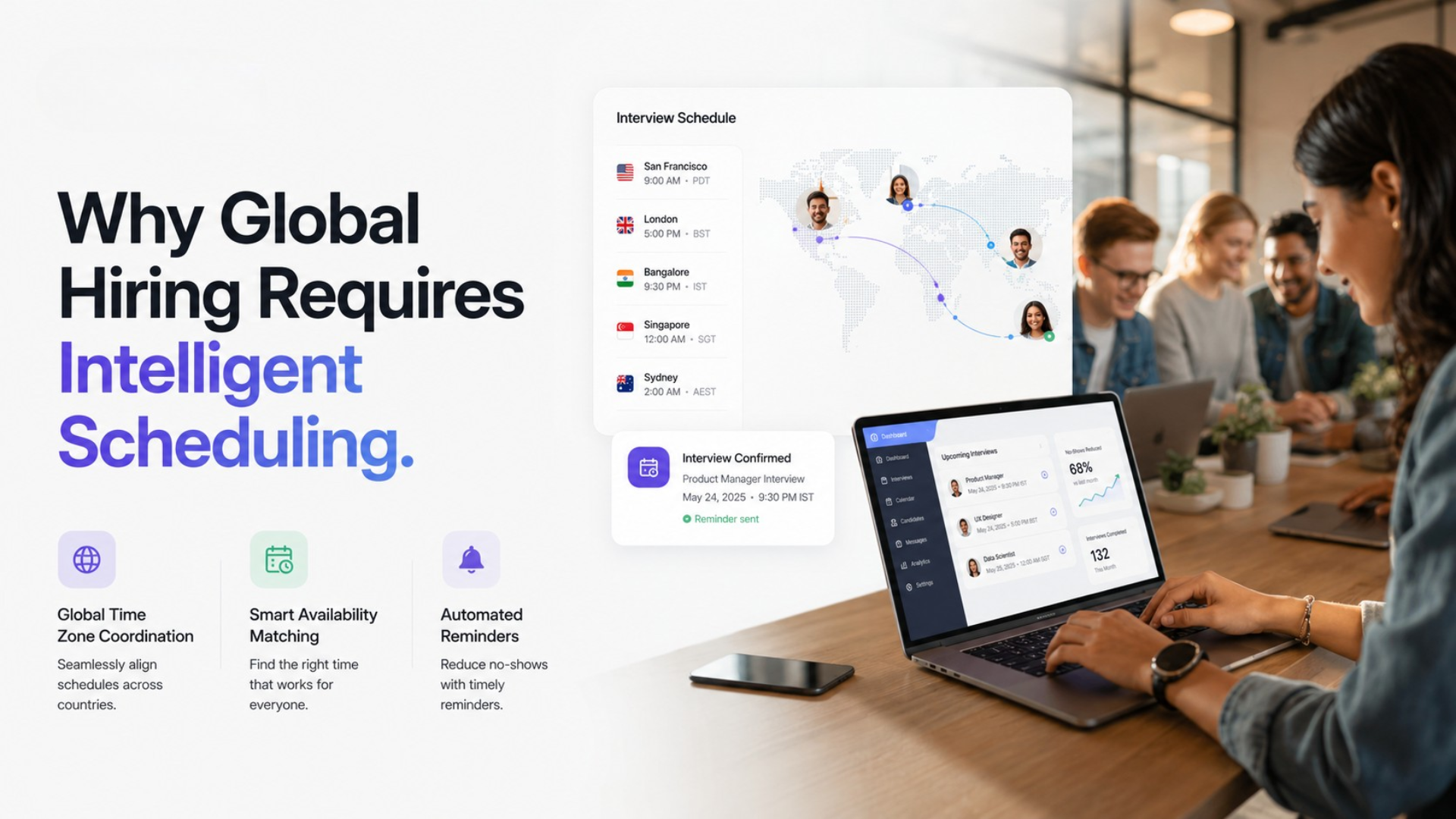
Intelligent scheduling systems enable global hiring by replacing sequential manual coordination with parallel automated optimization. The core mechanism is simultaneous availability evaluation across all participants regardless of time zone. Instead of a recruiter querying each participant sequentially and manually comparing results, the AI system connects to each participant calendar in real time, evaluates all possible time slots against all constraints simultaneously, and presents validated options that work for everyone. This parallel processing reduces scheduling time from weeks to hours, a transformation that fundamentally changes the dynamics of global hiring. According to LinkedIn talent solutions research on global hiring trends, organizations that deploy AI scheduling for cross-border hiring reduce average time-to-interview by sixty to eighty percent compared to manual coordination, with the largest improvements occurring for interviews involving participants in three or more time zones. This speed improvement is not incremental. It is transformative, because it compresses the scheduling timeline to a point where the candidate experience in a global hiring process becomes indistinguishable from the experience in a local one.
Beyond speed, intelligent scheduling systems provide capabilities that are simply impossible to deliver through manual coordination. Real-time availability monitoring means that when a panelist in one time zone has a schedule change, the system immediately re-evaluates all affected interviews and proposes updated slots before any participant is inconvenienced. Automated time zone handling accounts for daylight saving time transitions, local holidays, and cultural working hour norms as constraints within the optimization model, eliminating the errors that plague manual conversion. One-click rescheduling allows candidates or panelists to propose alternative times at any hour of the day, with the system automatically evaluating the new time against all other participants and confirming instantly. This capability is particularly valuable when managing follow-up scheduling between interview rounds in a global process, because the compressed timeline between rounds leaves no margin for the delays that manual rescheduling would introduce. Research on why referrals outperform cold outreach has consistently found that scheduling speed and professionalism are among the strongest predictors of candidate engagement in global hiring processes, because candidates in cross-border hiring situations face higher uncertainty and lower trust, and they interpret fast, error-free scheduling as a signal that the organization is competent, organized, and genuinely interested in them as individuals rather than as interchangeable resources.
Intelligent scheduling also enables global hiring at scale by automating the communication complexity that accompanies cross-time-zone coordination. Calendar invitations are generated with localized time displays for each participant, so a panelist in Berlin sees the time in Central European Time while a panelist in Austin sees the same interview in Central Standard Time. Reminder notifications are sent at appropriate times for each time zone, ensuring that a candidate in Bangalore receives a reminder at a useful local time rather than at three in the morning. Rescheduling communications are handled automatically and transparently, with all participants receiving updated invitations in their local time without manual intervention. This communication automation eliminates an entire category of scheduling errors that are
endemic to global manual coordination and that disproportionately damage the candidate experience. The broader principle at work is explored in discussions about the difference between AI sourcing and AI recruiting, where the most effective tools are those that orchestrate entire cross-functional workflows rather than performing isolated tasks. Intelligent scheduling for global hiring operates at the workflow orchestration level, managing not just calendar math but the complete human communication process that surrounds every interview across every time zone.
Cultural and Regulatory Considerations in Global Scheduling
Global scheduling is not only a technical challenge. It is also a cultural and regulatory one. Interview scheduling practices that are standard in one region may be inappropriate or illegal in another. In some European countries, scheduling interviews outside of standard business hours may raise compliance concerns under working time regulations. In the Middle East, scheduling around prayer times and Friday observances is essential for candidate respect. In India, scheduling around major festival periods requires awareness of regional holiday calendars that differ by state. An intelligent scheduling system designed for global use must encode these cultural and regulatory considerations as constraints within the optimization model, ensuring that proposed time slots are not only feasible but appropriate for every participant cultural context. According to Gartner research on global HR technology requirements, organizations that deploy scheduling systems without cultural and regulatory awareness report thirty to forty percent higher candidate complaint rates and significantly lower offer acceptance rates in affected regions, because candidates interpret culturally insensitive scheduling as a signal that the organization does not understand or value the markets it is hiring in.
Regulatory compliance adds another layer of complexity. The European Union General Data Protection Regulation imposes specific requirements on how personal data, including calendar data, is processed and stored. Some countries require that interview invitations include specific disclosures about data processing. Others have restrictions on recording interviews or collecting certain types of candidate information during the hiring process. When scheduling systems operate across multiple regulatory jurisdictions, they must be configurable to enforce the specific requirements of each jurisdiction without requiring recruiters to manually track and apply different compliance rules for different candidates. For organizations evaluating global scheduling tools, guidance on how to evaluate an AI sourcing tool before buying recommends verifying that the system supports jurisdiction-specific compliance configurations and can enforce different rules for different candidate and interviewer locations simultaneously. Tools that offer a single global configuration without regional adaptability create compliance risk that increases as the organization expands into additional markets.
Cultural considerations also extend to the candidate communication style and the interview experience itself. In some cultures, candidates expect a high degree of formality in scheduling communications, including detailed logistical information and advance notice measured in days rather than hours. In others, candidates prefer concise, direct communications and are comfortable with shorter notice periods. An intelligent scheduling system that operates
globally must be adaptable in its communication style, presenting information in a format and tone that matches the expectations of each candidate cultural context. This adaptability extends to the interview format as well. For candidates in regions with unreliable internet infrastructure, the system should prioritize video interview platforms that work well on low-bandwidth connections or offer telephone-based alternatives. Many organizations have attempted to address these cultural complexities by adding more tools to their recruiting stack, adding region-specific communication platforms or compliance management systems alongside their existing scheduling tools. The result is typically increased complexity and fragmentation rather than improved cultural sensitivity, because the tools are not integrated and cannot coordinate their behavior across the full scope of the global scheduling process.
Building a Scheduling Infrastructure for Global Hiring
Building a scheduling infrastructure that supports global hiring requires a deliberate approach that addresses technical, cultural, and organizational dimensions simultaneously. The first requirement is real-time calendar integration across all platforms and regions. The system must connect to Microsoft Outlook, Google Calendar, and any regional calendar platforms used by the organization, maintaining continuous synchronization that reflects schedule changes within seconds. Without this real-time foundation, every other capability, time zone optimization, conflict resolution, and automated communication, operates on stale data and produces unreliable results. Deloitte analysis of global HR technology infrastructure has found that real-time calendar integration is the single most important technical prerequisite for global scheduling, and that organizations that attempt to deploy AI scheduling without real-time integration achieve only twenty to thirty percent of the improvement realized by organizations with fully integrated calendar platforms.
The second requirement is configurable time zone and cultural awareness. The scheduling system must maintain a comprehensive database of time zone rules, including daylight saving time transitions, local holidays by region, cultural working hour norms, and regulatory constraints on interview scheduling. This database must be continuously updated and automatically applied to all scheduling decisions. The third requirement is unified communication that adapts to local context. Every participant, whether candidate, hiring manager, or panelist, should receive scheduling communications in their local time zone, in their preferred language when possible, and in a format that matches cultural expectations for business communication. The fourth requirement is scalable orchestration that handles the combinatorial complexity of global scheduling without performance degradation as the number of regions, participants, and concurrent hiring streams increases. EY research on technology infrastructure for global operations has found that the most successful global scheduling implementations are those that treat the system as a shared platform used by all regions rather than a set of regional deployments, because a shared platform provides visibility across the entire global hiring operation and enables optimization that spans regional boundaries.
For Marcus, the chief people officer who watched his recruiters struggle to connect Berlin hiring managers with Bangalore candidates and Austin panelists, intelligent scheduling was
the missing capability that would transform global hiring from an aspiration into an operational reality. His team did not lack recruiting skill. They lacked a scheduling infrastructure that could handle the time zone complexity, cultural sensitivity, and communication demands of coordinating interviews across three continents. The technology to provide that infrastructure exists today. Organizations that deploy it will access the full global talent pool, schedule interviews across time zones as effortlessly as they schedule them across the hall, and deliver a candidate experience that reflects the professionalism and cultural awareness that global talent expects and deserves. The organizations that do not will continue to fight a scheduling battle they cannot win with manual effort, watching their best global candidates accept offers from competitors who made the time zone problem invisible. A common concern among recruiting leaders considering global scheduling technology is whether automation will reduce the human connection that is essential to successful hiring in diverse cultural contexts. Research on whether recruiters should worry about AI replacing their jobs consistently shows the opposite effect in global hiring: by eliminating the scheduling complexity that consumes recruiter time without adding value, AI scheduling frees recruiters to invest more time in the cross-cultural relationship-building, candidate engagement, and strategic advisory activities that actually determine whether a global hire succeeds. The AI handles the time zones. The recruiters handle the human connections that turn a global candidate into a committed new hire.