Jordan starts every Monday morning with the same ritual. She opens her spreadsheet, scans the list of active candidates, and sorts by last contact date. There are always names that should not be there, candidates she meant to follow up with on Thursday, then Friday, and now it is Monday and the window has closed. She prioritizes the hottest ones, crafts careful messages for each, and feels good about her morning. By Wednesday, her spreadsheet has new names that need attention. By Thursday, three candidates from Monday have not replied and need second touches. By Friday, she is choosing between writing new outreach messages or following up with candidates who are already in the pipeline. Someone always gets left behind. The spreadsheet grows, the follow-ups get shorter and more generic, and the candidates who needed the most personalized attention are the ones who receive the least. Jordan is not a bad recruiter. She is a recruiter operating without an automated follow-up strategy, which means she is operating with a structural disadvantage that no amount of effort or talent can overcome.
The recruiting industry has reached a point where the volume and complexity of candidate communication exceed what manual processes can reliably deliver. The average recruiter managing fifteen to twenty-five active candidates simultaneously, each at a different stage of the hiring process, each with a different communication history and set of needs, cannot maintain personalized, timely follow-up with every candidate through manual effort alone. The math is straightforward but unforgiving. If each candidate requires an average of six to eight touchpoints across the hiring process, and each touchpoint takes fifteen to twenty minutes to research, draft, and send, a recruiter with twenty active candidates is looking at thirty to fifty-three hours of follow-up work per week, which is more hours than exist in the work week. Something has to give, and what usually gives is the quality, timeliness, or consistency of follow-up. The result is predictable: candidates disengage, offers go unaccepted, and hiring
timelines extend while the root cause, a system that demands more than human capacity can deliver, goes unaddressed. According to SHRM's talent acquisition research, recruiter workload overload is the single most cited reason for follow-up failures, and follow-up failures are the single most cited reason for candidate dropout. The solution is not to hire more recruiters or to work longer hours. It is to automate the follow-up process in a way that maintains personalization while eliminating the manual burden.
The Math That Makes Manual Follow-Ups Impossible
The core problem with manual follow-ups is not recruiter effort or commitment. It is the combinatorial complexity of managing multiple candidates at multiple stages with multiple touchpoints each. A recruiter with ten active candidates, each requiring a different follow-up at a different time with different content, faces a coordination challenge that grows exponentially rather than linearly as candidate volume increases. With five candidates, manual follow-up is manageable. With ten, it requires careful organization. With twenty, it exceeds the capacity of even the most disciplined and talented recruiter, because the interruptions, shifting priorities, and unexpected demands of a typical recruiting day make it impossible to maintain the systematic attention that each candidate deserves. The recruiter does not fail because they are disorganized. They fail because the system they are operating in was designed for a simpler era with fewer candidates, fewer channels, and lower candidate expectations.
This complexity problem is compounded by the fact that follow-up timing matters enormously. Research consistently shows that the response rate to a follow-up message decays sharply after the first twenty-four to forty-eight hours, and that the optimal timing varies by candidate based on their communication patterns, engagement level, and the stage of the hiring process. A manual system cannot optimize timing for each individual candidate because the recruiter does not have the bandwidth to track and act on these signals across twenty simultaneous relationships. They follow up when they can, which is often when it is convenient for their schedule rather than when it is optimal for the candidate. This misalignment between recruiter capacity and candidate need is the fundamental reason that manual follow-up systems produce inconsistent results regardless of how skilled the recruiter is. The recruiters who understand the difference between AI sourcing and AI recruiting recognize this capacity gap clearly. Sourcing can be done in batches because it does not require real-time responsiveness. Follow-up, the engagement part of recruiting, requires continuous attention to individual candidate signals, and that is precisely the kind of work that automation handles better than manual processes.
What Automated Follow-Up Actually Means (And What It Does Not)
The phrase automated follow-up carries connotations that make many recruiters uncomfortable. It sounds like templates, blast emails, and the kind of impersonal communication that candidates delete without reading. This concern is valid for the kind of automation that was available five or ten years ago, when automated follow-up meant scheduling a sequence of
template messages to be sent on fixed intervals regardless of candidate behavior. That approach is automation without intelligence, and it deserves the negative reputation it has earned. Modern AI-powered automated follow-up is fundamentally different. It is not about sending the same message to everyone on a schedule. It is about using AI to maintain awareness of each candidate's status, detect engagement signals, and generate personalized follow-up recommendations that the recruiter can review, refine, and send in minutes rather than hours. The automation handles the information processing, signal detection, and draft generation. The recruiter handles the judgment, personalization, and relationship management. This division of labor is what makes modern automated follow-up both scalable and personal, a combination that was previously impossible.
The practical difference between old automation and modern AI-powered automation is the difference between a sprinkler system and an intelligent irrigation system. A sprinkler waters everything on a schedule, whether each plant needs it or not. An intelligent irrigation system monitors soil moisture, sunlight exposure, and plant type, and delivers precisely the right amount of water to each plant at precisely the right time. Both automate the delivery of water. Only one does it intelligently. In the same way, modern AI-powered follow-up systems monitor each candidate's engagement signals, analyze their communication history, and generate follow-up recommendations that are calibrated to the individual candidate's needs and behavior. This is what distinguishes an agentic AI recruiting platform from a simple automation tool. The agentic system observes, learns, and acts based on real-time conditions. The automation tool executes a pre-defined sequence regardless of conditions. The results are dramatically different. Organizations that deploy intelligent automation see significantly higher candidate engagement rates than those that deploy simple sequence-based automation, because candidates receive messages that are relevant to their specific situation rather than generic templates that could apply to anyone. The teams that add simple automation tools without upgrading to intelligent systems often find they have more tools but the same hiring problems, a pattern explored in the analysis of organizations with more tools but the same hiring problems. The technology must match the complexity of the challenge.
The Engagement Data That Demands Automation
The case for automated follow-up is not just about recruiter capacity. It is also about the data that is available to inform follow-up decisions but that no human recruiter can process manually at scale. Every candidate interaction generates data: email open times, response times, message length, topic engagement, LinkedIn profile views, and application page visits. This data contains powerful signals about the candidate's engagement level, interest trajectory, and the optimal timing and content for the next interaction. A candidate who opens emails within two hours of receiving them and responds within a day is signaling high engagement and should receive a different follow-up strategy than a candidate who opens emails after twenty-four hours and responds in fragments over several days. A candidate whose recent messages have gotten shorter is showing early signs of disengagement and may need a high-value touchpoint, such as a relevant article or a proactive concern resolution, to rekindle their
interest. A candidate who has started viewing the company's careers page more frequently is showing increased intent and may be ready for a concrete next step like interview scheduling.
These signals are available in the data, but processing them across twenty or more candidates simultaneously is beyond human cognitive capacity. An AI system can monitor these signals continuously for every candidate in the pipeline and trigger follow-up recommendations based on what the data is saying. This signal-based approach to follow-up timing and content is dramatically more effective than schedule-based approaches, because it aligns the follow-up with the candidate's actual behavior and needs rather than an arbitrary calendar. According to McKinsey's organizational insights organizations using signal-based automated follow-up systems see twenty-five to forty percent improvements in candidate response rates compared to those using fixed-schedule approaches, because the follow-ups arrive at the moment the candidate is most receptive rather than at a moment determined by the recruiter's convenience. This is especially important for niche and technical roles where candidate communication patterns vary widely and a one-size-fits-all cadence will miss the optimal moment for a significant portion of the talent pool. The AI does not replace the recruiter's understanding of when and how to reach out. It amplifies it by providing data-driven recommendations that the recruiter would not have the time or bandwidth to generate manually. Understanding how many followups one hire actually needs is a starting point, but the data-driven approach goes further by determining not just how many but when, through which channel, and with what content for each individual candidate.
How AI Makes Automated Follow-Ups Personal at Scale
The most common objection to automated follow-up is the fear of losing personalization. Recruiters rightly value the personal touch that distinguishes great recruiting from adequate recruiting, and they worry that automation will replace genuine, human communication with robotic templates. The reality of modern AI-powered follow-up is the opposite. The AI generates message drafts that are grounded in the specific details of each candidate's interactions, career background, and expressed interests. A recruiter who uses AI-powered automation can deliver a follow-up that references the candidate's recent project, addresses a concern they raised during the screening call, and connects the role to their stated career goals, all in a message that takes three minutes to review and send rather than forty-five minutes to research and draft from scratch. The result is not less personal. It is more personal, because the AI enables the recruiter to deliver this level of personalization to every candidate rather than only the ones they have time to research manually. The candidates who receive this AI-supported personalization do not know or care that a machine helped draft the message. They experience a recruiter who remembers their conversation, understands their priorities, and provides relevant, timely communication.
This scale-of-personalization advantage is transformative for recruiting outcomes, and it is the primary reason that organizations investing in AI-powered follow-up are seeing such significant improvements in candidate engagement and conversion rates. It also explains why
referred candidates have historically outperformed cold-sourced candidates in engagement metrics. Referrals arrive with built-in context, the referring employee provides the recruiter with information about the candidate's background, interests, and priorities that enables personalized communication from the very first interaction. This is why referrals outperform cold outreach so consistently. AI-powered follow-up systems give every candidate the referral experience by automatically generating the context that makes personalized communication possible, even when the candidate came through cold outreach. According to LinkedIn's recruiting resources candidates who receive AI-personalized follow-ups report satisfaction levels comparable to those of referred candidates, because the experience of being understood and valued is the same even when the mechanism that produced it is different. The recruiters concerned about whether AI will replace their jobs should recognize that AI is not replacing the personal touch. It is making it scalable, ensuring that every candidate receives the kind of attentive, informed communication that was previously reserved for a small handful of high-priority prospects. However, the quality of AI-generated personalization depends entirely on the quality of the underlying data. Teams that have struggled with outdated candidate data in AI tools know that AI personalization based on stale information will miss the mark, potentially damaging the relationship rather than enhancing it. Data quality is a prerequisite, not an afterthought.
Building Your First Automated Follow-Up Strategy
Implementing an automated follow-up strategy does not require a complete technology overhaul. It requires a systematic approach that can be implemented incrementally. The first step is to map the current follow-up process, documenting every stage at which candidates receive communication, who is responsible for that communication, how long it typically takes, and what the response rates look like. This mapping will reveal the gaps: stages where follow-up is delayed, inconsistent, or missing entirely. The second step is to define the engagement standard for each stage. What is the maximum acceptable time to first follow-up? What information should every follow-up contain? What is the minimum personalization requirement? These standards create the target that automation will help you hit consistently. The third step is to select the right technology. When evaluating platforms, use a structured approach such as the framework for evaluating an AI sourcing tool before buying adapted for follow-up capabilities. The key criteria should include signal awareness, the ability to detect engagement changes in real time; contextual personalization, the ability to generate messages that reference specific conversation history; and adaptive cadence, the ability to adjust timing based on candidate behavior rather than fixed schedules.
The fourth step is to implement the strategy in phases, starting with the highest-impact touchpoints. For most teams, the first follow-up after initial contact is the highest-leverage point, because it has the greatest impact on whether the candidate continues engaging. Automating this touchpoint first, with AI-powered personalization and signal-based timing, will produce immediate and measurable improvements in response rates and pipeline conversion. The fifth step is to measure, iterate, and expand. Track the metrics that matter, response rates, response
times, stage progression rates, and candidate satisfaction, and use the data to refine the automation rules, message templates, and timing parameters. According to Gartner's HR trends research organizations that implement automated follow-up in incremental phases, measuring and optimizing at each stage, achieve faster time to value and higher long-term engagement than those that attempt a full-process automation all at once. The sixth step is to extend the automation across the entire candidate journey, from first touch to post-hire, creating a seamless engagement experience that no candidate falls through. EY's technology insights report that enterprises with mature automated follow-up systems covering the full candidate journey are achieving forty to fifty percent reductions in candidate dropout rates, because the automation ensures that no stage is left without timely, personalized communication, regardless of recruiter workload or hiring volume.
From Automation to Intelligence: The Next Evolution
The evolution of automated follow-up is moving from execution to intelligence. First-generation automated follow-up executed pre-defined sequences on fixed schedules. Current-generation AI-powered follow-up generates personalized messages based on candidate data and engagement signals. The next generation will add predictive intelligence, anticipating candidate needs and proactively addressing them before the candidate even asks. A candidate who is likely to disengage based on their engagement pattern will receive a re-engagement touchpoint before they have made the conscious decision to stop responding. A candidate who is likely to receive a competing offer based on their market profile and engagement timeline will receive a proactive acceleration of the hiring process, with interview scheduling and decision timelines compressed to maintain competitive position. A candidate whose concerns are likely to intensify as they approach the offer stage will receive preemptive concern resolution that addresses those concerns before they become decision-blocking objections. This predictive capability does not replace the recruiter's judgment. It augments it by providing foresight that manual observation cannot deliver across a large candidate pool. Deloitte's talent research identifies predictive engagement as the defining capability of next-generation recruiting technology, because it transforms follow-up from a reactive activity, responding to what has happened, into a proactive one, anticipating what will happen and acting to shape the outcome before it is determined by default.
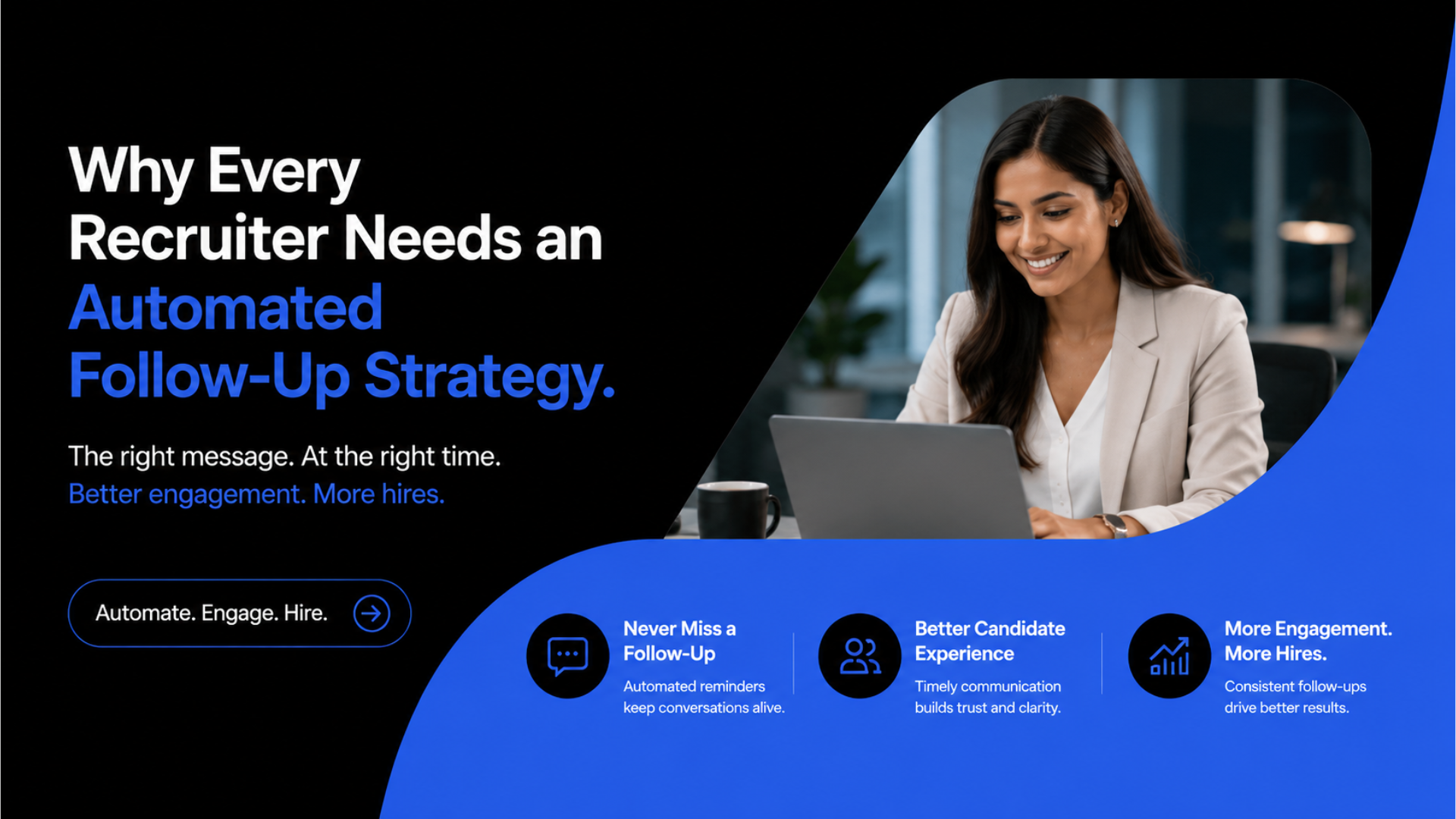
Manual follow-up is not a virtue. It is a limitation. The belief that every follow-up must be manually crafted and sent is not a sign of recruiter dedication. It is a sign of a system that has not yet adopted the tools that make consistent, personalized engagement achievable at the scale modern recruiting demands. Every week that your team relies on manual follow-up, candidates fall through the cracks, engagement decays in the gaps between touchpoints, and the best talent goes to competitors who move faster and more consistently. Automated follow-up is not about replacing the recruiter. It is about giving the recruiter the capacity to deliver their best work to every candidate, not just the ones they have time for. Huntlo.ai provides the intelligence layer that makes this possible: signal-based timing, contextual personalization, and adaptive cadence that ensures every candidate receives fast, relevant, and genuinely
personal communication at every stage. Stop choosing between quality and scale. Build a follow-up strategy that delivers both. Build it with Huntlo.