Rachel identified the perfect product manager candidate on a Tuesday afternoon. The profile matched every requirement. The candidate had led a product launch at a competitor, held the right title, and even listed the exact framework her hiring manager wanted experience with. Rachel sent a personalized outreach message that evening and went to sleep feeling good about the pipeline. The candidate replied Wednesday morning with two paragraphs about their current role and a question about the product roadmap. Rachel read the reply during a busy Thursday packed with interview debriefs and hiring manager syncs. She told herself she would craft a thorough response on Friday. Friday came, she sent a detailed message, and received an out-of-office auto-reply. On Monday she followed up again. On Tuesday she received a two-sentence reply: thanks for reaching out, but I have accepted another position. The other company had responded within four hours of the candidate's initial inquiry on Wednesday, scheduled a call for Thursday, and extended an offer by Friday. Rachel had the right candidate. The timeline had the right someone else.
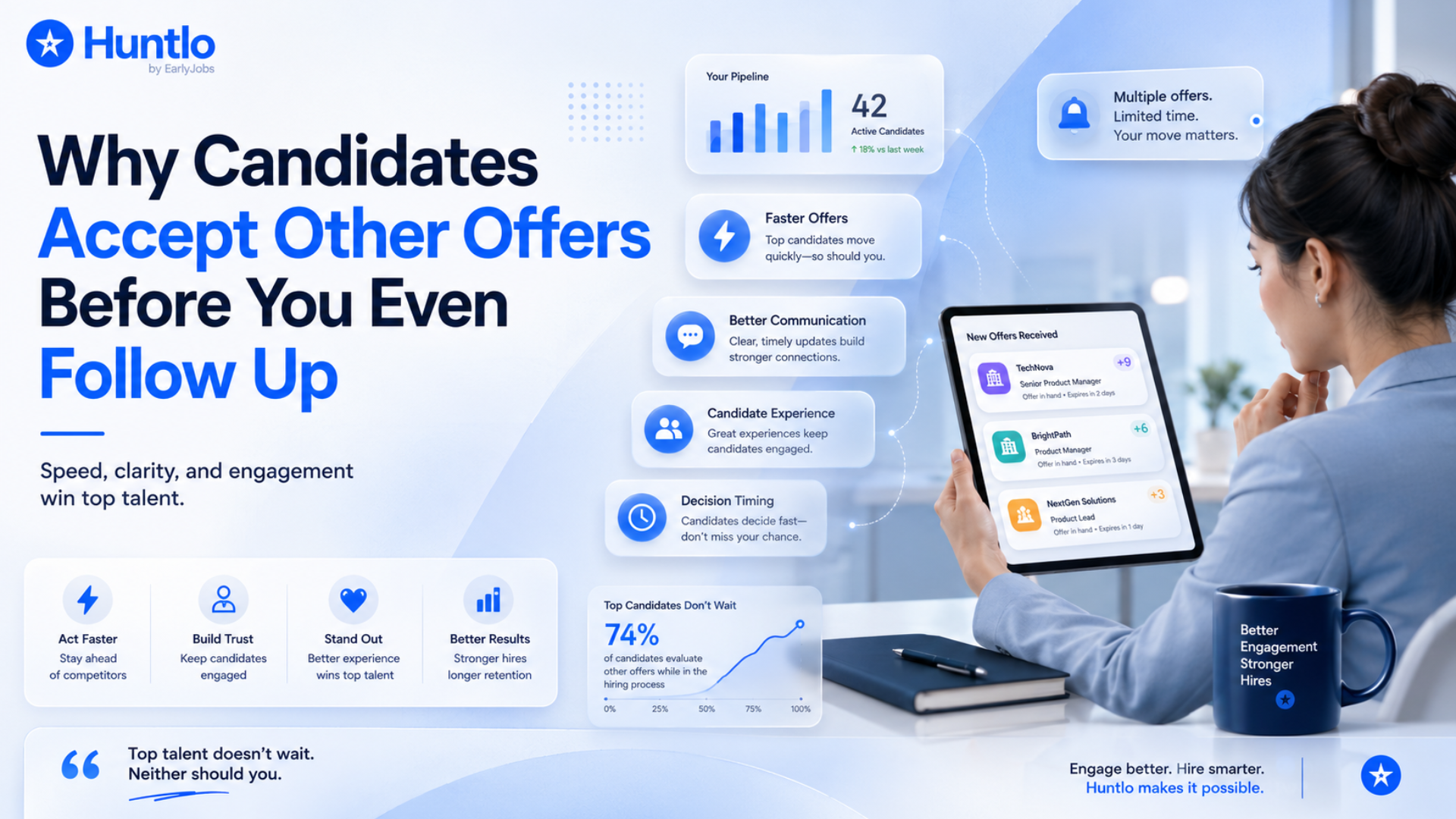
This scenario plays out thousands of times every week across the recruiting industry, and the outcome is almost always attributed to the wrong cause. The hiring manager assumes the competitor offered more money. The recruiter assumes the candidate was not that serious. The talent acquisition leader assumes the employer brand needs work. In reality, the most common reason candidates accept other offers is none of these. It is follow-up speed. The candidate chose the company that responded faster, engaged more quickly, and moved them through the process with less delay, not because that company was objectively better but because it felt better in the moment of decision. According to SHRM's talent acquisition research, the first recruiter to establish substantive contact with a qualified candidate wins the hire approximately sixty percent of the time when multiple companies are pursuing the same person. This statistic should terrify every recruiting leader whose team's average time to first
follow-up exceeds twenty-four hours, because it means they are systematically conceding the majority of competitive hiring situations to organizations that simply move faster.
The Forty-Eight-Hour Window That Decides Everything
Research on candidate behavior consistently identifies a critical window in the first forty-eight hours after a candidate expresses initial interest. During this window, the candidate's engagement level is at its peak. They are curious about the opportunity, motivated to learn more, and psychologically receptive to a conversation. This receptivity is not stable. It decays rapidly as time passes and as other demands compete for the candidate's attention. A candidate who receives a substantive, personalized response within hours of expressing interest is engaging with the opportunity while their curiosity is at maximum intensity. A candidate who waits two, three, or four days for a response is engaging with a version of the opportunity that has been filtered through days of competing priorities, diminishing curiosity, and the natural psychological tendency to favor the status quo over change. The difference in engagement quality between these two scenarios is not incremental. It is transformational. The candidate who connects during the peak-receptivity window forms a positive first impression of the organization that colors every subsequent interaction. The candidate who connects after the window has closed is already in a comparative evaluation mode, weighing your opportunity against others they have already engaged with, and your late arrival puts you at an inherent disadvantage.
The forty-eight-hour window is not a suggestion. It is a biological and psychological reality. Cognitive science has shown that interest follows an exponential decay curve when not reinforced. The candidate who was excited about your role on Tuesday is measurably less excited by Thursday if nothing has reinforced that excitement. This decay is invisible to the recruiter, who often assumes the candidate's interest level is stable and will still be there whenever they get around to following up. It is not. The recruiters who understand the difference between AI sourcing and AI recruiting recognize this intuitively. Sourcing is about finding candidates at the right moment. Recruiting is about engaging them before that moment passes. When the engagement window closes, the best sourcing in the world cannot reopen it. According to McKinsey's organizational insights, organizations that respond to candidate interest within the first four hours see conversion rates five to ten times higher than those that respond after forty-eight hours, a difference so large that it effectively represents two entirely different businesses operating under the same recruiting brand.
What Happens in Your Candidate's Inbox While You Wait
When your candidate expresses interest and you delay your follow-up, their inbox does not sit empty. The average professional in a competitive role receives two to four recruiting outreach messages per week, and a candidate who has recently updated their profile or engaged with employer content receives significantly more. During the days between your candidate's expression of interest and your follow-up, other recruiters are reaching out. Some of those
recruiters will be faster than you. One of them will probably respond within hours, schedule a call for the next day, and begin building the engagement that you are still planning to build. The candidate does not compare opportunities on a level playing field. They compare them in the order they experience them, and the first recruiter to deliver a fast, personalized, substantive interaction establishes a reference point that all subsequent interactions are measured against. If your follow-up arrives after the candidate has already had a positive experience with a competitor, you are not starting a conversation. You are trying to interrupt one that is already underway, and that is an enormously harder task.
This competitive dynamic is especially intense for candidates in high-demand fields, where multiple companies may be pursuing the same person simultaneously. For these candidates, the recruiting experience itself becomes a significant factor in their decision-making, because it serves as a proxy for how the organization operates more broadly. A candidate who receives fast, thoughtful communication from Company A and slow, generic communication from Company B naturally infers that Company A is better organized, more respectful of talent, and more likely to be a good place to work. This inference may or may not be accurate, but it is psychologically powerful, and it shapes the candidate's evaluation of the opportunity itself. This is why teams competing for niche and technical roles cannot afford even a single day of delay. The talent pool is small enough that competing recruiters are almost certainly reaching the same candidates, and the candidate's experience with the first responder creates a preference that is difficult for later entrants to overcome. Understanding how many followups one hire actually needs is valuable, but the first follow-up's timing has a disproportionate impact because it determines whether you are even in the race or watching from the sidelines.
Why Your Competitors Are Faster (And What They Know)
The companies that consistently beat you to the candidate are not necessarily better at recruiting. They are better at follow-up logistics, and they have made a deliberate strategic decision to prioritize speed. There are three structural advantages that fast competitors typically hold. First, they have explicit service-level agreements for follow-up timing, often requiring a substantive response within four to eight hours of candidate interest. These SLAs are measured, reported, and treated as key performance indicators rather than aspirational goals. Second, they have invested in technology that reduces the time required to prepare a high-quality follow-up. AI-powered tools that can research a candidate, analyze their profile, and generate a personalized draft message in seconds allow recruiters to respond fast without sacrificing the personalization that candidates expect. Third, they have organized their recruiting workflows so that candidate follow-up is treated as a top-priority activity that is protected from the operational interruptions, interview scheduling, feedback collection, and internal meetings, that consume most of a recruiter's day. When a candidate expresses interest, the follow-up happens immediately, not after the recruiter finishes whatever else they were working on.
The competitive advantage these companies enjoy is not based on a secret technique or a larger budget. It is based on a fundamentally different prioritization of follow-up speed as a
strategic capability rather than an operational afterthought. The gap between your team and these competitors is not a talent gap. It is a process and technology gap, and it is entirely closable. The organizations that simply add more tools without restructuring their follow-up priorities often discover they have more technology but the same outcomes, a pattern explored in the analysis of companies with more tools but the same hiring problems. Technology accelerates follow-up, but only if the organizational priority to follow up fast already exists. According to LinkedIn's recruiting resources, the fastest-responding organizations in talent acquisition are not the ones with the most recruiters or the biggest budgets. They are the ones that have made follow-up speed a non-negotiable standard and built their processes and technology stack around that standard. This is the approach that powers referrals outperform cold outreach so consistently as well. Referred candidates receive fast, context-rich follow-up because the referring employee creates urgency and provides the context that enables it. AI-powered engagement systems aim to deliver that same speed and context for every candidate, not just referred ones.
The Compounding Cost of Delayed First Follow-Up
The cost of a delayed follow-up is not limited to the single candidate you lose. It compounds across your entire recruiting operation in ways that are easy to underestimate. The most visible cost is the direct loss: the sourcing effort, screening time, and recruiter hours invested in a candidate who accepts another offer before you engage them. For a senior or specialized role, this direct cost can range from five thousand to fifteen thousand dollars per lost candidate. The second cost is the extended time to fill that results from losing your first-choice candidate and having to restart the process with your second or third choice, who may also accept another offer if your follow-up timing does not improve. The third cost, and the one with the longest tail, is the employer brand impact. Every candidate who accepts another offer because your team was too slow to follow up becomes a data point in the market's collective assessment of your organization as an employer. They tell colleagues, post on professional networks, and develop a negative association that persists for years and influences how future candidates perceive your outreach. Gartner's HR trends research has found that organizations perceived as slow to respond to candidates experience fifteen to twenty percent lower response rates on future outreach, even to entirely new candidate pools, because the brand perception has degraded across the professional community.
These costs compound because they create a negative feedback loop. Slow follow-up leads to lost candidates, which leads to longer time to fill, which increases pressure on recruiters to cut corners on follow-up quality to catch up, which leads to more generic messages and lower engagement, which leads to more lost candidates. Breaking this loop requires a deliberate, structural intervention that addresses the root cause, the time gap between candidate interest and recruiter response, rather than treating the symptoms with more aggressive outreach or more frequent follow-up sequences. An agentic AI recruiting platform provides this structural intervention by eliminating the logistical barriers that prevent fast follow-up. The AI researches the candidate, generates a personalized draft based on their profile and any prior
conversation, and delivers it to the recruiter for review and sending, compressing a process that previously took hours into one that takes minutes. The recruiters who ask whether AI will replace their jobs should consider this: the AI does not replace the recruiter's judgment. It eliminates the time gap between judgment and delivery, ensuring that the recruiter's expertise reaches the candidate while their interest is still at its peak. However, even the most sophisticated AI cannot deliver fast follow-ups if the candidate data it relies on is stale or incomplete. Teams that have struggled with outdated candidate data in AI tools know that data quality is a prerequisite for speed. Before investing in AI-powered engagement, organizations must ensure their candidate data infrastructure can support real-time, accurate intelligence. When evaluating platforms, the framework for evaluating an AI sourcing tool before buying should be adapted to assess data freshness and engagement speed capabilities alongside sourcing accuracy.
Building a Follow-Up System That Beats Every Competitor
Winning the follow-up speed competition requires a system, not just recruiter effort. Individual recruiters cannot consistently achieve sub-twenty-four-hour response times across dozens of active candidates without structural support, no matter how talented or motivated they are. The system has three components. The first is a clear standard, an explicit, measured, and enforced service-level agreement for follow-up timing. The standard should be ambitious enough to create competitive advantage, ideally within the same business day for first responses and within twenty-four hours for all subsequent interactions. The second component is technology that makes the standard achievable. AI-powered engagement tools that research candidates, generate personalized drafts, and recommend optimal send times based on engagement signals transform follow-up from a time-intensive manual task into a rapid, review-and-send workflow. The third component is workflow design that protects follow-up time from the operational interruptions that constantly compete for recruiter attention. This means designating specific blocks of time for candidate communication, establishing escalation protocols when follow-up windows are at risk of being missed, and measuring follow-up speed as a primary metric rather than a secondary one.
The organizations that have built these three-component systems are achieving outcomes that would look impossible to teams still operating with traditional manual processes. Same-day response rates above eighty percent. Candidate conversion rates two to three times higher than industry averages. Time to fill reduced by thirty to forty percent for competitive roles. And perhaps most importantly, a fundamentally different relationship with their candidate pipeline, one where candidates experience fast, personalized, respectful communication at every stage and develop a positive impression of the organization that makes them more likely to engage, more likely to advance, and more likely to accept. EY's technology insights report that enterprises with mature, AI-powered follow-up systems are winning competitive hiring situations at rates two to three times higher than organizations relying on manual processes, because they have eliminated the time gap that previously gave competitors a free pass to their best candidates. Deloitte's talent research concludes that follow-up speed has crossed a
threshold from operational metric to strategic differentiator, and that the organizations treating it as such, investing in the standards, technology, and workflows required to deliver consistent, fast, intelligent engagement, are building a sustainable competitive advantage in talent acquisition that will be very difficult for slower-moving competitors to close.
Every day your team takes to follow up with an interested candidate is a day your competitors are using to build the relationship you should be building. The candidate who accepts another offer before you follow up did not make a poor decision. They made a rational response to the information available to them, and the information your competitors provided arrived first. The solution is not to accept this as an inevitable cost of recruiting. It is to eliminate the time gap between candidate interest and recruiter response, so that every qualified candidate hears from your team before they hear from anyone else. Huntlo.ai provides the intelligence layer that makes this possible, detecting engagement signals in real time, generating personalized follow-ups in seconds, and ensuring that your best candidates never have a reason to look elsewhere. Stop losing hires to teams that are simply faster. Build the speed advantage that wins talent. Build it with Huntlo.