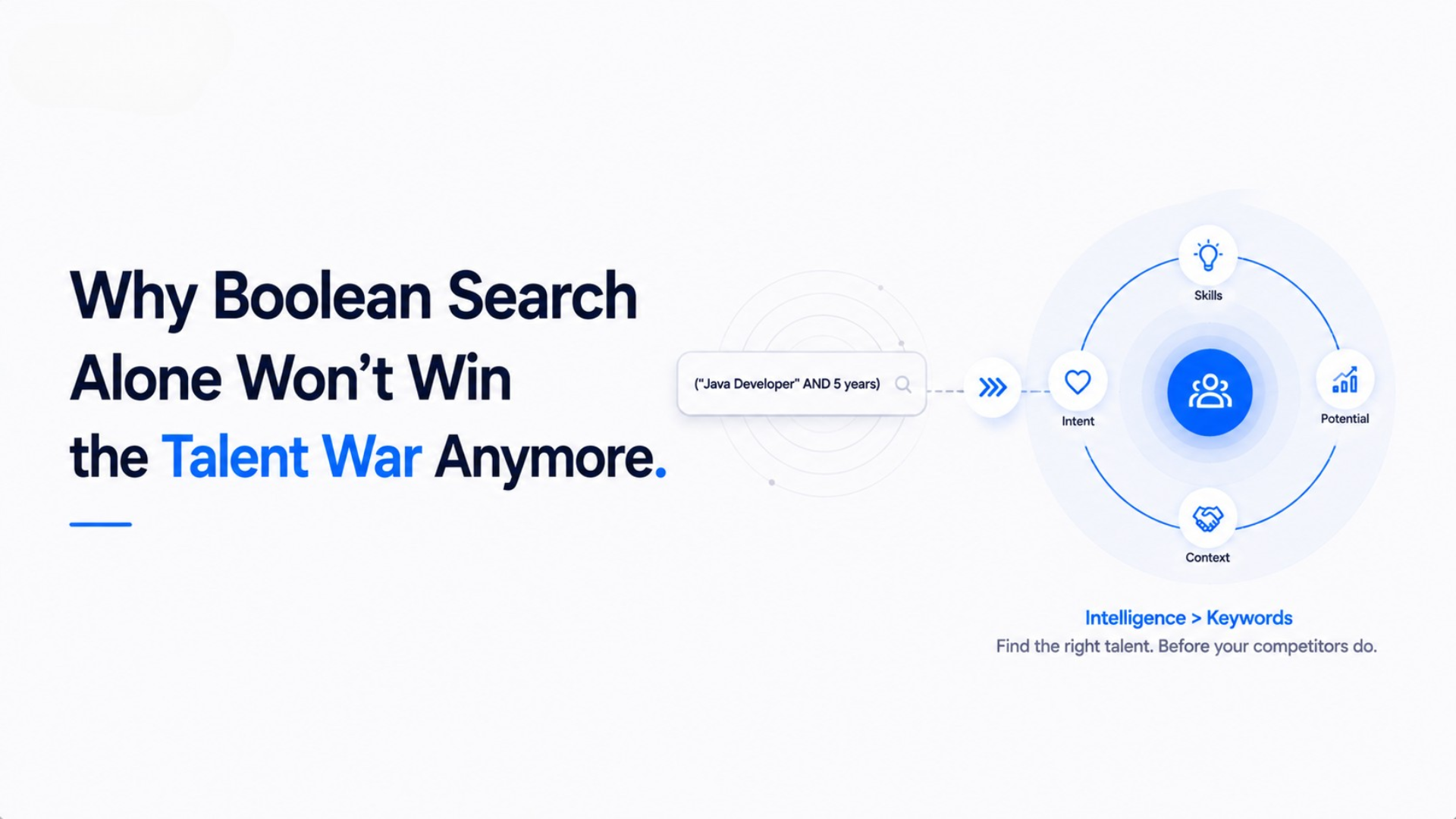
A recruiter spends forty-five minutes crafting the perfect boolean string for a senior data scientist role. They nest operators, exclude irrelevant titles, layer in experience requirements, and run the search. LinkedIn returns two hundred and twelve results. They feel satisfied. What they do not know is that every other recruiter sourcing for the same role is running essentially the same search and getting essentially the same results. The two hundred and twelve candidates they found are the same two hundred and twelve candidates their competitors found. The boolean string did not give them an advantage. It gave them the same list everyone else has. This is the fundamental problem with boolean search in the modern talent market: it is a shared capability. Every trained recruiter knows how to build a boolean string. Every recruiting platform supports boolean operators. The technique that was once a differentiator is now a baseline, and baselines do not win competitive markets. The recruiters who are winning the talent war today have moved beyond boolean to a multi-layered approach that combines AI-powered semantic understanding, real-time signal detection, and relationship-driven engagement, an approach that finds candidates boolean cannot reach and engages them in ways boolean cannot enable.
Boolean search is not useless. It remains a functional tool for finding candidates whose profiles contain specific, well-defined keywords and job titles. The problem is that the candidates
most recruiters want, the high performers who are already employed and not actively looking, are often the candidates whose profiles are least optimized for keyword matching. A senior engineer who describes their work in project-specific terms rather than standard job title language will not appear in a boolean search for senior software engineer, even though their actual skills and experience make them a perfect fit. The boolean search limitations are not technical. They are semantic. Boolean operates on exact text matches and logical operators. It does not understand meaning, context, or potential. It cannot recognize that a candidate who built a real-time recommendation system from scratch has equivalent or superior skills to a candidate whose profile simply lists machine learning engineer as their title. According to LinkedIn's talent solutions research, semantic matching tools that understand candidate profiles at a meaning level rather than a keyword level identify forty to sixty percent more qualified candidates than boolean-only searches, because they can see past title and keyword differences to the underlying skills and capabilities.
The Commodity Trap: Why Every Recruiter Gets the Same Results
When every recruiter uses the same technique, the technique ceases to be a competitive advantage and becomes a commodity. Boolean search has reached this point. The same boolean strings, or very similar ones, are widely shared in recruiting communities, blog posts, training programs, and even built into the search interfaces of major platforms. The result is that when a high-priority role opens, every recruiter in the market runs essentially the same search and receives essentially the same candidate list. The candidates on that list then receive multiple nearly identical outreach messages in the same week, which drives down response rates and increases candidate fatigue. Understanding why more tools produce the same hiring problems, the solution is not better boolean strings or more sophisticated operators. The solution is to stop competing in a space where everyone has the same capabilities and move to a space where your approach is genuinely different. The talent war recruiting strategy that wins is the one that accesses candidates that competitors cannot find through the same searches, and boolean search, by its nature, cannot provide that access because it is deterministic and transparent. Every boolean string produces the same results for every user.
The commodity trap also affects recruiter motivation and professional development. Recruiters who have invested years in developing their boolean skills, who take pride in crafting elegant and complex search strings, may resist moving to AI-powered approaches because it feels like abandoning a hard-won expertise. But expertise in a commodity skill is not a sustainable competitive position. According to SHRM's talent acquisition research, the recruiters who report the highest placement rates and the strongest client relationships are not the ones with the most sophisticated boolean skills. They are the ones who invest the most time in candidate relationship building, hiring manager advisory, and market intelligence. These are the activities that create genuine differentiation, and they are the activities that boolean search time directly displaces. The recruiting beyond keyword matching approach does not require recruiters to abandon boolean entirely. It requires them to recognize that boolean is one tool in a much larger toolkit, and that the other tools in that kit, AI matching,
signal detection, and relationship engagement, are now more important than boolean for winning competitive talent markets.
What Boolean Misses: Skills Hidden in Plain Sight
The most consequential limitation of boolean search is its inability to recognize skills and qualifications that are not expressed in the exact keywords the recruiter is searching for. Consider a common sourcing challenge: finding a candidate with strong distributed systems experience. A boolean search for distributed systems will return profiles that contain that exact phrase. But it will miss the candidate whose profile describes building a microservices architecture that handles ten million requests per second across fifteen geographic regions. That candidate has deep distributed systems expertise, but they expressed it in project-specific language rather than using the term distributed systems. The AI vs boolean search recruiting comparison reveals that AI-powered semantic matching understands that building a geo-distributed microservices platform and having distributed systems experience are the same thing, even when the words are completely different. According to McKinsey's people organization insights, AI semantic matching identifies thirty to fifty percent more qualified candidates than keyword-based search for technical roles, because technical professionals often describe their skills in project-specific or domain-specific language that does not align with standard job title or keyword taxonomies.
This mismatch between how candidates describe themselves and how recruiters search for them is not limited to technical roles. A marketing professional who led a campaign that generated five million organic impressions may not use the phrase digital marketing strategy anywhere in their profile, but an AI system can recognize that their experience is directly relevant. A finance professional who managed a two-hundred-million-dollar P&L during a period of organizational restructuring may not list change management as a skill, but an AI system can identify that capability from the context of their experience. The semantic candidate matching capability is what allows AI to see the full picture of a candidate qualifications, while boolean search sees only the keywords. Understanding AI recruiting for niche and technical roles, this gap is especially wide in specialized domains where candidates use highly specific language to describe their work, making keyword-based search particularly unreliable. Understanding why some AI recruiting tools have outdated candidate data, even the best semantic matching is only as good as the data it operates on, which is why platforms that refresh candidate profiles continuously will always outperform those that rely on static snapshots.
Signal-Based Sourcing: Finding Candidates Before They Search
Boolean search is reactive. It finds candidates based on what is already in their profile, which means it can only identify candidates who have already documented their qualifications in searchable terms. But the most valuable sourcing intelligence is not what a candidate has already published. It is what they are doing right now. A candidate who has just started
following three competitors on LinkedIn, who has updated their profile summary for the first time in two years, who has begun attending events in a new technology domain, or whose company has just announced a round of layoffs, is signaling something. They may not be actively applying for jobs, but they may be open to a conversation. Boolean search cannot detect these signals because they are behavioral, not textual. The candidate signal detection capability that AI platforms provide monitors these behavioral signals in real time and alerts the recruiter when a high-potential candidate shows signs of receptivity. According to Gartner's HR trends research, recruiters who incorporate behavioral signals into their sourcing strategy achieve two to three times the engagement rate of those who rely solely on profile-based search, because they are reaching candidates at the moment of maximum receptivity rather than at a random moment based on a static profile.
Signal-based sourcing also enables a fundamentally different recruiting timeline. Boolean search operates in the present tense: it finds candidates who match the current search criteria. Signal-based sourcing operates across time: it tracks candidates over weeks and months, building a picture of their career trajectory and identifying the optimal moment to engage. A candidate who has been steadily growing in their role for three years and suddenly starts showing exploratory behavior, following new companies, engaging with different content, updating their skills, may be approaching a career inflection point. The recruiter who detects this signal and engages at the right moment will have a dramatically higher success rate than the recruiter who runs a boolean search after the role opens and hopes the candidate is responsive. Understanding how many follow-ups one hire actually needs, signal-timed outreach also requires fewer follow-ups because the candidate is already in a receptive state, which means the recruiter can move faster through the pipeline with less effort. Understanding the difference between AI sourcing and AI recruiting, signal detection is a sourcing function, but it is one that operates continuously rather than on demand, and it is the foundation of the AI-native recruiting workflow.
Relationship Layer: The Advantage Boolean Can Never Provide
The most important thing in recruiting is not finding candidates. It is engaging them. And the most effective engagement comes from a pre-existing relationship, not from a cold message, no matter how well-crafted the boolean search was that identified the candidate. Boolean search produces a list of names. It does not produce trust, credibility, or warmth. Those qualities come from repeated, value-driven interactions over time. A recruiter who has been sharing relevant industry content with a candidate for six months, who commented thoughtfully on an article the candidate published, and who introduced the candidate to a useful professional contact, has a relationship that no boolean string can replicate. When that recruiter reaches out with an opportunity, the candidate responds not because the job description is compelling but because the recruiter has earned the right to their attention. Understanding why referrals outperform cold outreach, the mechanism is identical. Relationship-based outreach outperforms cold outreach because it carries trust, context, and credibility that no search technique can substitute. According to Deloitte's talent research, recruiters who
maintain active candidate relationships fill roles forty-five percent faster than those who rely on cold outreach, and their candidates are thirty percent more likely to accept offers.
The recruiting competitive advantage in the talent war is not about who can build the best boolean string. It is about who has the deepest relationships with the best candidates. Boolean search can help identify candidates, but it cannot build the relationships that convert those candidates into hires. The recruiters who combine AI-powered candidate discovery with systematic relationship building are the ones who consistently win competitive placements, because they are operating on two dimensions simultaneously: they have better candidate intelligence than their competitors and they have stronger relationships with the candidates they find. Understanding what makes an AI recruiting platform agentic vs. just automated, the platforms that support this dual approach, intelligent discovery plus relationship management, are the ones that define the next generation of recruiting technology. They do not replace the recruiter relationship skills. They amplify them by ensuring the recruiter always has the right candidates to build relationships with and by providing the context needed to make those relationships genuine and valuable rather than transactional and generic.
The Modern Sourcing Stack: What Replaces Boolean-Only
The sourcing stack that wins the talent war today has four layers, and boolean is only one of them. The first layer is AI-powered semantic matching, which identifies candidates based on the meaning of their experience rather than the exact keywords in their profile. This layer expands the addressable candidate pool by finding qualified people that boolean misses. The second layer is real-time signal detection, which monitors candidate behavior for signs of receptivity and alerts the recruiter when the timing is right for outreach. This layer ensures that outreach happens at the optimal moment rather than at a random moment. The third layer is relationship intelligence, which tracks all candidate interactions, notes, and context so the recruiter can engage with the depth and personalization that builds trust. This layer transforms cold outreach into warm, credible communication. The fourth layer is boolean search itself, used not as the primary discovery tool but as a complementary validation tool for specific, well-defined keyword requirements. According to LinkedIn's recruiting resources, recruiters who use all four layers of the modern sourcing stack report fifty-five percent higher placement rates than those who rely on boolean alone.
The modern talent sourcing methods that define the next era of recruiting are not about abandoning boolean. They are about putting boolean in its proper place as one tool among many, rather than the foundation of the entire sourcing process. The recruiters who insist on boolean as their primary method will continue to find the same candidates as every other recruiter and wonder why their response rates are declining and their time-to-fill is increasing. The recruiters who adopt the multi-layered approach will find candidates their competitors cannot find, engage them at the right moment, and convert them at higher rates. For organizations that are evaluating an AI sourcing tool before buying, the ability to provide all four layers of the modern sourcing stack, semantic matching, signal detection, relationship intelligence, and
boolean support, should be the primary evaluation criterion. And for recruiters who wonder whether AI will replace their jobs, the answer is clear: AI will not replace recruiters who use it to build deeper candidate relationships and find hidden talent. It will replace recruiters whose only differentiator is the ability to write a boolean string.
How Huntlo.ai Goes Beyond Boolean to Win the Talent War
Huntlo.ai is built for the post-boolean era of recruiting. The platform uses AI-powered semantic matching to find qualified candidates that keyword searches miss, identifies skills hidden in project descriptions and career narratives, and understands that a candidate who built a real-time data pipeline and a candidate who lists stream processing engineer are often the same person with different words. Huntlo also provides real-time signal detection, monitoring candidate behavior for the engagement signals that indicate receptivity, and surfacing candidates at the optimal moment for outreach. Every candidate profile is continuously refreshed, ensuring that the intelligence the platform provides reflects the candidate current reality rather than a months-old snapshot. The platform also supports AI recruiting for niche and technical roles, where boolean search is particularly inadequate because specialized talent often describes their expertise in language that does not match standard keyword taxonomies.
For recruiting leaders who recognize that boolean alone is no longer enough, Huntlo provides the complete multi-layered sourcing stack that wins competitive talent markets. Your competitors are running the same boolean searches as you and getting the same candidate lists. The recruiter who wins is the one who sees what boolean cannot see, finds who boolean cannot find, and engages with the relationship depth that boolean cannot provide. Huntlo gives you that advantage.