The recruiting industry is having the wrong debate about artificial intelligence. Every conference panel, every LinkedIn thread, every vendor pitch seems to revolve around the same question: will AI replace recruiters? The framing itself is the problem, because it treats AI and human recruiters as substitutes when they are fundamentally complements. The question is not whether machines will do what recruiters do. It is how machines can do what recruiters should not have been doing in the first place, so that recruiters can focus on the work that actually requires a human being.
This distinction is not semantic. It is architectural. A recruiting process that uses AI to replace human judgment is a process that will produce worse outcomes than one that uses AI to inform and accelerate that judgment. The difference is not in the technology. It is in how the technology is positioned relative to the human decision-maker. Platforms that understand this distinction, such as genuinely agentic AI recruiting platforms, are designed to augment recruiters, not bypass them. The results speak for themselves: faster screening, better shortlists, and recruiters who spend their time on high-value work instead of manual triage.
What AI Actually Does Better Than Humans in Screening
Before discussing what AI should not replace, it is important to be honest about what it does better. AI can evaluate thousands of candidate profiles against a defined set of criteria in seconds, and it can do so with perfect consistency. A human recruiter screening the 200th resume at the end of a long day is not making the same quality of decision they made on the first resume that morning. Fatigue, distraction, and the subtle influence of previously reviewed candidates all degrade human screening accuracy over time. AI does not get tired, and it does not adjust its standards based on what it saw ten minutes ago.
AI is also better at identifying patterns across large datasets. When evaluating whether a particular skill or experience attribute predicts job performance, AI can analyze outcomes across thousands of hires simultaneously. A recruiter working from memory and intuition cannot. This pattern recognition capability is what makes AI screening fundamentally different from keyword matching. As research from McKinsey’s people and organization practice, has demonstrated, organizations that leverage AI for pattern-based talent assessment consistently outperform those relying on individual recruiter judgment alone, particularly at the initial screening stage where volume makes human thoroughness impossible.
Finally, AI eliminates the consistency problem that plagues teams with multiple recruiters. When three recruiters are screening for the same role, they inevitably apply different standards, even with structured scorecards. The result is a shortlist that reflects the average of three different screening approaches rather than a single coherent evaluation. This is one of the reasons why adding more tools often produces the same hiring problems: the tools change, but the underlying inconsistency between human evaluators does not. AI applies the same criteria to every candidate, every time, producing shortlists that are genuinely comparable.
What Recruiters Do That AI Cannot
The list of things that require human judgment in recruiting is longer than most AI vendors want to acknowledge. Contextual evaluation is the most important. A candidate who switched careers twice in five years might look unstable on paper, but a recruiter who takes the time to understand why, perhaps they were pursuing a passion, responding to a family need, or escaping a toxic work environment, might recognize a pattern of resilience and adaptability that the AI cannot see. The AI can flag the career changes. Only a human can interpret them.
Relationship management is another capability that AI cannot replicate. Hiring is not a transactional process. It is a relational one, and the best recruiters build relationships with candidates over months or years. They maintain talent pools, re-engage passive candidates when the right role opens, and provide the human touch that turns a job offer into a career decision. These relationships are the primary reason why referrals consistently outperform cold outreach: they are built on trust, and trust requires a human connection. AI can identify candidates. It cannot build trust with them.
Strategic advising is the third irreplaceable recruiter capability. A good recruiter does not just find candidates. They advise hiring managers on what the role actually requires, whether the job description matches market reality, and whether the compensation package will attract the caliber of candidate the team needs. This advisory role requires business acumen, organizational awareness, and the ability to have difficult conversations with stakeholders who have unrealistic expectations. These are not skills that can be automated. They are skills that become more valuable when AI handles the screening workload, freeing recruiters to invest their time in the strategic work that actually moves the needle. As we have discussed in our analysis of whether recruiters should worry about AI replacing their jobs, the recruiters who
thrive in an AI-augmented environment are those who lean into these higher-value capabilities rather than defending the manual tasks that AI can do better.
The Replacement Trap: What Happens When You Remove the Human
Organizations that treat AI as a recruiter replacement invariably encounter the same set of problems. The first is candidate experience degradation. When candidates interact only with automated systems throughout the screening process, they feel like they are being processed rather than evaluated. According to LinkedIn’s talent solutions research, candidate experience is one of the top three factors influencing offer acceptance, and candidates who feel treated as data points are significantly more likely to drop out of the process or accept competing offers. The irony is that the efficiency gained by removing humans from screening is often lost when candidates reject offers or ghost because they never felt a human connection.
The second problem is hiring manager dissatisfaction. Hiring managers do not want a ranked list produced by a black-box algorithm. They want a recruiting partner who can explain why each candidate was selected, contextualize their strengths and weaknesses relative to the team’s specific needs, and adjust the search direction based on feedback. When AI screening is positioned as a replacement rather than an assist, the recruiter is removed from this conversation, and the hiring manager is left with a list they do not trust and a process they do not understand.
The third problem is the most dangerous: bias amplification. An AI system that replaces human judgment does not eliminate bias. It embeds bias into the process in a way that is harder to detect and correct, because there is no human reviewer questioning the outputs. We have written about how outdated or biased candidate data can distort AI screening results, and the risk is compounded when there is no human in the loop to catch those distortions. An AI assistant that produces shortlists for human review can be checked and corrected. An AI replacement that makes final decisions cannot.
The Assist Model: How the Best Teams Deploy AI in Screening
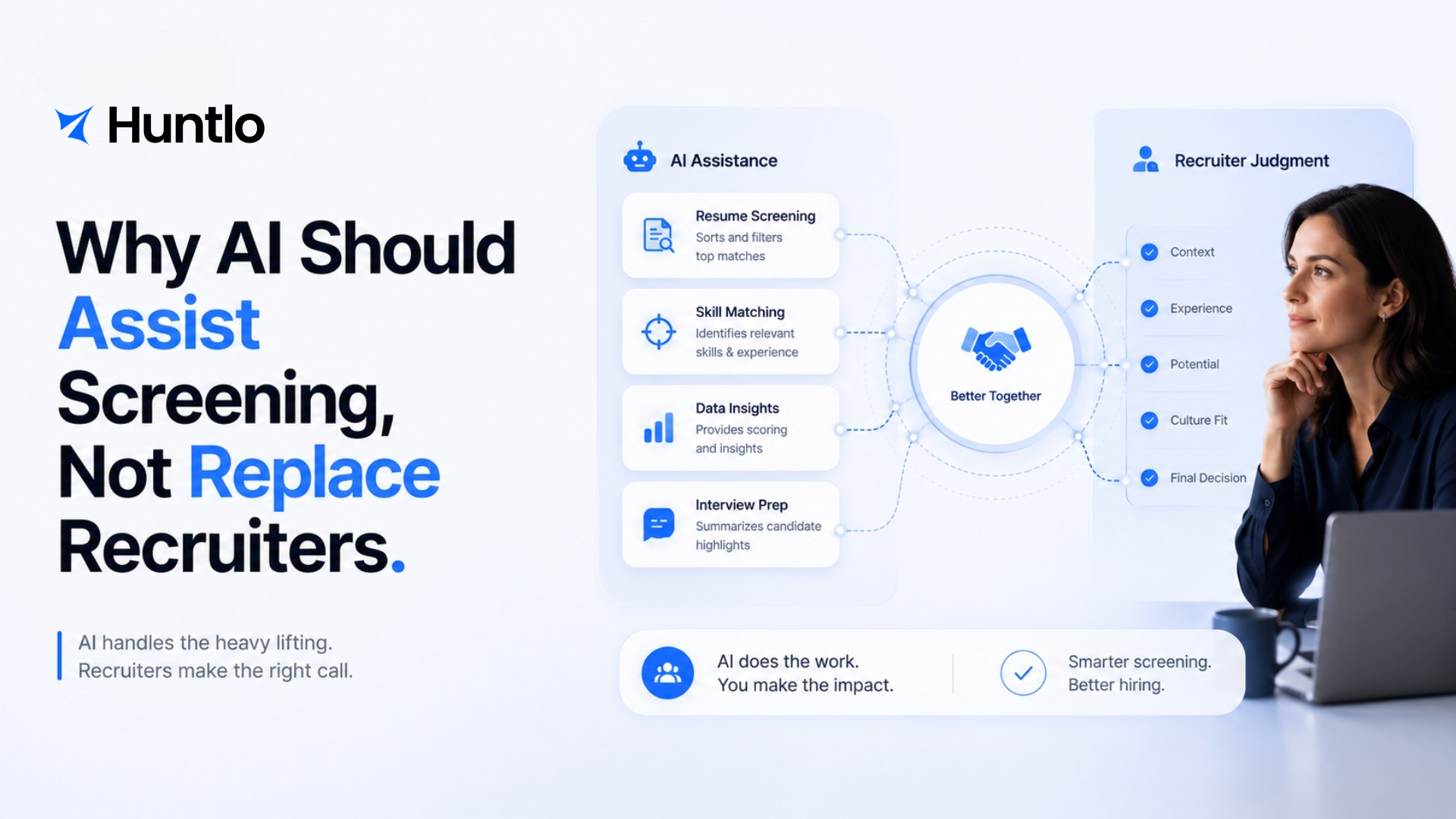
The most effective model for AI in screening is what we call the assist model. In this model, AI handles the initial evaluation of every candidate against predefined criteria, producing a ranked shortlist with transparent scoring. The recruiter then reviews that shortlist, applies contextual judgment that the AI cannot provide, and makes the final recommendation to the hiring manager. The AI does not make the hiring decision. It ensures that the human making the decision has the best possible information and a well-curated set of candidates to evaluate. According to Gartner’s research on HR technology trends, organizations that adopt this assist model see faster time-to-shortlist, higher shortlist quality, and better recruiter satisfaction compared to both fully manual and fully automated approaches.
The assist model also changes how recruiters spend their time. In a manual screening process, a recruiter might spend 70 percent of their day on resume triage and 30 percent on candidate engagement and hiring manager advisory. In the assist model, those ratios flip. The AI
handles the triage in minutes, and the recruiter spends the majority of their time on the activities where human judgment creates the most value: building relationships with shortlisted candidates, preparing compelling profiles for hiring managers, and providing strategic input on role design and candidate fit. This is not a small improvement. It is a fundamental transformation of what the recruiter role means.
The assist model also addresses the distinction between AI sourcing and AI recruiting in a practical way. Sourcing is the process of finding potential candidates. Recruiting is the process of evaluating, engaging, and advancing them. AI can assist with both, but the nature of the assistance is different. In sourcing, AI identifies candidates who match the role requirements. In recruiting, AI evaluates those candidates and supports the human recruiter in making nuanced decisions about who to advance. The assist model applies AI to both stages while keeping the human recruiter at the center of the evaluation and engagement process.
Why “Augmented Intelligence” Is the Right Frame
The term “augmented intelligence” captures the right relationship between AI and human recruiters. Augmentation means the technology makes the human better at their job, not that it does the job instead of them. A recruiter using AI screening is like a radiologist using an AI diagnostic tool: the AI identifies patterns and highlights potential issues, but the radiologist brings clinical context, patient history, and professional judgment that the AI cannot replicate. The result is better than either the AI or the human alone. Research from Deloitte’s human capital practice has shown that augmented intelligence models in hiring consistently outperform both fully automated and fully manual approaches across every measurable outcome.
The augmented intelligence frame also changes how organizations evaluate AI recruiting tools. Instead of asking whether the tool can replace a recruiter, which is the wrong question, they should ask whether the tool makes their recruiters more effective. Can it reduce the time recruiters spend on low-value tasks? Can it improve the quality and consistency of their screening decisions? Can it give them better data to work with when they advise hiring managers? These are the questions that matter, and they are the questions that separate useful AI screening platforms from expensive distractions.
This is precisely the framework we recommend when teams ask us about how to evaluate an AI sourcing tool before buying. The evaluation should focus on transparency, configurability, and the quality of the human-AI interface. Does the tool show you why it scored each candidate the way it did? Can you adjust the evaluation criteria to match your role requirements? Does it integrate into your existing workflow, or does it force you to work around its limitations? These practical questions determine whether the tool will augment your recruiters or frustrate them.
The Recruiter’s Role in an AI-Assisted Future
In an AI-assisted screening process, the recruiter’s role does not shrink. It evolves. The recruiter becomes a screening strategist rather than a screening operator. Instead of spending
their day reading resumes one after another, they define the evaluation criteria that the AI will apply. Instead of guessing which candidates might be good fits, they review AI-generated shortlists and apply the contextual judgment that turns a good shortlist into a great one. Instead of being the bottleneck in a slow manual process, they become the quality assurance layer in a fast, technology-driven one. And as we have noted in our discussion of whether AI will replace recruiting jobs, this evolution makes recruiters more valuable, not less.
The skill profile for this evolved role is different from the traditional recruiter profile. It requires data literacy, the ability to interpret AI-generated scores and identify when the AI might be missing something. It requires criteria design skills, the ability to translate a job description into a set of weighted evaluation competencies that predict actual performance. And it requires stakeholder management skills, the ability to explain AI-assisted screening outcomes to hiring managers who may be skeptical of technology or who have strong preferences for traditional hiring methods. According to SHRM’s talent acquisition resources, the recruiters who are advancing fastest in their careers are those who are developing these strategic capabilities rather than defending the manual screening status quo.
There is also a critical role for recruiters in niche and technical hiring, where the evaluation criteria are more complex and the candidate pool is smaller. In these contexts, AI screening is less about volume reduction and more about depth of analysis. The AI can map a candidate’s technical skills against the specific requirements of a specialized role, but the recruiter needs to assess whether the candidate’s approach to problem-solving, their communication style, and their cultural fit with a highly specialized team are aligned. This is judgment work, and it is work that requires a human who understands both the technology and the organization.
Why Huntlo.ai Is Built for the Assist Model
Huntlo.ai was designed from the beginning as an assistive platform, not a replacement one. Every feature is built around the principle that AI should handle evaluation and ranking while the recruiter handles interpretation and decision-making. The platform produces ranked shortlists with full transparency, so recruiters can see exactly why each candidate was scored the way they were. It allows recruiters to adjust criteria, re-rank candidates, and override AI recommendations based on context that the algorithm cannot see. And it tracks the outcomes of every screening decision so the AI gets better over time and the recruiter’s judgment is continuously validated. As we have discussed, adding more tools without a coherent strategy is counterproductive. Huntlo is not another tool. It is a screening system designed to make the recruiter’s judgment more impactful.
The result is a recruiting team that screens faster, decides better, and spends its time on work that actually requires a human being. The AI handles what is routine and repetitive. The recruiter handles what is nuanced and strategic. This is not a future state. It is what Huntlo users experience today. And it is why the most important question in AI recruiting is not whether AI will replace recruiters, but how quickly recruiters will embrace the tools that make them better at their jobs. The teams that figure this out first will have a significant and
sustained competitive advantage in the talent market. After all, even with the best AI in the world, you still need someone who knows how many follow-ups one hire actually needs, and when a personal touch makes the difference between a candidate who accepts and one who walks away.