Five years from now, the way organizations discover, evaluate, and engage talent will be fundamentally different from today. Not incrementally different. Fundamentally different. The tools that most recruiting teams consider advanced, Boolean search, resume database subscriptions, and manual outreach sequences, will look as outdated in 2030 as newspaper classified ads look today. This is not speculation. It is the trajectory that current technology investments, market dynamics, and organizational behavior are already pointing toward. According to Gartner's HR trends research, by 2030 more than eighty percent of large enterprises will use AI-powered autonomous sourcing agents as their primary candidate identification mechanism, up from less than ten percent today. The question for recruiting leaders is not whether this transformation will happen but whether their teams will be leading it or scrambling to catch up.
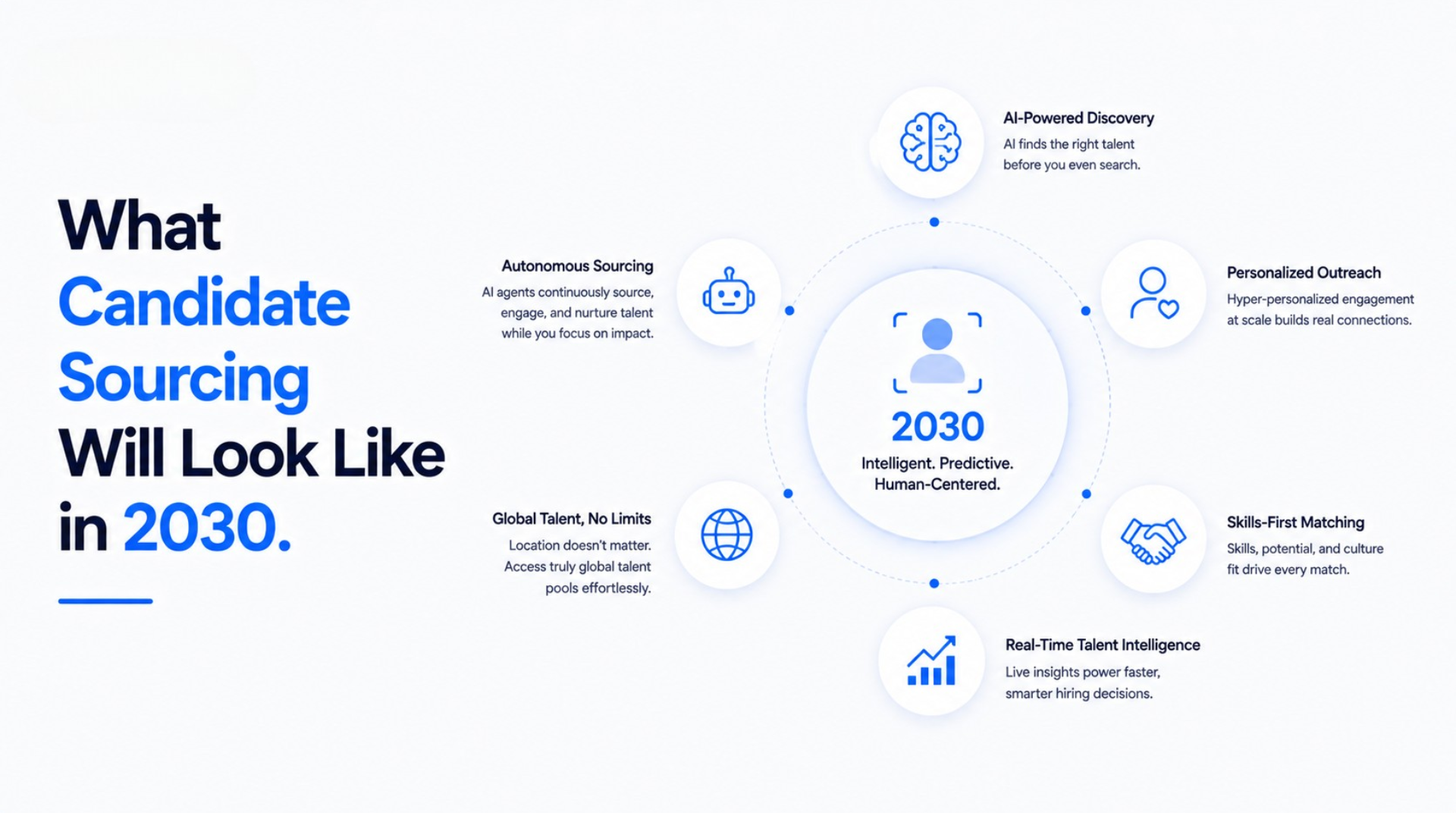
This article maps five specific shifts that will define candidate sourcing by 2030. For each shift, it describes what the change looks like, why it is happening, and what recruiting teams should be doing now to prepare. These are not distant possibilities. Each one is already emerging in early form, driven by advances in AI, changes in workforce expectations, and the competitive dynamics of the talent market. The organizations that recognize these shifts early and begin adapting their strategies, technology, and team capabilities will have a significant advantage over those that wait until the changes are fully mature. The gap between early adopters and late adopters in recruiting technology has historically been measured in months. By 2030, it will be measured in competitive survival.
Shift One — From Search to Autonomous Discovery
The most fundamental shift in sourcing by 2030 will be the move from recruiter-initiated search to AI-driven autonomous discovery. Today, sourcing begins when a recruiter runs a
query. By 2030, it will begin when an AI agent detects that a role requirement is emerging, even before a formal requisition exists. The agent continuously monitors workforce planning data, team performance metrics, attrition signals, and business growth projections to anticipate hiring needs. When it identifies an emerging need, it proactively begins building a candidate pipeline, so that by the time the requisition is approved, a shortlist of pre-qualified candidates is already waiting. This shift from reactive search to proactive discovery is already beginning with agentic AI recruiting platforms that operate autonomously rather than waiting for human-initiated queries. The difference is that by 2030, this autonomous capability will be the default rather than the exception.
Autonomous discovery also means that the concept of running a search will become obsolete for most roles. Instead of a recruiter defining a Boolean string and reviewing results, the AI agent will continuously maintain a living talent pool for each anticipated role type. Candidates will be added as they become available, re-ranked as their profiles evolve, and surfaced when their engagement signals align with the organization's hiring timeline. The recruiter's role will shift from searcher to curator, reviewing and refining the agent's recommendations rather than generating them from scratch. According to McKinsey's organizational insights, organizations piloting autonomous sourcing agents today report identifying candidates forty to sixty percent faster than traditional search-based approaches, because the agent has been monitoring the market continuously rather than searching it episodically. For niche and technical roles where the qualified candidate pool is small and competitive intensity is high, this speed advantage translates directly into hiring outcomes that manual search cannot match.
Shift Two — From Resumes to Real-Time Skill Profiles
The resume as a candidate representation format will not disappear entirely by 2030, but its role will diminish significantly. It will be replaced, for most sourcing purposes, by real-time skill profiles that are continuously constructed from observable evidence rather than self-reported claims. A real-time skill profile is a dynamic, AI-maintained representation of a professional's capabilities that draws from their actual work products, professional activities, and career signals. It includes skills inferred from code contributions, publications, project outcomes, and professional interactions, not just skills that the candidate has chosen to list. It updates continuously as new evidence becomes available, so it always reflects the candidate's current capabilities rather than their historical self-presentation.
This shift has profound implications for how candidates are evaluated. Resume-based screening is inherently backward-looking: it assesses what a candidate claims to have done in the past. Real-time skill profiling is forward-looking: it assesses what a candidate is demonstrably capable of doing now, based on current evidence. A candidate whose resume says they are a Python developer but who has been writing Rust for the past year will be accurately represented in a real-time skill profile but misrepresented in a resume. This accuracy advantage improves every downstream decision in the hiring process, from initial ranking through
interview selection to final offer. Understanding why some AI recruiting tools have outdated candidate data is a 2024 problem. By 2030, the expectation will be that candidate data is always current, and platforms that cannot deliver real-time profiles will be considered fundamentally broken. SHRM's talent acquisition research projects that skill-based hiring will be the dominant evaluation methodology for professional roles by 2030, driven by both the superior accuracy of evidence-based assessment and the growing regulatory pressure to reduce bias in hiring decisions.
Shift Three — From Outbound Campaigns to Relational Engagement
The third shift transforms how recruiters interact with candidates. Today's outbound sourcing model is campaign-based: identify a list, send messages, follow up, and move on. This approach treats candidates as targets of a marketing campaign rather than professionals to build relationships with. By 2030, the most successful recruiting teams will have replaced campaign-based outreach with relational engagement, a model where the AI platform maintains an ongoing, evolving relationship with a broad network of potential candidates and engages them at the right moment with the right message. The relationship exists before the specific role, the message is triggered by a candidate signal rather than a requisition, and the interaction feels like a professional conversation rather than a recruiter pitch.
This shift is driven by candidate expectations as much as by technology. Professionals, especially in high-demand fields, are increasingly intolerant of generic recruiter outreach and increasingly responsive to personalized, context-rich engagement. They want to hear from recruiters who understand their work, not recruiters who found them in a search. This is the same dynamic that explains why referrals outperform cold outreach— the referral comes with built-in context and trust that generic outreach lacks. By 2030, AI platforms will provide that context and trust at scale, making every outreach interaction feel as relevant and personalized as a referral. The technology to do this exists today in early form, but adoption is still limited. LinkedIn's recruiting resources report that candidate expectations for personalization are rising sharply, with over seventy percent of passive candidates saying they would engage with a recruiter who demonstrated genuine knowledge of their work, compared to less than fifteen percent who respond to generic outreach. The implication is clear: relational engagement is not just a nicer approach. It is a more effective one.
Shift Four — From Local Pools to Borderless Talent Markets
The fourth shift is geographic. By 2030, the default assumption for professional roles will be that talent can be sourced from anywhere in the world, not just from the city or country where the role is based. Remote and hybrid work has already begun this transformation, but most recruiting teams still operate with a strong local bias, sourcing primarily from their home market and treating international candidates as a secondary option. By 2030, this bias will be reversed. AI-powered talent intelligence will make it as easy to source candidates in Bangalore, Berlin, or Buenos Aires as it is to source them in Boston or San Francisco. Language barriers
will be handled by AI translation. Time zone management will be automated. Compensation benchmarking will be multi-currency and region-adjusted in real time. The result is that the effective talent pool for any role will be five to ten times larger than it is today.
This borderless sourcing capability creates enormous opportunities for organizations willing to embrace it, and enormous risks for those that do not. A company that restricts its sourcing to a single country will be competing for a fraction of the available talent while its competitors access the full global market. The quality advantage of global sourcing is well documented. Deloitte's talent research has found that organizations sourcing globally report twenty to thirty percent higher quality-of-hire metrics than those sourcing locally, because they access a more diverse and deeper candidate pool. However, global sourcing also introduces complexity in evaluation, engagement, and hiring logistics. AI platforms that provide unified, multi-region talent intelligence will be essential for managing this complexity. Understanding the difference between AI sourcing and AI recruiting becomes even more important in a global context, because sourcing candidates across borders requires intelligence that spans languages, cultures, and regulatory environments in ways that manual processes cannot effectively handle. Organizations that simply add more point tools often find they have more tools but the same hiring problems, because global sourcing requires integrated intelligence, not fragmented tools.
Shift Five — From Reactive Hiring to Predictive Workforce Planning
The fifth and most strategic shift is the integration of sourcing with predictive workforce planning. Today, sourcing is triggered by a requisition, which is triggered by a hiring need, which is usually identified after the need has become acute. By 2030, AI-powered workforce planning will anticipate hiring needs months in advance based on business growth projections, attrition predictions, skill evolution forecasts, and competitive intelligence. Sourcing will begin proactively against these predicted needs, so that pipeline is built before the requisition exists. This integration eliminates the most expensive phase of the hiring process: the gap between identifying the need and having qualified candidates ready to engage.
Predictive workforce planning does not replace human judgment about hiring strategy. It augments it by providing data-driven forecasts that help recruiting leaders and hiring managers make better decisions about when to hire, what skills to prioritize, and how to allocate sourcing resources. The AI analyzes historical hiring patterns, market trends, and real-time talent signals to produce probabilistic forecasts: there is an eighty percent probability that the engineering team will need three additional backend developers in Q2, based on current project pipeline and historical attrition rates. The sourcing team can begin building pipeline against that forecast immediately, rather than waiting for a formal headcount request. Understanding how many followups one hire needs becomes more strategic in a predictive model, because the follow-up cadence can be planned in advance based on forecasted hiring timelines rather than improvised in response to an urgent requisition. The recruiters who wonder whether AI will replace their jobs should recognize that in a predictive model, their role is more valuable,
not less. They are strategic talent advisors who interpret AI forecasts, make judgment calls, and build the relationships that machines cannot.
Preparing for 2030 does not require a five-year technology roadmap. It requires beginning the transition now with the tools and capabilities that are already available. Evaluating an AI sourcing tool today should include assessing its trajectory toward these five shifts: does it operate autonomously, does it build real-time skill profiles, does it support relational engagement, does it handle multi-region sourcing, and does it integrate with workforce planning data? Huntlo.ai is built for the 2030 talent market. Its intelligence engine already delivers autonomous discovery, real-time skill profiling, relational engagement capabilities, and borderless sourcing. Whether you are preparing your team for the future or simply trying to hire better today, Huntlo provides the platform that bridges both. The future of sourcing is not five years away. It is already here for the teams that choose to adopt it. Choose Huntlo.