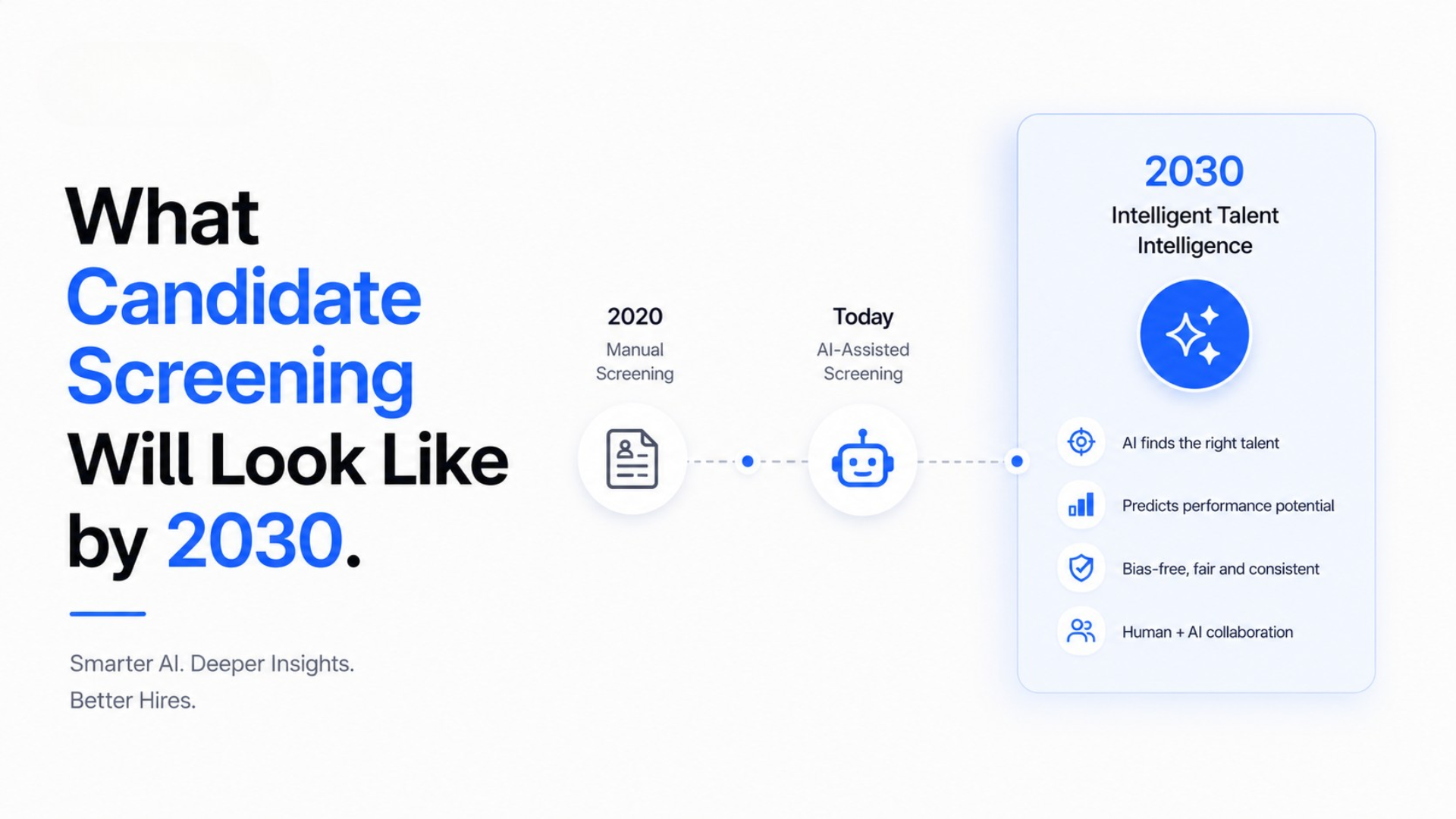
The recruiting industry is five years into a transformation that most teams have not yet noticed. The surface-level indicators, job postings on LinkedIn, recruiters sending InMails, candidates uploading resumes, look reassuringly familiar. But underneath that surface, the infrastructure of candidate evaluation is changing at a pace that has no historical precedent. By 2030, the screening process that most organizations use today will be unrecognizable, not because the technology changed, but because the definition of what screening means will have fundamentally shifted.
This is not speculation about some distant future. The building blocks are already in place. AI platforms that evaluate candidates on demonstrated capability rather than resume keywords are operational today. AI-conducted first-round interviews that assess communication, problem-solving, and role-specific competencies are already being deployed at scale. The organizations adopting these tools now are building the data assets and process maturity that will make the 2030 screening model standard practice. Platforms like Huntlo.ai, which were designed from the ground up for this model, are already proving what the future looks like in practice.
Shift 1: From Resume-First to Evidence-First Evaluation
The most visible change in screening by 2030 will be the demotion of the resume from primary evaluation document to optional supplementary input. Resumes will not disappear entirely, but they will no longer be the thing that screening decisions are based on. The reason is simple: resumes are a low-fidelity signal in a world where high-fidelity alternatives exist. A resume tells you what a candidate claims they have done. AI evaluation can assess what they have actually done by analyzing verified work history, project outcomes, skills assessments,
and structured interview responses.
The evidence-first model starts with a role-specific competency framework, the same foundation that the best screening processes use today. But instead of mapping resumes to that framework, the AI maps a multi-dimensional candidate profile that includes verified achievements, assessed competencies, and behavioral indicators. The result is an evaluation that is based on evidence of capability rather than claims of capability. Research from McKinsey’s people and organization practice has consistently shown that evidence-based hiring processes produce significantly better outcomes than credential-based ones, and the technology to operationalize evidence-based screening at scale is now available.
The practical impact of this shift is that candidates who have strong resumes but weak actual capabilities will be screened out earlier, while candidates with non-traditional backgrounds but strong demonstrated skills will be surfaced. This is a net gain for both hiring quality and diversity, and it addresses the persistent problem of outdated or incomplete candidate data that undermines traditional screening. When the system evaluates evidence rather than documents, the quality of the input document matters less than the quality of the candidate’s actual capabilities.
Shift 2: AI-Conducted First-Round Assessments as Standard Practice
By 2030, the idea that a human recruiter should be the first person to evaluate a candidate will seem as wasteful as manually sorting mail in the age of email. AI-conducted first-round assessments, whether through structured voice interviews, skills evaluations, or interactive scenario-based assessments, will be the default entry point for every candidate at every organization of meaningful size. These assessments will not replace human judgment. They will ensure that human judgment is applied to a pre-qualified, pre-evaluated shortlist rather than to a raw pile of applications.
The technology for AI-conducted assessments is already mature enough to be deployed at scale. What has been missing is the organizational willingness to rethink the screening workflow. By 2030, that willingness will no longer be optional. The efficiency gains are too large, and the quality improvements too significant, for any competitive organization to ignore. According to Gartner’s HR technology predictions, by 2028 more than 70 percent of large enterprises will use AI-conducted assessments as the standard first step in their hiring process, up from less than 15 percent today.
The implications for candidates are also important. AI-conducted assessments are more consistent, less biased, and more respectful of the candidate’s time than traditional screening. Every candidate gets the same evaluation, in the same format, with the same standards. There is no “resume black hole” where candidates submit their information and hear nothing for weeks. The assessment happens in real time, feedback is immediate, and the candidate experience is dramatically better. This matters because LinkedIn’s research on candidate experience has shown that candidate experience is one of the strongest predictors of offer acceptance and employer brand strength.
Shift 3: Predictive Screening Based on Performance Data, Not Job Descriptions
Today’s screening criteria are derived from job descriptions, which are themselves derived from hiring manager preferences, which are themselves shaped by assumptions about what “good” looks like. This chain of derivation introduces bias at every step. By 2030, the most effective screening systems will derive their criteria from a more reliable source: actual performance data from previous hires. The question will not be “does this candidate’s profile match the job description?” It will be “does this candidate’s profile resemble the profiles of people who have been successful in this role?”
This predictive approach requires a feedback loop between screening assessments and on-the-job performance. Every hire becomes a data point that refines the screening model. If candidates with certain skill profiles consistently perform well, the model increases the weight of those skills. If candidates who scored high on a particular competency consistently underperform, the model decreases that competency’s weight. Over time, the screening criteria become an increasingly accurate predictor of actual job success rather than an increasingly outdated reflection of what the hiring manager thought they wanted. This is the distinction between a static tool and a genuinely agentic AI recruiting platform, one that learns and improves from its own outcomes.
The organizations that will lead this shift are those that start building their performance data infrastructure now. It takes time to accumulate enough hiring outcome data to train predictive models, and the companies that start collecting and structuring that data today will have a significant advantage by 2030. According to Deloitte’s human capital insights, organizations that invest in hiring outcome tracking and predictive analytics today are positioning themselves to reduce mis-hires by 30 to 40 percent within three years, with compounding improvements as their models mature.
Shift 4: Continuous Screening and Talent Pooling, Not Role-by-Role Hiring
The current model of screening is reactive and episodic. A role opens, candidates apply, the screening process runs, a hire is made, and the process resets. By 2030, this start-stop model will be supplemented, and in many cases replaced, by continuous screening and talent pooling. AI systems will maintain living databases of evaluated candidates, updated in real time as candidates develop new skills, achieve new outcomes, and become available for new opportunities. When a role opens, the screening system will not start from scratch. It will query the existing talent pool and produce an initial shortlist in seconds.
This model is already operational in the most sophisticated recruiting organizations, but it will become standard practice within the next five years. The technology to maintain and continuously update large candidate databases is mature, and the business case for proactive talent pooling is overwhelming. Organizations with active talent pools fill roles 40 to 60 percent faster than those that start from zero for every requisition. They also produce better hires, because the candidates in the pool have already been evaluated over time rather than assessed in
a single, high-pressure application moment. As we have discussed in our analysis of AI sourcing versus AI recruiting, the future belongs to systems that can both identify and continuously evaluate candidates, not just find them when a role opens.
Continuous screening also changes the candidate relationship. Instead of a transactional interaction where a candidate applies for one specific role and is either accepted or rejected, the relationship becomes ongoing. Candidates can be evaluated once and considered for multiple roles over time. This is particularly valuable for niche and technical roles where the qualified candidate pool is small and candidates may not be actively looking when the right role opens. The screening system acts as a talent radar, continuously scanning the landscape for capability matches and alerting recruiters when high-potential candidates become available.
Shift 5: The Recruiter Becomes a Screening Strategist, Not a Screening Operator
The most important shift by 2030 is not technological. It is the evolution of the recruiter’s role from screening operator to screening strategist. In the current model, recruiters spend the majority of their time on manual screening, the mechanical task of reading resumes and making binary advance-or-reject decisions. In the 2030 model, AI handles that task entirely, and recruiters spend their time on the work that actually requires human intelligence: designing evaluation frameworks, interpreting AI-generated assessments in the context of team dynamics and organizational culture, advising hiring managers on role design, and building the relationships with candidates that turn good hires into great ones. We have explored whether recruiters should worry about AI replacing their jobs, and the answer for screening is clear: AI replaces the task, not the role. The role evolves.
The skill profile for this evolved role is fundamentally different from today’s recruiter profile. It requires data literacy, the ability to design and interpret evaluation frameworks. It requires business acumen, the ability to connect hiring outcomes to organizational strategy. And it requires relationship skills that go far beyond sending the right number of follow-ups, to include genuine talent advisory, candidate career counseling, and cross-functional collaboration with hiring managers, finance teams, and business unit leaders. According to SHRM’s talent acquisition research, the recruiters who are advancing fastest are those developing these strategic capabilities, while those who remain focused on manual screening are seeing their influence and career trajectories plateau.
There is a critical caveat to this optimistic vision. The transition to the 2030 screening model is not automatic, and it is not guaranteed to produce better outcomes for every organization. The risks of poorly implemented AI screening, bias amplification, loss of candidate trust, and over-reliance on algorithmic judgment, are real. The difference between an intelligent platform and just another tool, is not marketing. It is a measurable difference in screening quality, transparency, and fairness. Organizations that choose their screening technology carefully, using rigorous evaluation criteria rather than vendor hype, will thrive. Those that do not will find that they have automated their existing problems at scale.
Why the Future of Screening Is Being Built on Huntlo.ai Today
Every shift described in this article is something that Huntlo.ai is already delivering to its users. Evidence-first evaluation through rich candidate profiles. AI-conducted assessments that produce structured, comparable evaluations. Predictive screening models that improve with every hiring outcome. Continuous talent pooling that turns reactive hiring into proactive talent strategy. And a design philosophy that positions the recruiter as a strategist, not an operator, supported by transparent, configurable AI screening rather than replaced by it. The 2030 screening model is not a prediction about what might happen. It is a description of what is already happening for teams using the right technology.
The gap between organizations that adopt this model now and those that wait will widen every year between now and 2030. Early adopters are building the data assets, the process maturity, and the team capabilities that compound over time. Their screening gets better with every hire. Their recruiters become more strategic. Their talent pools grow deeper. By the time the rest of the market catches up, the advantage will be structural and difficult to close. The question is not whether this future will arrive. It is whether your organization will be leading it or chasing it. After all, even in the most AI-driven future, referrals still outperform cold outreach, and human relationships still matter. The difference is that by 2030, those relationships will be built on a foundation of intelligence, not intuition.