Meera is a product designer who had been passively open to new opportunities for eight months. During that time, she received over sixty recruiter messages. Most followed a familiar script: a brief compliment, a job description, and a question about her availability. Then, three weeks ago, something different happened. A recruiter from a logistics company sent a message that did not pitch a role at all. Instead, it noted that Meera had recently completed a design sprint on supply chain visibility, asked what she found most surprising about the constraints she worked with, and mentioned that the recruiter's team was rethinking their own warehouse management interface. No ask. No link. Just a genuine observation and an open question. Meera replied with a detailed response about the friction between operational efficiency and user trust in logistics software. The recruiter responded the same day with a follow-up question, and over the next two weeks, they exchanged four more messages before the recruiter ever mentioned an open position. By the time the role was introduced, Meera was already engaged. She was not being recruited. She was in a conversation that had built genuine interest on both sides. The recruiter who reached out to Meera was supported by AI that had analyzed her recent work, identified the design sprint as a conversation entry point,
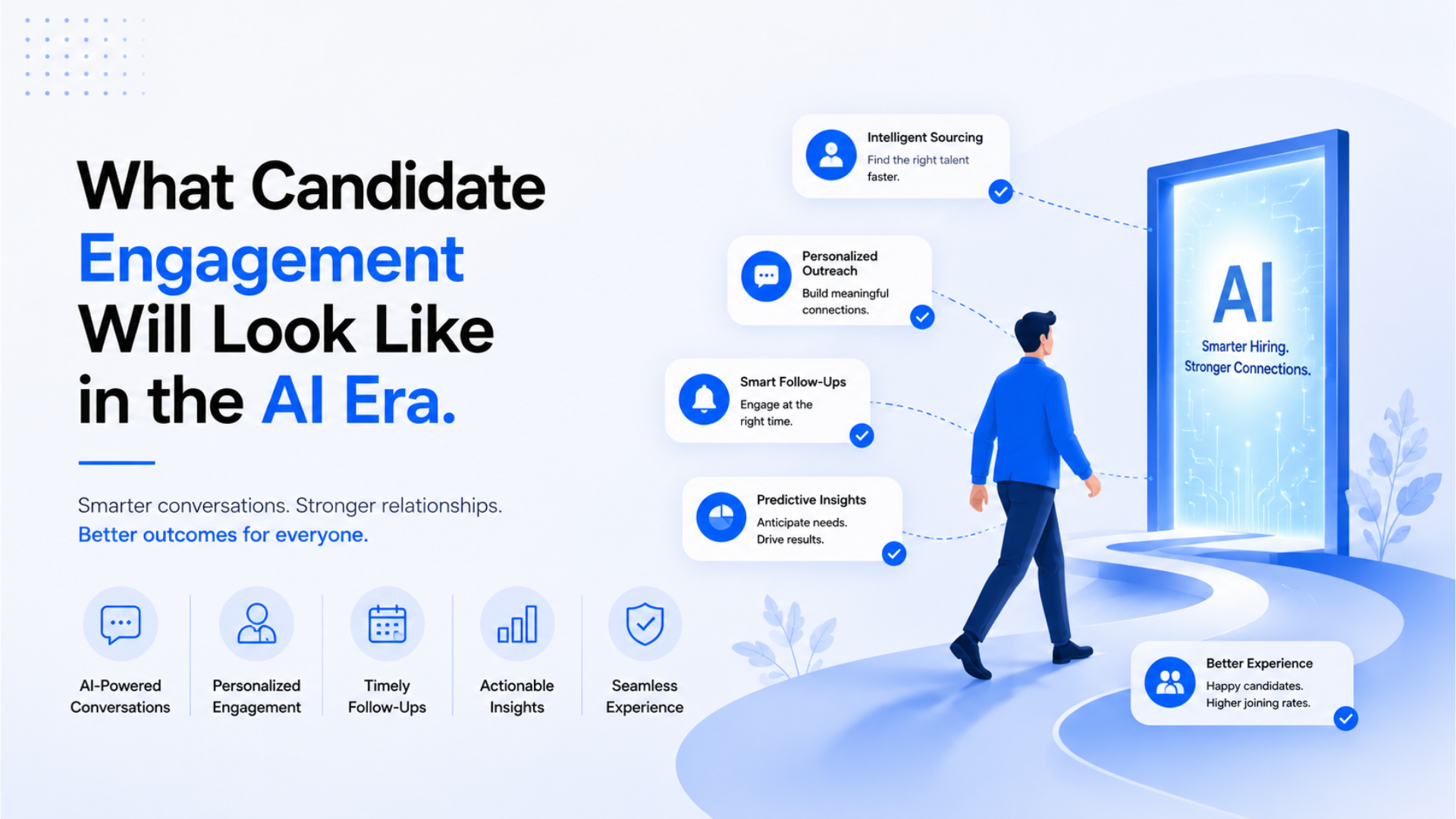
and drafted a message framework that the recruiter refined with their own judgment. The AI handled the research, signal detection, and timing. The recruiter handled the relationship. That combination, AI intelligence with human connection, is what candidate engagement will look like in the era that is now arriving.
The recruiting industry is entering a period of transformation that will redefine what it means to engage a candidate. For the past two decades, candidate engagement has operated within a narrow band of possibilities: a recruiter identifies a candidate, sends an outreach message, conducts a screening call, manages the interview process, and extends an offer. The tools have evolved, email templates have been refined, and automation has reduced some of the manual burden, but the fundamental model of engagement has remained unchanged. A human recruiter manages a pipeline of candidates through a series of discrete interactions, each one requiring manual effort to research, compose, and send. This model works, but it works within severe constraints. A recruiter can maintain genuine, personalized engagement with perhaps ten to fifteen candidates at a time. Beyond that number, the quality of engagement degrades, communication gaps widen, and candidates begin to experience the fragmented, inconsistent journey that drives withdrawal and decline. According to SHRM's talent acquisition research, the average recruiter in a mid-size enterprise manages thirty to forty active candidates simultaneously, which means that the majority of candidates in most pipelines are receiving engagement that is below the quality threshold needed to sustain their interest and trust. The AI era changes this equation fundamentally by providing the intelligence, speed, and consistency that human recruiters cannot deliver alone, not by replacing the recruiter, but by amplifying their ability to engage every candidate at the quality level that only the most committed recruiters currently achieve for a small handful of priority candidates. Understanding the difference between AI sourcing and AI recruiting is essential here. Sourcing is about finding candidates. Engagement is about building relationships with them. AI is transforming both, but the more profound transformation is in engagement, because that is where hiring outcomes are actually determined. Huntlo's platform represents this new paradigm by providing continuous, context-aware engagement support that enables recruiters to deliver personalized, relationship-driven interactions with every candidate in their pipeline, not just the ones at the top of their list.
From Batch Messaging to Predictive Engagement
The first and most visible shift in the AI era of candidate engagement is the move from batch messaging to predictive engagement. Today, most recruiters operate on a batch model: they identify a group of candidates who match a role's requirements, craft a message, and send it to the entire group with minor personalization. The timing of the message is determined by the recruiter's schedule, not the candidate's receptivity. The content is shaped by the role's requirements, not the candidate's current situation. The result is a message that may be relevant in general but is rarely optimal for any individual recipient. Predictive engagement inverts this model. AI systems analyze candidate signals, recent activity, publication patterns, social media behavior, and career trajectory indicators to determine when a candidate is most likely
to be receptive to outreach, what topics are most likely to resonate, and what framing will produce the highest probability of response. The recruiter still initiates the contact and makes the final decision about timing and content, but they do so with an intelligence layer that transforms the quality of their judgment. According to McKinsey's organizational insights, organizations that have adopted predictive engagement models report forty to sixty percent improvements in first-contact response rates, because the messages arrive at the right time, reference the right topics, and frame the opportunity in terms that connect to the candidate's current professional context rather than the recruiter's hiring urgency. This is not about sending more messages. It is about sending smarter messages at smarter times, which is precisely what AI enables.
The predictive model also transforms follow-up engagement, which is where most candidate relationships break down. In the traditional model, follow-ups are triggered by the recruiter's schedule or by crude automation rules, such as a reminder to contact a candidate if they have not responded in five days. These rules produce follow-ups that are timed for the recruiter's convenience rather than the candidate's engagement cycle. A candidate who has not responded because they are genuinely busy may respond positively to a well-timed follow-up a week later, but the same follow-up sent two days after the initial message may feel intrusive and reduce the likelihood of a future response. AI-powered predictive engagement solves this problem by analyzing each candidate's communication patterns and engagement signals to recommend optimal follow-up timing and content. The recruiter receives a recommendation, not an automated message, and can adjust the timing and content based on their knowledge of the candidate's situation. The data on how many followups one hire actually needs reveals an important nuance: the number varies dramatically by candidate, role, and stage, but the quality of each follow-up matters far more than the quantity. A single well-timed, contextually rich follow-up outperforms three generic check-in messages. AI enables recruiters to deliver that single high-quality follow-up by providing the candidate intelligence needed to make it relevant. Teams that simply add more tools without fundamentally changing their engagement model often find they have more tools but the same hiring problems, because the tools optimize the old batch-messaging model rather than enabling the new predictive one. Huntlo's platform operates on the predictive model by default, analyzing candidate signals in real time and providing engagement recommendations that are calibrated to each candidate's individual receptivity and context, whether hiring for generalist positions or for niche and technical roles where candidate signals are more specialized and timing is more critical.
Real-Time Personalization at Scale: The End of Template-Driven Recruiting
The second defining shift of the AI era is the move from template-driven communication to real-time personalization at scale. Template-driven recruiting has been the standard for over a decade. Recruiters create message templates for different scenarios, initial outreach, follow-up, interview scheduling, status update, offer notification, and then customize them with candidate-specific details before sending. The customization is typically limited to the candidate's name, current role, and perhaps one or two additional details drawn from their resume
or profile. The result is a message that is personalized at the surface level but generic at the structural level. Every candidate in a given scenario receives essentially the same message with minor variations. Candidates recognize this, especially high-quality candidates who receive multiple recruiter messages and can immediately identify template patterns. The AI era replaces this template-driven approach with real-time personalization, where every message is generated dynamically based on the full context of the candidate's profile, their career history, their recent activity, their prior interactions with the recruiting team, and the specific stage of the hiring process they are in. According to LinkedIn's recruiting resources, candidates who receive messages that demonstrate real-time awareness of their recent professional activity, a project they shipped, a talk they gave, or a skill they recently developed, are three to four times more likely to respond than those who receive messages based on static profile data, because the real-time signal communicates genuine interest and attention in a way that template customization cannot.
Real-time personalization extends beyond the content of individual messages to the structure of the engagement itself. An AI system that maintains continuous awareness of a candidate's journey can adapt the pacing, depth, and focus of communication as the candidate moves through the hiring process. A candidate who is highly engaged in the early stages may need less frequent communication during the interview process because they are already invested. A candidate who is cautiously exploring may need more frequent, information-rich communication to maintain their engagement through a longer decision-making process. This adaptive engagement is impossible with template-driven systems, because templates are designed for scenarios, not for individuals. The recruiter who understands this distinction is already operating at a level that template-driven recruiters cannot match. The question many recruiters are asking, whether AI will replace their jobs, is fundamentally about this shift. The answer is that AI replaces the template-driven, mechanical aspects of recruiting, the parts that candidates already experience as generic and impersonal, while amplifying the relational, judgment-driven aspects that candidates value most. An agentic AI recruiting platform like Huntlo does exactly this: it maintains a living intelligence profile for every candidate that updates in real time as new signals emerge, and it uses this profile to generate engagement recommendations that are specific to the candidate's current context. The recruiter reviews, refines, and delivers these recommendations with their own voice, judgment, and relationship skills. The candidate experiences a recruiter who is remarkably well-informed and consistently attentive, which is exactly what they have always wanted but rarely received. The quality of the intelligence that drives this personalization depends entirely on the freshness and depth of the candidate data. Teams that have encountered outdated candidate data in AI tools know that real-time personalization based on stale data is worse than no personalization at all, because it creates the impression of awareness without the substance. Huntlo addresses this by maintaining a continuously updated candidate intelligence layer that ensures every personalization recommendation is grounded in current, accurate data.
The Always-On Candidate Relationship: Engagement That Never Goes Cold
Perhaps the most fundamental shift in the AI era of candidate engagement is the move from episodic to continuous candidate relationships. Today, candidate engagement is episodic. It is triggered by an open role, sustained through the hiring process for that role, and then ended, either because the candidate was hired, because the candidate withdrew or declined, or because the role was filled by someone else. When a new role opens that might fit a previously engaged candidate, the relationship must be rebuilt from scratch, because the recruiter has no practical way to maintain meaningful contact with candidates who are not currently in an active hiring process. This episodic model wastes enormous value. Every interaction with a candidate builds knowledge, trust, and rapport that are lost when the engagement ends. A candidate who was not the right fit for one role but would be ideal for a future role must be re-engaged from zero, at significant cost in time and conversion probability. The AI era makes continuous candidate relationships operationally viable for the first time. An AI system can maintain awareness of a candidate's career trajectory, engagement history, and relationship context even when no active role is open, and it can prompt the recruiter to engage at moments of relevance, a career milestone, a published article, a conference presentation, or a shift in the candidate's professional focus, that create natural re-engagement opportunities. According to Gartner's HR trends research, organizations that implement continuous candidate relationship models report fifty to seventy percent higher conversion rates on re-engaged candidates compared to cold outreach, because the accumulated context and trust from prior interactions dramatically reduces the friction of re-engagement.
The always-on model also transforms how organizations handle the most common failure mode in recruiting: the candidate who was strong but not selected. In the episodic model, these candidates receive a rejection message and the relationship ends. In the always-on model, the rejection is reframed as a pause, and the AI system continues to monitor the candidate's trajectory, alerting the recruiter when a new role opens that matches the candidate's profile or when the candidate's career evolution creates a new fit. The candidate, meanwhile, continues to receive periodic, non-intrusive touchpoints that keep the relationship warm without creating the impression that the organization is relentlessly pursuing them. This is the model that has always existed in high-performing referral networks. Research confirms that referrals outperform cold outreach in part because the referring employee maintains a continuous relationship with the referred candidate that persists regardless of whether a specific role is open. The referring employee does not need AI to maintain this relationship because it is based on a personal connection. Recruiters do not have this luxury with most candidates, which is why the AI-enabled always-on model is so transformative. It gives recruiters the ability to provide referral-quality continuous engagement to every candidate in their talent community, not just the ones they happen to know personally. However, evaluating which platforms can actually deliver this capability requires careful assessment. Use the framework for evaluating an AI sourcing tool before buying to distinguish platforms that maintain genuine continuous intelligence from those that simply store candidate records and call it a talent pool. Huntlo's platform delivers the always-on model by maintaining a living, continuously updated profile for every candidate the organization has ever engaged, tracking their career
evolution, engagement history, and relationship context, and providing the recruiter with timely, relevant re-engagement opportunities that feel natural rather than automated. The result is a talent community that is genuinely engaged, not merely a database of names waiting to be contacted when a role opens.
The Intelligent Handoff: Where AI Ends and the Recruiter Begins
The most critical design question in AI-era candidate engagement is not what the AI can do, but where the AI should stop and the recruiter should take over. Engagement systems that rely too heavily on AI produce interactions that feel robotic and impersonal, undermining the trust and rapport that drive hiring outcomes. Systems that rely too heavily on human recruiters cannot scale, producing the inconsistency and communication gaps that plague traditional recruiting. The answer is the intelligent handoff, a design principle that defines clear boundaries between AI-generated and human-delivered engagement, and ensures that transitions between the two are seamless and invisible to the candidate. In practice, the intelligent handoff works as follows. The AI handles the preparatory and operational layers of engagement: candidate research, signal analysis, timing optimization, draft generation, and journey monitoring. The recruiter handles the relational and strategic layers: message refinement, conversation direction, empathetic response to candidate concerns, hiring manager advocacy, and offer positioning. The candidate interacts with the recruiter, but the recruiter is informed, prepared, and supported by the AI in ways that would be impossible without it. According to EY's technology insights, organizations that implement this intelligent handoff model achieve the highest candidate satisfaction scores, because candidates experience the warmth and authenticity of human interaction combined with the responsiveness and consistency of AI-powered operations. The candidate never knows which parts of the interaction were AI-supported, because the recruiter delivers every message with their own voice and judgment.
The intelligent handoff also determines how organizations handle the long-tail of candidate engagement, the ongoing communication with candidates who are in early exploration stages, who are not yet ready for a formal process, or who are being nurtured for future roles. In traditional recruiting, these candidates receive minimal attention because the recruiter's time is consumed by candidates in active hiring processes. In the AI era, the AI can maintain meaningful engagement with these long-tail candidates through intelligent, context-aware touchpoints that keep the relationship warm, while flagging the candidates who show signals of increased readiness for the recruiter to engage personally. This tiered engagement model ensures that every candidate receives some level of meaningful contact, while the recruiter's personal attention is reserved for the moments and candidates where it will have the greatest impact. According to Deloitte's talent research, this tiered model enables recruiting organizations to maintain active relationships with five to ten times as many candidates as they could through manual engagement alone, creating a talent community that is genuinely engaged and responsive rather than merely a list of contacts in a database. The future of candidate engagement is not AI instead of recruiters. It is AI and recruiters, working together in a design that uses the strengths of each to create an experience that is more responsive, more personal,
and more consistent than either could deliver alone. Huntlo's platform is built for exactly this future, providing the intelligence infrastructure that enables recruiters to engage every candidate at the quality level that produces hires. The AI era of candidate engagement is not coming. It is here. Start engaging with Huntlo.