A VP of engineering at a growth-stage startup has been trying to hire a senior infrastructure engineer for ninety days. The job posting has generated forty applications, none of which meet the technical bar. The internal recruiter has run every boolean string they can think of on LinkedIn Recruiter and found twelve potential candidates, four of whom responded to outreach, two of whom interviewed, and zero of whom accepted the offer. The role is now in its fourth month open, the engineering team is working weekends to cover the gap, and the VP is starting to question whether the role requirements are even realistic. Here is the secret that the VP and the recruiter do not know: the candidate they need exists, they are employed at a company two time zones away, they are not actively looking, and their profile does not contain the exact keywords the recruiter has been searching for. The candidate is findable, reachable, and hirable, but not through the methods being used. The hard-to-hire role problem is almost never a candidate shortage problem. It is a sourcing methodology problem. The roles that take the longest to fill are the roles where the gap between the candidate reality and the recruiting approach is widest, where the best candidates do not look like the job description, do not respond to standard outreach, and are not findable through keyword search. Filling these roles faster requires a fundamentally different approach to identifying, understanding,
and engaging candidates.
The first step in solving the hard-to-hire problem is understanding what makes a role hard to hire in the first place. Not all difficult roles are difficult for the same reason. According to research from LinkedIn's talent solutions team, the most common reasons roles remain open beyond sixty days fall into three categories. The first category is scarcity, where the required skill combination genuinely exists in a small number of professionals relative to the demand. Roles requiring rare technical skills, deep domain expertise, or highly specific experience fall into this category. The second category is invisibility, where qualified candidates exist but are not findable through standard search methods because their profiles use different language, they work in adjacent industries, or they have non-traditional career paths. The third category is engagement resistance, where candidates are findable but not responsive because they are passive, skeptical of recruiters, or not motivated by the value proposition being offered. The hard-to-fill position strategy must address the specific category that is causing the difficulty, because a scarcity problem requires a different solution than an invisibility problem, and an invisibility problem requires a different solution than an engagement resistance problem. Treating all hard-to-hire roles as if they have the same root cause is the most common mistake recruiting teams make.
Why Standard Recruiting Fails on Hard Roles
Standard recruiting is designed for a specific set of conditions: abundant candidates, clear job titles, well-defined skill requirements, and active job seekers. When these conditions are met, standard methods work well. Job postings attract applicants, boolean searches find matches, and outreach generates responses. Hard-to-hire roles exist precisely because one or more of these conditions is not met. The candidates are scarce, not abundant. The job titles do not map cleanly to candidate profiles. The skill requirements are nuanced and resist keyword matching. And the best candidates are passive, not active. Standard recruiting methods fail on hard roles not because recruiters are unskilled but because the methods are being applied outside the conditions they were designed for. The difficult role recruiting challenge is not a recruiting failure. It is a methodology mismatch. Understanding why more tools produce the same hiring problems, adding more standard recruiting tools does not solve the mismatch because each additional tool operates within the same set of assumptions about candidate availability, profile clarity, and keyword matching. The niche role talent sourcing problem requires methods that are designed for scarcity, ambiguity, and passivity, not for abundance, clarity, and activity. According to SHRM's talent acquisition research, roles that remain open beyond ninety days are almost always being filled with standard methods that are structurally mismatched to the actual candidate market conditions, and the organizations that fill these roles fastest are the ones that switch to a specialized approach within the first thirty days rather than persisting with standard methods for months.
The methodology mismatch also affects how hiring managers and recruiters communicate about difficult roles. When a role stays open for months, the conversation typically defaults to
either lowering the requirements or offering more money. Both responses treat the problem as a candidate shortage, which it rarely is. The candidate exists. They are simply not reachable through the channel being used. A hiring manager who says we cannot find anyone with these skills is almost always incorrect. A more accurate statement would be we cannot find anyone with these skills using the methods we are currently using. This distinction matters because it points toward the solution. If the problem is methodology, then changing the methodology will solve it. If the problem is an actual candidate shortage, no methodology change will help. Understanding AI recruiting for niche and technical roles, the vast majority of hard-to-hire roles fall into the methodology mismatch category, which means they are solvable with the right approach. The specialized talent acquisition approach that solves these roles starts with a different set of assumptions: assume the candidate exists, assume they are not actively looking, assume their profile does not match your keywords, and design your sourcing strategy accordingly.
Intelligence Before Outreach: Understanding the Candidate First
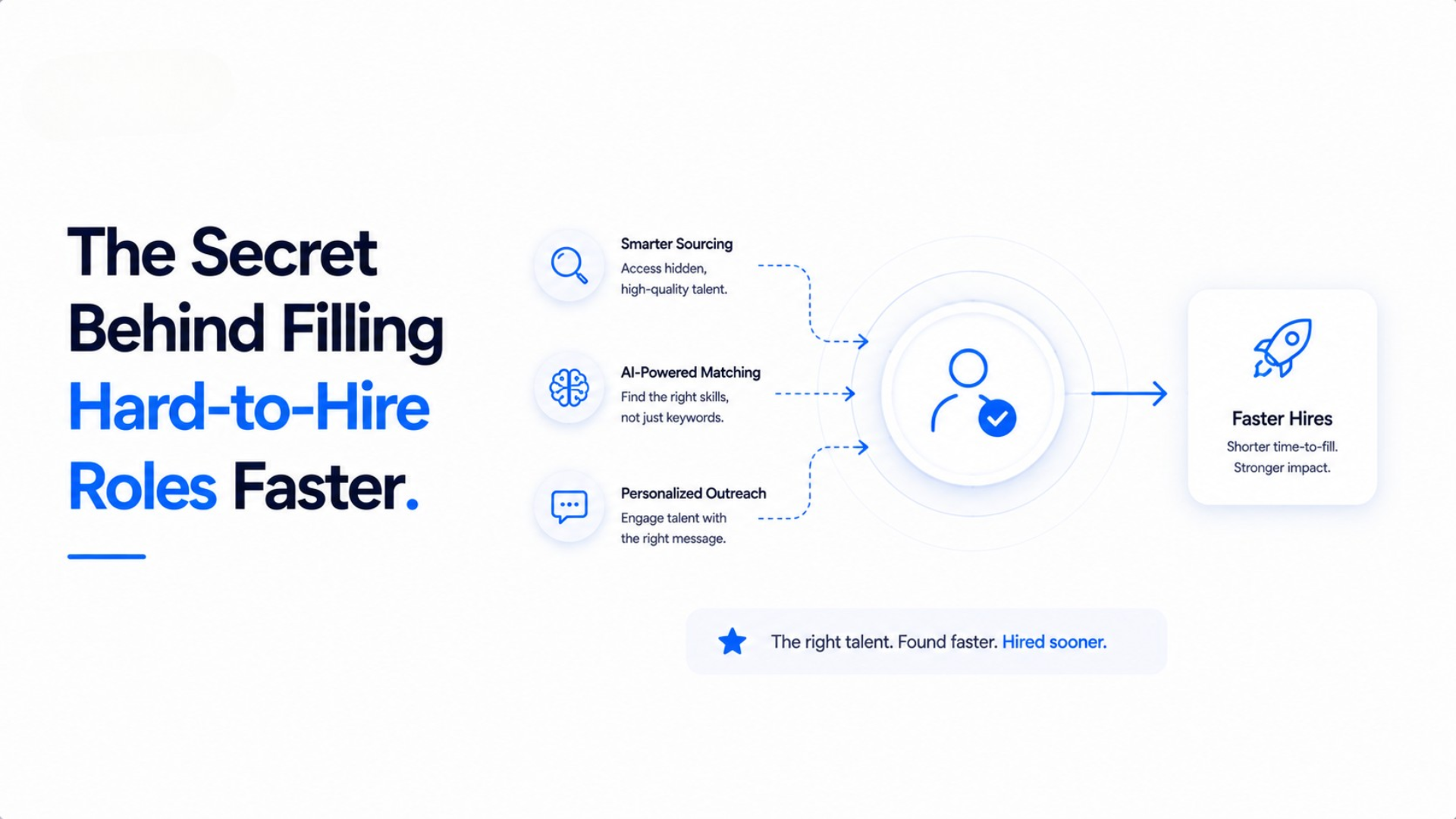
The recruiters who fill hard-to-hire roles fastest share a common practice: they spend more time understanding the candidate before they ever reach out. Where a standard recruiter might spend five minutes reviewing a profile before sending an outreach message, the hard-role specialist spends twenty to thirty minutes researching the candidate career trajectory, recent projects, professional interests, and potential motivations. This research is not academic. It directly determines the quality of the outreach. A message that demonstrates genuine understanding of the candidate work and career context is dramatically more likely to generate a response than a message that shows the recruiter has done only a surface-level scan. According to McKinsey's people organization insights, recruiters who invest in deep candidate research before outreach achieve four to six times the response rate for hard-to-fill roles compared to those who send standard outreach, because the research enables personalization that cuts through the noise of generic recruiter messages. The niche candidate discovery process starts with intelligence gathering, not with messaging, and the quality of the intelligence directly determines the quality of the engagement.
This intelligence-first approach also reveals candidates that standard search misses entirely. A recruiter who understands the candidate market deeply can identify professionals who have the required capabilities but who would never appear in a boolean search for the role title. The infrastructure engineer who has been leading a platform migration at a non-tech company, the data scientist who has been publishing research on the exact problem the hiring team is trying to solve, or the engineering leader who has been quietly building open-source tools in the required technology stack. These candidates exist in every market, but they are invisible to recruiters who only search for job titles and keywords. The senior role hiring speed advantage comes from seeing the candidate market more broadly and more deeply than competitors. Understanding the difference between AI sourcing and AI recruiting, intelligence gathering is a sourcing function that operates best when it is continuous and AI-augmented, because the volume of candidate information that needs to be processed for hard-to-hire roles
exceeds what any manual research process can handle. Understanding why some AI recruiting tools have outdated candidate data, the intelligence must also be fresh, because the candidate who was a perfect match three months ago may have changed roles, shifted focus, or become unavailable.
Redefining the Search: Skills, Signals, and Adjacencies
Filling hard-to-hire roles faster requires redefining what the search is looking for. Standard recruiting searches for job titles and keywords. Hard-role recruiting searches for skills, signals, and adjacencies. Skills-based search looks for evidence that the candidate can do the work, regardless of what their current title says. A candidate who has built and deployed a distributed event processing system at scale has the skills for a senior streaming platform engineer role even if their title says software engineer and their profile never mentions streaming. Signal-based search looks for behavioral indicators that a candidate may be receptive to a conversation, such as recent profile updates, increased professional activity, or company instability. Adjacency-based search looks for candidates in related roles, industries, or domains who have transferable skills that would enable them to succeed in the target role. The technical role hiring challenges are almost always solvable when the search is broadened beyond job title matching to include these three dimensions. According to Gartner's HR trends research, recruiters who use skills-based and adjacency-based search for hard-to-fill roles expand their qualified candidate pool by three to five times compared to title-based search, and the candidates they find through these methods are often stronger because they bring diverse perspectives and non-obvious backgrounds.
The redefined search also requires a different relationship with the hiring manager. Standard recruiting treats the job description as a fixed specification that the recruiter must match. Hard-role recruiting treats the job description as a starting point for a conversation about what the team actually needs. The best recruiters for difficult roles push back on requirements that are unnecessarily restrictive, suggest alternative candidate profiles that the hiring manager may not have considered, and help the team distinguish between essential requirements and nice-to-haves. This consultative approach often unlocks candidate pools that the original job description would have excluded entirely. Understanding why referrals outperform cold outreach, the recruiter who acts as a trusted advisor to the hiring manager produces better hiring outcomes than the recruiter who acts as an order taker, because the advisory relationship enables more flexible and creative candidate identification. The specialized candidate pipeline that fills hard roles fastest is one where the recruiter and hiring manager have a genuine dialogue about what the role requires, rather than a one-way handoff of a job description. According to Deloitte's talent research, hiring manager-recruiter collaboration on role definition reduces time-to-fill for hard roles by thirty to forty percent, because the collaborative process produces a more nuanced and realistic candidate profile than the original job description.
The Multi-Touch Engagement Playbook for Passive Experts
Reaching passive candidates for hard-to-hire roles requires a multi-touch engagement playbook that is fundamentally different from the single-message outreach used for active candidates. The passive expert receives multiple recruiter messages per week and has learned to ignore the generic ones. Breaking through this resistance requires a sequence of touchpoints that demonstrates genuine understanding and provides value before asking for anything in return. The first touchpoint should not mention a job at all. It should reference something specific about the candidate recent work, a project they led, a talk they gave, or an article they published, and offer an insight or resource related to that work. The second touchpoint, sent one to two weeks later, might share a relevant industry development or connect the candidate with a useful professional contact. The third touchpoint might invite the candidate to an event, a webinar, or a conversation about a topic they care about. Only after two to three value-driven touchpoints does the recruiter introduce the opportunity, and when they do, the candidate is already in a receptive state because the prior interactions have established trust and credibility. Understanding how many follow-ups one hire actually needs, the hard-to-hire role typically requires four to six touchpoints over four to six weeks to convert a passive candidate, compared to one to two touchpoints for an active candidate.
The executive role recruiting speed advantage of the multi-touch approach is that it converts candidates who would never respond to a cold job pitch. The candidate who ignores ten generic recruiter messages a week will respond to a recruiter who has demonstrated genuine knowledge of their work and provided value before asking for anything. The hard-to-hire role secrets are not about hidden databases or secret techniques. They are about patience, personalization, and the discipline to invest in relationship building before asking for a commitment. Understanding what makes an AI recruiting platform agentic vs. just automated, the AI platforms that support this multi-touch approach do not just send messages. They track the entire engagement history, detect the candidate response patterns, and optimize the timing and content of each subsequent touchpoint based on what has worked so far. For organizations evaluating an AI sourcing tool before buying, the ability to support multi-touch, relationship-driven engagement sequences should be a primary evaluation criterion for hard-to-hire roles, because single-touch outreach platforms are structurally incapable of solving the engagement resistance problem. And for recruiters who wonder whether AI will replace their jobs, the answer is that AI will replace recruiters who can only send single-touch cold messages, because recruiters who build patient, multi-touch relationships with passive experts will always produce better outcomes for the hardest roles.
How Huntlo.ai Fills Hard-to-Hire Roles That Stump Other Platforms
Huntlo.ai is specifically designed to solve the hard-to-hire problem. The platform uses AI-powered semantic matching to find candidates whose skills match the role requirements even when their job titles and keywords do not, which means it identifies the infrastructure
engineer who has been building distributed systems at a non-tech company, the data scientist who has been publishing relevant research, and the engineer who has been contributing to open-source projects in the required technology stack. Huntlo also provides real-time signal detection, identifying when passive candidates are showing signs of receptivity so the recruiter can engage at the optimal moment. The platform maintains continuously refreshed candidate data, ensuring that the intelligence the recruiter relies on is current, not months old. Every candidate profile includes the deep context, career trajectory, recent accomplishments, and engagement signals, that the recruiter needs to craft the personalized, multi-touch outreach that converts passive experts into engaged candidates. The platform also supports AI recruiting for niche and technical roles, where the combination of semantic matching, signal detection, and continuous data refresh is most impactful because the candidate pool is small, specialized, and rapidly changing.
For recruiting leaders who are tired of watching hard-to-hire roles stay open for months while the team runs the same searches and sends the same messages, Huntlo provides the intelligence, the engagement tools, and the fresh data to fill difficult positions in weeks instead of months. The candidate you need is out there. Huntlo finds them, understands them, and helps you engage them before your competitors do.