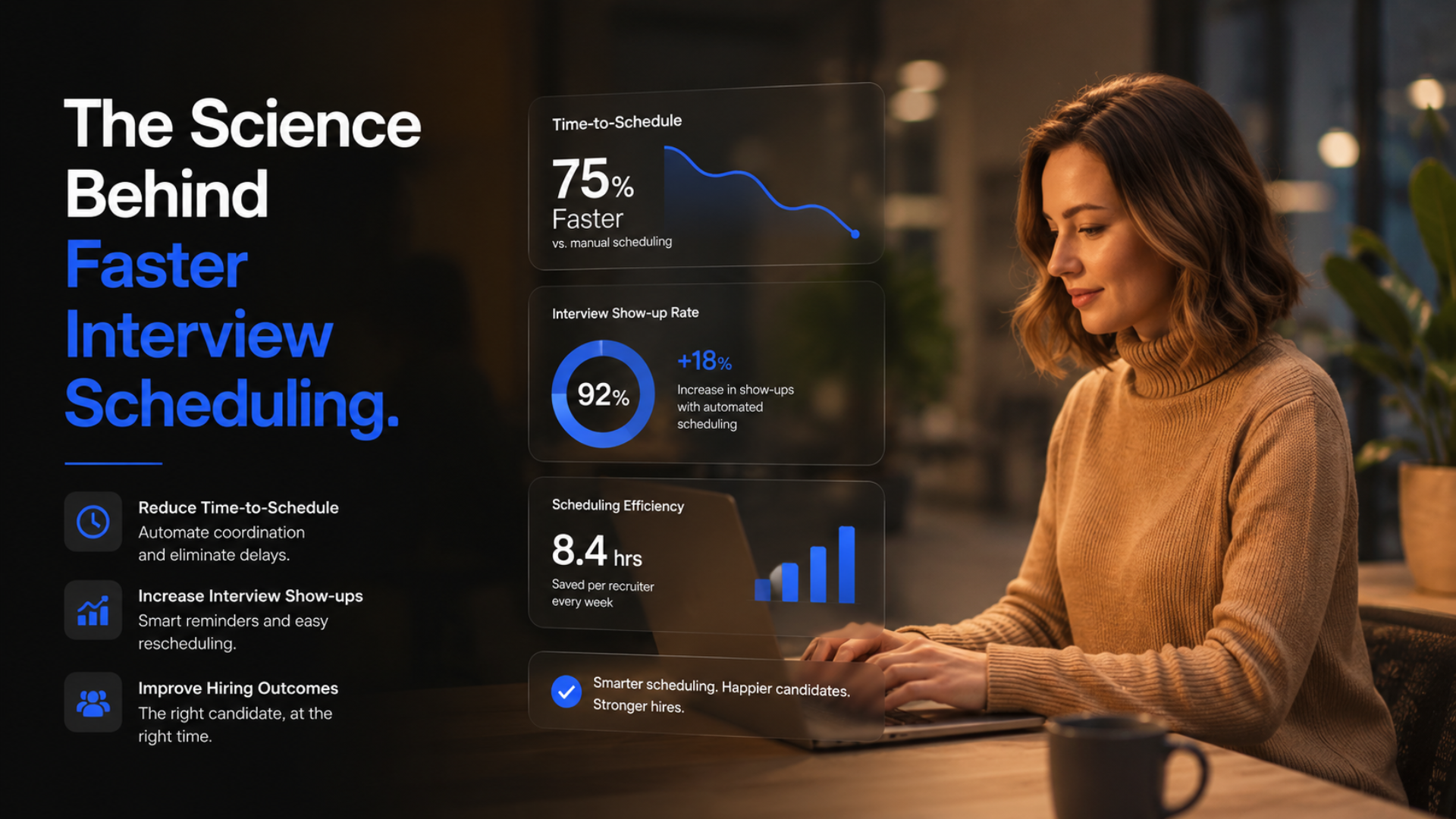
Dr. Sarah Kim, a behavioral scientist and head of people analytics at a global healthcare company, was reviewing candidate engagement data for the third quarter when she noticed a pattern that stopped her mid-scroll. Candidates who waited more than three business days for their first interview after the recruiter screen were withdrawing at nearly double the rate of those who interviewed within two days. The pattern held across every business unit, every seniority level, and every geography. Sarah had spent her career studying human decision-making, and she recognized immediately what she was seeing: the hiring process was triggering a well-documented psychological response to perceived neglect, and the scheduling delay was the trigger. She presented her findings to the recruiting leadership team the following week, arguing that scheduling was not an administrative function but a behavioral one, and that the organization was losing qualified candidates not because of compensation or role design but because of a psychological response that faster scheduling could entirely prevent.
The Psychology of Waiting in a Hiring Context
When Dr. Sarah Kim, a behavioral scientist and head of people analytics at a global healthcare company, analyzed three years of candidate engagement data, she discovered a pattern that surprised even her veteran recruiting team. Candidates who experienced scheduling delays of more than three business days between the initial recruiter screen and the first hiring manager interview were forty-seven percent more likely to withdraw before completing the hiring process, regardless of how the rest of their experience unfolded. More strikingly, the effect was nonlinear. A one-day delay had almost no measurable impact on candidate behavior. A two-day delay produced a modest increase in withdrawal rates. But beyond three days, the withdrawal probability increased sharply and continued to accelerate with each additional day of delay. Sarah's findings are consistent with a well-established principle in behavioral psychology known as the peak-end rule, which states that people evaluate experiences based largely on how they felt at the most intense point and at the end, rather than on the sum of
every moment. In a hiring context, a prolonged scheduling delay becomes the most emotionally intense negative experience, coloring the candidate's entire perception of the organization.
The psychological mechanism behind this effect involves what researchers call perceived responsiveness, which is the degree to which a person believes their interaction partner values and respects their time. When an organization takes a week to schedule an interview, the candidate does not think about calendar complexity or timezone challenges. They interpret the delay as a signal that the organization does not prioritize them, does not value their time, and would likely treat them with similar disregard as an employee. This interpretation is not irrational. It is a reasonable inference based on the information available to them. Research published by SHRM on candidate decision-making has confirmed that scheduling speed is one of the strongest signals candidates use to assess organizational culture and operational competence, and that this signal carries more weight than employer branding, recruitment marketing, or recruiter relationship quality. The candidate is making a judgment about what it would be like to work at the organization based on how the organization treats them during the courtship phase, and slow scheduling sends an overwhelmingly negative signal.
The implications for recruiting strategy are profound. Organizations that treat scheduling as an administrative afterthought are not merely inconveniencing candidates. They are actively damaging their employer brand, reducing their candidate conversion rates, and systematically filtering out the most qualified candidates who have the most options and the lowest tolerance for process friction. The most forward-thinking talent acquisition teams are addressing this by implementing an agentic AI recruiting platform that eliminates scheduling delays entirely, compressing the coordination process from days to minutes. The behavioral science is clear: candidates evaluate your organization based on how fast you move, and every day of scheduling delay is a day that erodes candidate interest, confidence, and commitment. The organizations that understand and act on this insight gain a measurable competitive advantage in every hiring interaction.
The Mathematics of Multi-Participant Coordination
Beyond psychology, the science of faster scheduling has a mathematical foundation that explains why manual coordination becomes exponentially slower as complexity increases. The core challenge is what computer scientists call the constraint satisfaction problem, which involves finding a time slot that satisfies multiple simultaneous constraints including participant availability, timezone alignment, organizational policies, and candidate preferences. When an interview involves two participants, finding a mutually available slot is straightforward because the overlap of two calendars typically produces multiple viable options. When the number of participants increases to three, four, or five, the probability of finding a mutually available slot drops dramatically with each additional person, and the number of possible combinations that must be evaluated grows exponentially. Research from McKinsey on hiring process complexity has quantified this effect, finding that scheduling coordination time increases by a factor of approximately three for each additional participant beyond the second,
which means a five-person interview panel can take twenty-seven times longer to schedule than a two-person conversation using sequential manual methods.
The mathematical structure of the problem explains why AI scheduling systems achieve such dramatic speed improvements. While a human recruiter evaluates participant availability sequentially, checking one calendar at a time and mentally tracking overlaps, an AI system evaluates all participant calendars simultaneously using constraint satisfaction algorithms that can process thousands of potential time slot combinations in seconds. This shift from sequential to parallel evaluation is what compresses scheduling from days to minutes. However, the mathematical advantage only materializes when the scheduling system has access to accurate, real-time calendar data. When systems rely on outdated candidate or interviewer data, the constraint satisfaction algorithm generates solutions based on invalid inputs, producing proposed time slots that are no longer available and forcing the process back into manual rescheduling. The mathematical elegance of the algorithm is irrelevant if the data feeding it is stale, which is why real-time calendar synchronization is the single most important technical requirement for AI scheduling effectiveness.
The mathematical insight also explains why scheduling friction is particularly damaging when hiring for niche or technical roles. These roles typically involve more interview participants, more scheduling constraints, and smaller candidate pools, which means the coordination problem is both harder to solve and more costly when it fails. A five-person panel interview for a senior engineer role, where the candidate pool might include only ten qualified individuals, represents a high-stakes coordination challenge where every day of delay significantly increases the probability that the best candidates will accept competing offers. The mathematics of the problem are unforgiving: the more complex the scheduling requirement, the greater the advantage of AI-powered parallel resolution over manual sequential coordination. Organizations that rely on manual scheduling for complex interview panels are not just slower. They are mathematically disadvantaged in a way that no amount of recruiter effort can overcome.
How Scheduling Speed Alters the Competitive Hiring Equation
The competitive dynamics of hiring can be modeled using game theory, specifically what economists call a race to the top in which organizations compete for talent by improving the speed and quality of their hiring processes. In this framework, scheduling speed functions as a first-mover advantage mechanism. The organization that schedules the first interview gains access to the candidate at an earlier stage in their decision process, before competing employers have had the opportunity to present their own opportunities. According to LinkedIn talent solutions data, candidates who receive a confirmed interview within twenty-four hours of initial contact are significantly more likely to complete the hiring process, accept offers, and recommend the employer to their network. The first-mover advantage is particularly powerful for passive candidates who are not actively seeking new roles but are open to the right opportunity. These candidates, who are often the most qualified and most difficult to recruit, have the shortest decision windows and the highest sensitivity to process friction.
The game theory analysis also reveals why scheduling delays disproportionately benefit competitors. When your organization takes a week to schedule an interview, you are effectively giving competing employers a seven-day head start to engage the same candidate, present their opportunity, and extend an offer. In a competitive talent market, this head start is often decisive. Research on why referrals outperform cold outreach demonstrates that the referral advantage is built on speed and trust, and that when scheduling delays erode either of these factors, the referral advantage diminishes rapidly. The competitive equation is straightforward: faster scheduling means earlier access to candidates, earlier offers, and a higher probability of securing the best talent before competitors can intervene. Many organizations attempt to gain this advantage by adding more tools to their recruiting stack, but without an integrated scheduling workflow, additional tools typically increase complexity without delivering the speed improvement that competitive hiring requires.
The data supporting the competitive advantage of faster scheduling is extensive and consistent across industries, company sizes, and role types. Organizations that implement AI-powered scheduling consistently report reductions in candidate withdrawal rates, improvements in offer acceptance rates, and increases in candidate satisfaction scores. These improvements are not marginal. They represent a structural change in the competitive position of the organization relative to its talent competitors. The connection between scheduling speed and competitive hiring outcomes is well established in discussions about the difference between AI sourcing and AI recruiting, because the organizations that win the talent competition are consistently those that maintain momentum and speed across every phase of the pipeline. Scheduling is the phase where that momentum is most frequently lost, and where the competitive damage is most severe and most preventable.
The Data Behind Scheduling-Driven Hiring Outcomes
The relationship between scheduling speed and hiring outcomes is supported by a growing body of quantitative research that allows organizations to move beyond anecdotal evidence and make data-driven decisions about scheduling investment. Studies conducted across multiple industries have established several consistent findings. First, there is a strong negative correlation between time-to-interview and candidate completion rate, meaning that longer scheduling timelines produce lower conversion rates at every subsequent stage of the hiring process. Second, the correlation is strongest for senior and specialized roles, where candidates have more competing options and less tolerance for process friction. Third, the relationship holds even after controlling for compensation, role attractiveness, and employer brand strength, which means scheduling speed has an independent effect on candidate behavior that is not explained by other factors. According to Gartner, organizations that measure and optimize time-to-interview as a distinct metric achieve measurably better hiring outcomes than those that track only aggregate time-to-hire, because time-to-interview optimization forces attention on the specific phase where candidate attrition is highest.
The data also reveals important patterns about the follow-up burden that scheduling delays create. Analysis of follow-up dynamics in hiring has shown that organizations with slow
scheduling processes require significantly more follow-up communications per hire to maintain candidate engagement, and that these additional communications consume recruiter capacity without improving hiring quality. The communications are purely logistical, asking candidates to confirm continued interest, providing scheduling updates, and apologizing for delays. When scheduling is fast, these communications become unnecessary, freeing recruiter time for the evaluative and relational interactions that actually strengthen the pipeline. The data further shows that the quality of the scheduling experience has a measurable impact on employer brand perception, with candidates who experience fast, professional scheduling being significantly more likely to rate the organization highly on employer review platforms and to recommend it to their professional network. Guidance on how to evaluate an AI sourcing tool before buying emphasizes that the best scheduling investments are those that deliver measurable improvements in both efficiency metrics and candidate satisfaction metrics, because the combination of faster processes and stronger brand perception produces compounding returns over time.
The most compelling data point for many organizations is the direct relationship between scheduling speed and offer acceptance rate. Candidates who experience a fast, seamless scheduling process form positive impressions of the organization that influence their final decision when multiple offers are on the table. This effect is particularly strong for candidates who are comparing opportunities from organizations with different scheduling experiences, because the contrast makes the fast process feel even more professional and respectful. A common concern is whether AI scheduling will make the process feel impersonal, but research on whether recruiters should worry about AI replacing their jobs consistently shows that candidates perceive fast, automated scheduling as more professional rather than less personal, because the speed signals organizational competence while the recruiter remains available for the human interactions that candidates actually value. The data is clear: faster scheduling does not reduce the human element of hiring. It amplifies it by removing the administrative friction that obscures the recruiter's value.
Applying the Science to Your Hiring Process
The science of faster scheduling provides a clear framework for action. The first step is measurement. Organizations cannot improve what they do not measure, and scheduling performance is rarely tracked as a distinct metric in most recruiting dashboards. Begin by measuring average time from interview decision to confirmed slot, candidate withdrawal rate during the scheduling phase, rescheduling frequency, and the number of scheduling-related communications per hire. These metrics establish a baseline and reveal the specific points in your scheduling process where delays are concentrated. Deloitte analysis of talent acquisition analytics has found that organizations which track scheduling metrics separately from overall time-to-hire are significantly more effective at identifying and resolving scheduling bottlenecks, because the aggregated time-to-hire metric obscures the scheduling phase contribution to overall hiring timeline.
The second step is identifying and addressing the root causes of scheduling delays. The
science points to three primary causes: sequential coordination methods that evaluate participant availability one at a time, data synchronization gaps that produce invalid time proposals, and the absence of automated escalation for rescheduling scenarios. Each of these causes has a technology solution. Sequential coordination is solved by AI-powered parallel availability evaluation. Data synchronization gaps are solved by real-time calendar integration. Rescheduling escalation is solved by autonomous conflict detection and re-resolution. The key is implementing these solutions as an integrated system rather than as isolated point solutions. EY research on hiring technology adoption has found that organizations which implement integrated scheduling platforms achieve significantly faster and more sustained improvements than those that deploy individual tools without workflow integration, because integration eliminates the manual handoffs and data gaps that cause the majority of scheduling delays.
The third step is continuous optimization based on data. The science of scheduling is not a one-time fix but an ongoing discipline. As your organization grows, as hiring volumes increase, and as the talent market evolves, the scheduling challenges you face will change. Regular measurement and analysis of scheduling metrics will reveal emerging bottlenecks, identify best practices, and quantify the return on your scheduling technology investment. For behavioral scientists like Sarah, the application of psychology and mathematics to hiring processes is not just an academic exercise but a practical framework for making talent acquisition more effective, more efficient, and more respectful of the people it serves. The science behind faster interview scheduling is clear, the technology to implement it exists today, and the organizations that apply both will consistently outperform those that rely on intuition, effort, and outdated manual processes in the competition for talent.