There is a body of scientific research that explains how to evaluate candidates accurately, and it has existed for decades. Industrial-organizational psychologists have studied which assessment methods predict job performance, which criteria are valid predictors, and how to structure evaluation processes for maximum predictive accuracy. The findings are robust, replicated across thousands of studies, and remarkably consistent. Yet most recruiting teams do not apply them. The gap between what science knows about hiring and what organizations actually do is one of the largest in any business discipline.
The reason for this gap has never been disagreement about the science. It has been practicality. The most predictive evaluation methods, structured assessments, competency-based interviews, and validated scoring frameworks, are time-consuming and labor-intensive when applied manually. A recruiter handling fifty applications per role does not have time to conduct structured behavioral assessments for each one. So they default to faster, less rigorous methods: resume skimming, keyword filtering, and gut instinct. The result is a screening process that feels efficient but produces mediocre outcomes. AI is changing this dynamic by making scientifically rigorous screening practical at scale, and platforms like Huntlo.ai are at the forefront of this transition.
Predictive Validity: The Science of What Actually Predicts Performance
The foundational concept in screening science is predictive validity, which measures how well a given assessment method correlates with subsequent job performance. A screening method with high predictive validity accurately identifies candidates who will perform well. A method with low predictive validity produces shortlists that are only weakly related to actual outcomes. Decades of meta-analytic research have produced a clear hierarchy of
assessment methods ranked by their predictive validity, and the findings have significant implications for how screening should be designed.
At the top of the validity hierarchy are structured work samples and structured behavioral assessments, methods that directly observe or measure how a candidate performs tasks similar to those required in the role. Next are structured interviews with standardized questions and scoring rubrics. Cognitive ability tests rank surprisingly high, though their use raises equity concerns that must be managed carefully. At the bottom of the hierarchy are unstructured interviews, resume reviews, and reference checks, the very methods that most recruiting teams rely on most heavily. Research compiled by SHRM’s talent acquisition research consistently shows that the most commonly used screening methods are among the least predictive, while the most predictive methods are among the least commonly used.
The practical implication is clear: if your screening process relies primarily on resume review and unstructured evaluation, you are using the least predictive methods available. The solution is not to abandon resumes entirely but to supplement them with assessment methods that have demonstrated higher predictive validity. Structured competency evaluations, skills assessments, and standardized scoring frameworks all outperform traditional screening, and AI platforms can deliver these methods at scale. As we have discussed in our analysis of what makes an AI recruiting platform genuinely agentic, the difference between intelligent and automated screening is the difference between applying the science and ignoring it.
Signal versus Noise: Why Most Screening Evaluates the Wrong Things
Screening science draws a critical distinction between signal and noise. Signal is any data point that genuinely predicts job performance. Noise is any data point that feels relevant but does not actually predict performance. The problem for most recruiting teams is that the data points easiest to evaluate, company names, job titles, years of experience, and educational credentials, are mostly noise. They are proxy signals that correlate weakly with performance but are easy to extract from a resume. The data points that are strong signals, demonstrated problem-solving ability, applied skill depth, and behavioral evidence of competencies, are harder to evaluate and require more sophisticated assessment methods.
This signal-to-noise problem is the primary reason why traditional screening has a predictive accuracy of roughly 50 percent, barely better than random selection. Recruiters are spending their limited evaluation time on the data points that contribute least to accurate predictions. AI screening platforms address this by evaluating the signals that matter, demonstrated capabilities, verified achievements, and competency evidence, rather than the surface-level credentials that are easy to read but uninformative. The distinction between AI sourcing and AI recruiting, is relevant here. Sourcing can work with surface signals because its job is identification, not evaluation. But screening, the actual assessment of candidate capability, must be built on predictive signals, and that requires the kind of deep evaluation that AI makes scalable.
The data quality problem compounds the signal-to-noise issue. Even the best evaluation
framework will produce poor results if the input data is unreliable. Resumes are self-reported, unverified, and optimized for keyword density rather than accuracy. We have explored the problem of outdated or incomplete candidate data in AI recruiting tools, and the lesson applies directly here: the science of screening only works when the data being screened reflects actual capability. Enriching candidate profiles with verified work history, skills assessments, and structured interview responses transforms the signal-to-noise ratio and dramatically improves screening accuracy.
Consistency and Reliability: Why Human Screening Is Inherently Unreliable
One of the most well-established findings in screening science is that human evaluators are unreliable. Give the same resume to five different recruiters and you will get five different evaluations. Give the same resume to the same recruiter on five different days and you may get five different evaluations. This inconsistency is not a failure of individual recruiters. It is a fundamental characteristic of human judgment under conditions of information overload, time pressure, and cognitive fatigue, which describes the daily reality of every screening team.
The science of inter-rater reliability, a measure of how consistently different evaluators produce the same assessment of the same candidate, shows that unstructured human screening produces reliability coefficients in the range of 0.20 to 0.40. A perfect reliability score is 1.0, meaning every evaluator produces the same assessment every time. Structured evaluation methods with clear scoring rubrics produce reliability scores of 0.60 to 0.80. AI screening systems, which apply the same criteria consistently to every candidate, produce reliability scores approaching 1.0. According to McKinsey’s research on talent management, improving screening consistency is one of the highest-leverage improvements an organization can make, because inconsistency is the single largest source of preventable screening errors.
The consistency advantage of AI screening is not just about eliminating bad days. It is about ensuring that every candidate is evaluated against the same standard, which is both fairer and more predictive. When screening criteria are applied inconsistently, the shortlist reflects the random variation in evaluator attention and mood rather than the actual distribution of candidate capability. This is one of the reasons why adding more tools without a coherent strategy does not improve outcomes: if the underlying evaluation is inconsistent, more inconsistent evaluations do not produce a better result. They produce more of the same bad result.
Structured Decision Frameworks: The Science of Better Criteria
The science of decision-making under uncertainty, a field pioneered by Daniel Kahneman and Amos Tversky, has direct application to candidate screening. Their research demonstrated that humans make systematically biased decisions when evaluating complex information under time pressure, relying on heuristics, mental shortcuts, and narrative coherence rather than evidence. The solution they proposed, and that has been validated in thousands of subsequent studies, is structured decision frameworks that decompose complex judgments into specific,
independently evaluated dimensions.
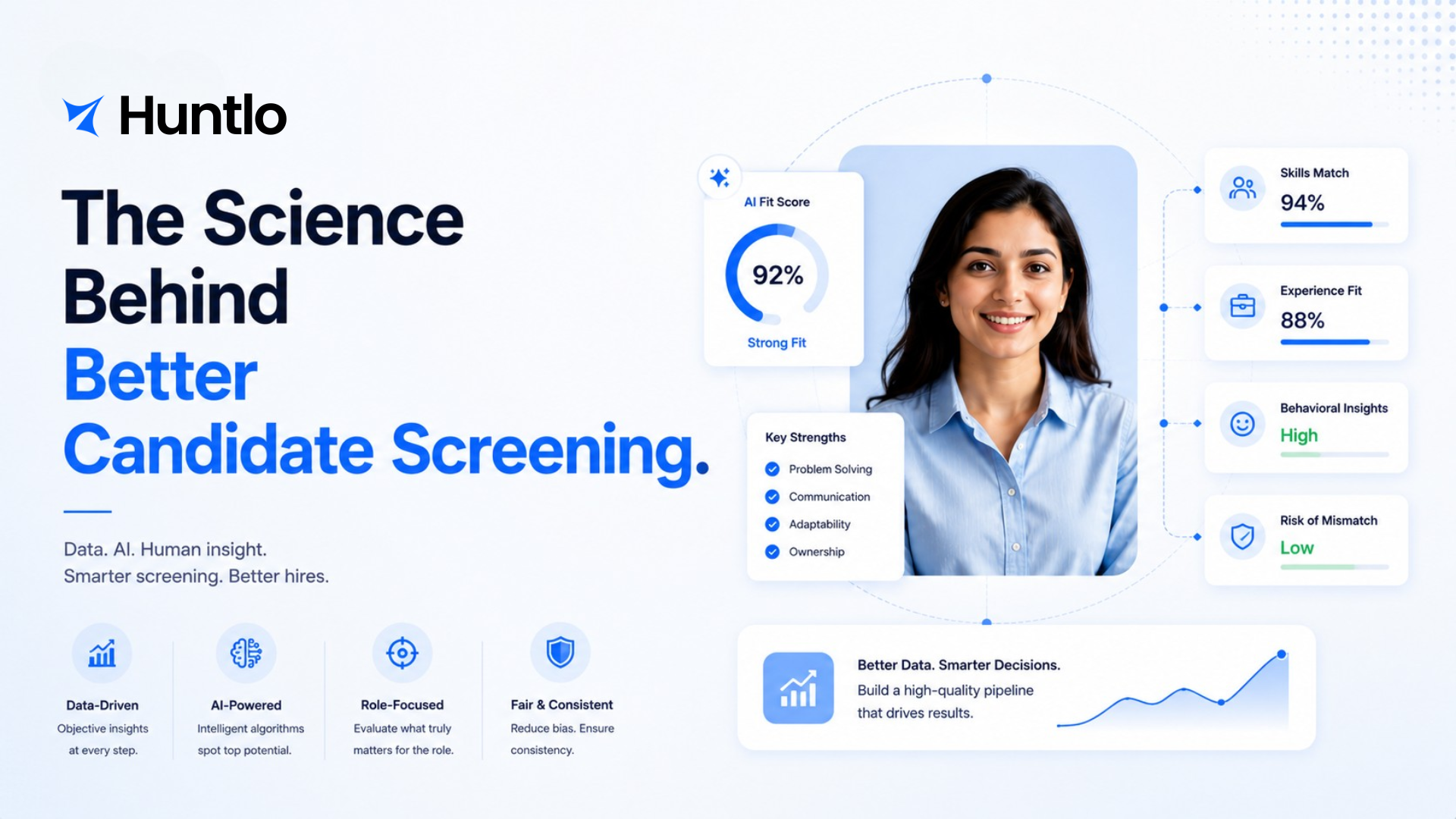
Applied to screening, this means defining the specific competencies a role requires, weighting them by importance, and evaluating each candidate independently on each dimension before combining the scores into an overall assessment. This structured approach consistently outperforms unstructured holistic evaluation, the “I know a good candidate when I see one” method, by a significant margin. The structured approach is also less vulnerable to bias, because each dimension is evaluated independently, which prevents a single strong or weak signal from disproportionately influencing the overall assessment. Platforms like Huntlo.ai that implement structured evaluation frameworks as their core architecture are applying a scientific principle that has been proven across decades of research.
The practical challenge with structured frameworks has always been the time required to apply them manually. A thorough structured evaluation of a single candidate against five weighted competencies might take twenty to thirty minutes. For a role with three hundred applicants, that is one hundred to one hundred fifty hours of evaluation time, which is why most teams abandon structured evaluation as soon as volume increases. AI eliminates this constraint entirely. A structured framework that takes a human thirty minutes per candidate takes an AI platform seconds, with perfect consistency. This is the core value proposition of AI screening technology, and it is why the science of better screening is finally becoming practical for every organization, not just those with unlimited recruiting budgets.
The Feedback Loop: Turning Screening Into a Learning System
The most underappreciated principle in screening science is the feedback loop. Screening accuracy improves over time only if the organization systematically tracks the relationship between screening assessments and actual job performance. Most organizations do not do this. They track time-to-hire and cost-per-hire, which are process metrics, not quality metrics. They do not track whether candidates who scored high during screening actually performed better than those who scored low. Without this feedback, the screening process cannot improve, because there is no signal to indicate whether the criteria are working. According to Gartner’s HR technology research, fewer than 20 percent of organizations systematically track screening-to-performance correlations, which means more than 80 percent are flying blind.
AI screening platforms make feedback loops operational by maintaining a persistent record of every screening assessment and connecting it to post-hire performance data. Over time, this creates a training dataset that allows the system to identify which evaluation criteria are genuinely predictive for specific roles and which are adding noise. The screening model improves with every hire, becoming more accurate and more efficient. This continuous improvement capability is what distinguishes an intelligent screening system from a static one. It is also what makes the investment in better screening technology compound over time, producing returns that grow rather than plateau. As we have noted, LinkedIn’s recruiting insights show that organizations with data-driven hiring processes outperform their peers on every
measurable recruiting metric.
The feedback loop also addresses one of the most common objections to AI screening: the concern that AI might replace recruiters. In a feedback-loop-driven system, the recruiter’s role becomes more important, not less. Recruiters are the ones who define the initial evaluation criteria, interpret AI-generated assessments in context, and provide the qualitative judgment that the algorithm cannot. The AI provides the data. The recruiter provides the interpretation. The combination is more accurate than either alone, and the feedback loop ensures that both the AI and the recruiter’s judgment improve over time.
Why Huntlo.ai Applies the Science of Screening at Scale
Everything described in this article, predictive validity, signal-to-noise optimization, structured decision frameworks, and continuous feedback loops, is what Huntlo.ai does by design. The platform evaluates candidates against role-specific competency frameworks that reflect the science of predictive hiring. It prioritizes demonstrated capability signals over proxy credentials, improving the signal-to-noise ratio of every shortlist. It applies structured evaluation with perfect consistency, eliminating the reliability problem that plagues human-only screening. And it connects screening outcomes to performance data, creating a feedback loop that makes every subsequent hire more accurate than the last. Even with the best science in the world, practical details matter: understanding how many follow-ups a hire actually needs, knowing why referrals outperform cold outreach, and adapting to the specific dynamics of each hiring market. Huntlo integrates these insights into a scientifically grounded screening system that improves with every use.
The science of better screening is not new. What is new is the ability to apply it consistently, at scale, across every role and every candidate. That ability is what separates the hiring teams that will lead their markets from those that will follow. The research is clear. The technology is ready. The only remaining question is whether your organization will apply the science or continue to rely on guesswork.