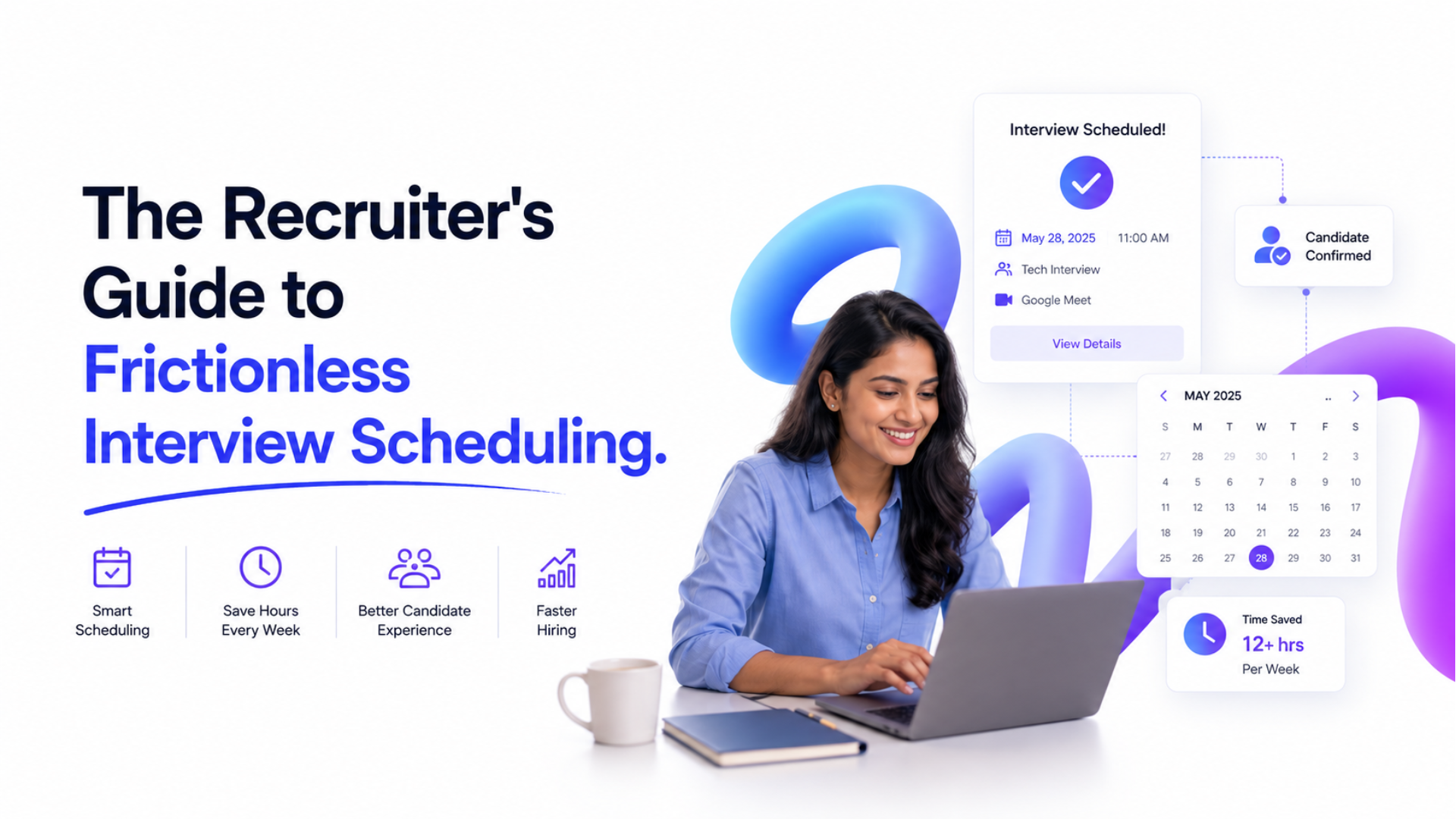
Priya Sharma, a senior recruiter at a rapidly growing health technology company, was coordinating interviews for a critical product leadership position when everything fell apart. She had six interviewers across four time zones, two hiring managers with back-to-back travel schedules, and a candidate who was also juggling three other active interview processes. Priya spent four full days sending emails, cross-referencing calendars, and negotiating time slots that could accommodate everyone. On day five, the candidate sent a polite but firm message withdrawing from consideration, explaining that another company had already completed their entire interview loop while she was still trying to schedule the first conversation. Priya had done nothing wrong in terms of candidate evaluation or relationship building. The failure was entirely logistical, and it was entirely preventable. Her experience reflects a problem that thousands of recruiters face every week: scheduling friction is not a minor inconvenience but a systematic barrier that costs organizations their best candidates, damages employer brand, and consumes recruiter time that should be spent on the strategic work that actually drives hiring outcomes.
Why Scheduling Is the Most Underestimated Hiring Bottleneck
Most talent acquisition leaders focus their optimization efforts on sourcing, screening, and offer negotiation while treating interview scheduling as a routine administrative task that requires no special attention. This assumption is wrong, and the data consistently proves it wrong. According to research published by SHRM, the average time-to-interview accounts for a significant portion of overall time-to-hire, and delays during the scheduling phase are the single most common reason candidates cite for withdrawing from hiring processes before the first conversation even takes place. The scheduling bottleneck is invisible in most
recruiting dashboards because it is not tracked as a distinct metric, which means it escapes accountability and improvement efforts. Recruiters feel the pain daily but lack the data to make the case for systemic change, leaving the bottleneck untreated quarter after quarter.
The hidden nature of the problem makes it particularly damaging. When a candidate rejects an offer because of compensation, the reason is documented and the organization can respond. When a candidate withdraws because of scheduling delays, the reason often goes unrecorded, showing up in analytics simply as "candidate declined" or "process abandoned." This ambiguity prevents organizations from recognizing the true scale of the problem and investing in appropriate solutions. The cost compounds because the same scheduling inefficiency affects every open role, every recruiter, and every candidate interaction. A recruiting team that loses ten percent of its candidates to scheduling friction is not facing a minor leak; it is facing a structural deficit that undermines every other investment in sourcing, employer branding, and candidate engagement.
Modern hiring demands modern coordination, and the tools that recruiters inherit from their applicant tracking systems were designed for an era when hiring moved more slowly and candidates had fewer options. Today, candidates expect the same scheduling convenience they experience in their personal lives, where booking a doctor appointment or a restaurant reservation takes seconds rather than days. When your hiring process requires a week of email exchanges to schedule a single conversation, it signals organizational dysfunction to the very people you most want to impress. An agentic AI recruiting platform treats scheduling as an intelligent, autonomous workflow rather than a manual coordination task, resolving calendar conflicts and confirming interviews in the background while recruiters focus on candidate relationships and hiring strategy.
The Five Friction Points That Sabotage Your Scheduling Process
Understanding where friction enters the scheduling process is the first step toward eliminating it. The most common friction point is multi-participant coordination failure. When an interview requires three or more participants, the probability of finding a mutually available time slot drops dramatically with each additional person. Recruiters typically handle this by sending availability requests to each participant individually, then manually cross-referencing responses to find overlapping windows. This sequential approach is inherently slow and error-prone because participants respond at different speeds, availability changes between when they respond and when the recruiter compiles the results, and the proposed slot is often already taken by the time the candidate confirms. Research from McKinsey on hiring process efficiency has found that coordination complexity is the primary driver of scheduling delays, and that organizations using parallel availability resolution methods complete scheduling three to five times faster than those relying on sequential email exchanges.
The second friction point is timezone mismanagement. Teams that operate across multiple regions frequently propose times that are outside normal working hours for one or more participants, leading to rescheduling cycles that add days to the process. The third friction point is calendar data staleness. Interviewers update their calendars through multiple systems, and
when the scheduling tool relies on cached or infrequently synchronized data, it proposes slots that are no longer available, triggering the entire coordination process to restart. This problem is especially prevalent when tools rely on outdated candidate or interviewer data, because even a few hours of data lag can render a proposed time slot invalid and force another round of back-and-forth communication that frustrates all participants and extends the hiring timeline.
The fourth friction point is the rescheduling cascade. When a single interviewer needs to reschedule, the entire process often restarts from scratch, because finding a new time that works for all participants requires repeating the same coordination effort. Each rescheduling event adds an average of two to three days to the hiring timeline and significantly increases the probability that the candidate will withdraw. The fifth friction point is the absence of candidate self-service. Many organizations still require candidates to communicate their availability through a recruiter rather than offering a direct booking interface, creating an unnecessary intermediary that slows the process and reduces candidate satisfaction. This is particularly damaging when hiring for niche or technical roles, where candidates have high expectations for a professional and efficient process and will quickly disengage from organizations that make scheduling unnecessarily complicated.
How Frictionless Scheduling Transforms Candidate Experience
Candidate experience during the scheduling phase directly influences offer acceptance rates, employer brand perception, and the likelihood that candidates will recommend your organization to their professional network. According to LinkedIn talent solutions research, candidates who describe their scheduling experience as smooth and professional are significantly more likely to view the hiring organization favorably, accept offers when extended, and recommend the company to peers. The scheduling phase is often the first substantive interaction a candidate has with your hiring team beyond the initial recruiter screen, and it sets expectations for how the organization operates. A frictionless scheduling experience signals that the company is organized, respects the candidate's time, and values efficiency. These are qualities that top candidates actively look for when evaluating potential employers, and they carry significant weight in competitive hiring situations where multiple attractive options exist simultaneously.
The transformation is most visible when comparing organizations that have implemented automated scheduling against those still relying on manual coordination. Teams that have adopted AI-powered scheduling report that candidates consistently comment on the speed and professionalism of the process, and these positive experiences translate directly into higher engagement rates, lower withdrawal rates, and stronger offer acceptance outcomes. Referral candidates, who represent one of the highest-converting talent segments, are especially sensitive to scheduling quality because their expectations are shaped by the personal endorsement from their referring employee. Research on why referrals outperform cold outreach demonstrates that the referral advantage is built on a foundation of trust and positive experience. When scheduling friction undermines that experience early in the process, it erodes the very
trust that makes referrals so valuable, and the referred candidate may disengage without ever communicating their frustration to anyone on the hiring team.
The broader impact extends beyond individual candidate interactions into the recruiting team's operational efficiency and morale. When scheduling is frictionless, recruiters spend less time on coordination logistics and more time on the activities that actually strengthen hiring outcomes: building relationships with candidates, coaching hiring managers on interview techniques, and developing sourcing strategies for hard-to-fill roles. The cumulative effect is a recruiting function that operates with greater speed, higher quality, and better candidate relationships. However, achieving this transformation requires more than just adopting a new tool. Many organizations have learned the hard way that adding more tools without addressing workflow often increases complexity rather than reducing it. The key is implementing scheduling automation as part of an integrated workflow that connects seamlessly with existing systems and eliminates manual handoffs between tools.
Building a Frictionless Scheduling Workflow Step by Step
Building a frictionless scheduling workflow begins with mapping your current process end to end, identifying every handoff, delay point, and manual step that candidates and interviewers must navigate. Most recruiting teams discover that their scheduling process involves far more steps than they realized, with multiple email exchanges, calendar checks, and approval sequences that add days without adding value. Once you have a clear map, the next step is identifying which elements can be automated entirely and which require human judgment. Calendar availability checking, conflict detection, time zone conversion, and candidate communication can all be fully automated. Decisions about interview panel composition, assessment format, and strategic sequencing should remain with the hiring team. Understanding the difference between AI sourcing and AI recruiting is relevant here, because the same principle applies to scheduling: automation should handle the operational mechanics while recruiters focus on the strategic decisions that require human judgment and relationship awareness.
The third step is selecting a scheduling solution that integrates with your existing technology stack rather than operating as an isolated point solution. Scheduling tools that cannot connect to your applicant tracking system, calendar platforms, and communication channels will create new silos that require manual data transfer between systems. This is precisely the kind of fragmentation that follow-up research in hiring has identified as a major source of recruiter inefficiency, because each disconnected tool adds another layer of communication overhead that slows the process and increases the risk of errors. The fourth step is establishing clear scheduling policies that reduce ambiguity for everyone involved. Define standard interview durations, set maximum response time expectations, create timezone-aware availability windows, and communicate these policies to all participants before the scheduling process begins. When candidates and interviewers know what to expect, the process moves faster and requires fewer clarification exchanges. According to Gartner, organizations that formalize their scheduling policies and automate their enforcement see measurably faster time-to-interview and higher candidate satisfaction scores than those that leave scheduling to ad hoc
coordination.
The fifth and final step is continuous measurement and improvement. Track the metrics that matter: average time from interview decision to confirmed slot, candidate withdrawal rate during scheduling, rescheduling frequency, and interviewer no-show rates. These metrics will reveal whether your workflow is actually delivering the frictionless experience you designed, and they will highlight specific areas where further optimization is needed. Without measurement, scheduling improvements are based on anecdote rather than evidence, and the same problems recur without being addressed. Regularly reviewing these metrics with your recruiting team creates accountability and ensures that scheduling performance remains a priority rather than reverting to the manual processes that created the bottleneck in the first place.
From Manual Coordination to Strategic Recruiting
The ultimate benefit of frictionless scheduling is not that it makes scheduling faster, although that is certainly valuable. The deeper benefit is that it fundamentally changes what recruiters spend their time doing and the strategic value they deliver to the organization. When scheduling no longer consumes hours of each day, recruiters can redirect that time toward sourcing higher-quality candidates, building stronger relationships with hiring managers, developing more effective engagement strategies, and contributing to workforce planning conversations that shape the organization's long-term talent strategy. This shift from operational coordination to strategic influence is the real return on investment for scheduling automation, and it compounds over time as the recruiting team develops capabilities that were previously impossible under the weight of manual logistics. A common concern is whether this shift means recruiters should worry about AI replacing their jobs, but the evidence consistently shows the opposite: AI amplifies recruiter effectiveness by eliminating the low-value tasks that consume their capacity, enabling them to focus on the relationship-driven work that defines recruiting excellence.
For organizations ready to make this transition, the implementation approach matters as much as the technology choice. Guidance on how to evaluate an AI sourcing tool before buying applies equally well to scheduling tools: prioritize platforms that integrate with your existing stack, demonstrate real-time calendar synchronization, support multi-participant and multi-timezone coordination, and provide the analytics you need to measure improvement over time. Avoid tools that require extensive manual configuration or that operate in isolation from your broader recruiting workflow. The most successful implementations are those that feel like a natural extension of the existing process rather than a disruptive replacement. Deloitte research on talent acquisition technology adoption consistently shows that organizations which prioritize integration and workflow continuity during implementation achieve faster adoption, higher recruiter satisfaction, and measurably better hiring outcomes than those that deploy standalone tools without considering how they fit into the broader recruiting ecosystem.
The business case for frictionless scheduling is compelling regardless of organization size or hiring volume. EY has documented that companies investing in streamlined hiring processes
report stronger employer branding, higher candidate satisfaction, and significantly faster time-to-fill across all role types and seniority levels. For individual recruiters like Priya, the difference is personal and immediate: fewer stressful coordination marathons, more productive candidate conversations, and the confidence of knowing that qualified candidates will not be lost to preventable scheduling delays. The path from manual coordination to strategic recruiting begins with a single decision to treat scheduling as a core competency rather than an afterthought, and the tools to make that transition are available today.