Amit responded to the outreach within two hours. On the screening call, he asked about the team's approach to data infrastructure, wanted to know how decisions got made at the leadership level, and even mentioned a blog post the CTO had written about microservices. The recruiter, Lena, walked away energized. She told the hiring manager this one was special. Three days passed before Lena sent a follow-up, a short note saying she would be in touch soon about next steps. A week later she sent a scheduling link for the hiring manager call. Amit opened the email but did not click the link. Lena sent a reminder two days later. No response. She tried LinkedIn. Nothing. Amit had not made a deliberate decision to end the conversation. What happened was quieter than that. During the nine days between his enthusiastic call and the scheduling email, a set of psychological processes eroded his inclination to continue. Each day of silence, each generic message, each moment of uncertainty activated mental shortcuts that made not responding feel easier than engaging. Amit did not ghost. His brain did.
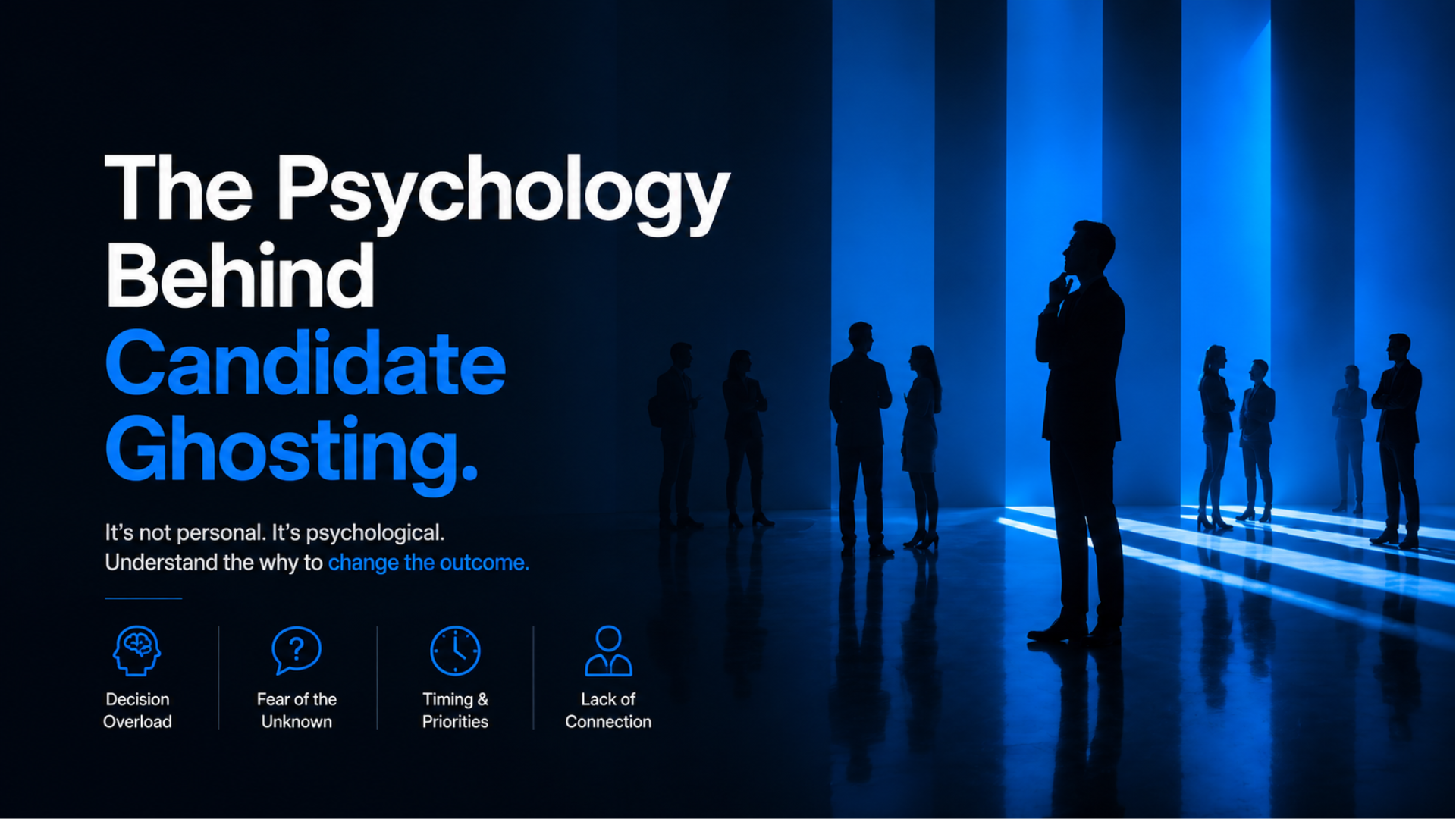
The recruiting industry spends enormous energy on the mechanics of hiring, sourcing strategies, interview frameworks, compensation benchmarks, and offer workflows, while paying almost no attention to the psychological dynamics that determine whether a candidate stays engaged or disappears. Ghosting is treated as a behavioral problem, a failure of candidate professionalism, when in reality it is a psychological phenomenon driven by well-documented cognitive biases and emotional responses that the recruiting process itself often triggers. Understanding these psychological mechanisms does not just explain why ghosting happens. It reveals exactly how to prevent it, because once you understand the mental forces that pull a candidate toward disengagement, you can design a process that counteracts those forces rather than amplifying them. According to SHRM's talent acquisition research, the organizations with the lowest ghosting rates are not those that send the most follow-up messages.
They are those whose processes align with the psychological principles that govern human decision-making.
Ghosting Is a Psychological Response, Not a Moral Failure
The first and most important psychological insight about ghosting is that it is not a moral act. Candidates who ghost are not making a considered ethical decision to behave poorly. In most cases, they are not making a decision at all. Ghosting is typically the result of cognitive ease, the psychological tendency to take the path of least mental effort. When a candidate receives a generic follow-up that requires a thoughtful response, and they are busy with work, and they are not sure where they stand in the process, and they have other opportunities moving faster, the effort required to compose a polite response feels disproportionately large compared to the ease of simply doing nothing. The brain evaluates the cost of responding, time, energy, emotional investment, against the benefit, maintaining a connection with a process that feels uncertain and slow, and the cost wins. This is not a character flaw. It is how human cognition works under conditions of uncertainty and competing demands. The candidate does not feel good about not responding. They feel a flicker of guilt that quickly dissolves because the alternative, engaging with a process that has not given them a clear reason to prioritize it, feels worse.
This understanding reframes the recruiter's challenge entirely. The goal is not to convince candidates to be more professional or more committed. The goal is to reduce the cognitive cost of engaging and increase the perceived benefit of continuing. A fast, personalized follow-up that references specific topics from the prior conversation reduces the cognitive cost because the candidate does not have to re-establish context or figure out what to say. A clear communication of next steps increases the perceived benefit because the candidate can see a concrete outcome from their continued participation. A proactive update that addresses a concern the candidate raised eliminates the uncertainty that drives cognitive avoidance. Each of these interventions targets a specific psychological mechanism rather than vaguely appealing to the candidate's sense of obligation. The recruiters who grasp the difference between AI sourcing and AI recruiting intuitively apply this principle. Sourcing creates the initial psychological opening. Recruiting, the engagement part, is the discipline of maintaining it against the cognitive forces that push candidates toward disengagement.
Loss Aversion: Why Candidates Fear the Wrong Move
Loss aversion is one of the most powerful forces in human decision-making, and it operates in recruiting with particular intensity. First described by behavioral economists Daniel Kahneman and Amos Tversky, loss aversion is the principle that people feel the pain of a loss approximately twice as strongly as they feel the pleasure of an equivalent gain. In the context of a hiring process, this means that a candidate evaluates a potential job change not just in terms of what they might gain, a new role, better compensation, interesting challenges, but also in terms of what they might lose, job security, team relationships, institutional
knowledge, and the comfort of the known. As the hiring process extends over days and weeks, the candidate's loss aversion intensifies. The longer they sit in the process without a clear resolution, the more time they have to imagine potential losses, and the more those imagined losses loom larger than the potential gains. A candidate who was excited about a role on day one may be actively rationalizing reasons to stay put by day ten, simply because their loss aversion has had ten days to amplify the downsides of leaving.
The practical implication for recruiters is that speed and certainty are the most effective antidotes to loss aversion. A fast, well-structured process gives the candidate less time for loss-oriented thinking to take root. Clear communication about role expectations, team dynamics, and growth opportunities provides concrete counterweights to the abstract fears that loss aversion generates. Proactive concern resolution, asking the candidate directly what would make them hesitate about a move and addressing those concerns early, prevents the candidate from constructing catastrophic loss narratives in the silence between interactions. This is one reason candidates pursuing niche and technical roles are particularly susceptible to loss aversion. Their specialized skills give them strong positions at their current employers, which means the perceived losses from leaving are larger and more specific. According to McKinsey's organizational insights, candidates in specialized roles take approximately forty percent longer to make hiring decisions than generalist candidates, not because they are more deliberative but because their loss aversion has more specific targets to fixate on. The recruiters who recognize this dynamic and address it proactively, rather than waiting for the candidate to raise concerns, consistently achieve higher conversion rates.
Decision Fatigue and the Overwhelmed Candidate
Decision fatigue is the psychological degradation of decision quality that occurs after a long series of choices. Every time a person makes a decision, they consume a finite resource of cognitive energy. As that resource depletes, they become more likely to take shortcuts, avoid decisions entirely, or default to the status quo. The hiring process is a gauntlet of decisions for the candidate. Should I respond to this outreach? Should I take the screening call? Should I share my salary expectations? Should I commit to an interview time? Should I ask about remote flexibility? Should I prepare for this interview or focus on my current job? Each of these decisions consumes cognitive energy, and the candidate is making them while simultaneously managing their full workload and personal responsibilities. By the time the process reaches the later stages, many candidates are simply too decision-fatigued to engage with another request, another question, or another scheduling email. They do not ghost because they lost interest. They ghost because their cognitive battery is empty.
Reducing decision fatigue requires minimizing the number and complexity of decisions the candidate must make at each stage. The recruiter can accomplish this by providing clear recommendations rather than open-ended options. Instead of asking the candidate when they are available for an interview, the recruiter can offer two specific time slots and ask which works better. Instead of asking the candidate what information they need about the role, the recruiter
can proactively share the most relevant information based on the candidate's background and priorities. This decision-reduction approach is precisely what an agentic AI recruiting platform can provide at scale. The AI analyzes the candidate's conversation history and generates recommendations that reduce the cognitive burden on both the candidate and the recruiter. However, technology alone does not solve the problem if the underlying process is poorly designed. Organizations that add tools without simplifying the candidate's decision journey often find they have accumulated more technology but the same cognitive load problem, a pattern explored in the analysis of having more tools but the same hiring problems. The goal is not to give the candidate more information. It is to reduce the mental effort required to move forward.
The Reciprocity Gap: When Candidates Feel Unvalued
Reciprocity is one of the most fundamental principles of human social behavior. When someone invests time, attention, or effort in us, we feel a natural psychological obligation to reciprocate. This principle is why personalized outreach generates higher response rates than generic templates, why candidates who receive detailed answers to their questions are more likely to advance, and why referred candidates, who enter the process with an existing relationship, are so much more likely to engage. The candidate invests in the process by responding, preparing, and showing up. They expect the recruiter to reciprocate with attention, personalization, and responsiveness. When that reciprocity is present, the relationship deepens. When it is absent, the candidate feels unvalued and the psychological contract that sustained their engagement breaks down.
The reciprocity gap, the difference between the investment the candidate makes and the investment they perceive from the recruiter, is one of the most reliable predictors of ghosting. A candidate who spends forty-five minutes on a screening call and then waits five days for a generic follow-up experiences a large reciprocity gap. They invested significantly. The recruiter appeared to invest minimally. The candidate interprets this gap not as a scheduling issue but as a signal that their time and interest are not valued, and they disengage accordingly. This dynamic explains why referrals outperform cold outreach so dramatically. Referred candidates enter the process with a pre-existing reciprocity relationship through the referring employee, and the recruiter's follow-up builds on that foundation rather than starting from zero. Understanding how many followups one hire actually needs is important, but the quality of reciprocity in each follow-up matters more than the quantity. A single follow-up that demonstrates genuine investment in the candidate, referencing specific conversation details, providing new and relevant information, and proactively addressing concerns, delivers more reciprocity than five generic check-in messages. LinkedIn's recruiting resources have found that candidates who perceive high recruiter investment in the relationship are four times less likely to ghost than those who perceive low investment, regardless of the number of touchpoints.
Cognitive Dissonance and Competing Opportunities
Most candidates who engage with a recruiter are simultaneously considering other opportunities, and the presence of competing options creates a state of cognitive dissonance that can accelerate disengagement. Cognitive dissonance is the mental discomfort a person feels when they hold two conflicting beliefs or when their behavior does not align with their beliefs. A candidate who is genuinely interested in your opportunity but also exploring another role experiences dissonance because they cannot fully commit to either path. The longer this state persists, the more uncomfortable it becomes, and the brain resolves the discomfort not by making a deliberate choice but by gradually disengaging from the option that feels less certain. If your process has been slower, less communicative, or less personalized than the competing opportunity, the candidate's brain will quietly resolve the dissonance by deprioritizing your role. They will not announce this decision. They will simply stop responding, because non-response is the path of least cognitive effort when the brain is managing conflicting priorities.
The recruiting implication is that engagement speed and consistency directly determine whether your opportunity wins the cognitive dissonance resolution. A candidate holding two opportunities will naturally gravitate toward the one that feels more certain, more respectful, and more responsive, because certainty and respect reduce cognitive discomfort. This is not a rational evaluation of which job is better. It is a psychological process of reducing the mental strain of holding conflicting options. The recruiters worried about whether AI will replace their jobs should understand that managing this kind of psychological complexity at scale, across dozens of candidates with competing opportunities, is exactly where AI-powered engagement systems deliver the most value. By maintaining consistent, personalized, timely communication, the AI ensures that your opportunity remains the lower-dissonance option even when the candidate is evaluating multiple paths simultaneously. However, all of this engagement work depends on having accurate candidate data. Teams dealing with outdated candidate data in AI tools cannot deliver the personalized, relevant communication that reduces cognitive dissonance, because their messages are based on stale information that does not reflect the candidate's current situation. When evaluating platforms, use the framework for evaluating an AI sourcing tool before buying to ensure data freshness is a core capability, not an afterthought.
Designing a Process That Respects Candidate Psychology
The psychological principles behind ghosting, cognitive ease, loss aversion, decision fatigue, reciprocity gaps, and cognitive dissonance, are not abstract theories. They are predictable, measurable forces that can be systematically addressed through process design and technology. A psychologically aware recruiting process is one that makes engagement easy by reducing cognitive cost, fast by minimizing time for loss aversion to build, clear by providing the certainty that resolves dissonance, and reciprocal by demonstrating consistent investment in the candidate. These four principles translate directly into operational practices. Fast, personalized first follow-ups that reference specific conversation details. Clear stage-by-stage communication that tells the candidate exactly what to expect. Proactive concern resolution that
addresses the worries that loss aversion amplifies. Decision-reduction touchpoints that minimize the cognitive burden on the candidate. And consistent recruiter presence that sustains the reciprocity relationship throughout the entire journey. Gartner's HR trends research identifies psychologically aware process design as the next frontier in talent acquisition, because the organizations implementing these principles are achieving conversion rates that traditional process-centric approaches simply cannot match.
Implementing these principles at scale requires technology that can monitor engagement signals, detect the psychological warning signs of impending disengagement, and trigger the right intervention at the right moment. An AI-powered engagement system does not just send messages on a schedule. It understands the psychological state of each candidate based on their behavior and communication patterns, and it adapts its approach accordingly. A candidate showing signs of loss aversion, asking increasingly cautious questions about risk, receives reassurance and concrete details that counter their fears. A candidate showing signs of decision fatigue, shorter responses, delayed replies, receives simplified, low-friction touchpoints that make continuing easy. A candidate showing signs of a reciprocity gap, declining engagement despite continued communication, receives a high-investment message that demonstrates genuine attentiveness. This psychologically intelligent approach is what distinguishes modern AI-powered recruiting from the automation tools that preceded it. EY's technology insights report that organizations deploying psychologically aware AI engagement systems are reducing ghosting by fifty to sixty-five percent, not by sending more messages but by sending the right messages informed by an understanding of what the candidate is actually experiencing. Deloitte's talent research concludes that the future of recruiting belongs to organizations that treat candidate psychology as a design parameter rather than an uncontrollable variable, and that AI is the enabling technology that makes this psychologically informed approach achievable at the scale modern hiring demands.
Candidates do not ghost because they are unreliable. They ghost because the recruiting process activates psychological forces, cognitive ease, loss aversion, decision fatigue, reciprocity gaps, and cognitive dissonance, that make not responding feel like the easiest option. These forces are predictable, well understood, and entirely addressable through process design and AI-powered engagement. The solution is not to blame candidates for responding to the incentives your process creates. The solution is to design a process that creates different incentives, one where engaging feels easy, fast, clear, and genuinely reciprocal. Huntlo.ai provides the intelligence layer that makes psychologically aware recruiting possible, detecting the signals that indicate disengagement risk, generating interventions that counteract the specific psychological forces at work, and maintaining the kind of consistent, personalized engagement that keeps candidates connected from first touch to offer. Stop fighting human psychology with generic templates and manual processes. Work with it. Build your engagement around it. Build it with Huntlo.