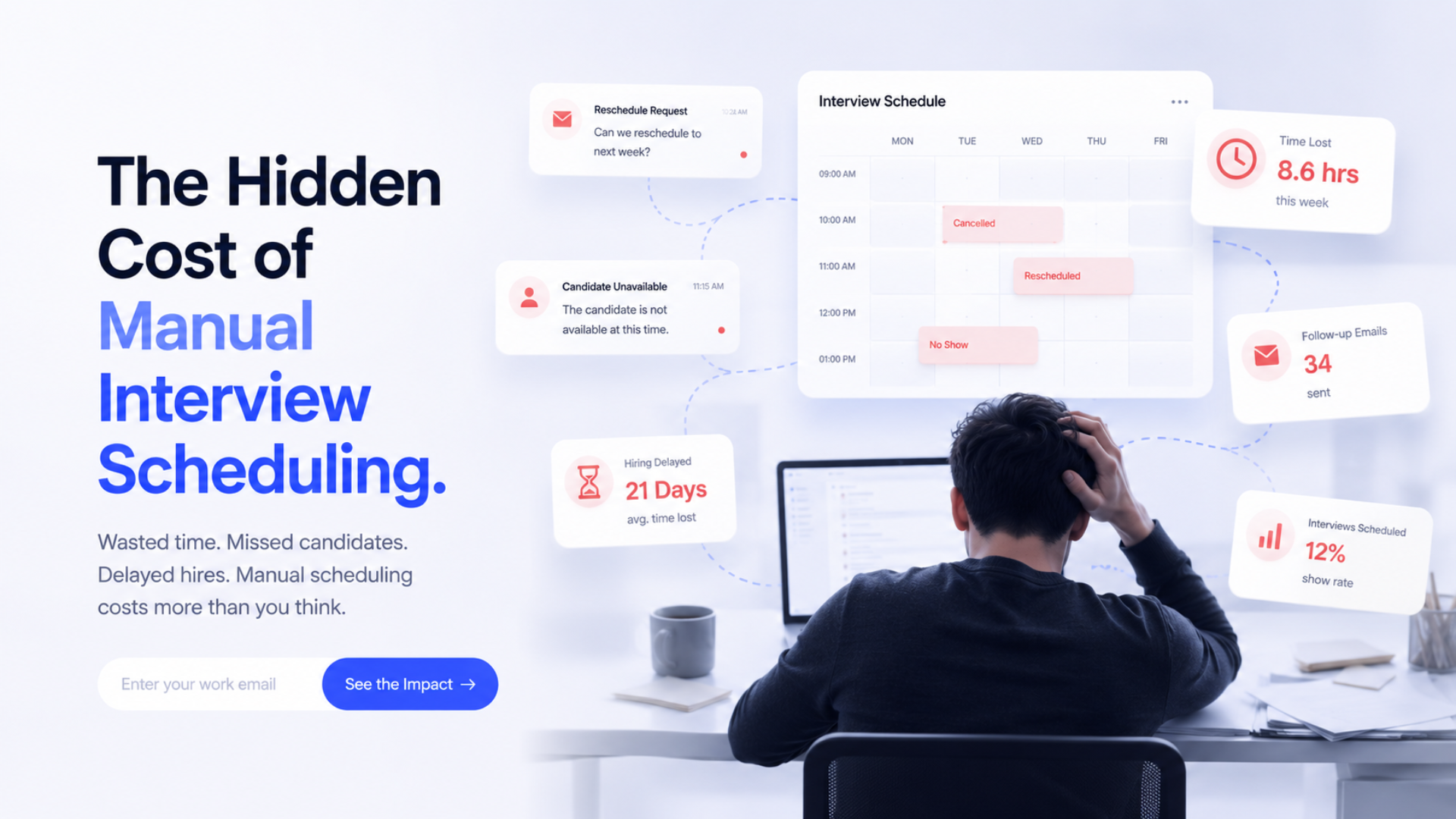
Sarah Chen, a senior recruiter at a midsize SaaS company, spent the first two hours of every Tuesday doing the same thing: emailing back and forth with candidates and hiring managers to lock down interview slots. She maintained a color-coded spreadsheet, three separate calendar tools, and a Slack channel dedicated solely to schedule changes. Despite all that effort, at least one interview per week would fall through because of a timezone mix-up, a double booking, or a last-minute cancellation that nobody could absorb quickly enough. When her VP of People asked why their average time-to-hire had crept up from 28 to 42 days, Sarah pointed to the only honest answer: the scheduling process itself had become the bottleneck. Her story is not unusual. Across industries, talented recruiters are losing hours every week to a task that should be trivial, and the costs extend far beyond wasted time.
What Manual Scheduling Really Costs Your Hiring Team
The most visible cost of manual interview scheduling is the sheer number of recruiter hours consumed. Industry surveys consistently show that scheduling a single interview round can take between fifteen and forty-five minutes of back-and-forth communication. When a company runs dozens of interviews per week, those minutes compound into entire workdays lost to calendar juggling. According to research from SHRM, talent acquisition professionals spend nearly a third of their workweek on administrative tasks, and scheduling ranks among the most time-consuming. That is time not spent on sourcing candidates, building relationships, or crafting compelling outreach.
Beyond the hours lost, manual scheduling introduces errors that carry their own financial weight. Double bookings force reschedules that push hiring timelines out by days or weeks. A missed interview slot can mean losing a top candidate to a competitor who moved faster.
When recruiters manually juggle multiple calendars across time zones, mistakes are not rare outliers but predictable occurrences. Platforms like Huntlo approach scheduling as part of a larger agentic workflow, where the system understands context and handles coordination without requiring a human to serve as the middleman. The difference is not just speed but reliability.
There is also an opportunity cost that rarely appears on any dashboard. Every hour a recruiter spends negotiating time slots is an hour they cannot spend engaging passive candidates, refining job descriptions, or analyzing pipeline data. Over the course of a quarter, those lost hours translate into weaker pipelines, slower response rates, and ultimately fewer hires across every business unit. Organizations that treat scheduling as a low-priority administrative task are effectively paying recruiters to do work that machines can handle in seconds, while the high-value strategic work piles up unanswered. In competitive labor markets, this misallocation of recruiter capacity directly constrains revenue growth, because every unfilled role represents delayed product launches, understaffed teams, and missed revenue targets that compound over time.
The Ripple Effect on Candidate Experience
Candidates notice scheduling friction more than most employers realize, and they talk about it. Glassdoor reviews and social media posts frequently cite slow or disorganized scheduling as a reason for withdrawing from a process. Research conducted by McKinsey found that candidate experience is one of the strongest predictors of offer acceptance rates, and the scheduling phase is where many candidates form their first substantive impression of a company operational maturity. When a candidate receives three emails to settle on a single time slot, or when they are asked to reschedule because of an internal mix-up, the signal they receive is that the organization does not value their time.
The impact is especially pronounced for senior and specialized candidates who are often juggling multiple interview processes simultaneously. These individuals have limited availability and high expectations, and they are precisely the candidates your organization can least afford to lose. A VP-level engineering candidate interviewing at three companies in the same week will naturally gravitate toward the firm that makes coordination effortless. If your scheduling process feels cumbersome, they will quietly prioritize other opportunities. Tools designed for niche and technical roles recognize that every interaction matters, and scheduling is often the very first real interaction a candidate has with your team. A smooth, fast scheduling experience communicates competence and respect before a single interview question is asked.
Referral candidates, who traditionally convert at higher rates than cold applicants, are not immune to scheduling frustration either. The referral advantage depends entirely on a positive candidate experience from the first touchpoint onward, and scheduling is often one of the earliest touchpoints after the initial conversation. Even when a warm introduction brings someone into the pipeline, a clunky coordination process can undermine the trust that the referral was built on. Research on why referrals outperform cold outreach consistently shows that the
candidate experience from first contact to offer is what sustains that conversion advantage. Scheduling is a critical link in that chain, and when it breaks, the referral edge diminishes rapidly.
Where Traditional Calendars and Tools Fall Short
Most companies rely on a patchwork of calendar applications, email threads, and spreadsheet trackers to manage interviews. None of these tools were designed for the specific complexity of interview scheduling, which involves multiple participants, varying availability windows, timezone differences, and room or video-link assignments. A shared calendar might show open slots, but it cannot prioritize them based on interviewer seniority or candidate preference. An email thread captures preferences but cannot resolve conflicts automatically. The result is a fragile system that requires constant human supervision and frequent manual intervention. As hiring volume scales, this approach becomes unsustainable, forcing teams to hire scheduling coordinators whose sole job is to manage the complexity that the tools themselves should handle.
According to LinkedIn, the average corporate hiring team uses four to six separate tools across the recruiting workflow, and scheduling sits at the intersection of many of them, creating persistent coordination challenges. This fragmentation means data lives in silos. A candidate availability might be captured in an applicant tracking system, interviewer preferences in a calendar app, and room bookings in a separate reservation tool. Reconciling these sources manually is where most of the friction originates. Adding more tools rarely solves the problem because the underlying issue is not a lack of features but a lack of integration and intelligence.
Even dedicated scheduling links, while better than pure email negotiation, have significant limitations. They do not account for interviewer workload balance, cannot enforce policies like minimum buffer time between interviews, and offer no visibility into scheduling patterns that might indicate systemic problems. They also fail to handle multi-round interviews that require sequential or back-to-back sessions with different panelists, which is the norm for most mid-senior and leadership roles. How many follow-ups does one hire actually need, and what portion of those follow-ups are caused by scheduling failures rather than genuine decision delays? Exploring follow-up dynamics in hiring reveals that a surprising number of recruitment cycles extend not because of evaluation difficulty but because of coordination overhead that could be eliminated entirely.
How AI Eliminates Scheduling Friction End to End
AI-powered scheduling tools operate on a fundamentally different model. Instead of presenting available slots and waiting for human confirmation, these systems analyze the calendars, preferences, and constraints of every participant simultaneously. They propose optimal meeting times, handle timezone conversions automatically, send invitations, and manage reschedules without requiring a recruiter to act as the intermediary. The result is a process that takes
minutes instead of hours and produces fewer errors because the machine does not forget, double-book, or miscalculate. Modern AI schedulers can also learn from historical patterns, for example recognizing that certain interviewers prefer morning slots or that candidates in specific regions tend to accept afternoon invitations at higher rates. Over time, these systems become progressively better at reducing friction across the entire hiring pipeline.
A critical advantage of AI scheduling is its ability to maintain current, accurate data across all participants. When an interviewer updates their calendar or a candidate changes their availability, an AI system absorbs that change instantly and adjusts pending proposals accordingly. Tools that rely on stale or incomplete candidate information will inevitably propose slots that no longer work, triggering another round of rescheduling. Understanding why some AI recruiting tools have outdated candidate data highlights the importance of real-time synchronization in every stage of the hiring workflow, not just sourcing. When scheduling intelligence is built on top of fresh data, the entire coordination process becomes faster and more trustworthy.
The distinction between AI sourcing and AI recruiting becomes relevant here because scheduling bridges both activities. A platform that understands the full hiring context can prioritize scheduling based on candidate score, role urgency, and interviewer expertise rather than treating every interview as identical. As explored in discussions about the difference between AI sourcing and AI recruiting, the most effective tools are those that connect each phase of the pipeline rather than operating in isolation. Gartner has noted that organizations using integrated AI platforms report significantly shorter hiring cycles and higher recruiter satisfaction compared to those relying on point solutions.
Making the Shift From Manual to Intelligent Scheduling
Transitioning from manual to AI-driven scheduling does not require a complete overhaul of your recruiting stack. Most AI scheduling tools integrate with existing calendars, applicant tracking systems, and communication platforms, which means teams can adopt them incrementally without disrupting ongoing hiring processes. The key is choosing a solution that fits your workflow rather than forcing your team to adapt to a rigid new process. Successful implementations typically start with a single department or role type, demonstrate measurable time savings within the first month, and then expand across the organization as confidence builds. Evaluating options carefully, as recommended in guides on how to evaluate an AI sourcing tool before buying, helps teams avoid the common trap of adopting technology that looks impressive in a demo but fails to deliver in production.
Recruiters sometimes worry that AI scheduling will make their roles redundant, but the reality is the opposite. By automating the mechanical parts of coordination, AI frees recruiters to focus on the human aspects of hiring: building relationships, assessing cultural fit, and making strategic decisions about pipeline management. The most effective recruiting teams in 2025 are those that have shifted their time allocation away from logistics and toward candidate engagement, and AI scheduling is a key enabler of that shift. The question of whether recruiters should worry about AI replacing their jobs has been studied extensively, and the
consensus is that AI amplifies recruiter effectiveness rather than diminishing it. Scheduling is a perfect example of a task where automation creates more value for everyone involved.
The business case is compelling when examined through the lens of total cost of ownership. When organizations calculate the full expense of manual scheduling, including recruiter salaries, lost candidate conversions, extended time-to-fill metrics, and the downstream impact on team productivity, the investment in AI scheduling pays for itself within the first quarter of deployment in most cases. Deloitte research on talent acquisition efficiency shows that reducing administrative overhead by even twenty percent can yield measurable improvements in quality of hire and retention. Meanwhile, EY has documented how technology-enabled hiring processes correlate with stronger employer branding and higher offer acceptance rates, creating a virtuous cycle where better processes attract better talent. The hidden cost of manual scheduling is not just the hours lost today but the competitive disadvantage that accumulates over time as faster-moving organizations consistently win the talent race.