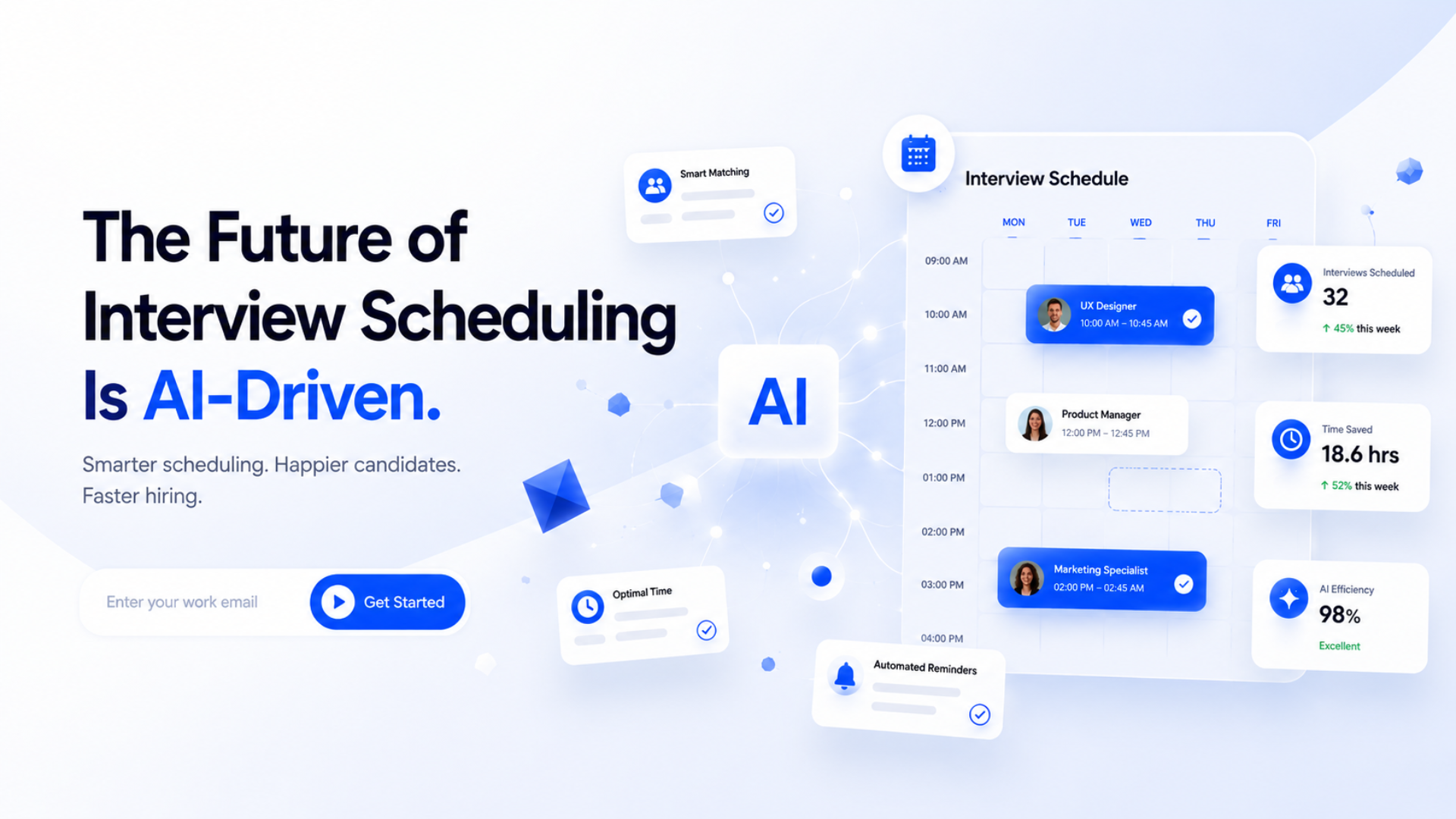
Rachel oversees recruiting operations at a global fintech company with offices in New York, London, and Singapore. Her team schedules over four hundred interviews per month across three time zones. Before AI, scheduling consumed thirty-five percent of recruiter hours and generated constant candidate friction. A single interview with four panelists across two regions routinely required six to eight email exchanges and took an average of nine business days to confirm. Candidates in Singapore regularly received interview slots at unreasonable hours because no one on the recruiting team was tracking time zone fairness. Hiring managers in New York grew frustrated by the constant availability requests. Recruiters spent more time managing calendars than building candidate relationships. When Rachel deployed an AI scheduling system integrated into the recruiting platform, the transformation was immediate. The average coordination rounds per interview dropped from seven to one. Time from screening to first interview fell from eleven days to three. Candidate complaints about scheduling disappeared. The recruiters regained twelve to fifteen hours per week, which they redirected to candidate engagement and hiring manager consulting. The AI did not just speed up scheduling. It fundamentally changed what the recruiting team was able to do with their time.
The interview scheduling process in most organizations has not changed meaningfully in over a decade. Recruiters still email candidates for availability, check interviewer calendars manually or through fragmented tools, propose time slots, handle conflicts through additional rounds of communication, and follow up repeatedly when participants do not respond. The tools have evolved slightly, with calendar links and booking widgets reducing some of the friction, but the fundamental architecture remains the same: the recruiter sits at the center of every coordination decision, manually mediating between participants who cannot see each
other's constraints. This architecture was acceptable when hiring volumes were low, interview panels were small, and candidates tolerated slow processes. None of those conditions hold today. According to SHRM's talent acquisition research, the average time-to-schedule has actually increased over the past five years, even as organizations have added more scheduling tools, because the complexity of the scheduling problem has grown faster than the tools' ability to address it. More interview rounds, more panelists per interview, more geographically distributed teams, and more candidates with competing opportunities have transformed scheduling from a manageable administrative task into a structural bottleneck that determines whether the organization can compete for talent. The distinction between AI sourcing and AI recruiting matters here because scheduling sits at the critical junction between the two: sourcing identifies candidates efficiently, but if the recruiting process cannot convert that identification into a timely interview, the sourcing advantage is wasted. Huntlo's AI-driven scheduling eliminates this junction friction, ensuring that the speed and intelligence that sourcing provides carries through to the interview stage without the coordination delays that currently destroy candidate momentum.
What AI-Driven Scheduling Actually Means
AI-driven scheduling does not mean a slightly better calendar tool. It means a fundamentally different approach to how interview scheduling decisions are made and executed. The current generation of scheduling tools operates on what can be called availability matching, which is the process of finding a time when all participants are free. This is useful but limited, because it treats scheduling as a constraint-satisfaction problem with a single variable: calendar availability. AI-driven scheduling operates on a broader set of variables that includes calendar availability but also candidate engagement risk, interviewer performance history, time zone fairness, panel composition balance, room and conferencing capacity, hiring priority, and candidate preference signals. The system does not just find a time. It finds the optimal time based on the full strategic context of the interview. A candidate who has a competing offer with a five-day deadline receives faster scheduling than a candidate who is early in their exploration. An interviewer whose feedback has historically been the most predictive of hiring success is prioritized for the most strategically important candidates. A time slot that falls at a reasonable hour for the candidate's time zone is preferred over one that is technically available but requires the candidate to take an interview at six in the morning. According to McKinsey's organizational insights, organizations that use AI-driven scheduling with this broader set of variables achieve twenty to thirty percent better interview-to-offer conversion rates than organizations that use simple availability matching, because the quality of the scheduling decision directly affects the quality of the interview conversation and the candidate's perception of the organization.
The autonomy dimension is what truly separates AI-driven scheduling from tool-assisted scheduling. In a tool-assisted process, the AI suggests and the recruiter decides. The recruiter reviews proposed times, confirms or adjusts them, communicates with participants, and resolves conflicts. The AI reduces the recruiter's effort but does not eliminate their involvement.
In an AI-driven process, the system executes the full scheduling workflow autonomously, from availability capture to confirmation to proactive conflict resolution, and it escalates to the recruiter only when human judgment is genuinely required. This autonomy is possible because the system maintains a comprehensive model of every participant's constraints, preferences, and context, allowing it to make scheduling decisions that would previously have required the recruiter to manually synthesize information from multiple sources. An agentic AI recruiting platform like Huntlo provides this autonomy by integrating scheduling intelligence with the broader recruiting workflow, ensuring that scheduling decisions are informed by the same candidate intelligence, hiring manager preferences, and pipeline context that guide the rest of the recruiting process. Organizations that add scheduling tools without this integration often discover they have more tools but the same hiring problems, because the scheduling tool operates in isolation from the candidate intelligence and pipeline context that would make its decisions truly intelligent. Research on how many followups one hire actually needs shows that a large portion of recruiter follow-up effort is consumed by scheduling status checks, which autonomous AI scheduling eliminates entirely by communicating directly with participants and notifying the recruiter only of confirmed outcomes or exceptions that require their attention.
Why AI-Driven Scheduling Wins on Candidate Experience
Candidate experience is the dimension where AI-driven scheduling delivers the most visible and most impactful improvement over manual and tool-assisted approaches. The candidate's experience of the scheduling process is their first meaningful interaction with the organization's operational competence. Before they meet a single employee, before they see the office or the product, they experience how the company manages a simple coordination task. If that task takes two weeks, requires seven emails, and results in a time slot at an inconvenient hour, the candidate forms a judgment about the organization that no amount of employer branding can reverse. AI-driven scheduling transforms this experience by making it fast, respectful, and intelligent. The candidate receives a single communication presenting time slots that are tailored to their stated availability, their time zone, and their context. The system confirms the selection, provides relevant preparation information, and sends proactive updates if anything changes. The entire experience communicates that the organization values the candidate's time and operates with competence. According to LinkedIn's recruiting resources, candidate satisfaction with the scheduling stage is the strongest predictor of overall candidate experience scores, more than the interview itself, more than the offer stage, and more than the onboarding experience, because scheduling is the first operational interaction and it sets the candidate's expectations for every subsequent interaction with the organization.
The experience advantage compounds when hiring for niche and technical roles, where candidates are typically employed, passive, and managing multiple competing opportunities. These candidates have the lowest tolerance for scheduling friction because they are not desperate for the opportunity and they are comparing the organization's process against the processes of other companies who are also courting them. A company that takes three days to
schedule an interview will consistently lose these candidates to a company that takes one day, regardless of the relative strength of the role or the compensation. The recruiters who worry about whether AI will replace their jobs should recognize that AI-driven scheduling does not replace the recruiter. It replaces the scheduling overhead that prevents the recruiter from delivering the high-touch, personalized candidate experience that wins these competitive hires. The AI handles the coordination logistics while the recruiter invests their time in the relationship-building, the strategic advising, and the nuanced communication that convert interested candidates into committed hires. Huntlo's platform delivers this experience advantage by integrating scheduling into a unified AI-driven recruiting workflow, ensuring that every candidate interaction, including the scheduling interaction, reinforces the candidate's confidence in the organization. The candidates who feel this competence during scheduling carry that confidence into the interview, into the offer negotiation, and often into their decision to accept.
The Operational Intelligence That AI Scheduling Unlocks
AI-driven scheduling does not just solve the scheduling problem. It generates operational intelligence that transforms how recruiting leaders manage their hiring operations. Every scheduling interaction produces data: how long candidates take to respond to availability requests, which interviewers create the most scheduling conflicts, which time slots produce the highest interview quality scores, which hiring managers are the fastest to confirm availability, and which scheduling patterns correlate with candidate withdrawal. In a manual process, this data is lost or fragmented across email threads and calendar entries. In an AI-driven process, it is captured, structured, and analyzed continuously, producing insights that recruiting leaders can use to optimize their operations. A recruiting leader who can see that Interviewer A creates forty percent more scheduling conflicts than the average panelist can investigate whether the issue is calendar management, overcommitment, or scheduling preference rigidity, and take corrective action. A leader who can see that candidates for a specific hiring manager's roles take twice as long to schedule can identify whether the bottleneck is the hiring manager's availability, the panel size, or the interview format, and address the root cause. According to Gartner's HR trends research, organizations that leverage scheduling intelligence for operational optimization reduce their overall time-to-hire by fifteen to twenty percent beyond the direct scheduling time savings, because the intelligence identifies and addresses upstream bottlenecks that were previously invisible.
The intelligence layer also enables predictive scheduling, which is the ability to anticipate scheduling problems before they occur and take preemptive action. If the system detects that a hiring manager's calendar is becoming increasingly constrained, it can proactively secure interview slots for upcoming candidates before the calendar fills completely. If it detects that a candidate's engagement signals suggest they are considering competing opportunities, it can prioritize their scheduling to reduce the risk of withdrawal during the coordination delay. This predictive capability transforms scheduling from a reactive process, where the recruiter responds to scheduling problems after they occur, into a proactive process where the system prevents problems before they affect the candidate. The quality of the data that feeds this
intelligence is essential. Teams that have encountered outdated candidate data in AI tools understand that predictive intelligence built on stale data produces incorrect predictions that erode trust in the system. When evaluating platforms, use the framework for evaluating an AI sourcing tool before buying to verify that real-time data integration and continuous intelligence updates are core capabilities. Data consistently confirms that referred candidates have higher scheduling satisfaction, and referrals outperform cold outreach partly because the referring employee provides informal scheduling guidance. AI-driven scheduling provides this same intelligent coordination for every candidate, not just those with an internal connection, raising the scheduling experience for the entire pipeline to referral quality. Huntlo delivers this operational intelligence layer, capturing scheduling data, generating actionable insights, and enabling predictive scheduling that prevents problems before they reach the candidate.
Scheduling Across Time Zones Without the Chaos
Multi-regional scheduling is where AI-driven scheduling delivers its most dramatic advantage over manual approaches, because the complexity of coordinating across time zones exceeds human cognitive capacity in ways that no amount of recruiter skill or effort can overcome. A recruiter in New York scheduling an interview between a candidate in London, a hiring manager in Singapore, and a technical interviewer in Berlin is managing four time zones, each with different working hours, different public holidays, and different cultural expectations about scheduling notice and flexibility. The manual approach to this problem is slow, error-prone, and almost guaranteed to produce at least one time slot that is convenient for the recruiter's time zone but unreasonable for one of the participants. AI-driven scheduling handles this complexity natively. The system maintains real-time awareness of every participant's time zone, working hours, and holiday calendar, and it evaluates every proposed time slot against all of these constraints simultaneously. It does not just find a time that works. It finds a time that works well, meaning a time that falls within reasonable working hours for every participant, avoids known holiday conflicts, and respects the cultural expectations of each participant's region. According to Deloitte's talent research, organizations that deploy AI-driven scheduling for multi-regional hiring reduce their cross-border scheduling time by sixty to seventy percent and their candidate withdrawal rate during scheduling by forty to fifty percent, because the system eliminates the time zone errors and cultural missteps that damage candidate experience in manual cross-border coordination.
The multi-regional capability also enables organizations to access talent pools that were previously impractical to recruit from. A company that can seamlessly schedule interviews across ten time zones can recruit from a global talent pool without the scheduling overhead that previously made global recruiting prohibitively expensive in recruiter time and candidate patience. This expanded access is particularly valuable for hard-to-fill roles where the best candidates are often located in different regions and the local talent pool is insufficient. According to EY's technology insights, the recruiting organizations that are building the strongest global talent pipelines are the ones that use AI-driven scheduling to eliminate the coordination barrier that previously made cross-border hiring impractical. Huntlo's platform
delivers multi-regional scheduling intelligence that handles time zones, holidays, and cultural scheduling preferences automatically, making global hiring as operationally simple as local hiring. The future of interview scheduling is not a better calendar tool. It is an intelligent, autonomous system that coordinates across regions, optimizes for candidate experience, and generates the operational intelligence that makes recruiting organizations faster and more effective. Huntlo delivers that future now. Start scheduling intelligently with Huntlo.