Diana manages a team of eight recruiters at a mid-stage fintech company. A year ago, her team processed roughly forty active candidates per recruiter at any given time, and the engagement quality was inconsistent. Some candidates received prompt, thoughtful follow-ups. Others waited days for responses and received generic templates when messages finally arrived. The team was working as hard as it could, and the engagement gaps were not a reflection of effort but of capacity. Six months ago, Diana deployed an AI-assisted engagement platform. Today, her team processes sixty active candidates per recruiter, but the engagement quality has improved dramatically. Every candidate receives a follow-up within twenty-four hours of each interaction. Every message references the candidate's specific conversations and concerns. Every candidate's engagement signals are monitored continuously, and the system alerts recruiters when a candidate shows early signs of disengagement. The recruiters have not been replaced. They have been amplified. They spend their time on the activities that genuinely require human expertise, navigating complex candidate concerns, building rapport with hiring managers, and making strategic decisions about pipeline prioritization, while the AI handles the informational and operational work that previously consumed their days. The result is not just better metrics. It is a fundamentally different experience for both the recruiters and the candidates they serve.
The recruiting industry is in the middle of a transition that will define the next decade of talent acquisition. The old model, manual candidate engagement delivered by individual recruiters operating on their own schedules and capacities, is being replaced by a new model where AI provides the informational infrastructure that enables consistent, personalized, and timely communication at scale. This transition is not about replacing recruiters with algorithms. It is about giving recruiters the tools they need to deliver their best work to every candidate rather than only to the ones they have time for. The distinction matters enormously, because the organizations that get this transition right, deploying AI as an augmentation layer
that amplifies recruiter capabilities rather than a replacement layer that eliminates recruiter judgment, will build a sustainable competitive advantage in talent acquisition. Those that get it wrong, either by rejecting AI entirely and continuing with manual processes that cannot scale, or by over-automating and losing the human touch that candidates value, will fall behind. According to SHRM's talent acquisition research, the organizations currently achieving the highest candidate satisfaction and offer acceptance rates are those that have adopted an AI-assisted model where technology handles data processing and recruiters handle relationship management. This is the model that platforms like Huntlo are built to deliver, providing the AI-powered signal detection, contextual personalization, and adaptive cadence that transform engagement from a recruiter-dependent activity into a system-enabled one. The recruiters who understand the difference between AI sourcing and AI recruiting see this clearly. Sourcing is increasingly AI-driven because it is primarily a data and pattern-matching activity. Engagement, the ongoing relationship management that converts a candidate from contact to hire, requires the human judgment and empathy that AI can support but not replace. Huntlo's platform is designed precisely for this AI-assisted model, observing candidate signals, generating contextually grounded recommendations, and handling the operational burden of timing and research, while the recruiter exercises the judgment that builds genuine trust and drives hiring decisions.
What AI-Assisted Engagement Actually Means
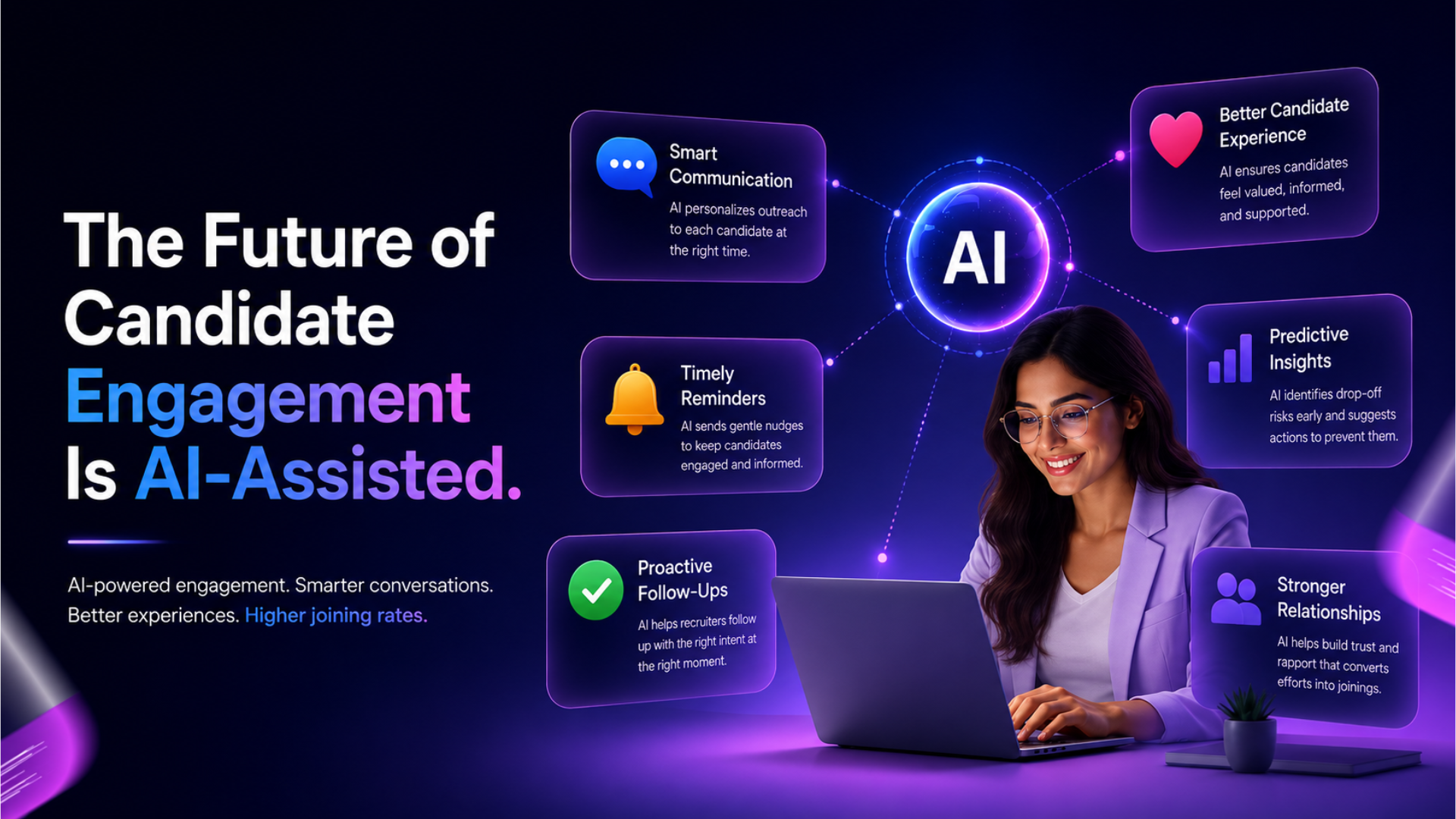
The phrase AI-assisted engagement is often used loosely to describe any technology that touches the recruiting process, but its meaning is specific and important to understand. In an AI-assisted engagement model, the AI handles four categories of work that are necessary for effective candidate engagement but that do not require human judgment. The first category is signal monitoring. The AI tracks every candidate's behavioral signals across all communication channels, email open times, response patterns, platform activity, and message sentiment, and uses these signals to maintain a real-time assessment of each candidate's engagement level. This continuous monitoring is beyond what any human can do manually for more than a handful of candidates, and it provides the foundation for every other capability in the system. The second category is contextual research. When a follow-up is due, the AI retrieves and synthesizes the candidate's full interaction history, career background, and expressed priorities, producing a brief that the recruiter can review in seconds rather than spending fifteen to twenty minutes researching each candidate before every follow-up. The third category is draft generation. Based on the candidate's engagement classification and interaction history, the AI generates a personalized follow-up draft that references prior conversations, addresses expressed concerns, and provides relevant information. The fourth category is timing optimization. The AI determines the optimal moment for each follow-up based on the candidate's behavioral signals and the stage of the hiring process, ensuring that messages arrive when the candidate is most receptive rather than when the recruiter happens to have time.
The critical design principle of AI-assisted engagement is that every AI-generated recommendation passes through the recruiter before it reaches the candidate. The AI does not send
messages autonomously. It recommends messages that the recruiter reviews, refines, and approves. This human-in-the-loop design preserves the authenticity and judgment that candidates value while eliminating the operational burden that makes consistent engagement impossible at scale. The practical difference is significant. A recruiter using an AI-assisted system can deliver a deeply personalized follow-up, one that references the candidate's specific conversation history and addresses their individual concerns, in five to seven minutes rather than the thirty to forty-five minutes it would take to research and draft the same message manually. Across a pipeline of twenty candidates, this time savings transforms the recruiter's capacity from being unable to maintain consistent engagement to being able to maintain it easily, with time remaining for the high-value activities that genuinely require human expertise. Understanding how many followups one hire actually needs is useful for planning, but the AI-assisted model changes the question from how many follow-ups can I manage to how many follow-ups does each candidate need, because the system handles the volume while the recruiter focuses on quality. According to McKinsey's organizational insights organizations using AI-assisted engagement models are achieving thirty to fifty percent improvements in recruiter productivity alongside twenty to thirty percent improvements in candidate engagement metrics, because the AI handles the work that previously consumed recruiter time without adding value, freeing the recruiter to focus on the work that genuinely drives outcomes. The teams that add simple automation tools without this intelligent assistive layer often discover they have more tools but the same hiring problems, a pattern explored in the analysis of organizations with more tools but the same hiring problems. Huntlo delivers this AI-assisted model as an agentic AI recruiting platform that observes, learns, and recommends, ensuring that the recruiter's judgment is amplified rather than bypassed at every step of the engagement process.
Why the Future Is Assisted, Not Automated
The debate about AI in recruiting often frames the choice as a binary between full automation and no automation. This framing is misleading, because neither extreme produces optimal outcomes. Full automation, where AI sends messages to candidates without human review, can achieve consistency and scale but sacrifices the authenticity, empathy, and strategic judgment that candidates value and that drive hiring decisions. A candidate who receives a perfectly timed but emotionally tone-deaf message from an AI that has misread their sentiment will not feel engaged. They will feel processed. No automation, where recruiters do everything manually, can produce authentic and empathetic communication but cannot deliver it consistently at scale, meaning most candidates in the pipeline receive generic, delayed, or missed follow-ups that erode trust and engagement. The AI-assisted model occupies the productive middle ground between these extremes. It uses AI to handle the informational and operational work that does not require human judgment, signal monitoring, contextual research, draft generation, and timing optimization, while preserving human involvement for the activities that do require judgment, empathy evaluation, strategic personalization, concern resolution, and relationship deepening. This division of labor is not a compromise. It is the optimal
configuration, because it combines the scalability and consistency of AI with the authenticity and judgment of human recruiters in a way that neither extreme can achieve alone.
The evidence for this middle-ground advantage is substantial. Candidates consistently report higher satisfaction with AI-assisted communication than with fully automated communication, because the messages feel more authentic and responsive to their specific situation. Recruiters consistently report higher job satisfaction and lower burnout in AI-assisted models, because they are freed from the repetitive operational work that causes exhaustion and redirected toward the relationship-building work that drew them to the profession. And hiring outcomes are consistently stronger in AI-assisted models than in either extreme, because the combination of AI consistency and human judgment produces engagement that is both reliable and genuinely personal. This is especially important for candidates being pursued for niche and technical roles, where the candidate's evaluation of the opportunity is more sophisticated and their expectations for communication quality are higher. These candidates can detect the difference between AI-assisted communication, where a human has reviewed and refined the message, and fully automated communication, where a template has been sent on a schedule. The difference matters to them, and it affects their willingness to engage. The recruiters asking whether AI will replace their jobs should find the answer in this evidence. AI is not replacing the recruiter. It is redefining the recruiter's role, elevating it from a role that is eighty percent operational and twenty percent strategic to one that is eighty percent strategic and twenty percent operational. This is not a threat. It is a liberation, and the recruiters who embrace it are building more successful careers and delivering better outcomes than those who resist it. Research consistently shows that referrals outperform cold outreach in engagement quality because the referring employee provides the continuous, informed communication that candidates value. Huntlo's AI-assisted platform is designed to give every candidate this referral-quality experience by providing the recruiter with the contextual intelligence and operational support needed to deliver it consistently, regardless of pipeline volume.
The AI Capabilities Transforming Candidate Engagement Today
The current generation of AI-powered engagement tools provides four capabilities that are already transforming how recruiting teams maintain candidate relationships. The first capability is real-time signal detection. Modern AI systems monitor candidate engagement signals continuously, email opens, response times, message length, platform visits, and application page activity, and use these signals to classify each candidate's engagement level in real time. This classification is not a static label. It updates dynamically as new signal data arrives, enabling the system to detect changes in engagement that would be invisible to a recruiter managing twenty simultaneous relationships. A candidate whose response time increases from four hours to twenty-four hours over three interactions is showing a measurable decline in engagement that the AI can detect and flag for intervention before the candidate has made a conscious decision to disengage. This early warning capability is transforming drop-off prevention from a reactive activity into a proactive one. The second capability is contextual memory. The AI maintains a detailed profile of every candidate's interactions, including the topics
discussed, concerns raised, information provided, and career priorities expressed, and draws on this profile to generate follow-up recommendations that are grounded in the actual conversation history rather than generic templates. According to LinkedIn's recruiting resources organizations using AI systems with strong contextual memory capabilities are seeing forty to fifty percent improvements in candidate response rates, because candidates can immediately tell that the message is informed by their specific situation rather than generated from a template.
The third capability is adaptive cadence. Rather than applying a fixed follow-up schedule, AI-powered systems adjust the frequency, timing, and intensity of communication based on each candidate's individual engagement trajectory. A candidate showing high engagement receives fewer but more substantive touchpoints, while a candidate showing early signs of disengagement receives more frequent, lower-friction touchpoints designed to maintain connection without creating pressure. This individualized approach to communication timing is one of the most impactful capabilities of AI-assisted engagement, because it ensures that every candidate receives communication calibrated to their specific needs and behavior rather than a one-size-fits-all schedule that works for some candidates and fails for others. The fourth capability is predictive analytics. The most advanced systems are beginning to move beyond reactive signal detection to predictive engagement, identifying candidates who are likely to disengage, accept competing offers, or withdraw before the start date based on patterns in their engagement data and market profile. This predictive capability enables recruiters to intervene before a problem becomes a loss, shifting the engagement model from reactive to anticipatory. However, the quality of all four capabilities depends entirely on the quality and freshness of the underlying candidate data. Teams that have experienced outdated candidate data in AI tools know that AI-powered engagement based on stale information will produce recommendations that miss the mark, potentially damaging the candidate relationship rather than strengthening it. When evaluating platforms, use the framework for evaluating an AI sourcing tool before buying to ensure data freshness, signal accuracy, and contextual memory depth are core capabilities. Huntlo's platform is built on a continuously updated candidate intelligence layer that ensures every signal detection, contextual recommendation, and predictive insight is grounded in current, accurate data, making the AI assistance genuinely helpful rather than potentially harmful.
What Comes Next: Predictive and Proactive Engagement
The next evolution of AI-assisted engagement will extend the current capabilities in three directions that will further transform how recruiting teams maintain candidate relationships. The first direction is predictive engagement. While current systems detect disengagement after it has begun, the next generation will predict disengagement before behavioral signals visibly change, using patterns in the candidate's communication history, market profile, and the hiring process timeline to identify candidates who are at risk of withdrawal and recommend preemptive interventions. A candidate whose profile suggests they are in active conversations with competitors, whose engagement timeline is approaching the typical counteroffer
window, and whose recent messages have shown subtle shifts in sentiment, will receive a proactive touchpoint from the recruiter, with the AI providing specific recommendations about the content and timing of the intervention. This predictive capability does not replace the recruiter's judgment. It provides foresight that manual observation cannot deliver across a large candidate pool, enabling the recruiter to act before the candidate's decision is made rather than after. According to Gartner's HR trends research early adopters of predictive engagement capabilities are reporting twenty-five to thirty-five percent reductions in candidate dropout rates, because the system identifies at-risk candidates days or weeks before they would have been flagged by manual observation, giving the recruiter a window for intervention that did not previously exist.
The second direction is multi-modal engagement. Current AI-assisted engagement operates primarily through text-based communication, email and messaging platforms. The next generation will incorporate voice, video, and interactive content into the engagement mix, enabling the AI to recommend not just what to say but the best modality for each interaction. A candidate who has been primarily communicating through email but whose engagement is declining might be better reached through a brief, AI-prepared voice call or a personalized video message from the hiring manager. The AI will detect when a modality shift is likely to be effective and provide the recruiter with the content and timing recommendations to execute it. The third direction is collaborative intelligence, where the AI learns from the recruiter's interventions to improve its recommendations over time. When a recruiter modifies an AI-generated recommendation and the modified version produces a better outcome, the system learns from the modification and adjusts its future recommendations accordingly. This feedback loop creates a continuously improving system that becomes more effective the longer it is used, developing an understanding of what works for the organization's specific candidate population that no off-the-shelf tool can replicate. This collaborative intelligence model is the ultimate expression of the AI-assisted paradigm, because it treats the recruiter and the AI as partners in a shared learning process rather than as operator and tool. EY's technology insights report that enterprises investing in these next-generation capabilities are building engagement advantages that compound over time, because each hiring cycle generates data that improves the system's accuracy and effectiveness for the next one. Deloitte's talent research concludes that the AI-assisted model is not a transitional step between manual and fully automated recruiting. It is the end state, the optimal configuration that combines the best of human judgment with the best of AI capability, and the organizations reaching this state earliest are building a talent acquisition advantage that will define the competitive landscape for years to come. The future of candidate engagement is not recruiters versus AI. It is recruiters with AI. Huntlo provides the intelligence layer that makes this partnership productive from day one. Build the future of engagement with Huntlo.