Every recruiter has experienced the frustration of running the same Boolean string across multiple platforms and getting back the same pool of familiar names. The problem is not your search syntax— it is the fundamental limitation of search itself. Search operates on what is explicitly stated: job titles, listed skills, and self-reported experience. But the most valuable candidates often do not clearly advertise what makes them exceptional. Their capabilities are embedded in project outcomes, inferred from career transitions, and revealed through patterns that no keyword query can capture. According to research from SHRM, the majority of high-performing hires come from passive candidate pools— people who are not actively searching and whose profiles do not neatly align with standard search parameters.
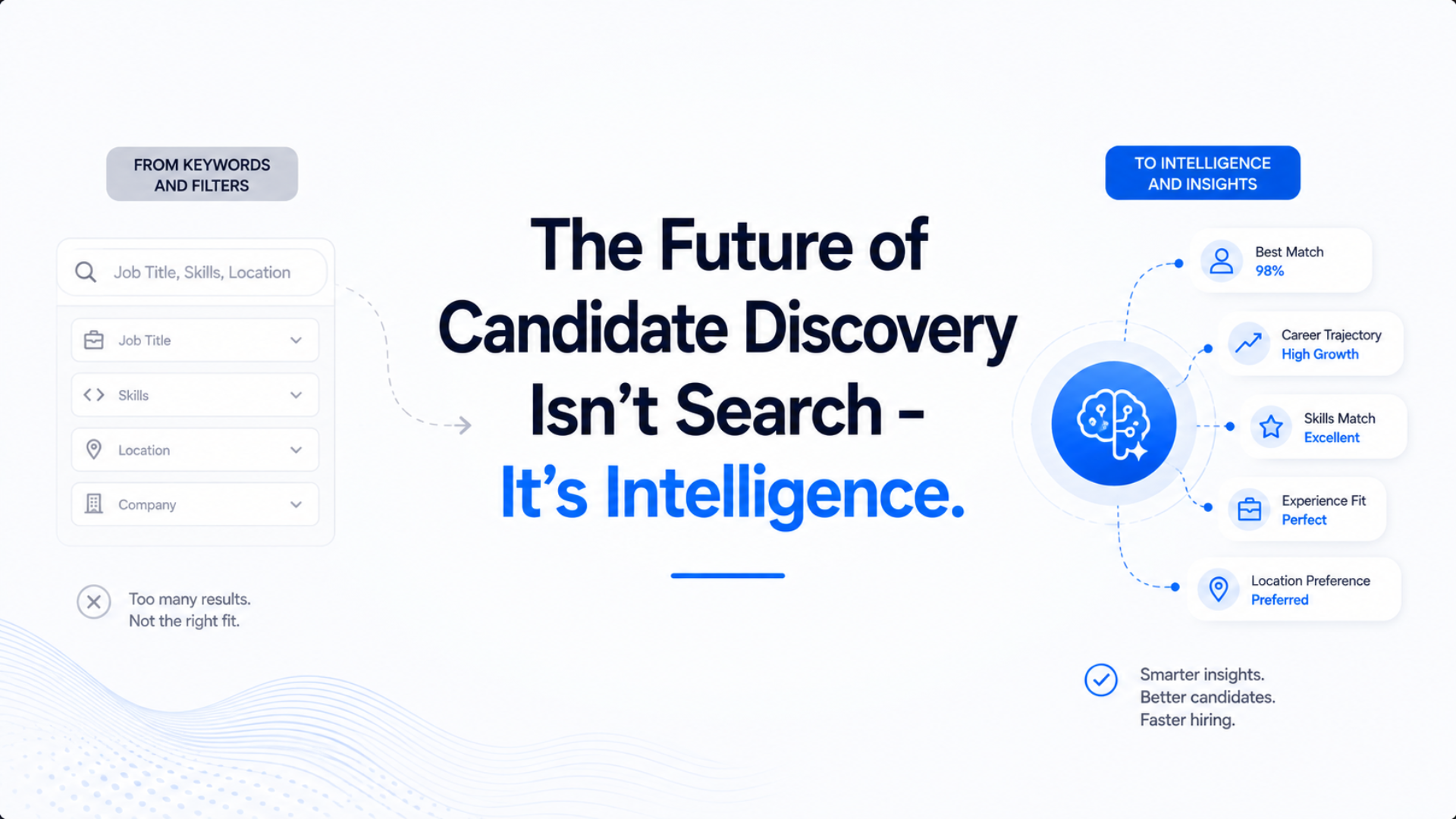
The recruitment industry is at an inflection point. The tools that powered the last decade of talent acquisition— job board aggregators, resume databases, and Boolean search interfaces— are no longer sufficient on their own. What is replacing them is not a better search engine but an entirely different paradigm: talent intelligence. This shift from search to intelligence represents the most significant evolution in candidate discovery since the advent of online job boards. It changes not just how recruiters find people, but what they can know about them before the first conversation ever takes place.
Why Search-First Recruiting Is Running Out of Road
Search-first recruiting treats candidate discovery as an information retrieval problem. You define a query, the system returns matching documents, and you manually evaluate the results.
This approach made sense when candidate data was scarce and centralized. But today, the average recruiter has access to dozens of data sources, hundreds of millions of profiles, and an ever-expanding set of signals. The bottleneck is no longer access to data— it is making sense of it. McKinsey's research on organizational talent consistently shows that companies leveraging advanced analytics in hiring make significantly better placement decisions than those relying on manual evaluation alone.
There are deeper structural problems with search that no amount of query refinement can solve. First, search only surfaces what candidates choose to publish. A software engineer who lists 'Java' on their profile but has spent the last two years architecting distributed systems in Go will not appear in a Java search despite being highly relevant. Second, search treats all matches as equally valid. It cannot distinguish between a candidate who barely meets a keyword threshold and one who genuinely excels in the relevant domain. Third, search is inherently backward-looking— it matches against what someone has done, not what they are capable of doing next. These limitations compound over time, leaving recruiters stuck with an increasingly stale and repetitive candidate pool.
The result is a phenomenon many recruiting teams know all too well: pipeline fatigue. You keep searching, but you keep finding the same people. LinkedIn's talent solutions reports indicate that recruiters who rely exclusively on manual search spend upwards of sixty percent of their sourcing time on repetitive queries that yield diminishing returns. That is time not spent on relationship building, candidate engagement, or strategic workforce planning. The economics of search-first recruiting simply do not scale in a competitive talent market.
What Talent Intelligence Actually Means
Talent intelligence is the systematic application of AI and machine learning to understand, predict, and rank candidate potential. Unlike search, which retrieves records based on explicit matches, intelligence systems build multidimensional profiles that go far beyond what any candidate has written about themselves. They analyze career trajectories, project outcomes, peer networks, publication records, open-source contributions, and hundreds of other signals to construct a holistic picture of a person's capabilities and fit.
At its core, talent intelligence answers a fundamentally different question than search. Search asks: 'Who matches this query?' Intelligence asks: 'Who is the best fit for this role, given everything we know?' That distinction— between matching and fitting— is what separates reactive recruiting from proactive talent acquisition. An agentic AI recruiting platform does not wait for a recruiter to type a query. It continuously monitors talent pools, identifies emerging candidates, and proactively surfaces recommendations based on evolving role requirements and organizational context.
The key components of a robust talent intelligence system include skill inference engines that can identify capabilities a candidate has but has not explicitly listed, predictive models that forecast career transitions and likelihood to engage, cultural fit scoring based on work
environment preferences and team dynamics, and competitive intelligence that maps where top talent is concentrated and how aggressively competitors are pursuing them. Together, these components transform candidate discovery from a manual, query-driven task into a continuous, AI-assisted process that improves with every interaction.
From Keywords to Context: How AI Reconstructs Candidate Profiles
One of the most powerful capabilities of intelligence-driven discovery is context reconstruction. Traditional search evaluates each profile in isolation— does this resume contain the right keywords? An intelligence system evaluates profiles in context, cross-referencing career history, industry trends, and role requirements to build a much richer understanding of each candidate. For example, a product manager at a fintech startup may not list 'regulatory compliance' as a skill, but an AI that understands the industry context knows that managing a payments product inherently requires that expertise.
This contextual understanding extends to niche and technical roles where traditional search performs especially poorly. In specialized domains like quantum computing, bioinformatics, or climate tech, the gap between what candidates know and what they list on their profiles is often enormous. Talent intelligence bridges that gap by inferring skills from project descriptions, educational backgrounds, publication records, and professional associations. The result is a candidate pool that is both broader and more relevant than what keyword search could ever produce.
Context reconstruction also solves one of the most persistent problems in recruiting: title inflation and inconsistency. The title 'Senior Engineer' means vastly different things at a ten-person startup versus a ten-thousand-person enterprise. An intelligence system normalizes for these differences by looking at actual scope of work, team size, budget responsibility, and technical complexity rather than relying on titles alone. This is a fundamentally more accurate way to assess candidate seniority and readiness, and it eliminates the false positives and false negatives that plague title-based searches.
Predictive Discovery: Finding Candidates Before They're Looking
Perhaps the most transformative aspect of intelligence-driven discovery is its predictive capability. Rather than waiting for candidates to update their profiles or respond to job postings, predictive models analyze behavioral signals— changes in work patterns, publication frequency, conference attendance, social media engagement— to identify candidates who are likely to be open to new opportunities before they actively start looking. Gartner's HR trends research highlights predictive analytics as one of the top strategic priorities for talent acquisition leaders, precisely because it shifts recruiting from reactive to proactive.
Predictive discovery also addresses the fundamental asymmetry of the talent market. The best candidates rarely need to look for jobs— opportunities find them. By the time a top performer updates their LinkedIn status to 'Open to Work,' they are already in conversation with
multiple recruiters. Intelligence systems level this playing field by identifying high-potential candidates earlier in their decision journey, giving proactive recruiters a critical first-mover advantage. This approach is especially valuable for roles where referrals outperform cold outreach, because early engagement through intelligence signals achieves similar personal-connection advantages at scale.
The mechanics of predictive discovery involve analyzing career cadence patterns— how often a candidate typically changes roles, what triggers their transitions, and what signals precede a move. Machine learning models trained on millions of career histories can identify these patterns with remarkable accuracy, flagging candidates who are statistically likely to make a move within the next three to six months. Recruiters who act on these signals can build relationships with candidates long before a formal search begins, dramatically improving their conversion rates. Understanding how many followups one hire needs, the intelligence platform also optimizes outreach timing and cadence to maximize response rates from these predicted candidates.
Skill Adjacency Mapping: Discovering Hidden Capabilities
One of the most underappreciated capabilities of talent intelligence is skill adjacency mapping— the ability to identify candidates whose existing skills are closely related to, and easily transferable from, the ones a role requires. Traditional search creates an artificial boundary between qualified and unqualified candidates based on exact keyword matches. But in reality, skills exist on a continuum, and many of the most innovative hires come from adjacent domains rather than exact matches. A candidate with deep experience in financial modeling may be an exceptional fit for a data science role, even if they have never used the specific ML frameworks listed in the job description.
Intelligence systems build skill adjacency maps by analyzing millions of career transitions and identifying which skills commonly co-occur, which ones predict the acquisition of others, and which transferable capabilities indicate rapid learning potential in a new domain. Deloitte's talent research emphasizes that the most successful hiring organizations are those that prioritize learning agility over exact skill matching, and talent intelligence makes this approach operational at scale.
This capability is particularly relevant in fast-moving fields where the half-life of technical skills is shrinking. By the time a job description is written and a search is executed, the specific technologies listed may already be evolving. An intelligence system that understands skill adjacencies can identify candidates who are not just qualified for today's requirements but adaptable enough to grow with tomorrow's. This is how AI sourcing differs fundamentally from traditional keyword search— it optimizes for potential, not just proximity to a job description. However, understanding why some AI recruiting tools have outdated candidate data is critical, because skill adjacency mapping only works when the underlying candidate data is fresh, comprehensive, and continuously updated.
Building an Intelligence-First Sourcing Strategy
Transitioning from search-first to intelligence-first recruiting requires more than adopting a new tool— it requires a strategic shift in how teams think about candidate discovery. The first step is redefining success metrics. In a search-first model, success is measured by the volume of profiles retrieved and the speed of query execution. In an intelligence-first model, success is measured by the quality and diversity of the candidate pipeline, the accuracy of fit predictions, and the time-to-hire for critical roles. These metrics reflect a fundamentally different orientation: from finding more candidates to finding the right candidates faster.
The second step is investing in data infrastructure that supports intelligence rather than just search. This means moving beyond single-source databases and building integrated talent intelligence platforms that can aggregate, normalize, and analyze data from multiple sources simultaneously. Many organizations fall into the trap of accumulating more tools without solving core problems, adding point solutions that create data silos rather than intelligence synergies. A true intelligence platform breaks down these silos by unifying candidate data across sources and applying consistent analytical models.
The third step is training recruiting teams to work alongside AI rather than competing with it. The question of whether AI will replace recruiters misses the point— the real risk is not AI replacing recruiters but recruiters who use AI replacing those who do not. Intelligence-first sourcing is a collaboration between human judgment and machine computation. Recruiters bring empathy, negotiation skill, and organizational knowledge. AI brings scale, pattern recognition, and predictive accuracy. Together, they achieve outcomes that neither could produce alone.
Finally, organizations need to establish feedback loops that allow intelligence systems to improve over time. Every hire, every rejection, and every candidate interaction provides data that can refine predictive models, improve skill adjacency maps, and enhance fit scoring. Evaluating an AI sourcing tool should include assessing how well the platform learns from outcomes and adapts to changing market conditions, not just how accurately it matches current job descriptions.
The Competitive Advantage of Early Adoption
Organizations that adopt intelligence-driven discovery early are building a compounding advantage. Every candidate interaction feeds their models. Every hire validates their predictions. Every market shift refines their understanding. Over time, this creates an intelligence moat that is extremely difficult for competitors to replicate. Late adopters, by contrast, will find themselves competing for the same visible candidate pools using the same search techniques, while early adopters are quietly engaging with high-potential candidates that no one else has identified.
The competitive dynamics are particularly stark in industries where talent is the primary driver of innovation and growth. In AI, biotech, cybersecurity, and clean energy, the difference between hiring a top-tier candidate and a good-enough one can translate into years of competitive advantage. Companies that rely on search-first recruiting in these markets are essentially bringing a knife to a gunfight. Intelligence-driven discovery is not a marginal improvement— it is a categorical shift in what is possible. The organizations that recognize this shift and act on it now will define the next decade of talent acquisition.
For recruiting leaders who want their team to stop searching harder and start discovering smarter, Huntlo provides the intelligence engine to make that shift immediately. Whether you are hiring for niche technical roles or scaling a global team, Huntlo's intelligence-first approach means you spend less time running repetitive queries and more time engaging with candidates who are genuinely the right fit. The future of candidate discovery is not about finding more profiles— it is about understanding them better. And that future is already here.