Daniel Okonkwo, the head of global talent acquisition at a Fortune 500 manufacturing company, oversees hiring across twelve offices in nine countries. His team of forty recruiters coordinates roughly two thousand interviews per month, and until recently, every single one of those interviews was scheduled manually by recruiters using a combination of email threads and shared spreadsheets. The result was predictable chaos: scheduling backlogs that stretched across multiple weeks, candidates withdrawing after experiencing disorganized coordination, and recruiter burnout rates that forced his team to replace nearly a third of its headcount annually. Daniel knew that AI scheduling existed, but as an enterprise leader, he faced questions that vendor demos never answered. How does AI scheduling work when you have multiple applicant tracking systems, conflicting security policies across regions, and interview panels that require sign-off from three different business units? His experience navigating those questions forms the backbone of this guide.
Why Enterprise Hiring Needs AI Scheduling Now
Enterprise organizations share a set of scheduling challenges that simply do not exist at smaller companies. Hiring volumes are measured in hundreds or thousands per month rather than per quarter. Interview panels routinely involve participants from multiple departments, time zones, and even third-party assessment providers. Compliance requirements mean that certain roles require specific interviewer certifications or panel compositions, adding constraints that manual coordinators must verify by hand. According to data from SHRM, large employers report that scheduling consumes an average of forty percent of total recruiter capacity, a figure that has increased over the past three years as remote and hybrid work has distributed participants across more locations and more variable schedules.
The cost of this coordination burden is not merely financial, though the financial impact is
substantial. When a recruiter earning ninety thousand dollars per year spends forty percent of their time on scheduling, the organization is effectively paying thirty-six thousand dollars per recruiter per year for calendar management rather than candidate engagement or strategic planning. Across a team of forty recruiters, that represents nearly one and a half million dollars in annual compensation allocated to administrative work. But the more significant cost is the opportunity cost: every hour spent negotiating time slots is an hour not spent building relationships with passive candidates, improving diversity outreach, or reducing the overall time-to-fill that directly affects business performance and revenue growth.
Enterprise hiring is also uniquely vulnerable to scheduling-driven candidate dropout. Senior candidates evaluating opportunities at large organizations typically hold multiple offers simultaneously and have little patience for coordination friction. A five-day delay in confirming an interview slot may seem acceptable to an internal team, but to a candidate comparing two competing offers, it signals that the organization is slow, bureaucratic, and potentially difficult to work with. Platforms like Huntlo address this by treating scheduling as an agentic workflow where the system independently resolves multi-participant conflicts, checks certifications and panel requirements, and confirms interviews in minutes rather than days, preserving the candidate experience even at enterprise scale.
Common Scheduling Challenges That Scale With Company Size
The first and most pervasive challenge is tool fragmentation, which gets worse as organizations grow and acquire new systems through mergers, acquisitions, or departmental technology choices. Enterprise recruiting stacks typically include an applicant tracking system, a human resources information system, multiple calendar platforms, video conferencing tools, and communication apps, each with its own data model and integration limitations. Scheduling data is scattered across these systems, and no single tool has a complete picture of interviewer availability, candidate preferences, and room or link assignments. Research from McKinsey has documented that tool fragmentation is one of the primary drivers of operational inefficiency in enterprise hiring, with scheduling being the function most affected because it sits at the intersection of so many disconnected systems.
A second challenge is the complexity of panel-based interviewing at scale, a problem that intensifies as organizations grow. Enterprise organizations frequently require interview panels of four to eight participants, each with different seniority levels, departmental affiliations, and certification requirements. The coordination complexity increases exponentially rather than linearly with each additional panel member. Coordinating these panels manually means reconciling not just calendar availability but also organizational policies about who must be present for specific role types. When hiring for niche or technical positions, the pool of qualified interviewers is small and their time is heavily contested, which means that finding a slot where every required panel member is simultaneously available can take a week or more through manual methods. The larger the organization, the worse this problem becomes because there are more potential conflicts and more policy layers to navigate.
A third challenge, and one that is frequently underestimated, is the compounding effect of
reschedules and cancellations. In a large organization running thousands of interviews per month, a meaningful percentage will require rescheduling due to interviewer illness, candidate conflicts, or business priorities. Each reschedule in a manual workflow triggers a full new round of coordination, consuming additional recruiter hours and extending the hiring timeline. Many enterprise teams attempt to solve these challenges by adding more tools, but this approach typically worsens fragmentation without addressing the underlying coordination problem. The most effective solution is a single intelligent system that can handle the full complexity of enterprise scheduling natively.
How AI Scheduling Works in Large, Complex Organizations
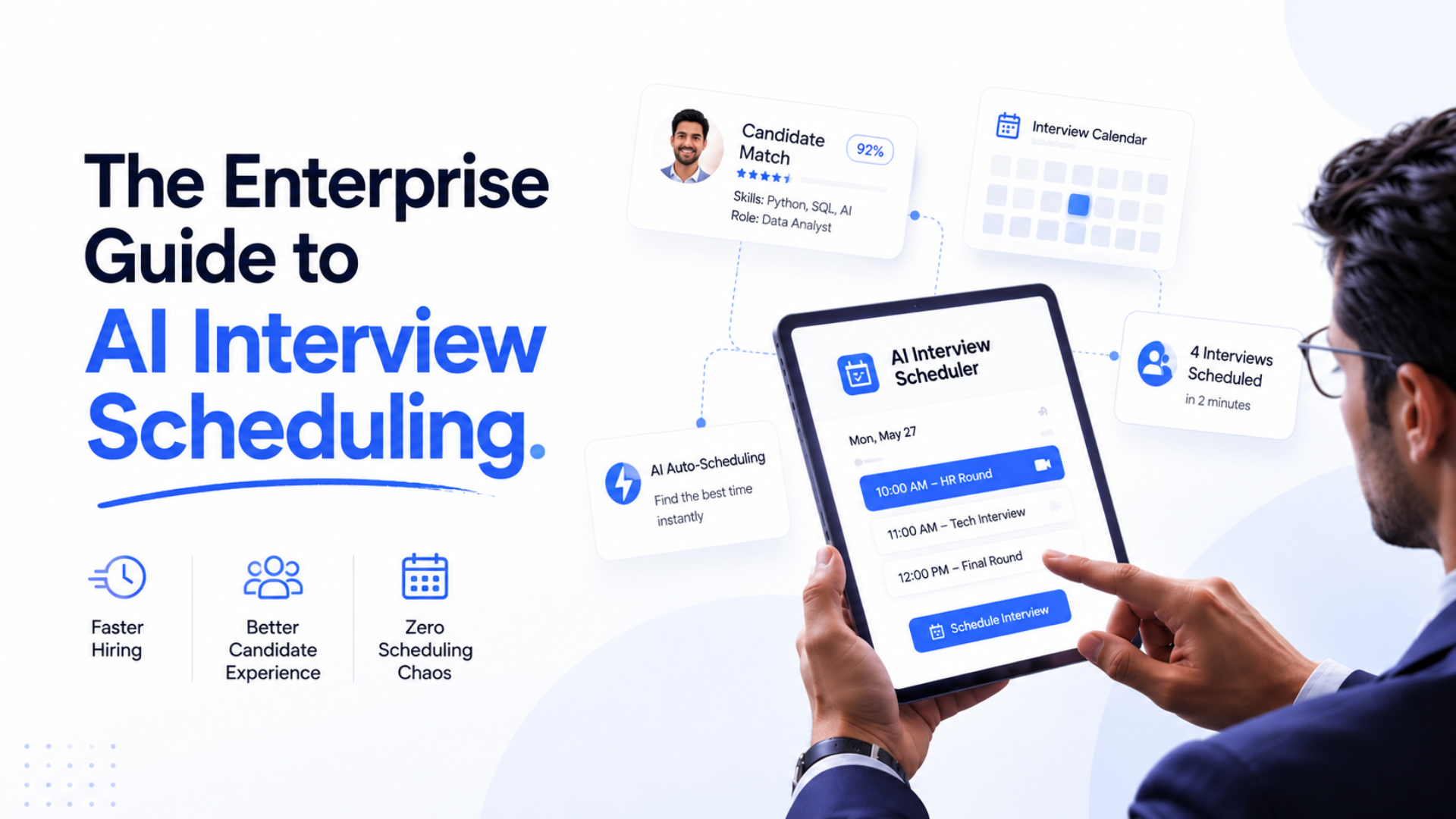
AI scheduling in an enterprise context operates on the same fundamental principle as it does for smaller teams, but the implementation must account for significantly more complexity. The system ingests availability data from every connected calendar, applies organizational policies about panel composition and buffer times, respects interviewer workload limits and regional working-hour constraints, and proposes optimized time slots that satisfy all requirements simultaneously. Unlike manual coordination, which processes each participant sequentially, AI evaluates all possible time combinations in parallel and returns the best available options within seconds. According to LinkedIn, enterprise teams that have deployed AI scheduling report reducing average coordination time from four business days to under twenty minutes for standard panel interviews.
Reschedule handling is where AI scheduling delivers some of its highest value in enterprise environments. When an interviewer becomes unavailable, the system immediately identifies alternative panel configurations, checks whether the remaining interviewers still satisfy policy requirements, and proposes new slots to all participants without requiring a recruiter to manually restart the coordination process. Research into follow-up dynamics in hiring reveals that a substantial portion of enterprise recruiting communication volume is driven by scheduling logistics rather than candidate evaluation. By automating these logistics, AI scheduling reduces email volume, shortens hiring cycles, and frees recruiters to focus on the candidate-facing work that actually improves hiring outcomes.
Data accuracy is a critical enabler of enterprise AI scheduling, and arguably the factor that most distinguishes enterprise-grade platforms from simpler alternatives. Systems that rely on outdated candidate or interviewer data will propose slots that are already invalid, triggering rescheduling loops that undermine the efficiency gains the tool was supposed to deliver. Enterprise AI scheduling platforms address this by maintaining real-time connections to all source systems, so that calendar updates, candidate availability changes, and policy adjustments are reflected instantly in the scheduling engine. This real-time synchronization is what separates enterprise-grade AI scheduling from simpler tools that may work for small teams but cannot handle the data volume and complexity of large organizations.
Measuring the ROI of AI Scheduling at Enterprise Scale
Measuring the return on investment for AI scheduling requires looking beyond simple time savings. The most important metrics are time-to-hire reduction, recruiter capacity reallocation, candidate experience scores, and offer acceptance rate improvement. Organizations that implement AI scheduling at enterprise scale typically see time-to-hire drop by twenty to thirty-five percent within the first two quarters, primarily because the coordination phase that previously accounted for the largest share of hiring duration shrinks to a negligible fraction. But the deeper ROI comes from recruiter capacity: when forty recruiters each reclaim fifteen to twenty hours per week, the organization gains the equivalent of ten to twelve additional full-time recruiting resources without any increase in headcount or compensation.
Candidate experience improvements also generate measurable financial returns. Higher candidate satisfaction scores correlate directly with higher offer acceptance rates, which means the organization spends less on re-opening searches for roles where the preferred candidate declined. The connection between scheduling efficiency and broader recruiting performance is well documented. Analysis of the difference between AI sourcing and AI recruiting shows that the most impactful improvements come from connecting each phase of the pipeline, and scheduling is the phase where the most time is typically lost. Referral candidates, who convert at significantly higher rates than cold applicants, are particularly sensitive to scheduling friction because their initial enthusiasm is based on trust. When coordination is fast and seamless, that trust is reinforced; when it is slow and chaotic, the referral advantage erodes.
Industry research validates these findings at the enterprise level. Gartner has reported that organizations using integrated AI hiring platforms, including AI scheduling, achieve measurably shorter time-to-hire and higher recruiter satisfaction scores compared to those relying on fragmented tool stacks. The key insight from this research is that the ROI of AI scheduling compounds over time: the first quarter delivers time savings, the second quarter delivers improved hiring metrics, and subsequent quarters deliver strategic advantages as the recruiting function operates with greater speed and precision than competitors who are still coordinating manually.
Implementation Strategies for Enterprise Teams
Successful enterprise implementation of AI scheduling follows a consistent pattern: start with a well-defined pilot, measure results rigorously against baseline metrics, and expand based on evidence rather than assumptions or vendor promises. The most effective pilots target a single business unit or role type where scheduling pain is highest and the potential improvement is most visible to stakeholders across the organization. Guidance on how to evaluate an AI sourcing tool before buying applies equally to scheduling solutions: assess real-time calendar integration capabilities, multi-participant conflict resolution accuracy, timezone handling, and compatibility with your existing applicant tracking system and HR technology stack. The pilot phase should produce concrete data on scheduling duration reduction and recruiter time savings that can be presented to leadership as the basis for broader adoption.
A common concern among enterprise recruiting leaders is whether AI scheduling will reduce the need for recruiters or fundamentally change the nature of the role, a question that has
been studied extensively across the industry and in academic research. The consensus, as explored in research on whether recruiters should worry about AI replacing their jobs, is that AI amplifies recruiter effectiveness and actually improves retention by eliminating the administrative tasks that cause the most frustration and burnout. Enterprise recruiters who transition from manual to AI-assisted scheduling consistently report higher job satisfaction because they can focus on relationship building, strategic planning, and the human elements of hiring that attracted them to the profession.
The business case for enterprise AI scheduling is strongest when presented as a total cost of ownership calculation. Deloitte research on talent acquisition efficiency demonstrates that reducing administrative overhead by twenty percent at enterprise scale produces measurable improvements in quality of hire, recruiter retention, and overall hiring velocity. Meanwhile, EY has documented that companies investing in technology-enabled hiring processes report stronger employer branding and higher offer acceptance rates, competitive advantages that compound with every hire made. For enterprise leaders like Daniel, the decision is no longer whether to implement AI scheduling, but how quickly they can deploy it before competitors who move faster gain an irreversible talent advantage.