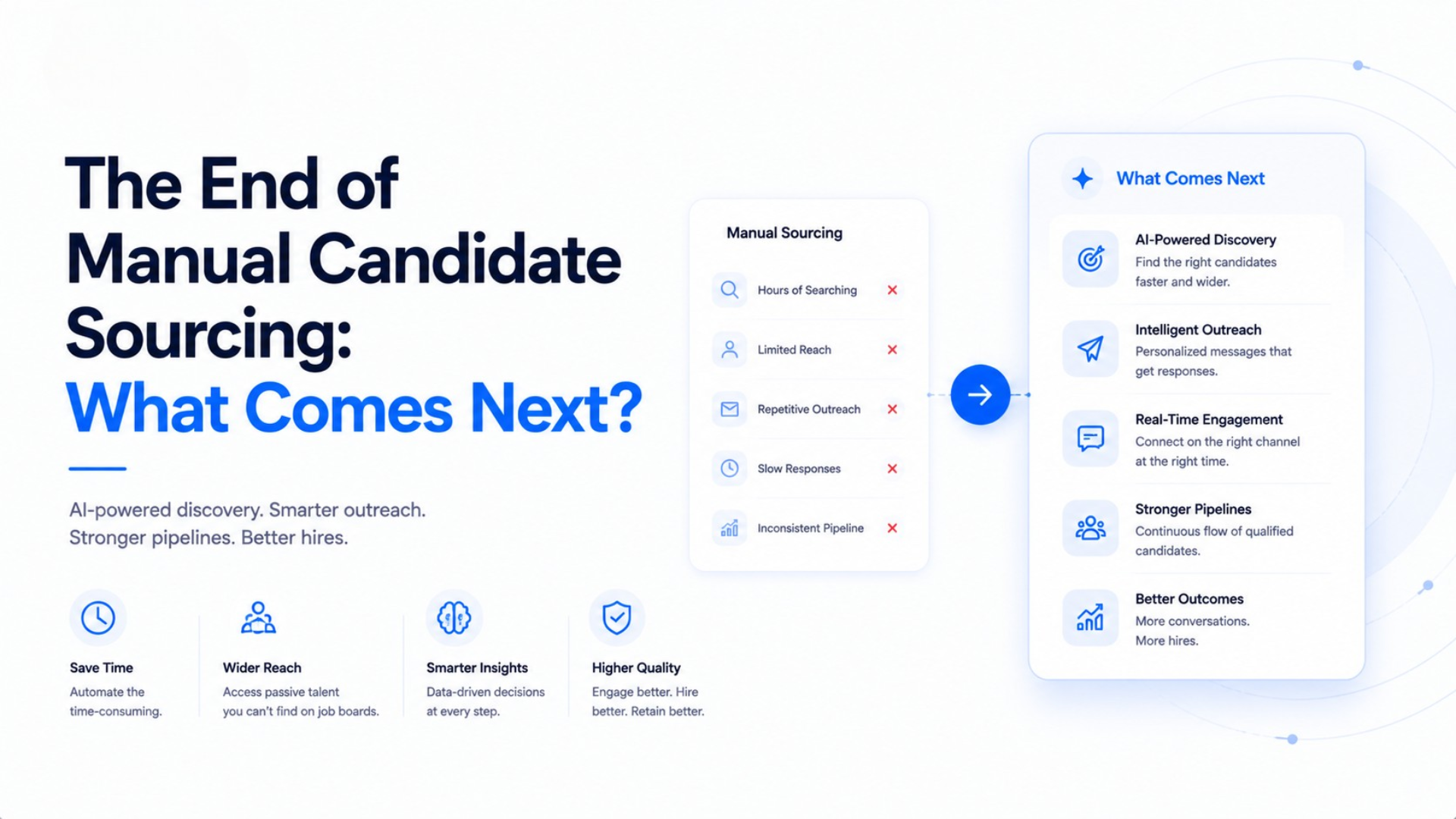
A senior recruiter at a mid-size tech company sits down at their desk at nine in the morning, opens LinkedIn Recruiter, types a boolean string into the search bar, and begins scrolling through profiles one by one. They click on a profile, scan the experience section, check the skills list, decide whether the candidate is relevant, and either saves the profile or moves on. By lunchtime, they have reviewed two hundred profiles, saved thirty, and sent outreach messages to twelve. By the end of the week, three of those twelve will have replied. One might eventually become a hire. This process has been the standard operating procedure for recruiting teams for two decades. It is also, by every available metric, one of the least efficient uses of skilled human labor in the modern enterprise. The recruiter spent forty hours to generate one potential hire from a pool of candidates that an AI system could have identified, scored, and prioritized in minutes. Manual sourcing is not just slow. It is structurally incapable of competing with the speed, scale, and intelligence that AI-powered platforms now bring to candidate identification.
According to research from LinkedIn's talent solutions team, the average recruiter spends sixty to seventy percent of their workweek on sourcing activities, the searching, reviewing, and initial outreach that precedes actual recruiting conversations. This means the majority of a recruiter working time is spent on tasks that AI can perform faster and more consistently. The AI candidate sourcing replacement does not eliminate the need for recruiters. It eliminates the
need for recruiters to do work that machines do better, freeing them to focus on the human activities that machines cannot replicate: building relationships, understanding candidate motivations, advising hiring managers, and managing the emotional complexity of the hiring process. The future of talent sourcing is not recruiterless. It is recruiter-amplified, where the AI handles the operational heavy lifting of candidate identification and the recruiter handles the strategic and relational work that turns a candidate profile into a successful hire.
Why Manual Sourcing Is Reaching Its Limits
Manual sourcing has three fundamental limitations that no amount of recruiter skill or effort can overcome. The first limitation is scale. A human recruiter can meaningfully evaluate roughly fifty to one hundred candidate profiles per day before the quality of their judgment starts to deteriorate. This is a biological constraint: attention fatigue, decision fatigue, and cognitive load accumulate with each profile reviewed, and after a certain point the recruiter is no longer making careful assessments. They are scanning and clicking on autopilot. Meanwhile, the talent market is producing new candidate data at a rate that no human can keep up with. New profiles, updated skills, published articles, conference talks, and project contributions are generated every hour. According to SHRM's talent acquisition research, the volume of candidate data available to the average recruiter has increased by roughly four hundred percent over the past decade, while the recruiter capacity to process that data has remained essentially flat. The manual sourcing vs AI sourcing comparison is not a contest of quality. It is a contest of capacity, and the human side has already lost.
The second limitation is consistency. Manual sourcing quality varies enormously based on the time of day, the day of the week, the recruiter mood, the complexity of the role, and a dozen other factors that have nothing to do with candidate quality. A candidate who would be shortlisted on Tuesday morning might be passed over on Thursday afternoon simply because the recruiter is tired, distracted, or overwhelmed by other requisitions. This inconsistency is invisible to the recruiter and to the hiring manager, but it systematically degrades the quality of the hiring pipeline. Understanding why more tools produce the same hiring problems, adding more manual search tools does not fix this problem because the inconsistency is not in the tools. It is in the human operator. The automated candidate identification approach eliminates this variability entirely. An AI system evaluates every candidate against the same criteria with the same precision at nine in the morning and five in the afternoon, on Monday and on Friday. It does not get tired, distracted, or impatient. According to McKinsey's people organization insights, AI-powered candidate screening produces thirty to fifty percent more consistent shortlists than manual screening, and the candidates on those shortlists are more likely to receive and accept offers because the screening criteria were applied uniformly rather than inconsistently.
The third limitation is speed. In a competitive talent market, the recruiter who presents a qualified candidate first has a significant advantage, both in securing the candidate interest and in setting the standard for the hiring manager evaluation. Manual sourcing, by its nature,
is sequential. The recruiter reviews one profile, then the next, then the next. An AI system evaluates thousands of profiles simultaneously and returns a ranked shortlist in seconds. The candidate sourcing evolution from manual to AI-driven is fundamentally a speed evolution, and the speed difference is not incremental. It is orders of magnitude. A manual sourcing process that takes three to five business days to produce a shortlist of ten candidates can be completed by an AI system in under an hour, and the AI shortlist is likely to be of equal or higher quality because it has evaluated a far larger candidate pool than any human could review in the same time frame.
What AI Sourcing Actually Does
The term AI sourcing is used broadly in the recruiting industry, and much of what is marketed as AI sourcing is actually just automation, the use of software to execute predefined rules and workflows faster than a human could. True AI sourcing goes beyond automation. It involves machine learning models that can understand candidate profiles at a semantic level, identifying relevant skills and experiences that keyword matching would miss, predicting candidate fit based on patterns learned from successful past hires, and continuously improving its own accuracy as it processes more data. Understanding what makes an AI recruiting platform agentic vs. just automated, the distinction matters because it determines whether the platform is genuinely reducing the recruiter workload or simply shifting it from one manual task to another. A truly agentic AI sourcing platform does not just find candidates who match a job description. It understands why certain candidates are a better fit than others, it identifies candidates who are likely to be receptive to outreach, and it provides the recruiter with the context needed to engage those candidates effectively.
The AI sourcing technology also enables capabilities that are literally impossible with manual methods. An AI system can simultaneously monitor thousands of candidates for changes in their career status, detect when a candidate has started showing engagement signals such as profile updates or increased platform activity, and alert the recruiter in real time when a high-potential candidate becomes available. This continuous monitoring capability transforms sourcing from a periodic activity triggered by open requisitions into an always-on intelligence function that identifies opportunities as they emerge. Understanding why some AI recruiting tools have outdated candidate data, the value of this continuous monitoring depends entirely on data freshness. A platform that monitors candidates but relies on stale data is worse than useless, because it creates false confidence in candidates who may no longer be available or relevant. The best AI sourcing platforms refresh their candidate data continuously, ensuring that the intelligence they provide is always current and actionable. Understanding the difference between AI sourcing and AI recruiting, sourcing is the identification and prioritization of candidates, while recruiting is the engagement and conversion of those candidates into hires. The most effective platforms do both, but they do them as integrated, continuous processes rather than as separate, episodic activities.
The Recruiter Role After Manual Sourcing
The most common fear among recruiters hearing about AI-powered sourcing is that it will make them redundant. This fear is understandable but misplaced. AI does not replace the recruiter. It replaces the manual labor that has been consuming the majority of the recruiter working time, freeing the recruiter to focus on the activities that actually require human intelligence and emotional capability. The recruiter of the post-manual-sourcing era will spend far less time on boolean searches, profile scrolling, and template-based outreach, and far more time on three activities that AI cannot replicate. The first activity is strategic candidate engagement, having deep, personalized conversations with high-priority candidates about their career goals, motivations, and concerns. The second activity is hiring manager advisory, helping hiring managers define realistic role requirements, calibrate their expectations, and make better hiring decisions. The third activity is relationship management, building and maintaining the kind of long-term candidate relationships that produce pipeline value over months and years. According to Gartner's HR trends research, recruiters who shift from manual sourcing to AI-augmented recruiting report forty percent higher job satisfaction and fifty percent higher hiring manager satisfaction, because they are doing more meaningful work and producing better results.
The transition requires a mindset shift. Recruiters who have built their identity around their sourcing skills, their ability to craft the perfect boolean string or find the hidden profile, may feel that AI is devaluing their expertise. But the recruiter expertise that matters most has never been about finding candidates. It has been about understanding people, building trust, navigating organizational dynamics, and making judgment calls about fit and potential that no algorithm can fully replicate. The recruiting automation next generation does not diminish the recruiter. It elevates them by removing the mechanical work that has been holding them back. Understanding whether AI will replace recruiting jobs, the recruiters who thrive in the AI era will be the ones who embrace the technology as a tool that amplifies their human capabilities rather than a threat that diminishes their value. The recruiters who resist the transition, who insist on manual sourcing as a point of professional pride, will find themselves competing against AI-augmented competitors who can identify and engage candidates ten times faster.
What the Next-Generation Sourcing Workflow Looks Like
The post-manual-sourcing workflow operates on a fundamentally different rhythm than the traditional one. In the traditional workflow, a requisition opens, the recruiter searches for candidates, screens them, sends outreach, and waits for responses. Each step is manual, sequential, and time-consuming. In the next-generation workflow, the AI platform has already identified and scored candidates before the requisition opens, because it has been continuously monitoring the talent market and building a pipeline that matches the organization hiring patterns. When the requisition arrives, the recruiter reviews a pre-built shortlist of qualified, pre-scored candidates, selects the ones they want to engage, and the platform generates
personalized outreach based on each candidate specific profile and context. The recruiter reviews and approves the messages, then shifts focus to the conversations that follow. According to Deloitte's talent research, organizations that have adopted this AI-first sourcing workflow report sixty percent reduction in time-to-shortlist and forty percent reduction in cost-per-hire, because the AI eliminates the most time-consuming and expensive part of the process.
The next generation recruiting tools also enable a continuous feedback loop that improves over time. Every candidate interaction, every hire, every rejection, and every offer decline provides data that the AI system uses to refine its matching and scoring models. The platform learns which candidates succeed at the organization, which outreach messages generate the highest response rates, and which engagement patterns predict candidate receptivity. This continuous learning capability means that the system gets better with every hiring cycle, producing progressively higher quality shortlists and more effective outreach. Understanding how many follow-ups one hire actually needs, the AI platform can also optimize the follow-up cadence for each individual candidate based on their engagement patterns, ensuring that no candidate is lost due to under-follow-up or alienated by over-follow-up. Understanding why referrals outperform cold outreach, the AI can also identify candidates who have the strongest connection pathways to the organization, whether through shared alumni networks, mutual connections, or previous interactions, and prioritize those candidates for outreach because they are more likely to respond and convert.
How to Transition Without Losing Recruiting Quality
Transitioning from manual sourcing to AI-powered sourcing is not a switch you flip. It is a staged process that requires deliberate management to avoid disruptions in hiring quality and team morale. The first stage is parallel operation, where the AI platform runs alongside the existing manual process for a period of two to four weeks. Both the AI and the manual process produce candidate shortlists for the same roles, and the team compares the results. This comparison builds confidence in the AI output and identifies any gaps or biases in its candidate selection. The second stage is AI-primary, where the AI generates the initial shortlist and the recruiter focuses their manual effort on validating and enriching that shortlist rather than building one from scratch. This stage reduces the recruiter sourcing workload by roughly seventy percent while maintaining full human oversight. The third stage is AI-native, where the AI handles end-to-end candidate identification, scoring, and outreach generation, and the recruiter role shifts entirely to relationship management, candidate conversation, and hiring manager advisory. According to LinkedIn's recruiting resources, organizations that follow this staged transition approach report zero degradation in quality-of-hire metrics during the transition period and significant improvements within two to three months of full adoption.
The intelligent candidate matching capabilities of modern AI platforms mean that the transition does not require the recruiting team to learn complex new tools. The best platforms
present their results through intuitive interfaces that feel like an extension of the recruiter existing workflow rather than a replacement of it. The recruiter still reviews candidate profiles, still makes decisions about who to engage, and still owns the relationship with the candidate. The difference is that the candidate profiles they are reviewing have been pre-selected from a pool thousands of times larger than any manual search could cover, and the outreach they are sending has been personalized based on deep candidate intelligence rather than generic templates. For organizations that are evaluating an AI sourcing tool before buying, the ability to support this staged transition, with parallel operation, AI-primary, and AI-native modes, should be a key selection criterion, because it determines how smoothly the team can adopt the platform without disrupting their current hiring output.
How Huntlo.ai Is Building the Post-Manual Sourcing Era
Huntlo.ai is designed for the world after manual sourcing. The platform does not help recruiters search faster. It eliminates the need to search at all. Huntlo continuously monitors the talent market, identifies and scores candidates against your organization hiring patterns, maintains fresh intelligence on thousands of potential candidates, and surfaces the right candidates at the right time with the context needed to engage them effectively. When a requisition opens, the recruiter reviews a pre-built, AI-generated shortlist and begins engaging candidates immediately, bypassing the days of manual searching that traditional sourcing requires. The platform also supports AI recruiting for niche and technical roles, where the candidate pool is small, specialized, and difficult to search manually, making AI-powered identification even more valuable.
For recruiting leaders who recognize that manual sourcing is a bottleneck holding their team back, Huntlo provides the complete platform to make the transition to AI-native recruiting. Your recruiters did not join the profession to scroll through LinkedIn profiles for forty hours a week. They joined to connect great people with great opportunities. Huntlo gives them the technology to do exactly that, by handling the sourcing work that machines do better and freeing your team to focus on the human work that only they can do. The end of manual sourcing is not the end of recruiting. It is the beginning of recruiting as it should have always been.