The desk is ready. The laptop is configured. The team has cleared their morning schedule for the new hire welcome. At nine AM, still no sign. At nine fifteen, the hiring manager starts checking their phone. At ten, a text message arrives: they are not coming. Or, in a growing number of cases, nothing arrives at all. The candidate simply does not show up, does not call, and does not respond to follow-up messages. The desk sits empty. The laptop goes back into inventory. And the recruiting team starts the entire process over from the beginning.
Candidate no-shows on joining day are one of the most expensive and preventable failures in the entire recruiting process. By the time a candidate reaches their joining date, the organization has invested heavily in sourcing, screening, interviewing, offer negotiation, and pre-boarding preparation. Losing the candidate at this stage does not just waste that investment. It doubles it, because the team must now repeat the entire process for the same role. And yet, most organizations have no systematic strategy for preventing no-shows, because they do not track the problem, do not understand its root causes, and do not invest in the tools that can solve it. As we have explored in our analysis of why more tools produce the same hiring problems, the answer is not adding more point solutions. It is building a systematic approach that covers the entire journey from offer acceptance through day one.
What Is a Candidate No-Show and Why It Costs More Than You Think
A candidate no-show occurs when an individual who has accepted a formal offer of employment fails to report for work on the agreed joining date without prior notice or cancellation. This is distinct from a candidate who withdraws during the notice period, because a no-show means the organization learns about the loss on the day it expected to gain a new team member. The operational disruption is immediate and acute. Teams that were counting on additional capacity must absorb the workload. Projects that were scheduled around the new hire’s
start date must be delayed. And the hiring manager, who has already invested significant time in the interview process, must重新engage with the recruiting team to restart the search. According to SHRM’s talent acquisition resources, the average cost of a single candidate no-show, including sunk recruiting costs, lost productivity, and restart expenses, exceeds six thousand dollars in most markets and can reach fifteen thousand dollars or more for senior or specialized roles.
The strategic cost is equally damaging, though harder to quantify. Every no-show erodes the hiring manager’s confidence in the recruiting function. Over time, this erosion leads to tighter scrutiny of candidate profiles, longer interview processes, and more conservative hiring decisions, all of which slow the organization down. The no-show problem also damages the candidate’s professional network, because the candidate’s colleagues, friends, and acquaintances learn about the failed start. In competitive talent markets, word travels fast, and a reputation for disorganized or unreliable hiring processes makes it harder to attract strong candidates in the future. Organizations that treat no-shows as isolated incidents rather than systemic problems are almost always underinvesting in the solution. The most direct way to reduce hiring cost is not to negotiate lower recruiter fees or cut job board spending. It is to ensure that every candidate who accepts an offer actually shows up.
The Five Stages Where No-Shows Originate
No-shows do not happen on joining day. They happen in the days and weeks before joining day, and the root cause is almost always established well before the candidate fails to appear. Understanding where no-shows originate requires mapping the post-offer journey into five distinct stages, each with its own risks and intervention points. The first stage is acceptance to resignation, the gap between the candidate signing your offer and actually resigning from their current employer. During this window, the candidate has not yet committed irrevocably, and the probability of a counteroffer or a change of heart is at its highest. The second stage is the notice period itself, typically two to four weeks during which the candidate remains in their current role while preparing to transition. This is the longest stage and the one where doubt has the most time to grow. Understanding how many follow-ups one hire actually needs, and ensuring those follow-ups happen consistently, is the single most impactful intervention during this stage.
The third stage is the pre-boarding period, typically the week before joining when the candidate completes administrative tasks and prepares for the transition. This is when the contrast between the interview experience and the pre-boarding experience is most visible, and where a negative impression can quickly undo months of positive engagement. The fourth stage is the final forty-eight hours before joining, when practical logistics like commute planning, first-day attire, and family arrangements can create last-minute anxiety that pushes a wavering candidate toward withdrawal. The fifth stage is joining day itself, when the candidate either shows up or does not. By the time a candidate reaches this stage without having withdrawn, the probability of a no-show is relatively low, but it is not zero. Last-minute emergencies, misunderstandings about the start time or location, and simple fear can still prevent a
candidate from walking through the door.
Step One: Create a Post-Offer Engagement Playbook
The foundation of no-show prevention is a structured, repeatable engagement playbook that defines exactly what happens at every stage of the post-offer journey. This playbook should specify who contacts the candidate, when they contact them, what they discuss, and what escalation triggers exist if the candidate becomes unresponsive. The playbook is not a script. It is a framework that ensures consistency while allowing personalization based on the candidate’s specific situation and concerns. A modern ATS that includes post-offer workflow management can automate the scheduling and tracking of every playbook activity, ensuring that nothing falls through the cracks regardless of how many candidates are in the pipeline. Without this systematization, post-offer engagement depends entirely on individual recruiter discipline, which is unreliable at scale and breaks down completely during high-volume hiring periods.
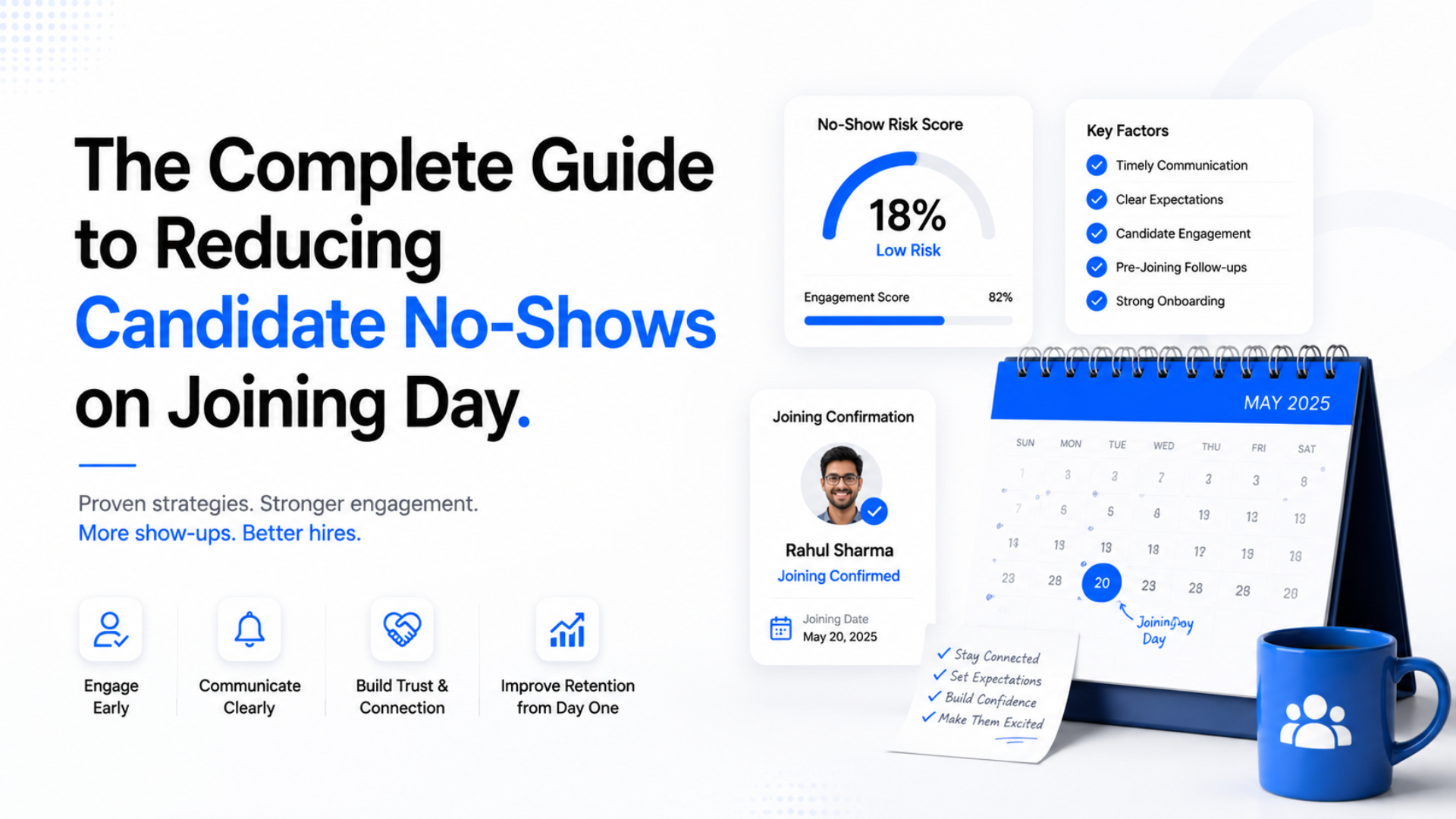
The playbook should define three tiers of engagement. Tier one activities are system-led: automated welcome messages, pre-boarding reminders, and logistical information about the first day. These require no human effort but keep the candidate informed and connected. Tier two activities are recruiter-led: personal check-in calls, responses to candidate questions, and coordination with the hiring manager. These require human judgment and empathy, but the scheduling and tracking should be handled by technology. Tier three activities are leadership-led: a personal call from the hiring manager, an invitation to a team event, or a conversation with a senior leader about the organization’s vision. These are high-impact, high-cost touchpoints that should be reserved for candidates who are identified as at-risk or who are filling mission-critical roles. This three-tier model is the foundation of an agentic AI recruiting platform, because it combines automated execution with human judgment in a way that neither manual processes nor simple automation can achieve.
Step Two: Implement Risk Detection and Early Warning
Not all candidates are equally likely to no-show. Risk factors include a long notice period, relocation requirements, a counteroffer history in the candidate’s industry, a high number of competing interviews, and a pattern of declining engagement after the offer was accepted. An AI system that monitors these signals in real time can flag at-risk candidates and trigger the escalation protocols defined in the engagement playbook. The key insight is that most no-shows are preceded by a period of declining engagement that is detectable if you are looking for it. Candidates who eventually no-show typically start responding more slowly to messages, give shorter and less detailed answers, and become less proactive in asking questions about the role or the company. These behavioral changes are subtle and easy to miss when a recruiter is managing dozens of candidates, but they are trivial for an AI system to detect.
The intelligence that powers risk detection depends on the quality and completeness of the data flowing into the system. This is why the problem of outdated candidate data in AI
recruiting tools is particularly damaging in the post-offer phase. If the AI’s understanding of the candidate’s engagement is based on stale data, its risk assessments will be inaccurate, and the recommended interventions will be misaligned with the candidate’s actual needs. A recruitment CRM that maintains a real-time record of every candidate interaction, from the initial sourcing message through the most recent pre-boarding activity, provides the data foundation that makes risk detection reliable. Without this foundation, even the most sophisticated AI will produce false positives and false negatives that erode the recruiting team’s trust in the system.
Step Three: Design a Pre-Boarding Experience That Builds Commitment
The pre-boarding period is the candidate’s first extended experience of what it will actually be like to work at your organization. If that experience is warm, responsive, and organized, the candidate’s confidence in their decision grows. If it is bureaucratic, impersonal, and disorganized, their doubt grows. The practical components of effective pre-boarding include a detailed first-week agenda that shows the candidate exactly what to expect, an introduction to a designated onboarding buddy who can answer questions informally, access to relevant documentation about the team, the project, and the company culture, and regular touchpoints that make the candidate feel like they are already part of the team. These components are not optional extras. They are essential elements of the hiring process, because the pre-boarding experience is the last major data point the candidate uses to evaluate their decision before committing to day one.
Technology plays a critical role in delivering this experience at scale. A HR automation software platform that integrates with the recruiting system can automatically trigger the appropriate pre-boarding activities based on the candidate’s role, location, and start date. It can generate personalized first-week agendas, send automated introductions to onboarding buddies, and track the candidate’s completion of pre-boarding tasks. According to Deloitte’s talent insights, organizations that invest in structured pre-boarding experiences see up to thirty percent higher new-hire satisfaction and significantly lower no-show rates. The key is treating pre-boarding not as an administrative process, but as a strategic extension of the candidate experience that began with the first outreach. As we have discussed in our analysis of the difference between AI sourcing and AI recruiting, it is the recruiting phase, the relationship management phase, where the candidate’s final decision to show up or not is actually made.
Step Four: Prepare for Day One Like It Matters
The final forty-eight hours before joining are disproportionately important. This is when practical anxiety peaks. The candidate is thinking about their commute, what to wear, whether they will like their team, and whether they made the right decision. Small logistical issues, confusion about the start time, uncertainty about where to park, not knowing who to ask for, can push an anxious candidate over the edge. The solution is to eliminate every possible source of uncertainty before joining day arrives. Send a detailed day-one logistics email forty-eight hours in advance that covers the arrival time, the office address with parking or
transit instructions, the name and phone number of the person who will greet them, the dress code, and what to bring. Follow up with a personal message twenty-four hours before, ideally from the hiring manager or the onboarding buddy, that expresses genuine excitement about the candidate’s arrival.
These final touchpoints may seem small, but their impact on no-show rates is significant. A candidate who receives a warm, personal message on the eve of their start date feels expected and valued. A candidate who receives nothing feels like a number. The difference between these two experiences can be the difference between a new hire who walks through the door and one who does not. This is why recruitment workflow automation software, that ensures these final touchpoints are never missed, is one of the highest-ROI investments a recruiting team can make. According to LinkedIn’s recruiting resources, candidates who receive personalized communication in the final forty-eight hours before joining are fifty percent less likely to no-show compared to those who receive only administrative information.
There is also a team preparation dimension that is frequently overlooked. The hiring manager and the candidate’s future teammates should be briefed on the new hire’s background, role, and start date, and they should be genuinely prepared to welcome them. A candidate who arrives to find that nobody knew they were starting, or that the hiring manager is in back-to-back meetings and unavailable, immediately questions their decision. This kind of failure is not just a recruiting problem. It is an organizational coordination problem, and it requires a recruitment CRM that bridges the gap between recruiting and operations, ensuring that the information flows seamlessly from the talent acquisition team to the business. As we have noted in our exploration of whether referrals outperform cold outreach, candidates who feel connected to their future team before day one are significantly more likely to show up, because the social bond has already begun to form.
Measuring and Improving Your No-Show Rate Over Time
You cannot improve what you do not measure. The no-show rate is calculated by dividing the number of candidates who fail to appear on their joining date by the total number of candidates who accepted offers during the same period. This metric should be tracked monthly, broken down by role type, seniority level, and geographic region, and reviewed in recruiting team meetings with the same rigor as time-to-fill or cost-per-hire. The goal is not to achieve a zero percent no-show rate, which is unrealistic, but to establish a baseline, identify the root causes of each no-show, and implement targeted interventions that drive the rate down over time. As we have discussed in our analysis of whether AI will replace recruiting jobs, the role of the recruiter is evolving from task executor to outcome optimizer, and no-show rate is one of the most important outcomes to optimize.
The data infrastructure required to track no-show rate effectively goes beyond what most organizations have in place. You need a system that records not just whether a candidate accepted an offer, but whether they completed each stage of the post-offer journey, whether they showed up on day one, and if not, at which stage they disengaged. This level of visibility is
what separates a modern ATS from a legacy one. Legacy systems treat the offer as the end of the process. Modern systems treat it as the beginning of the final and most critical phase. When combined with AI-powered risk detection and automated engagement sequences, this visibility transforms no-show prevention from a reactive, ad hoc activity into a systematic, data-driven discipline.
Why Huntlo.ai Is the Complete Solution for No-Show Prevention
Huntlo.ai provides an end-to-end solution for no-show prevention that covers every stage of the post-offer journey. The platform’s AI engine monitors every accepted candidate’s engagement in real time, detects risk signals before they become withdrawals, and orchestrates a personalized engagement sequence that keeps candidates connected, informed, and excited from acceptance through day one. The three-tier engagement model, system-led, recruiter-led, and leadership-led, ensures that every candidate receives the right level of attention at the right time. And the full-lifecycle analytics provide the visibility that recruiting teams need to measure their no-show rate, identify root causes, and drive continuous improvement. When evaluating an AI recruiting tool before buying, the ability to demonstrate measurable improvement in joining rate and no-show reduction is the ultimate proof of platform value.
For recruiting teams that are ready to stop losing great candidates on joining day, Huntlo offers a complete solution. One where every stage of the post-offer journey is managed, measured, and optimized. One where AI recruiting tools work for every type of role, including the high-demand positions where no-show rates are highest. And one where the recruiting team finally has the tools, the data, and the workflow to turn joining day from a source of anxiety into a cause for celebration. The difference between a recruiting team that prevents no-shows and one that does not is not effort. It is systems. And Huntlo provides the system.