Daniel is a VP of Engineering at a mid-size SaaS company. Last year, he interviewed at three companies for a potential move. The first company took nine days to respond to his initial expression of interest, then sent a generic screening invitation with no information about who he would speak with or what to expect. The second company responded within twenty-four hours with a personalized message from the hiring manager, provided a detailed interview agenda before each round, and sent a personal thank-you note within hours of his final interview. The third company responded quickly but then went silent for eleven days after the final round, during which Daniel assumed he had been rejected and began negotiating with the second company. He accepted the second company's offer. The first company was slow and impersonal. The third company was fast but inconsistent. The second company communicated with clarity, consistency, and personalization at every stage. Daniel did not choose the company with the highest salary. He chose the company that communicated the best, because communication quality was the only signal he could use to evaluate what it would be like to
work there. His logic was simple and rational. If this is how they treat me before I am an employee, how will they treat me after I become one? The answer, in his mind, was clear enough to make the decision easy.
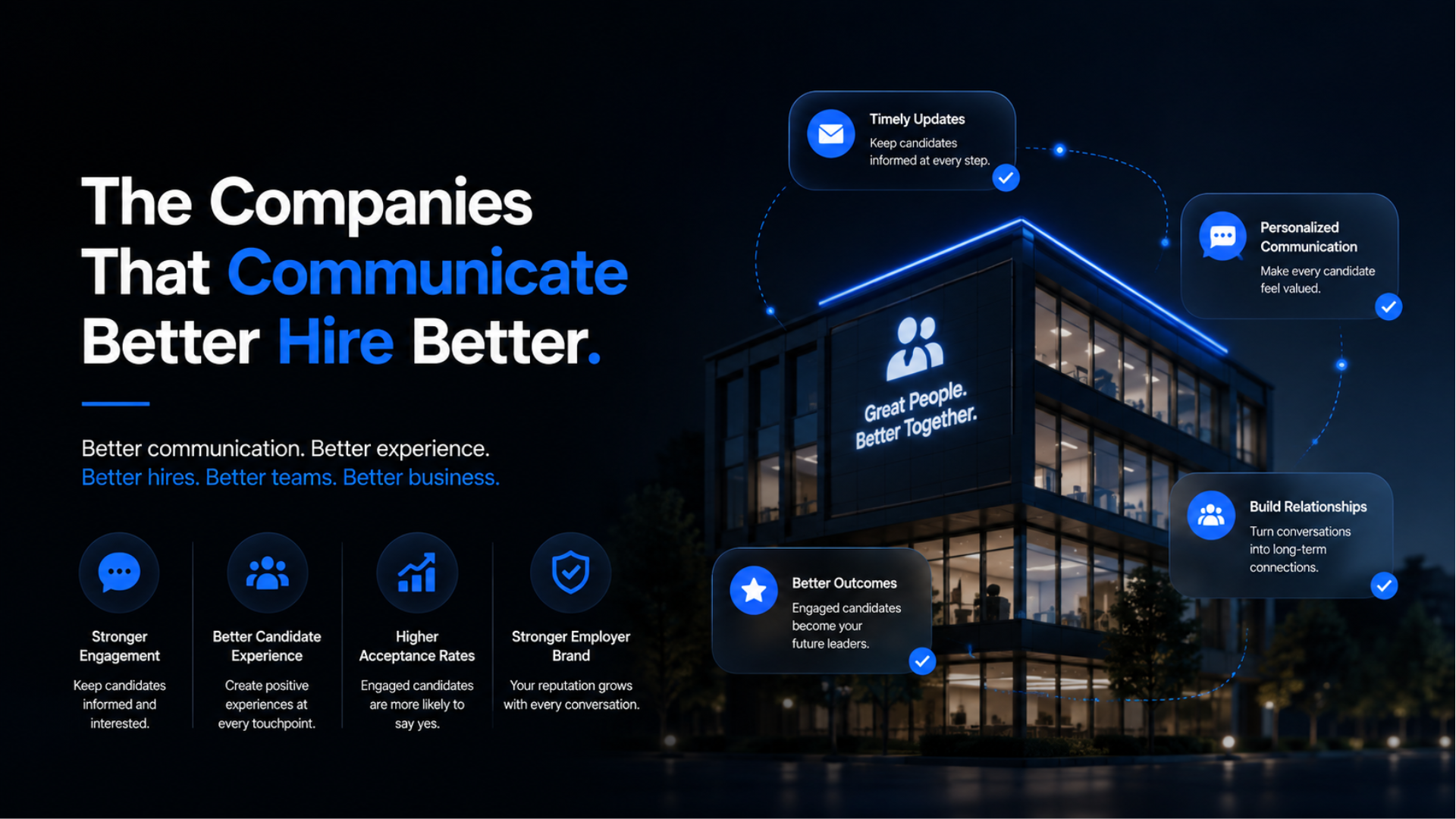
Daniel's experience is not an anecdote. It is a data point in a pattern that has become one of the most consistently documented findings in talent acquisition research: the quality of candidate communication is the strongest predictor of hiring outcomes, stronger than compensation, stronger than brand recognition, and stronger than the attractiveness of the role itself. Companies that communicate with candidates clearly, consistently, and personally at every stage of the hiring process consistently outperform their peers on response rates, conversion rates, offer acceptance rates, time-to-fill, and candidate satisfaction. Companies that communicate poorly lose candidates they should have hired, often to competitors with weaker value propositions but stronger communication practices. According to SHRM's talent acquisition research, eighty-two percent of candidates say that the quality of communication during the hiring process significantly influenced their decision about whether to accept an offer, and sixty percent of candidates who had a poor communication experience withdrew from the process before an offer was extended, even when the role itself was attractive. The communication advantage in hiring is not a marginal factor. It is the primary factor, because communication is the mechanism through which every other value proposition, compensation, culture, growth opportunity, and team quality, is delivered to the candidate. A great role communicated poorly is experienced as a mediocre opportunity. A good role communicated exceptionally well is experienced as a must-have opportunity. Huntlo's platform is built on this principle, providing the intelligence and automation needed to ensure that every candidate interaction is clear, timely, and personalized, transforming communication from an operational afterthought into a strategic hiring advantage. Understanding the difference between AI sourcing and AI recruiting helps clarify why this matters: sourcing generates the pipeline, but the communication that follows determines whether that pipeline converts into hires.
The Three Dimensions of Communication Quality That Drive Hiring Outcomes
Communication quality in hiring is not a single attribute but a combination of three distinct dimensions, and each dimension contributes independently to hiring outcomes. The first dimension is clarity. Clear communication means the candidate understands what is happening, what is expected of them, and what they can expect at each stage of the process. Clarity eliminates the ambiguity and uncertainty that cause candidates to disengage, become anxious, or seek reassurance from competing employers. A clear communication experience includes a specific agenda for each interview, a defined timeline for decision-making, honest information about the role's challenges as well as its attractions, and straightforward explanations of each step in the process. The second dimension is consistency. Consistent communication means the candidate receives timely updates and responsive interactions at every stage, with no gaps that create doubt about whether the process is still active or whether the company remains interested. A consistent experience means the candidate never has to follow up to find out where things stand, never waits more than a few business days for a substantive response,
and never experiences the kind of communication gap that signals they are not a priority. The third dimension is personalization. Personalized communication means the candidate experiences each interaction as relevant to their specific situation, their career goals, their concerns, and their prior conversations with the recruiting team, rather than as a generic exchange that could apply to any candidate for any role. According to McKinsey's organizational insights, each of these three dimensions independently predicts hiring outcomes, but the combination of all three produces a multiplicative effect, because candidates who experience clarity, consistency, and personalization together develop a level of trust and engagement that dramatically increases their likelihood of accepting an offer and their quality of contribution after they join.
The practical challenge is that delivering all three dimensions consistently across a full candidate pipeline is extremely difficult through manual effort alone. A recruiter managing thirty active candidates across six roles can maintain clarity, consistency, and personalization for the five or six candidates they interact with most frequently. The remaining twenty-five candidates receive communication that is progressively less clear, less consistent, and less personalized as the recruiter's attention is consumed by the most urgent demands. This degradation is not a failure of skill or commitment. It is a structural consequence of a workload that exceeds the human capacity for sustained, high-quality communication. The teams that simply accumulate more tools without addressing this capacity constraint often discover they have more tools but the same hiring problems, because each new tool optimizes a narrow aspect of the communication workflow without addressing the fundamental capacity limitation. The solution is to deploy AI-powered communication support that maintains clarity, consistency, and personalization across the entire pipeline, ensuring that every candidate receives the quality of communication that only the most attentive recruiters could previously deliver to a small handful of priority candidates. Research on how many followups one hire actually needs underscores this point: the number varies by candidate and context, but the quality of each communication, its clarity, relevance, and timing, is the consistent determinant of whether it moves the candidate forward. Huntlo's platform provides this capability by maintaining a continuous intelligence layer for every candidate that informs every communication with context, ensuring that clarity, consistency, and personalization are delivered not just to the candidates at the top of the list but to every candidate in the pipeline. This is especially critical when hiring for niche and technical roles, where the candidates are sophisticated evaluators of communication quality and have zero tolerance for generic or inconsistent interactions.
Communication as Employer Brand: What Candidates Actually Evaluate
There is a growing body of evidence that candidate communication during the hiring process has become the primary mechanism through which employer brand is experienced and evaluated. Companies invest heavily in employer branding, careers pages, social media presence, employee testimonials, and glassdoor management, but these branded assets represent the employer the company wants to project. The communication the candidate experiences
during the hiring process represents the employer the company actually is. Candidates understand this distinction intuitively. A careers page that promises collaborative, transparent culture followed by a recruiting process characterized by slow responses, vague information, and impersonal interactions creates a credibility gap that no amount of brand marketing can close. The candidate concludes, accurately, that the recruiting experience is a more reliable signal of the employee experience than the careers page, because the recruiting experience is what the company does when it is trying to impress them. If this is how they communicate when they want something from me, the candidate reasons, how will they communicate when I am already an employee and the incentive to impress has diminished? According to LinkedIn's recruiting resources, seventy-four percent of candidates who had a negative communication experience during hiring reported that it negatively affected their perception of the company as an employer, regardless of how positively they viewed the company before the process began. The reverse is also true: candidates who experience exceptional communication during hiring develop a stronger and more positive employer brand perception than any careers page or social media campaign could produce, because the communication experience is personal, direct, and credible in a way that marketing content is not.
This insight, that communication is employer brand in action, has significant strategic implications. It means that every candidate interaction is a brand-building opportunity, and every communication failure is a brand-damaging event. It also means that the recruiting team, not the marketing team, is the primary custodian of the employer brand, because they are the ones who deliver the direct, personal interactions that shape the candidate's perception. The recruiters asking whether AI will replace their jobs should recognize that this brand custodian role makes them more strategically important than ever, because the communication they deliver is the single most influential factor in whether top candidates choose to join or go elsewhere. An agentic AI recruiting platform like Huntlo amplifies this brand-custodian role by ensuring that every communication the recruiting team delivers is clear, consistent, and personalized, reflecting the employer brand the company wants to project rather than undermining it through inconsistency or impersonality. The research on referred candidates illustrates this principle clearly: data shows that referrals outperform cold outreach in part because the referring employee provides the kind of personal, informed, and consistent communication that formal recruiting often fails to deliver. When a referred candidate communicates with the recruiting team, they already have a positive brand impression from the referring employee. If the formal recruiting communication then falls below that standard, the contrast is damaging. Huntlo's platform ensures that formal recruiting communication meets and exceeds the referral standard by providing the intelligence and consistency needed to deliver personalized, brand-aligned communication to every candidate, regardless of how they entered the pipeline.
The Financial Cost of Poor Communication in Hiring
The strategic case for better communication is compelling, but the financial case is equally powerful and more immediately actionable. Poor candidate communication creates four
direct financial costs that compound across every open role. The first cost is extended time-to-fill. Every communication gap, delayed response, or unclear interaction adds days or weeks to the hiring process, because the candidate either disengages and must be re-engaged, or the process stalls while the candidate waits for information that should have been proactively provided. According to Gartner's HR trends research, poor communication adds an average of twelve to eighteen days to the time-to-fill for each role, which translates to significant costs in lost productivity, delayed projects, and overburdened teams. The second cost is candidate withdrawal. Candidates who experience poor communication withdraw from hiring processes at rates thirty to fifty percent higher than those who experience good communication, and every withdrawal means the entire investment in sourcing, screening, and interviewing that candidate is lost and must be repeated with a replacement. The third cost is declined offers. Candidates who receive an offer after a communication-poor process are twenty-five to forty percent less likely to accept it than candidates who receive an offer after a communication-rich process, because the offer arrives without the trust, emotional investment, and organizational confidence that good communication has built. The fourth cost is employer brand damage. Candidates who share their poor communication experiences on professional networks, review sites, and peer conversations create a compounding cost that makes future hiring harder and more expensive for every subsequent role.
The cumulative financial impact of these four costs is substantial. For a mid-size company hiring one hundred people per year, the estimated cost of poor candidate communication, calculated from extended time-to-fill, increased withdrawal and decline rates, and brand damage, ranges from several hundred thousand to over a million dollars annually. This is not a theoretical estimate. It is a direct consequence of the measurable impact that communication quality has on each stage of the hiring process. The quality of the candidate intelligence that drives communication is a critical variable in this equation. Teams that have struggled with outdated candidate data in AI tools understand that communication based on stale or incomplete data will lack the personalization and relevance that define high-quality interactions, regardless of how quickly or consistently it is delivered. When evaluating communication platforms, use the framework for evaluating an AI sourcing tool before buying to ensure that data freshness, contextual depth, and communication personalization are core capabilities.
Building a Communication-First Hiring Organization
The organizations that communicate best do not achieve it by accident or by relying on individual recruiter excellence. They achieve it by treating communication quality as an organizational capability, with defined standards, systematic support, and measurable outcomes. The first step in building a communication-first hiring organization is establishing communication standards that define what clarity, consistency, and personalization look like at every stage of the candidate journey. These standards should be specific enough to guide behavior but flexible enough to accommodate the natural variation that comes with human conversation. The second step is deploying AI-powered tools that provide the operational infrastructure for meeting these standards consistently across the entire pipeline. Without this infrastructure, the
standards remain aspirational rather than operational, because the human capacity to deliver high-quality communication at scale is insufficient to meet them through effort alone. The third step is measuring communication quality as a core recruiting metric, alongside traditional metrics like time-to-fill and cost-per-hire. According to Deloitte's talent research, the organizations that are winning the competition for talent are not necessarily those with the strongest brands or the highest compensation. They are the ones that communicate most effectively at every stage of the candidate journey, because communication is the delivery mechanism through which every other value proposition reaches the candidate. These organizations measure communication quality, invest in the tools and training needed to improve it, and hold their recruiting teams accountable for maintaining it as a core standard of professional excellence.
According to EY's technology insights, AI-powered communication platforms are enabling these organizations to deliver communication quality at scale that was previously achievable only through manual effort for a small number of priority candidates. Huntlo delivers this capability by providing the intelligence, automation, and consistency infrastructure that ensures every candidate receives clear, timely, and personalized communication from the first message to the final offer. The companies that communicate better hire better. Huntlo makes better communication possible. Start communicating at a higher standard with Huntlo.