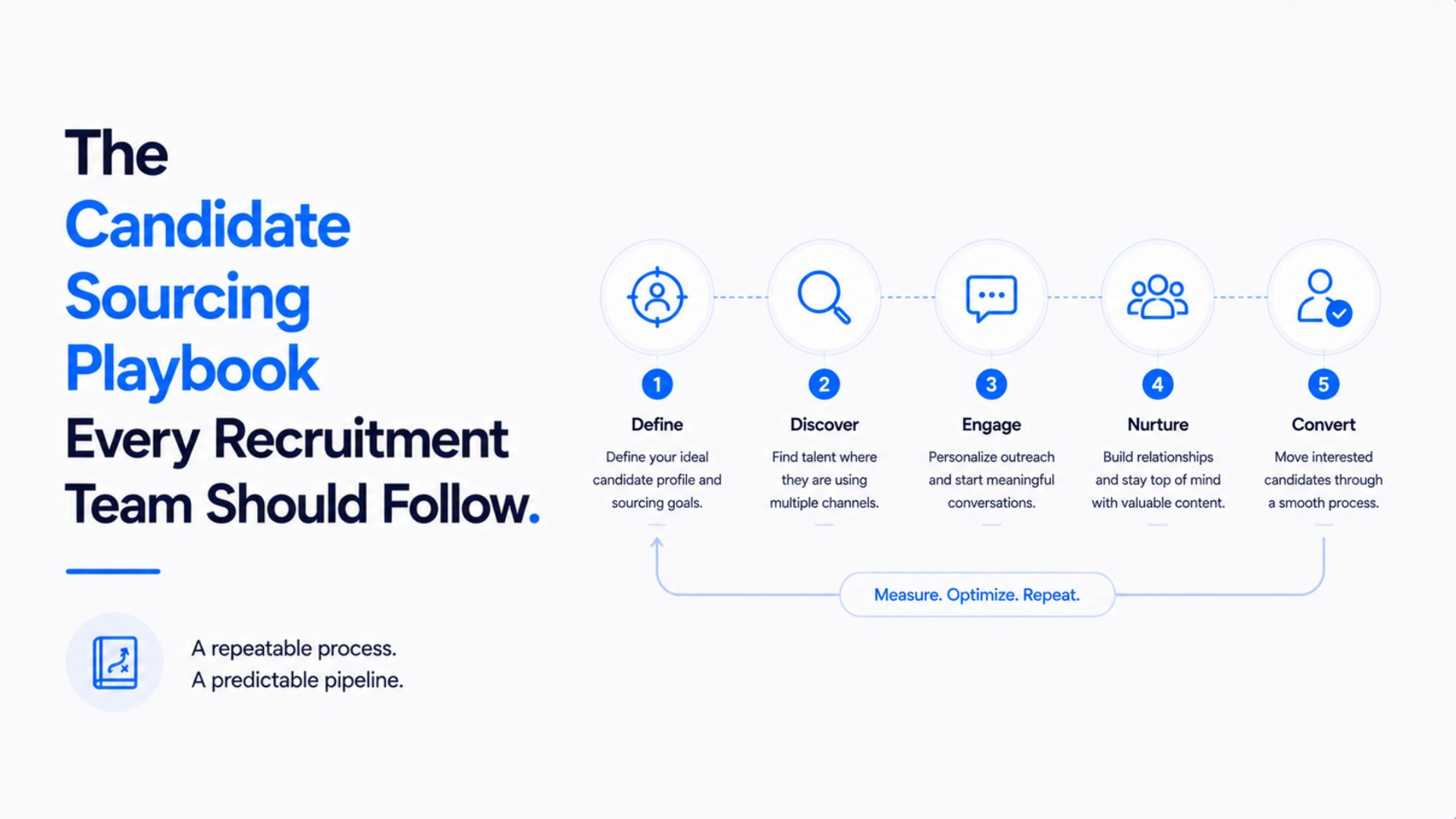
The difference between a high-performing recruiting team and an average one is rarely talent. It is process. High-performing teams follow structured, repeatable sourcing plays that ensure consistent pipeline quality, while average teams rely on the individual expertise of their strongest recruiters and accept inconsistent results from everyone else. When a top performer leaves an average team, the team's output drops significantly because the expertise walked out the door. When a top performer leaves a high-performing team, the output barely changes because the playbook remains. According to SHRM's talent acquisition research, organizations with formalized sourcing playbooks report thirty to forty percent more consistent pipeline metrics than those that rely on ad hoc approaches, and they onboard new recruiters to full productivity in half the time.
This article presents the seven sourcing plays that every recruitment team should have in their playbook. Each play is a discrete, executable process with clear inputs, outputs, and success criteria. Together, they form a complete sourcing system that covers the full lifecycle from market understanding through candidate engagement. The plays are designed to work with AI-powered talent intelligence platforms, because manual execution of all seven plays would be prohibitively time-consuming for most teams. With the right technology, however, every play becomes scalable, continuous, and data-driven. Whether you are a team of three recruiters or thirty, this playbook provides the framework for consistent, high-quality candidate sourcing that does not depend on any individual's expertise.
Play One — Market Mapping Before Requisition
The first play in any sourcing engagement should happen before a requisition is written. Market mapping is the process of analyzing the talent landscape for a role type before you
need to hire for it, so that when the requisition arrives, you already know where the best candidates are, what they are likely to expect, and how aggressively you will need to compete for them. This play transforms recruiting from a reactive, requisition-driven function into a proactive, intelligence-driven one. The inputs for market mapping include the target role's skill requirements, the geography or geographies you are hiring in, and any competitive intelligence about which companies are actively hiring for similar roles. The outputs are a talent market map that identifies the top source companies, the estimated size of the qualified candidate pool, typical compensation ranges, and a preliminary list of target candidates.
Without market mapping, every requisition starts with a period of discovery where the recruiter figures out the market landscape before they can begin serious sourcing. This discovery period can consume one to two weeks of the overall time-to-fill, during which competitors with pre-built market intelligence are already engaging candidates. An AI-powered platform can execute market mapping continuously, updating talent maps in real time as companies grow, shrink, or restructure. McKinsey's organizational insights highlight that organizations practicing proactive market mapping fill critical roles twenty-five to thirty-five percent faster than those that start sourcing only after requisition approval, because the intelligence work has already been done. This play is especially valuable for niche and technical roles where the talent market is small and understanding its structure is the difference between a fast hire and a months-long search.
Play Two — Multi-Source Candidate Discovery
The second play is multi-source candidate discovery, which means identifying potential candidates across multiple channels and data sources rather than relying on a single platform. The most common mistake in recruiting is treating LinkedIn as the sole or primary sourcing channel. While LinkedIn is a valuable tool, it represents only one slice of the professional talent market, and the candidates who are most visible on LinkedIn are also the ones receiving the most recruiter outreach. Multi-source discovery pulls candidates from professional networks, open-source platforms, publication databases, conference attendee lists, community forums, alumni networks, and any other source where professional capability is demonstrated. The key principle is that the best candidates are often found in the places where they do their best work, not where they optimize their professional profiles.
Executing this play manually requires a recruiter to search each source individually, which is time-prohibitive for most teams. An AI-powered talent intelligence platform automates multi-source discovery by aggregating data from dozens of sources, normalizing candidate profiles across different formats, and presenting a unified view of the candidate market. This is fundamentally different from using multiple search tools separately. When a recruiter searches LinkedIn, then GitHub, then a conference database, they are synthesizing results manually and managing the cognitive load of switching between different interfaces and data formats. A unified intelligence platform handles the synthesis automatically, so the recruiter sees one ranked list of candidates with comprehensive profiles drawn from all relevant sources.
Understanding the difference between AI sourcing and AI recruiting, multi-source discovery is a sourcing capability: it identifies candidates. The plays that follow convert those identifications into hires.
Play Three — Skill-Based Candidate Scoring
Once candidates have been identified, the third play applies a structured scoring methodology that ranks them by fit for the specific role. This is not a simple keyword match. Skill-based scoring evaluates candidates against the full spectrum of role requirements, including technical skills, domain expertise, leadership capabilities, cultural fit indicators, and career trajectory alignment. Each dimension is weighted according to the role's priorities, and candidates receive a composite score that reflects their overall fit. This structured approach eliminates the inconsistency of subjective evaluation, where different recruiters reviewing the same candidate pool might produce completely different shortlists. With a defined scoring framework, every recruiter on the team evaluates candidates against the same criteria, producing consistent and comparable results.
AI platforms elevate this play by inferring skills from evidence rather than relying on self-reported claims. A candidate who lists 'machine learning' on their resume receives the same keyword score as every other candidate who lists it. But an AI platform that has analyzed that candidate's actual work products, publications, and project contributions can distinguish between someone who has taken one machine learning course and someone who has built and deployed production ML systems. This evidence-based scoring produces a dramatically more accurate ranking than resume matching, and it surfaces candidates whose capabilities are stronger than their self-reported credentials suggest. However, this only works when the platform's underlying data is fresh and comprehensive. Understanding why some AI recruiting tools have outdated candidate data is essential, because a scoring model is only as good as the data it scores against. Gartner's HR trends research identifies skill-based scoring as a top priority for recruiting leaders because it directly improves the quality of hiring decisions by replacing gut-feel evaluation with evidence-based assessment.
Play Four — Engagement Signal Prioritization
Having a ranked list of candidates is valuable, but not all high-scoring candidates are equally reachable at any given moment. The fourth play uses engagement signal detection to prioritize outreach toward candidates who are most likely to respond. Engagement signals include profile updates, increased platform activity, new connections, conference registrations, publication of new content, changes in work patterns that suggest restlessness, and company-level signals like funding changes, leadership transitions, or organizational restructuring that may affect candidate satisfaction. The play analyzes these signals to produce an engagement likelihood score for each candidate, which is then combined with the fit score to determine outreach priority.
The practical impact of this play is significant. Most recruiting teams source candidates and then outreach to them in arbitrary order, often starting with the highest-fit candidates regardless of their current receptivity. This means they may spend weeks trying to engage a perfect-fit candidate who is completely happy in their current role while ignoring a strong-fit candidate who just signaled openness to a new opportunity. Engagement signal prioritization ensures that the team's outreach effort is directed where it will produce the highest return. Research shows that outreach timed to engagement signals produces response rates two to three times higher than untimed outreach. This is one reason referrals outperform cold outreach, because referred candidates come with implicit timing context. AI-powered platforms replicate this timing advantage at scale by continuously monitoring signals across the entire candidate pool and adjusting priorities in real time. Understanding how many followups one hire needs becomes more strategic when combined with signal-based prioritization, because each follow-up can be timed to coincide with renewed engagement signals.
Play Five — Personalized, Intelligence-Driven Outreach
The fifth play is the outreach itself, and the quality of outreach determines whether all the preceding intelligence work produces results. Intelligence-driven outreach uses the candidate's full profile, not just their name and company, to craft messages that demonstrate genuine understanding. The structure of an effective outreach message follows a consistent pattern: a specific observation about the candidate's work or career, a relevant connection to the opportunity, and a low-commitment ask that makes responding easy. The specific observation proves the recruiter has done more than run a search. The connection shows the opportunity is relevant. The low-commitment ask reduces the psychological barrier to responding. This three-part structure works because it transforms the message from a pitch into a professional conversation starter.
AI platforms support this play by generating personalized outreach recommendations for each candidate, including which signal points to reference, what framing to use based on the candidate's career context, and when to send the message for maximum impact. The recruiter reviews, approves, and often personalizes these recommendations further before sending. This collaborative model ensures that every message benefits from the deep candidate intelligence the platform has gathered while retaining the human judgment and authenticity that only a real recruiter can provide. LinkedIn's recruiting resources report that personalized, intelligence-driven messages achieve response rates four to six times higher than template-based outreach, confirming that the investment in personalization pays for itself many times over in engagement efficiency. However, organizations that add messaging tools without the underlying intelligence often end up with more tools but the same hiring problems, because personalization without depth is just better-formatted generic outreach.
Play Six — Structured Follow-Up Sequences
The majority of positive responses from passive candidates do not come on the first message.
They come on the second, third, or fourth touchpoint, when the recruiter has provided additional value, built credibility, and timed the follow-up to a moment when the candidate is more receptive. The sixth play defines structured follow-up sequences that are planned in advance, adapted based on candidate behavior, and sustained long enough to convert interest into conversation. Each follow-up should deliver new value, not repeat the same ask. Effective follow-up content includes sharing relevant market insights, referencing new developments in the candidate's field, providing updates about the role or team, and offering information that demonstrates the recruiter's genuine knowledge of the candidate's domain.
AI platforms manage these sequences by automating the timing, tracking candidate engagement across touchpoints, and generating new content suggestions for each follow-up based on the candidate's profile and recent activity. This ensures that no candidate falls through the cracks due to recruiter workload, and that every follow-up is relevant and timely. The recruiters who ask whether AI will replace their jobs should focus on this play in particular: AI handles the operational complexity of multi-touch sequences so the recruiter can focus on the strategic and relational aspects that actually close hires. An agentic AI recruiting platform manages the entire follow-up lifecycle autonomously, escalating to the recruiter only when a candidate responds or when a strategic decision is needed. Deloitte's talent research has found that structured follow-up sequences powered by AI increase passive candidate conversion rates by sixty to eighty percent compared to unstructured manual follow-up, because the sequences are more persistent, better timed, and more consistently executed.
Play Seven — Continuous Pipeline Monitoring and Feedback
The seventh and final play closes the loop by establishing continuous monitoring and feedback systems that keep the talent pipeline healthy and the playbook itself improving over time. Continuous monitoring means tracking the health of every active sourcing pipeline: candidate flow rates, engagement rates, conversion rates at each stage, and time-to-milestone metrics. When a pipeline metric falls below threshold, the system triggers a response: new candidates are surfaced, outreach sequences are adjusted, or the sourcing strategy for that role is revisited. This always-on monitoring ensures that pipelines do not quietly deteriorate between recruiter check-ins, which is one of the most common causes of unexpected hiring delays.
The feedback component is equally important. Every hiring outcome, whether a hire, a rejection, or a candidate who went dark, provides data that can refine the entire playbook. Candidates who were scored highly but did not perform well in interviews may indicate that the scoring model needs adjustment. Outreach messages that generated unusually high response rates can be analyzed to identify what made them effective and incorporated into future templates. Sources that consistently produce strong candidates can be weighted more heavily in future discovery plays. This feedback loop is what transforms a static playbook into a continuously improving system. Evaluating an AI sourcing tool should always include assessing how well it supports feedback loops and learning, because a platform that does not
improve from outcomes will produce diminishing returns over time as the talent market evolves. Huntlo.ai powers every play in this playbook with its integrated talent intelligence engine. From market mapping through continuous monitoring, Huntlo gives your recruitment team the structured, AI-amplified process that turns sourcing into a competitive advantage. Whether you are formalizing your first playbook or optimizing an existing one, whether you are hiring for niche technical roles or building enterprise-scale pipeline, Huntlo is the platform that executes the plays while your team makes the decisions. Build the playbook. Power it with Huntlo.