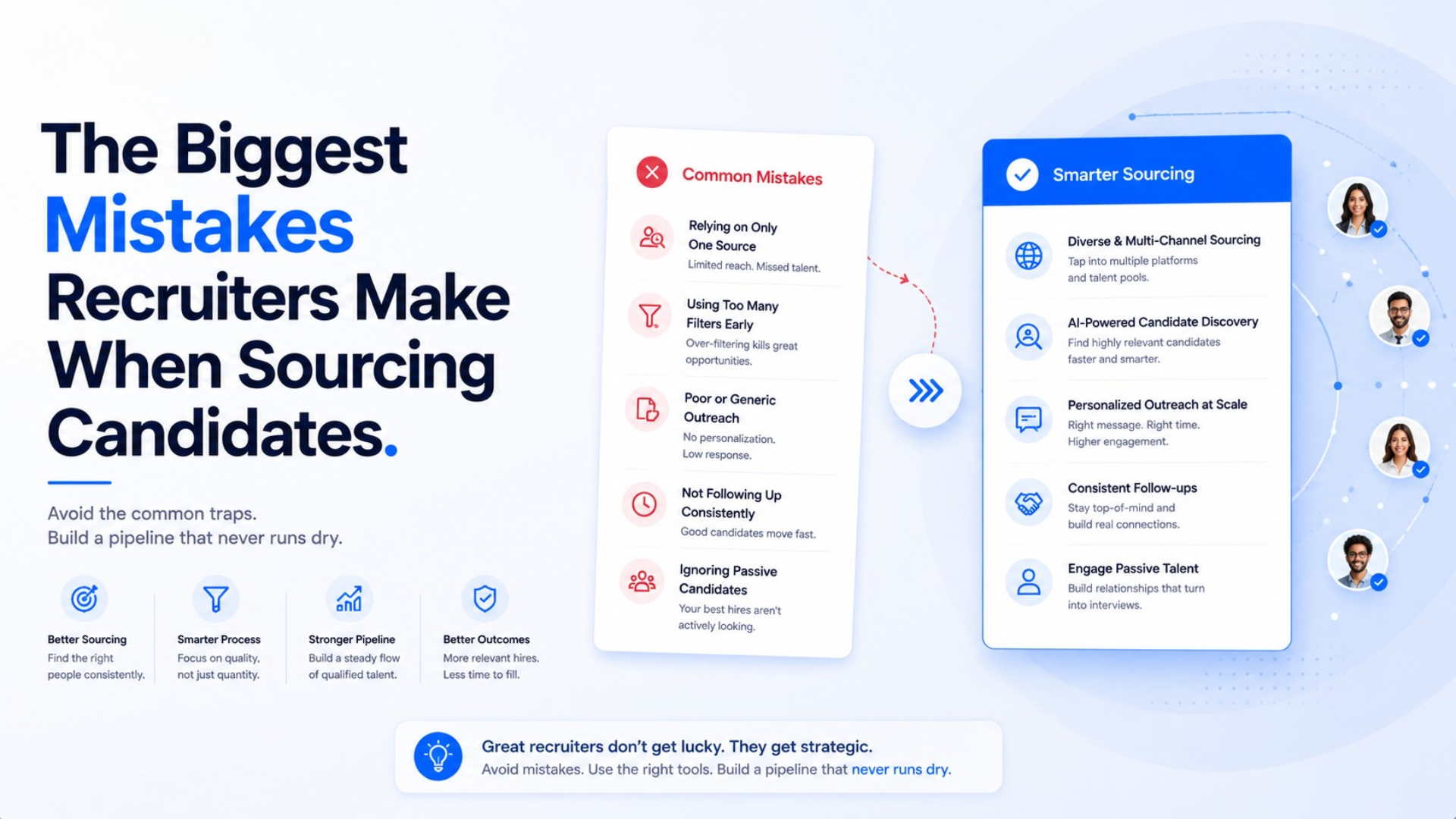
A recruiter posts a senior product manager role on three job boards, runs a LinkedIn search filtered by current job title, sends the same InMail to fifty profiles, and waits. After two weeks, they have twelve applicants, four of whom are qualified, and one of whom accepts an interview. The hiring manager reviews the candidate and says this person is fine but not impressive. The recruiter goes back to the same process, this time widening the search to adjacent titles, and finds a genuinely strong candidate who has already accepted another offer. The entire cycle took five weeks and produced no hire. The recruiter did not make a single unusual or avoidable error. They followed the standard process that most recruiting teams use. And that is precisely the problem. The standard sourcing process is itself the mistake, because it is designed for a market that no longer exists.
The sourcing mistakes that cost organizations the most are not dramatic failures of judgment. They are habitual practices that feel productive but produce mediocre results. They are the defaults that recruiting teams fall back on because they have always done things this way, and nobody has questioned whether the defaults still work. According to research from LinkedIn's talent solutions teamThe average recruiter spends sixty-five percent of their sourcing time on activities that produce fewer than ten percent of their hires. The remaining thirty-five percent of their time, the portion spent on high-value activities like relationship building, market intelligence, and candidate engagement, produces the vast majority of placements. The common talent sourcing failures that follow are not random errors. They are the structural habits that cause recruiters to invest their time in the sixty-five percent that does not work, at the expense of the thirty-five percent that does.
Mistake One: Sourcing Only Active Candidates
The single most expensive sourcing mistake is limiting the search to candidates who are actively looking for a job. Active candidates represent roughly twenty to thirty percent of the total talent market at any given time, which means that a recruiter who only sources active candidates is ignoring seventy to eighty percent of the available talent. More importantly, the active candidate pool is the most heavily contested pool in the market. Every other recruiter is reaching out to the same active candidates, which means the competition for attention is intense and the likelihood of finding a uniquely strong candidate is low. According to SHRM's talent acquisition dataRoles filled exclusively through active candidate sourcing take forty percent longer to fill and produce candidates who are twenty percent less likely to pass the interview bar, compared to roles where passive candidates are included in the sourcing strategy. The recruiting sourcing pitfalls of relying on active candidates are compounded by the fact that many of the strongest professionals in any field are not actively looking because they are already well-employed and well-compensated.
The correction is not to abandon active candidate sourcing entirely but to reposition it as one component of a broader strategy. The effective sourcer invests the majority of their time identifying and engaging passive candidates, people who are not looking but who would be open to the right opportunity. Passive candidate engagement requires a different approach than active candidate recruiting: it requires research, personalization, and relationship building rather than high-volume outreach. Understanding the difference between AI sourcing and AI recruitingSourcing is the identification of potential candidates, but effective sourcing requires understanding enough about each candidate to know whether they would be receptive to a conversation, and that understanding comes from intelligence, not from keyword matches.
Mistake Two: Confusing Activity with Productivity
Recruiting teams routinely measure sourcing performance by activity metrics: profiles viewed, messages sent, calls made, and InMails dispatched. These metrics are easy to track, easy to report, and almost completely unrelated to sourcing outcomes. A recruiter who sends one hundred messages and receives three responses is less productive than a recruiter who sends twenty messages and receives eight responses, but most recruiting dashboards would rank the first recruiter higher because they sent more messages. This activity-based measurement system creates perverse incentives: recruiters optimize for volume rather than quality, sending more messages with less personalization to hit their activity targets, which drives response rates down, which requires even more messages to hit the same target number of conversations. The cycle is self-reinforcing and self-defeating. According to McKinsey's people organization researchOrganizations that replace activity metrics with outcome metrics like response rate, conversation-to-interview rate, and sourcing channel ROI see a twenty to thirty percent improvement in sourcing efficiency within the first quarter.
The bad sourcing habits recruiters develop are a direct consequence of this measurement problem. When a recruiter is rewarded for sending eighty messages per day, they will send eighty messages per day, regardless of whether those messages are any good. When they are rewarded for filling roles quickly, they will gravitate toward the easiest candidates to reach rather than the best candidates for the role. The fix requires a fundamental shift in how recruiting leaders define and measure sourcing success, from how much the recruiter did to what the recruiter produced. As we have explored in our analysis of why more tools produce the same hiring problemsAdding more activity-tracking tools does not fix the underlying measurement problem; it amplifies it by giving recruiters more ways to measure activity without improving their ability to measure outcomes.
Mistake Three: Using Job Titles as the Primary Search Filter
Job titles are the most common and most misleading search filter in recruiting. The same role can have dozens of different titles across different companies. A product manager at a technology company may have the skills and experience required for a role called head of product at a startup, a product lead at a scale-up, or a director of product strategy at an enterprise. A recruiter who searches only for head of product will miss all of these candidates. Conversely, candidates with the title head of product at different companies may have wildly different levels of responsibility, team size, and strategic scope. The title tells the recruiter almost nothing useful about whether the candidate is actually qualified for the role they are trying to fill.
The most effective sourcers use skills, accomplishments, and career trajectory as their primary search criteria, with job titles as a secondary filter. They search for candidates who have built the kind of product the hiring company is building, who have managed the scale of team the hiring company needs, or who have solved the kind of problem the hiring company is facing. This skills-first approach produces a very different candidate pool than a title-first approach, and it consistently yields stronger, more diverse candidates. According to Gartner's HR trends analysisOrganizations that have shifted to skills-based sourcing report a thirty-five percent increase in candidate quality scores and a twenty percent increase in candidate diversity. Understanding whether AI recruiting tools work for niche or technical rolesThe skills-first approach is especially important for technical and specialized roles where job titles are particularly unreliable indicators of actual capability.
Mistake Four: Ignoring Candidate Timing Signals
A recruiter identifies a candidate who appears perfect for the role: the right skills, the right experience, the right industry background. They send a well-crafted, personalized message. The candidate does not respond. The recruiter marks them as unresponsive and moves on. Three months later, that candidate accepts a role at a competitor. What happened? The recruiter reached out at the wrong time. The candidate had just received a promotion, was in the middle of a major project launch, or had just returned from parental leave. The timing was bad, not the candidate. The sourcing strategy
mistakes related to timing are among the most frustrating because the candidate was genuinely qualified and the outreach was genuinely good, but the timing made the engagement impossible.
Great sourcers pay attention to timing signals before they invest in outreach. They check whether the candidate has recently changed roles, received a promotion, or has been with their current company for an extended period. They look at the candidate's recent activity, publications, and professional updates to assess whether the candidate is in a stable, settled phase or a transitional one. According to Deloitte's talent insightsRecruiters who incorporate timing signals into their prioritization achieve fifty percent higher response rates than those who outreach purely based on skill match. Understanding how many follow-ups one hire actually needsThe timing-aware sourcer also knows when to follow up and when to wait, because follow-up timing is just as important as initial outreach timing.
Mistake Five: Treating Sourcing as a One-Time Event
Most recruiting teams treat sourcing as an event that happens when a requisition opens and ends when the role is filled. This start-stop approach means that all of the sourcing intelligence, candidate relationships, and market knowledge accumulated during the search are effectively discarded when the role is filled, and the next search starts from zero. The recruitment sourcing best practices that produce the best results treat sourcing as a continuous process. The recruiter is always identifying talent, always building relationships, always gathering market intelligence, regardless of whether there is an open requisition. When a requisition does open, the continuous sourcer has a head start that the start-stop sourcer can never match.
The continuous sourcing approach also produces a compounding advantage over time. Every search adds to the recruiter's knowledge of the talent market, their network of professional relationships, and their library of candidate intelligence. A recruiter who has been sourcing continuously for two years in a specific domain has a depth of market knowledge that allows them to identify strong candidates faster, assess fit more accurately, and engage more effectively than a recruiter who starts each search from scratch. Understanding why referrals outperform cold outreachThe continuous sourcer's accumulated relationships function like an extended referral network, producing warm introductions and trusted connections that cold outreach can never match. The talent sourcing missteps of treating sourcing as a one-time event are invisible in the short term but devastating in the long term, because they prevent the accumulation of the very intelligence and relationships that make great sourcers great.
Mistake Six: Relying on Stale Candidate Data
Candidate data degrades rapidly. A profile that was accurate six months ago may be completely outdated today. The candidate may have changed roles, acquired new skills,
moved to a new city, or shifted their career focus. A recruiter who sources from a database that was last updated six months ago is working with intelligence that is, at best, partially accurate and, at worst, actively misleading. The candidate sourcing errors that result from stale data include outreach to candidates who are no longer in the target market, skill assessments based on outdated profiles, and wasted effort on candidates who have already been hired by competitors.
The solution is to use sourcing platforms that provide continuously updated candidate intelligence. Platforms that refresh candidate data in real time, that monitor career changes and skill developments, and that flag when a candidate's profile has changed significantly, give the recruiter a decisive advantage over competitors who are working with static databases. Understanding why some AI recruiting tools have outdated candidate dataThe freshness of candidate intelligence is not a nice-to-have feature. It is a fundamental requirement for effective sourcing, because sourcing decisions are only as good as the data they are based on. As we have explored in our analysis of what makes an AI recruiting platform agentic vs. just automatedThe platforms that treat candidate data as a living, continuously updated asset are the ones that produce the most reliable sourcing outcomes.
How Huntlo.ai Eliminates These Sourcing Mistakes
Huntlo.ai addresses every sourcing mistake described in this article through a unified platform that combines real-time candidate intelligence, skills-first matching, timing signal analysis, and pipeline management into a single workflow. The platform identifies candidates based on skills and accomplishments rather than job titles, ensures that every sourcing decision is based on fresh, continuously updated data, and surfaces timing signals that help recruiters prioritize outreach to the candidates who are most likely to engage. For recruiting leaders who want to eliminate the structural mistakes that undermine their sourcing performance, understanding how to evaluate an AI sourcing tool before buying means asking whether the platform addresses the root causes of sourcing failure or whether it simply automates the same broken process at higher volume. And for recruiters who wonder whether AI will replace their jobs The answer is that AI will not replace recruiters who source intelligently. It will replace recruiters who source the same way they always have.