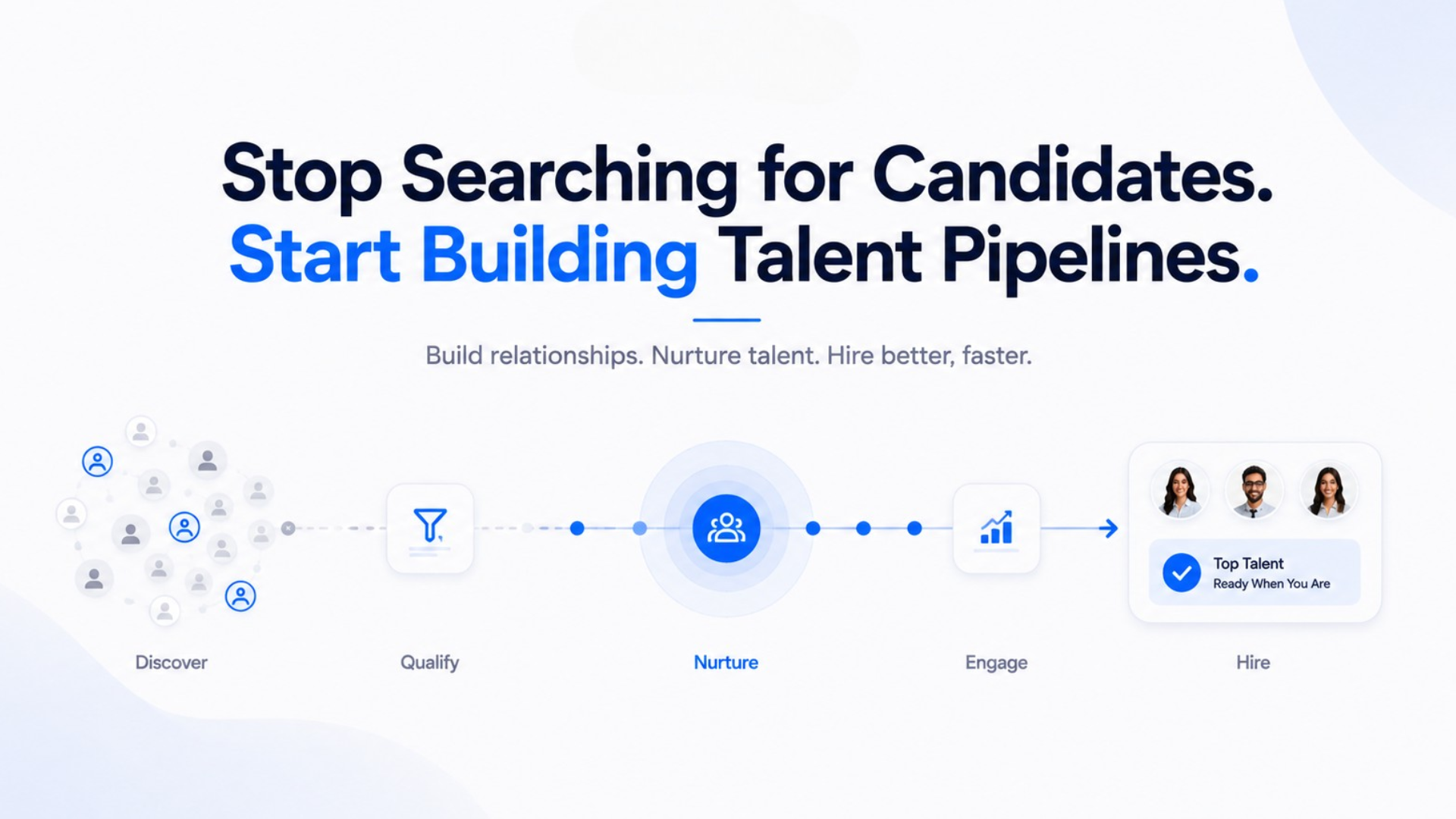
A hiring manager posts an urgent requisition on Monday morning and expects shortlisted candidates by Friday. The recruiter opens LinkedIn, runs the same boolean searches they ran last month, sends fifty identical InMails, and receives three replies by Thursday afternoon, none of whom meet the technical requirements. Sound familiar? This is the reality of search-based recruiting, an approach that treats every open role as an isolated emergency rather than the predictable outcome of a broken process. The recruiter is not failing because they lack skill. They are failing because they are using the wrong model. The most effective recruiters in the industry do not search for candidates when a role opens. They have already found them, engaged them, and warmed them up over weeks and months. They operate from a talent pipeline, a living database of pre-qualified, pre-engaged professionals who trust the recruiter and are receptive to conversations. When a requisition opens, they do not start from zero. They start from a position of abundance.
According to data compiled by LinkedIn's talent solutions research, recruiters who maintain an active candidate pipeline fill positions forty to sixty percent faster than those who rely on search-based methods alone, and their candidates are twenty percent more likely to accept an offer because the relationship pre-exists the opportunity. The talent pipeline recruiting model does not just make recruiting faster. It makes it more predictable, more scalable, and more resilient to market fluctuations. When the talent market tightens, the recruiter with a pipeline does not feel the squeeze because they have been building relationships during the good
times. When a critical role opens unexpectedly, they do not panic because they have qualified candidates who have been engaged for weeks or months. The recruitment pipeline management approach is not a tactic. It is a fundamentally different operating model for talent acquisition, and it is the single most impactful shift a recruiting team can make.
Why Search-Based Recruiting Is a Losing Game
Search-based recruiting operates on a simple but flawed premise: when a role opens, go find candidates who match the job description. This model has three structural weaknesses that no amount of optimization can fix. The first weakness is timing. Search-based recruiting depends entirely on candidate availability at the exact moment the recruiter reaches out. The best candidates, the ones who are already employed, performing well, and not actively looking, are the least likely to respond to a cold message from a recruiter they have never interacted with. According to SHRM's talent acquisition research, roughly seventy percent of the workforce is passive, meaning they are not actively applying for jobs but would consider the right opportunity. Search-based recruiting cannot reach these candidates effectively because it has no prior relationship to leverage. The recruiter is a stranger knocking on a door, and most people do not open the door for strangers, no matter how good the opportunity sounds. The proactive candidate sourcing approach reverses this dynamic entirely by establishing the relationship before the opportunity exists.
The second weakness is competition. When a recruiter searches for candidates at the moment a role opens, they are competing with every other recruiter who has the same role open at the same time. The same candidates appear in the same LinkedIn searches, the same job board results, and the same boolean strings. The candidate receives five nearly identical messages in the same week, and the recruiter who wins is usually the one who happened to reach out first or had the most recognizable employer brand, not the one who is best suited to represent the opportunity. Understanding why more tools produce the same hiring problems, adding more search tools or sending more messages does not solve this problem because the structural issue is not a lack of tools or effort. The structural issue is that search-based recruiting treats candidates as commodities to be found rather than relationships to be built, and commodity markets always favor the buyer, which in this case is the candidate.
The third weakness is scalability. A recruiter who sources from scratch for every role can handle maybe four to six active requisitions before the quality of their outreach starts to deteriorate. Each new requisition adds another round of searches, another batch of outreach messages, another set of screenings and follow-ups. The recruiter becomes a bottleneck, response times slow down, personalization suffers, and hiring managers grow frustrated. The pipeline vs reactive recruiting comparison reveals that pipeline recruiters can handle two to three times the number of active requisitions because they are not starting from zero for each one. They are mobilizing pre-existing relationships, not building new ones under time pressure. According to McKinsey's people organization insights, organizations that shift from search-based to pipeline-based recruiting reduce their cost-per-hire by thirty to forty percent while
simultaneously improving quality-of-hire metrics, because the pipeline model eliminates the most expensive part of recruiting: the repeated cost of finding and engaging candidates from scratch.
What a Talent Pipeline Actually Looks Like
A candidate pipeline strategy is not a spreadsheet of names collected from job fairs and conference badges. It is a systematically maintained network of professionals who have been identified, engaged, and nurtured over time through deliberate, value-driven interactions. The pipeline has three layers. The first layer is awareness, which includes professionals who have been identified as potential matches for future roles based on their skills, experience, and career trajectory. These candidates may not have had a direct conversation with the recruiter yet, but they are on the recruiter radar and are being monitored for engagement signals such as profile updates, publication activity, or conference attendance. The second layer is engagement, which includes candidates who have had at least one meaningful interaction with the recruiter, whether a conversation at an event, a personalized message about a relevant industry development, or a referral from a mutual connection. These candidates know who the recruiter is and have a baseline level of trust and recognition. The third layer is warmth, which includes candidates who have had multiple interactions with the recruiter, who have expressed interest in future opportunities, and who are actively receptive to being approached when a relevant role opens.
The pipeline is continuously refreshed. New candidates enter at the awareness layer, engaged candidates move into the warmth layer, and candidates who are hired or who become unavailable are moved out. The recruiter spends a portion of every working week maintaining and growing the pipeline, regardless of whether there are open requisitions. This is the critical distinction. Search-based recruiters only work when there is a role to fill. Pipeline recruiters work continuously, and their work compounds over time. According to Gartner's human resources trends analysis, recruiting teams that maintain a structured pipeline with clear stage definitions report thirty-five percent higher recruiter satisfaction and twenty percent lower turnover within their own recruiting teams, because the pipeline model eliminates the feast-or-famine stress cycle that drives recruiter burnout. The candidate engagement pipeline transforms recruiting from a stressful, reactive sprint into a sustainable, proactive practice.
How to Build a Pipeline Without an Open Requisition
The most common objection to pipeline recruiting is that recruiters do not have time to build relationships when they are already overwhelmed with open requisitions. This objection misunderstands what pipeline building actually looks like in practice. Pipeline building is not an additional task layered on top of existing work. It is a different way of doing the same work. Every time a recruiter sources a candidate for an open role and finds someone who is strong but not quite right for that specific role, that candidate enters the pipeline. Every time a candidate declines an offer because of timing or location, that candidate enters the pipeline with a
note about what would make them say yes in the future. Every time a hiring manager rejects a candidate after an interview, that candidate enters the pipeline as a pre-vetted prospect for a future role that might be a better fit. The pre-qualified candidate pool is built as a natural byproduct of the recruiting process itself, not as a separate initiative that requires additional time and budget.
Beyond capturing candidates from the existing recruiting process, the recruiter also invests deliberate time in pipeline expansion activities. These include market mapping to identify talent clusters and emerging skill pools in their domain, attending and contributing to industry events where potential candidates gather, engaging with professional communities on platforms like GitHub, Stack Overflow, and specialized Slack groups, and sharing relevant content that demonstrates expertise and keeps the recruiter visible to passive candidates. Understanding how many follow-ups one hire actually needs, the pipeline approach fundamentally reduces the number of cold follow-ups required because many of the candidates in the pipeline have already been warmed through prior interactions. According to Deloitte's talent research, recruiters who dedicate even ten percent of their weekly time to pipeline-building activities reduce their average time-to-fill by thirty percent within six months, because the pipeline starts producing candidates faster than search-based methods as it matures.
The Technology That Makes Pipelines Possible at Scale
A recruiter who manages a pipeline of three to five hundred candidates across multiple domains cannot do it with spreadsheets, notes, and memory. They need technology that tracks candidate interactions, monitors engagement signals, alerts them when a candidate becomes active or updates their profile, and surfaces the right candidates for the right roles automatically. This is where always-on talent acquisition becomes possible. AI-powered recruiting platforms can monitor thousands of candidates simultaneously, track changes in their career trajectories, detect signals that indicate openness to new opportunities, and prioritize the recruiter attention toward the candidates who are most likely to convert. The technology does not replace the recruiter relationship-building. It amplifies it by ensuring that the recruiter never misses a signal, never forgets a conversation, and never loses track of a candidate who could be perfect for a future role.
Understanding the difference between AI sourcing and AI recruiting, sourcing is the act of finding candidates, and recruiting is the act of engaging and converting them. Pipeline recruiting requires both capabilities working together in a continuous loop, not as separate, episodic activities triggered by requisitions. The AI system sources continuously, identifying and adding candidates to the pipeline based on predicted fit and future likelihood of engagement. The recruiter recruits continuously, engaging pipeline candidates with relevant, personalized interactions that build trust and maintain warmth. As explored in our analysis of what makes an AI recruiting platform agentic vs. just automated, the platforms that provide this continuous, intelligent pipeline management are fundamentally different from the ones that simply automate boolean searches and mass messaging. They are recruiting operating
systems that maintain a living, intelligent talent network on behalf of the recruiter. Understanding why some AI recruiting tools have outdated candidate data, pipeline technology is only as good as the freshness of the data it operates on, which is why the best platforms continuously refresh candidate profiles rather than relying on static snapshots.
Measuring Pipeline Health: The Metrics That Matter
Most recruiting teams measure activity metrics like messages sent, calls made, and interviews scheduled. These metrics measure effort, not effectiveness, and they encourage the kind of high-volume, low-quality outreach that makes search-based recruiting unsustainable. Pipeline recruiting requires a different set of metrics that measure the health and productivity of the candidate network itself. The first metric is pipeline size by stage. How many candidates are in the awareness, engagement, and warmth layers? A healthy pipeline has a roughly pyramid shape, with the largest number at awareness and the smallest at warmth, because not every identified candidate will become engaged, and not every engaged candidate will become warm. The second metric is pipeline velocity, which measures how quickly candidates move from one stage to the next. A pipeline where candidates sit in the awareness layer for months without progressing is not a pipeline. It is a database. The third metric is pipeline conversion rate, which measures what percentage of warm pipeline candidates become hires when a matching role opens.
The recruiting pipeline best practices include tracking these metrics weekly and using them to adjust pipeline-building activities. If awareness-to-engagement conversion is low, the recruiter needs to improve their initial outreach and value proposition. If engagement-to-warmth conversion is low, the recruiter needs to increase the frequency and quality of their touchpoints. If warmth-to-hire conversion is low, the recruiter needs to improve their understanding of candidate motivations and role requirements so that they are matching the right candidates to the right opportunities. For organizations that are evaluating an AI sourcing tool before buying, the ability to track pipeline health metrics should be a core selection criterion, because a platform that cannot measure pipeline health cannot support pipeline recruiting. And for recruiters who wonder whether AI will replace their jobs, the answer is that AI will not replace recruiters who build and maintain talent pipelines. It will replace recruiters who rely on manual search as their primary sourcing method, because pipeline recruiters with AI technology will always outperform search-based recruiters regardless of how hard the latter work.
How Huntlo.ai Turns Every Recruiter into a Pipeline Recruiter
Huntlo.ai is built around the pipeline recruiting model from the ground up. The platform does not just help you find candidates when a role opens. It maintains a continuously updated, intelligently prioritized talent pipeline that is specific to your organization, your domains, and your hiring patterns. Every candidate interaction is captured, every engagement signal is monitored, and every candidate profile is kept fresh with the latest available data. When a
requisition opens, Huntlo surfaces the most qualified, most receptive candidates from your existing pipeline first, then supplements with new candidates who match the role requirements. You never start from zero. You always start from a position of strength. The platform also supports AI recruiting for niche and technical roles, ensuring that even the most specialized talent pools are continuously monitored and maintained.
For recruiting teams that are ready to stop searching and start building, Huntlo provides the complete technology stack to make pipeline recruiting the default operating mode. The platform handles the operational complexity of pipeline management, monitoring hundreds or thousands of candidates across multiple dimensions, so that your recruiters can focus on what they do best, building relationships, understanding candidate motivations, and making great hires. And as our research on why referrals outperform cold outreach, demonstrates, the candidates who come through warm, relationship-driven channels are consistently higher quality and more likely to stay. Huntlo makes every channel a warm channel by ensuring that every candidate in your pipeline has been engaged, nurtured, and is ready to have a real conversation when the right opportunity emerges.