Marcus closes his laptop at seven thirty on a Thursday evening. His streak of sending one more follow-up before leaving the office has kept him at his desk past six every night this week. He chased a senior designer across three platforms over eleven days before she finally replied, only to say she had already accepted another offer. He chased a product manager through six increasingly desperate messages before realizing the role had been filled internally last Friday and nobody told him. He chased an engineering lead who seemed perfect on paper, exchanged four enthusiastic messages, scheduled a call for Tuesday, and then watched the candidate vanish without explanation on Monday afternoon. Three weeks of effort, dozens of messages, and zero hires to show for it. Marcus is not lazy, unmotivated, or bad at his job. He is operating without an engagement system, which means every candidate interaction depends on his personal memory, his available time, and his ability to guess when and what to send next. The result is a recruiting process that feels like sprinting on a treadmill: enormous effort, constant motion, and no forward progress.
The recruiting industry has a chasing problem. Recruiters spend the majority of their time pursuing candidates who are not responding, re-engaging candidates who have gone silent, and scrambling to maintain conversations that are decaying faster than they can sustain them. This pattern is so widespread that it has become normalized, treated as an inherent and unavoidable part of the profession rather than a symptom of a broken process. But it is neither inherent nor unavoidable. The recruiters who consistently close the most positions are not the ones who chase the hardest. They are the ones who have replaced chasing with a system, a structured, repeatable approach to candidate engagement that maintains relationships at every stage of the hiring process without requiring heroic individual effort. The difference between chasing and systematizing is not a matter of working harder or longer. It is a matter of working differently, building infrastructure that maintains engagement consistently so that the recruiter's effort is focused on high-value activities like relationship deepening, concern
resolution, and strategic positioning rather than on the repetitive, time-consuming work of trying to remember who needs to hear from you today and what you last said to them. According to SHRM's talent acquisition research, recruiters who operate within a structured engagement system close positions thirty to forty percent faster than those who rely on ad hoc chasing, because the system ensures that no candidate falls through the cracks regardless of how busy the recruiter becomes.
Why Chasing Candidates Is a Losing Game
Chasing candidates is a losing game for three structural reasons that no amount of recruiter skill or effort can overcome. The first reason is scalability. A recruiter can chase three or four candidates effectively through manual effort. They can maintain detailed mental models of each candidate's status, recall the specifics of prior conversations, and craft timely, personalized follow-ups that demonstrate genuine attention and care. At ten candidates, this becomes difficult. At twenty, it becomes impossible. The cognitive load of maintaining distinct, accurate models of twenty simultaneous candidate relationships exceeds what any individual can manage, which means the quality of engagement degrades as volume increases. The candidates who receive the worst engagement are often the ones who need it most: the high-potential prospects who are juggling multiple opportunities and evaluating each one based in part on how well the recruiter communicates. When engagement quality degrades, these candidates do not complain. They simply stop responding and accept the offer from the competitor whose system maintained consistent communication. This scalability problem is not a recruiter performance issue. It is a system design issue, and no amount of talent or effort can solve a system design problem with individual heroics.
The second reason chasing loses is timing misalignment. Chasing is driven by recruiter convenience, not candidate readiness. The recruiter follows up when they have time, which is typically between other tasks, at the end of the day, or during a brief window between meetings. The candidate's receptivity, however, follows its own rhythm, influenced by their schedule, their engagement with other opportunities, and their evolving evaluation of your role. A follow-up that arrives at the wrong moment, even if well-written and personalized, will have far less impact than a simpler message that arrives at the right moment. Manual chasing cannot reliably optimize for this timing alignment because the recruiter does not have real-time visibility into each candidate's engagement signals across all twenty simultaneous relationships. The third reason chasing loses is inconsistency. Manual follow-up is inherently inconsistent because it depends on the recruiter's current workload, energy level, and priorities, all of which fluctuate throughout the week and across hiring surges. A candidate who receives a prompt, thoughtful follow-up on Monday may receive nothing for five days because the recruiter is managing an offer crisis for another role. From the candidate's perspective, this inconsistency signals that the opportunity is not a priority, which erodes the trust and enthusiasm that drive acceptance. The recruiters who understand the difference between AI sourcing and AI recruiting recognize this immediately. Sourcing can tolerate some inconsistency because it is a volume activity. Engagement, the ongoing relationship management that converts
a candidate from contact to hire, cannot tolerate inconsistency without losing the candidate. According to McKinsey's organizational insights inconsistent follow-up is the single largest predictor of candidate dropout, more significant than compensation, role fit, or employer brand, because inconsistency directly undermines the trust that sustains the candidate's interest through a multi-week hiring process.
The Difference Between Chasing and Engaging
The distinction between chasing and engaging is not semantic. It is operational, and it determines whether recruiting is a sustainable, scalable function or a perpetual crisis management exercise. Chasing is reactive. It is triggered by the absence of a response, driven by anxiety about losing the candidate, and focused on re-initiating a conversation that has stalled. The message sent during a chase is fundamentally about the recruiter's need to re-establish contact, not about the candidate's current situation or needs. Engaging is proactive. It is triggered by candidate signals, driven by a strategy for maintaining the relationship, and focused on providing value that sustains the candidate's interest and momentum. The message sent during engagement is fundamentally about the candidate's experience, addressing their questions, providing relevant information, and demonstrating that the opportunity and the organization are worth their continued attention. The practical difference is visible in the message cadence and content. A chasing recruiter sends three messages in two days when they realize the candidate has gone silent, then goes quiet for a week. An engaging system sends a steady, calibrated stream of communication that maintains the candidate's connection without creating pressure or noise.
The shift from chasing to engaging also changes the recruiter's relationship to their own work. Chasing is exhausting because every interaction feels high-stakes and uncertain. The recruiter does not know whether the candidate is still interested, whether the message will land, or whether the next follow-up will be the one that re-opens the conversation. This uncertainty creates a constant low-level stress that compounds across multiple candidates and erodes the recruiter's ability to do their best work. Engaging, by contrast, is predictable and sustainable because the system provides visibility into each candidate's status, signals when intervention is needed, and ensures that routine communication happens automatically. The recruiter's energy is reserved for the moments that genuinely require human judgment: navigating a candidate's concerns about a career transition, providing nuanced information about team culture that an AI cannot authentically convey, or building the kind of rapport that converts a good candidate into a committed hire. This is what an agentic AI recruiting platform actually delivers. It does not replace the recruiter. It creates the conditions under which the recruiter can do their highest-value work consistently, rather than spending their time on the mechanical work of remembering who to follow up with and what to say. The recruiters who have made this shift report not only better hiring outcomes but significantly lower burnout and higher job satisfaction, because their days are spent on the parts of recruiting that drew them to the profession in the first place: building relationships, solving problems, and connecting great people with great opportunities.
What a Candidate Engagement System Actually Looks Like
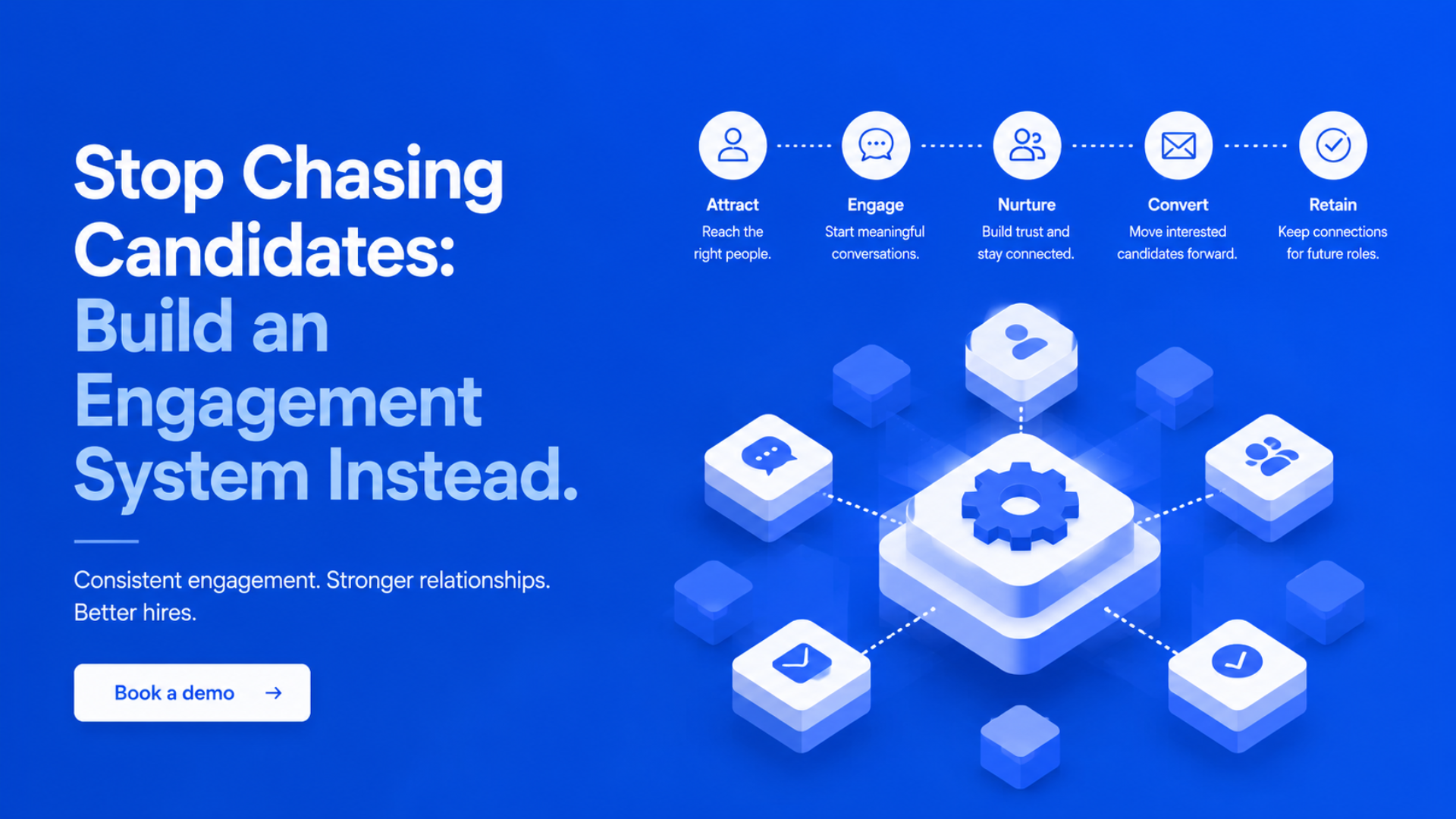
A candidate engagement system is not a single tool or a simple automation sequence. It is an integrated set of capabilities that work together to maintain personalized, timely communication with every candidate at every stage of the hiring process. The foundation of the system is a unified candidate profile that aggregates all interaction data: every message sent and received, every email opened and when, every LinkedIn profile view, every application page visit, and every response to prior outreach. This profile is not a static record. It is a living, continuously updated representation of each candidate's engagement status, interest trajectory, and communication preferences. Without this foundation, any engagement system is operating with incomplete information, and incomplete information leads to irrelevant follow-ups that damage rather than enhance the relationship. Teams that have experienced the frustration of outdated candidate data in AI tools understand how critical data freshness is. A system that sends a follow-up referencing a conversation from three jobs ago, or suggesting a role the candidate has already explicitly declined, does not look intelligent. It looks broken, and it erodes trust faster than no follow-up at all.
On top of this data foundation, the engagement system has three operational layers. The first layer is signal detection. The system continuously monitors each candidate's engagement signals, email opens, response patterns, platform activity, and time between interactions, and uses these signals to classify the candidate's current engagement level: high, stable, declining, or disengaged. This classification drives every downstream decision about timing, channel, and content. A candidate classified as high engagement receives different communication than one classified as declining, and the system adjusts these classifications in real time as new signal data arrives. The second layer is message generation. Based on the candidate's engagement classification, interaction history, and career profile, the system generates a follow-up recommendation that includes the suggested timing, channel, and draft content. The recommendation is grounded in the specific context of the candidate's journey, referencing prior conversations, addressing expressed concerns, and connecting the opportunity to the candidate's stated career priorities. The third layer is execution and learning. The recruiter reviews the recommendation, refines it if needed, and sends it. The system then tracks the outcome, did the candidate respond, how quickly, with what sentiment, and feeds this data back into the signal detection layer, continuously improving the accuracy of its recommendations. This feedback loop is what makes the system intelligent over time, learning from every interaction to deliver better recommendations for the next one. According to LinkedIn's recruiting resources organizations with fully operational engagement systems that include all three layers report fifty to sixty-five percent improvements in candidate response rates and thirty to forty percent reductions in time to fill, because the system maintains consistent, relevant communication at every stage rather than depending on the recruiter's available time and memory.
The Components of a High-Performing Engagement System
Building a high-performing engagement system requires getting five components right. The first component is signal awareness. The system must be able to detect and interpret candidate engagement signals across multiple channels and update its understanding of each candidate's status in real time. This means not just tracking whether an email was opened, but tracking when it was opened, how many times, whether the candidate clicked any links, and whether their response time is getting faster or slower compared to their baseline. These granular signals enable the system to distinguish between a candidate who is engaged but busy and a candidate who is disengaging, two situations that look identical without signal depth but require very different follow-up approaches. The second component is contextual memory. The system must maintain a detailed, accurate record of every candidate interaction and use this record to generate follow-up recommendations that reference specific prior conversations, concerns, and interests. This is what transforms a follow-up from a generic check-in into a genuinely personal communication that demonstrates the recruiter's attentiveness and the organization's investment in the individual candidate.
The third component is adaptive cadence. The system must be able to adjust the frequency, timing, and intensity of follow-ups based on each candidate's individual engagement trajectory rather than applying a fixed schedule. A highly engaged candidate moving quickly through the process may need frequent, substantive touchpoints. A candidate in the early exploration phase may need lighter, lower-pressure communication that maintains connection without creating urgency they are not ready for. Understanding how many followups one hire actually needs is important, but the number varies by candidate, and an adaptive system determines the right cadence for each individual rather than applying a one-size-fits-all rule. The fourth component is channel intelligence. Different candidates prefer different communication channels, and the same candidate may prefer different channels at different stages of the process. A candidate who responds best to email during initial outreach may prefer a quick WhatsApp message for scheduling logistics and a LinkedIn message for substantive conversations about role scope. The system should track channel preferences and optimize accordingly. The fifth component is recruiter empowerment. The system must enhance the recruiter's capabilities, not replace them. Every AI-generated recommendation should be reviewable and editable, and the system should clearly present the reasoning behind each recommendation so the recruiter can make informed decisions about when to follow the system's guidance and when to override it. The recruiters asking whether AI will replace their jobs should note that the most effective engagement systems are designed around the principle of augmented intelligence, where the AI handles data processing, signal detection, and draft generation while the recruiter handles judgment, empathy, and relationship management. This division of labor is what makes the system both scalable and genuinely personal.
From Reactive to Proactive: Making the Transition
Transitioning from a chasing model to a systematic engagement model does not require abandoning everything you are currently doing. It requires layering intelligence on top of your existing process in a way that immediately reduces the manual burden while improving
consistency and quality. The first step is to audit your current engagement gaps. For the next two weeks, track every candidate interaction and every missed follow-up. Document who needed to hear from you, when they needed to hear from you, and when they actually heard from you. The gap between need and delivery is the waste that an engagement system eliminates. Most recruiters who conduct this audit discover that twenty to thirty-five percent of their follow-ups are delayed beyond the optimal window, and that the delay is concentrated in the highest-workload periods when the most candidates need attention. This concentration effect means that the candidates who need the best engagement, those in active, competitive hiring processes, are the ones most likely to receive delayed, generic, or missed follow-ups. The second step is to identify the highest-impact automation opportunities. For most teams, the first follow-up after initial contact, the follow-up after the screening call, and the follow-up between interview stages are the three touchpoints with the greatest impact on candidate progression. Automating these three touchpoints with AI-powered personalization will produce immediate, measurable improvements in pipeline conversion rates.
The third step is selecting the right technology. This is where many teams make mistakes, deploying a tool that automates execution without providing the intelligence that makes automation effective. Teams that add simple automation tools to a fundamentally manual process often discover they have more tools but the same hiring problems, a pattern explored in the analysis of organizations with more tools but the same hiring problems. The technology you select should provide signal awareness, contextual memory, and adaptive cadence as core capabilities, not add-on features. When evaluating platforms, use the framework for evaluating an AI sourcing tool before buying adapted specifically for engagement capabilities. Ask whether the platform can detect real-time engagement changes, generate contextually personalized recommendations, and adjust cadence based on individual candidate behavior. If the answer to any of these is no, the platform is an automation tool, not an engagement system, and it will not solve the chasing problem. The fourth step is phased implementation. Start with the highest-impact touchpoints, measure the results, refine the approach, and expand. According to Gartner's HR trends research organizations that implement engagement systems incrementally, proving value at each stage before expanding, achieve full adoption three times faster than those that attempt a complete process overhaul. The fifth step is to redefine the recruiter's role within the system. Once the system is handling routine communication, signal detection, and draft generation, the recruiter's role shifts from message sender to relationship strategist, focused on the high-judgment, high-impact activities that genuinely require human expertise. This role redefinition is not a threat to recruiters. It is a liberation, freeing them from the mechanical work that causes burnout and redirecting their energy toward the work that produces satisfaction and results.
The Data That Proves Systems Beat Hustle
The evidence that engagement systems outperform chasing is now substantial and consistent across organization sizes, industries, and geographies. The most comprehensive data point comes from comparing hiring outcomes before and after engagement system implementation.
Organizations that deploy AI-powered engagement systems see the following pattern: offer acceptance rates increase by fifteen to thirty percent, because candidates who have received consistent, personalized communication throughout the process are significantly more likely to accept when the offer arrives. Time to fill decreases by twenty to thirty-five percent, because faster, more consistent follow-up eliminates the gaps that extend hiring timelines. Candidate dropout rates between stages decrease by forty to sixty percent, because the engagement the system maintains prevents the disengagement that leads to ghosting and withdrawal. And recruiter capacity increases by thirty to fifty percent, because the time previously spent on manual follow-up is freed for higher-value activities. These are not theoretical projections. They are the measured outcomes reported by organizations that have made the transition from chasing to systematized engagement. The compounding nature of these improvements is particularly significant. Faster closes mean more recruiter capacity for the next round of hiring. Higher acceptance rates mean less re-sourcing and more time invested in relationship building. Lower dropout rates mean fewer wasted interviews and less hiring manager frustration. These compounding benefits create a virtuous cycle where the system gets more effective over time, generating better data, more accurate signal detection, and more refined recommendations with every hiring cycle.
The impact is especially pronounced for teams hiring for niche and technical roles, where the candidate pool is small, competition is intense, and the cost of losing a single engaged candidate is disproportionately high. In these markets, the difference between a system that maintains engagement consistently and one that allows gaps is the difference between closing a critical role in four weeks and watching it remain open for four months. This is also why referred candidates have historically outperformed cold-sourced candidates. Referrals arrive with built-in engagement, the referring employee maintains the candidate's connection to the opportunity between recruiter touchpoints, creating a de facto engagement system powered by human relationships. The data shows that referrals outperform cold outreach because the engagement is consistent, personalized, and maintained by someone who has context about the candidate's priorities. An AI-powered engagement system aims to give every candidate this referral-quality experience, regardless of how they entered the pipeline. EY's technology insights report that enterprises with mature engagement systems are achieving twenty to thirty percent lower cost per hire alongside higher close rates, because the efficiency gains from systematic engagement compound across the entire recruiting operation. Deloitte's talent research concludes that the shift from chasing to systematized engagement is not an incremental improvement. It is a fundamental transformation of how recruiting operates, and the organizations making this transition earliest are building a competitive advantage in talent acquisition that will be very difficult for late adopters to overcome. The recruiters who embrace this shift are not replacing their craft with technology. They are giving their craft the infrastructure it needs to operate at its full potential.
Every hour you spend chasing a candidate who has already disengaged is an hour you are not spending with a candidate who is ready to move forward. Every generic follow-up you send because you do not have time to personalize it is a signal to the candidate that they are one of
many, not the one you want. Every gap in communication between stages is an opening for a competitor who moves faster and more consistently. Chasing is not a strategy. It is a symptom of a process that lacks the infrastructure to maintain engagement at the scale modern recruiting demands. The alternative is not working harder or longer. It is building a system, a candidate engagement system that uses AI-powered signal detection, contextual personalization, and adaptive cadence to maintain personalized, timely communication with every candidate at every stage. Huntlo.ai provides this system: signal awareness that detects engagement changes in real time, contextual memory that makes every follow-up genuinely personal, and adaptive cadence that adjusts to each candidate's individual rhythm. Stop chasing. Start engaging. Start closing. Start with Huntlo.