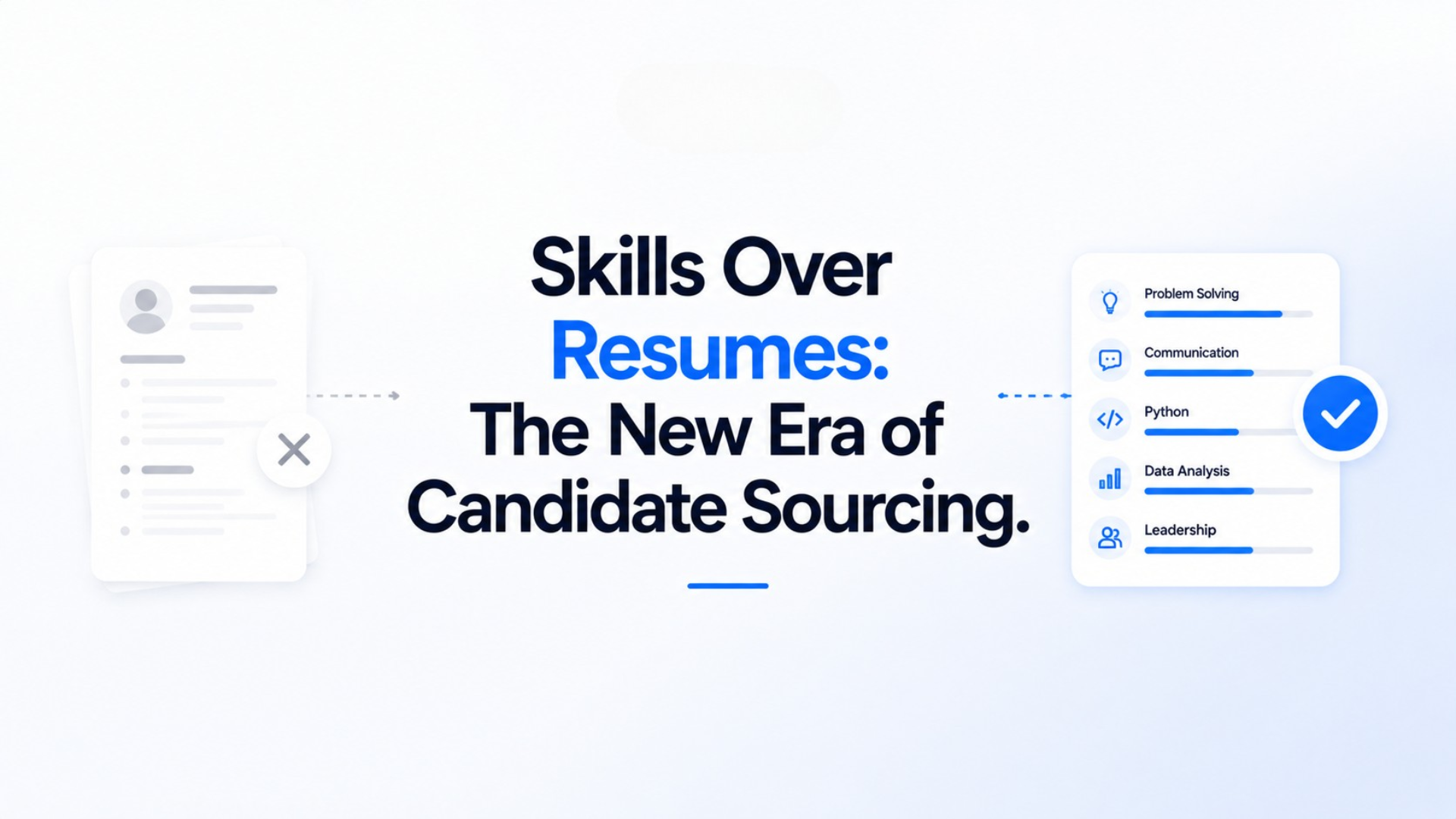
The resume is one of the most deeply entrenched artifacts in the hiring process, and it is also one of the most misleading. A two-page document listing job titles, employers, and dates tells you where someone has been, but it tells you remarkably little about what they can actually do. Two candidates with identical resumes can have vastly different capabilities, and the candidate whose resume looks less impressive on paper may be the one who possesses the exact combination of skills and problem-solving ability your team needs. This disconnect between resume presentation and actual capability has always existed, but it has become critically important as the pace of skill evolution accelerates and the gap between formal credentials and practical ability widens. According to SHRM's talent acquisition research, a growing number of organizations are shifting toward skills-based hiring precisely because the resume-first approach systematically filters out high-potential candidates who lack the right credentials but possess the right capabilities.
The shift from resumes to skills is not just a philosophical preference. It is a strategic necessity driven by changes in the talent market, the nature of work, and the capabilities of AI-powered recruiting technology. Skills evolve faster than job titles. The skills required for a data engineering role today are substantially different from what they were three years ago, and they will be different again three years from now. A resume captures a historical snapshot of someone's job titles, but it cannot capture the dynamic, continuously evolving skill profile that actually determines a candidate's ability to contribute. AI-powered talent intelligence platforms, by contrast, can analyze a candidate's actual work product, professional activity, and learning patterns to construct a real-time skills profile that is far more accurate and current than any resume. This article explores why the skills-over-resumes paradigm is gaining momentum, what it looks like in practice, and how organizations can make the transition.
Why Resumes Are a Poor Predictor of Actual Capability
The fundamental problem with resumes is that they are self-reported summaries designed for persuasion, not accuracy. Candidates optimize their resumes to pass through screening processes, which means they emphasize credentials, titles, and keywords that they believe will trigger a match while downplaying or omitting information that they think will not help. This optimization creates a systematic bias: the candidates who appear strongest on paper are often the ones who are best at resume writing, not the ones who are best at the work itself. A candidate who has held the title 'Senior Software Engineer' at a well-known company will always look more impressive on a resume than a candidate who has been building production systems as a lead developer at a lesser-known startup, even if the latter has deeper technical expertise and more relevant experience. McKinsey's organizational insights have found that traditional resume screening processes filter out up to fifty percent of high-potential candidates because their backgrounds do not align with the specific credential and title patterns that screening algorithms are designed to detect.
The resume format also creates artificial constraints on how candidate value is communicated. A resume is a linear, chronological document that forces complex professional capabilities into a rigid structure of job titles and bullet points. But real capability is not linear. A product manager who has deep expertise in pricing strategy may have developed that expertise across multiple roles, companies, and side projects that do not fit neatly into any single resume bullet point. A designer who has mastered interaction design through years of iterative work may have no formal design education and a job title that says 'UI Developer.' The resume format obscures these realities because it was designed for an era when hiring was about matching job titles to job descriptions, not about mapping complex skill combinations to complex role requirements. This is especially problematic for niche and technical roles where the most important capabilities are often the ones that are hardest to express in traditional resume language.
There is also a significant diversity and equity problem embedded in resume-based hiring. Research consistently shows that resume screening, whether performed by humans or keyword-matching algorithms, introduces biases related to name, education, employment gaps, and career paths that disproportionately disadvantage qualified candidates from non-traditional backgrounds. Candidates who are career changers, self-taught, or returning from employment gaps often have resumes that look weaker on paper despite possessing the exact skills the role requires. Skills-based sourcing bypasses these biases by evaluating what candidates can do rather than where they have been or what their background looks like. LinkedIn's recruiting resources report that organizations implementing skills-based screening see measurable improvements in candidate diversity without any decrease in quality-of-hire metrics, because they are evaluating a broader and more representative talent pool.
What Skills-Based Sourcing Actually Looks Like
Skills-based sourcing replaces the resume-match workflow with a skill-match workflow. Instead of posting a job description and screening resumes for matching keywords, the
recruiter defines the role as a set of required and preferred skills, and an AI platform identifies candidates whose verified capabilities align with those requirements. The word 'verified' is critical here. In a skills-based model, a skill claim is not taken at face value because the candidate listed it on a resume. It is inferred from observable evidence: code repositories, published work, project outcomes, peer endorsements, certification completion, conference presentations, and professional contributions that demonstrate the skill in action. This evidence-based approach produces a fundamentally different and more accurate picture of candidate capability than resume self-reporting.
An agentic AI recruiting platform takes this further by continuously updating each candidate's skill profile as new evidence becomes available. When a candidate contributes to a new open-source project, publishes an article, or completes a certification, the platform incorporates that signal into the candidate's profile in real time. This means the talent intelligence is always current, which addresses one of the most persistent complaints about traditional candidate databases: that the information is outdated by the time the recruiter sees it. Understanding why some AI recruiting tools have outdated candidate data is essential for evaluating any skills-based sourcing solution, because the value of a skills profile is directly proportional to its freshness. A skills profile that was accurate six months ago may be significantly less accurate today, especially in fast-moving technical domains where professionals are constantly acquiring new capabilities.
The practical workflow for a recruiter using skills-based sourcing is also fundamentally different from the traditional resume-screening process. Instead of receiving a stack of applications and manually reviewing each one, the recruiter accesses a pre-ranked list of candidates scored by skill-fit, engagement likelihood, and overall match quality. The recruiter can then drill into each candidate's profile to see the specific evidence behind each skill assessment: which projects demonstrate the skill, how recently it was used, how it compares to the candidate's other capabilities, and how it maps to the role requirements. This evidence layer transforms the recruiter from a screener into an evaluator, spending their time on judgment calls rather than data gathering. The distinction between AI sourcing and AI recruiting becomes particularly relevant here: skills-based sourcing is about identifying candidates based on verified capabilities, while the recruiting function engages and converts those candidates once identified.
How AI Identifies Skills That Resumes Miss
One of the most powerful capabilities of AI-powered skills-based sourcing is the ability to identify skills that candidates have not explicitly claimed. This skill inference capability works by analyzing the actual work a candidate has produced and comparing it against comprehensive skill taxonomies. For example, an AI system analyzing a software engineer's GitHub contributions can infer skills in distributed systems, API design, performance optimization, and team collaboration even if the candidate has never listed those skills on their resume or LinkedIn profile. It can assess the complexity and quality of the work, not just its
existence, to distinguish between a candidate who has superficial exposure to a technology and one who has deep, production-grade expertise.
This inference capability extends well beyond technical roles. For product managers, AI can analyze product launches, market entries, and growth metrics from their tenure at previous companies to assess skills in go-to-market strategy, pricing, user research, and cross-functional leadership. For sales professionals, AI can analyze deal sizes, sales cycle lengths, and industry verticals to assess skills in enterprise selling, negotiation, and account development. The common thread is that AI evaluates evidence of capability rather than relying on self-reported claims. Gartner's HR trends research identifies skill inference as one of the most impactful capabilities in next-generation recruiting technology, because it dramatically expands the accessible candidate pool by including professionals whose capabilities are demonstrated through their work rather than documented on their resumes.
Skill inference also solves the adjacency problem that plagues traditional keyword matching. Many of the best hires come from candidates whose existing skills are adjacent to rather than identical with the role requirements. A candidate with deep expertise in relational database optimization may be an exceptional fit for a role requiring NoSQL database experience, because the underlying skills of query optimization, indexing strategy, and data modeling transfer across database paradigms. A resume-based screen would reject this candidate because the keyword does not match. An AI-powered skills assessment would recognize the adjacency and flag the candidate as a high-potential match. This is one reason why referrals outperform cold outreach in quality-of-hire metrics: referrers often recommend candidates with adjacent skills who would not survive a keyword screen but who excel in the actual role. AI skill inference replicates this pattern-recognition capability at scale.
Overcoming the Transition Challenges
Moving from resume-based to skills-based sourcing is not without challenges. The most significant barrier is usually organizational inertia. Hiring managers, recruiters, and HR leaders have decades of experience with resume-centric processes, and changing established workflows requires deliberate effort. The first practical step is to pilot skills-based sourcing on a specific role or team where the limitations of resume screening are most acute. For many organizations, this means starting with hard-to-fill technical roles where the gap between resume credentials and actual capability is largest and the impact of better hiring is most visible. A successful pilot creates internal case studies and converts skeptics into advocates, making broader adoption much easier.
The second challenge is data infrastructure. Skills-based sourcing requires rich, multi-source candidate data that goes far beyond what resumes provide. Organizations need access to professional platforms, open-source repositories, publication databases, and other signals that AI platforms use to construct skill profiles. Building this data infrastructure internally is prohibitively expensive for most organizations, which is why adopting an AI-powered talent intelligence platform is the most practical path. However, organizations that simply add another
tool to an already fragmented stack often find they have more tools but the same hiring problems. The key is to adopt an integrated platform that combines data aggregation, skill inference, candidate ranking, and outreach intelligence in a single workflow rather than scattering these capabilities across multiple point solutions. Deloitte's talent research emphasizes that the organizations seeing the greatest ROI from skills-based hiring are those that invest in integrated platforms rather than collections of disconnected tools.
The third challenge is retraining recruiters and hiring managers to evaluate candidates based on skills evidence rather than resume credentials. This requires a mindset shift from 'does this candidate's background look right on paper?' to 'does this candidate's demonstrated capability match what we need?' It also requires new evaluation frameworks and interview processes that assess skills directly rather than inferring them from career history. Training programs should include hands-on practice with AI-generated skill profiles, so recruiters learn to interpret skill evidence, assess inference confidence, and identify gaps that require deeper investigation. Evaluating an AI sourcing tool should include assessing the quality of its skill inference outputs, the transparency of its evidence presentation, and the availability of training and support to help recruiting teams make the transition effectively.
The Competitive Advantage of Skills-First Hiring
Organizations that adopt skills-based sourcing gain a compounding competitive advantage that is difficult for resume-dependent competitors to replicate. The first advantage is access. Skills-based platforms can identify candidates who are invisible to resume-based search, including career changers, self-taught professionals, and experts whose capabilities are demonstrated through work product rather than job titles. This dramatically expands the accessible candidate pool, particularly for roles where talent is scarce. The second advantage is accuracy. Evidence-based skill assessment produces more accurate candidate evaluations than resume screening, which means better hiring decisions, higher quality-of-hire, and lower early-tenure turnover. The third advantage is speed. Because skills-based platforms pre-rank candidates and provide evidence-based profiles, recruiters can move from identification to outreach much faster than in a resume-screening workflow.
The fourth advantage is adaptability. In a skills-based model, when role requirements change, the platform can immediately re-rank and re-surface candidates based on the updated skill profile, without requiring a new job posting and a fresh round of resume screening. This agility is critical in fast-moving markets where role definitions evolve rapidly and the ability to pivot quickly is a competitive asset. The recruiters who understand how many followups one hire needs know that engagement efficiency matters, and skills-based sourcing makes every touchpoint more effective by ensuring the recruiter is engaging candidates who are genuinely well-matched rather than casting a wide net based on imperfect resume signals.
The recruiters who worry about whether AI will replace their jobs should focus on a more relevant question: what happens to recruiters who do not develop skills-based sourcing capabilities while their competitors do? The answer is straightforward. Recruiters who can evaluate
candidates based on demonstrated capability rather than resume credentials will produce better hiring outcomes, earn more trust from hiring managers, and build stronger candidate relationships than those who remain dependent on the traditional resume-screening paradigm. AI is not replacing the recruiter. It is giving the best recruiters a decisive advantage over the rest. Huntlo.ai is built for this new era of skills-based sourcing. Its intelligence engine constructs evidence-based skill profiles for millions of candidates, identifies matches that resume screens would miss, and gives recruiters the tools to engage the right talent with the right message at the right time. Whether you are hiring for specialized technical roles or building a more diverse and capable workforce, Huntlo's skills-first approach means you stop hiring resumes and start hiring capability. The era of skills over resumes is not coming. It is here.