Sarah Chen, a talent acquisition lead at a midsize technology company, arrived at the conference room at two in the afternoon for a scheduled interview with a senior product manager candidate. The candidate had confirmed the interview twice: once when the initial invitation arrived and again twenty-four hours before the scheduled time. Sarah had prepared a structured interview guide. The hiring manager, a director of product, had cleared her entire afternoon to accommodate the ninety-minute session. Two senior engineers had rescheduled their one-on-one meetings with their own teams to serve as technical panelists. At two fifteen, with no candidate present, Sarah sent a text message to the candidate phone. No response. At two thirty, she called. The call went to voicemail. By three o clock, the conference room was empty, the panelists had returned to their desks frustrated, and the hiring timeline for a critical role had just extended by at least two more weeks. Sarah spent the next hour composing a professional follow-up email that she knew would probably never receive a response. The candidate had not declined the interview. The candidate had simply not shown up, and the scheduling process that produced this outcome had cost the organization thousands of dollars in wasted time and an immeasurable amount of hiring manager trust.
The Real Cost of Interview No-Shows
Sarah Chen, a talent acquisition lead at a midsize technology company, arrived at the conference room at two in the afternoon for a scheduled interview with a senior product manager candidate. The candidate had confirmed twice: once when the invitation was sent and again twenty-four hours before the interview. The hiring manager, a director of product, had cleared her afternoon calendar. Two senior engineers had moved their one-on-one meetings to make room. At two fifteen, Sarah sent a follow-up message. No response. At two thirty, she called the candidate directly. Voicemail. The candidate had simply not shown up, and had not
communicated in any way. Research published by SHRM on candidate no-show rates has found that interview no-shows affect approximately ten to fifteen percent of all scheduled interviews across industries, with rates climbing to twenty to twenty-five percent for high-demand technical roles and senior positions. Each no-show represents a measurable financial cost in wasted interviewer time, lost recruiting capacity, and delayed hiring timelines that compound across the entire recruitment pipeline.
The financial impact of a single no-show extends well beyond the hours lost on the day of the missed interview. Consider the full cost chain. The recruiter spent time sourcing the candidate, conducting initial outreach, scheduling the interview, and preparing the hiring manager. The hiring manager spent time reviewing the candidate profile and preparing interview questions. Two or three additional panelists each invested thirty to sixty minutes in preparation. The recruiter operations team invested time coordinating calendars, sending confirmations, and managing logistics. When the candidate fails to appear without notice, all of this invested time is wasted and cannot be recovered. But the cost does not stop there. The hiring timeline for that role extends by the time required to identify and schedule an alternative candidate, which typically adds one to three weeks to the time-to-fill. During that extended period, the existing team absorbs additional workload, project timelines slip, and the organization continues to operate below capacity. For organizations that track these costs rigorously, the fully loaded cost of a single interview no-show, including all preparatory work, interviewer time, and timeline impact, routinely exceeds two thousand to four thousand dollars for professional roles.
The cumulative impact is staggering. An organization hiring two hundred people per year with a twelve percent no-show rate and an average of two interview rounds per hire experiences approximately forty-eight no-shows annually. At a conservative cost of three thousand dollars per no-show, the annual cost of interview no-shows exceeds one hundred and forty thousand dollars. For larger organizations or those hiring for roles with multiple interview rounds, the figure can easily reach several hundred thousand dollars per year. This is a cost that is almost never measured, almost never managed, and almost entirely preventable. The key insight is that interview no-shows are not random events caused by irresponsible candidates. They are predictable outcomes of scheduling processes that create the conditions for no-shows to occur. Long gaps between scheduling and interview, inflexible time slots, lack of candidate engagement between confirmation and interview, and cumbersome rescheduling processes all contribute to no-show rates. An agentic AI recruiting platform that addresses these scheduling process failures can reduce no-show rates by fifty to seventy percent, recovering tens or hundreds of thousands of dollars annually in what is essentially pure waste.
Why Scheduling Quality Determines No-Show Rates
The relationship between scheduling quality and no-show rates is supported by extensive research and consistent operational data. The single strongest predictor of interview no-shows is the interval between scheduling confirmation and the interview date. When interviews are scheduled more than ten business days in advance, no-show rates increase dramatically
because candidates have more time to receive competing offers, lose interest, or simply forget about the commitment. Research from McKinsey on candidate decision-making timelines has found that candidate commitment to an interview decays at a measurable rate over time, with the steepest drop occurring between days seven and fourteen after confirmation. This means that scheduling speed is not just a convenience metric. It is a direct lever on no-show rates, and organizations that schedule interviews within three to five business days of candidate engagement consistently report no-show rates fifty to sixty percent lower than those with average scheduling intervals of ten days or more.
The second strongest predictor is scheduling flexibility. When candidates are given rigid time slots that do not accommodate their actual availability, particularly for candidates who are currently employed and must interview during limited windows, the likelihood of no-shows increases substantially. Candidates who feel forced to accept an inconvenient slot often experience resentment or scheduling anxiety that reduces their commitment to attending. For niche or technical roles where candidates are typically employed and interviewing with multiple employers simultaneously, scheduling inflexibility is especially damaging because these candidates have competing demands on their time and will prioritize interviews with organizations that accommodate their schedules. The no-show in these cases is not a character flaw. It is a rational response to a scheduling process that failed to respect the candidate time constraints. When scheduling systems offer multiple options, allow easy self-rescheduling, and present times that genuinely align with candidate availability, no-show rates decline significantly because the candidate feels ownership over the scheduled time rather than feeling imposed upon.
The third predictor is communication quality between scheduling and interview. When candidates receive a calendar invitation and hear nothing until the day of the interview, the lack of communication creates ambiguity about whether the interview is still happening, whether the panel composition has changed, or whether the organization is still interested. This ambiguity erodes commitment and increases the likelihood of no-shows, particularly for candidates who are juggling multiple interview processes. The problem is compounded when scheduling systems rely on outdated candidate or interviewer data that produces incorrect calendar invitations or sends confirmations to outdated contact information. Candidates who receive inaccurate logistics information may simply conclude that the process is disorganized and disengage. The most effective approach to reducing no-shows through communication is a structured cadence of touchpoints between scheduling confirmation and interview: a confirmation message immediately after scheduling, a preparation guide three to five days before the interview, a logistical reminder twenty-four hours before, and a same-day check-in one to two hours before the scheduled time. Each touchpoint reinforces the candidate commitment and provides an opportunity to address any concerns or scheduling conflicts before they result in a no-show.
How Intelligent Scheduling Reduces No-Shows Proactively
Intelligent scheduling systems reduce no-shows not by responding to them after they occur
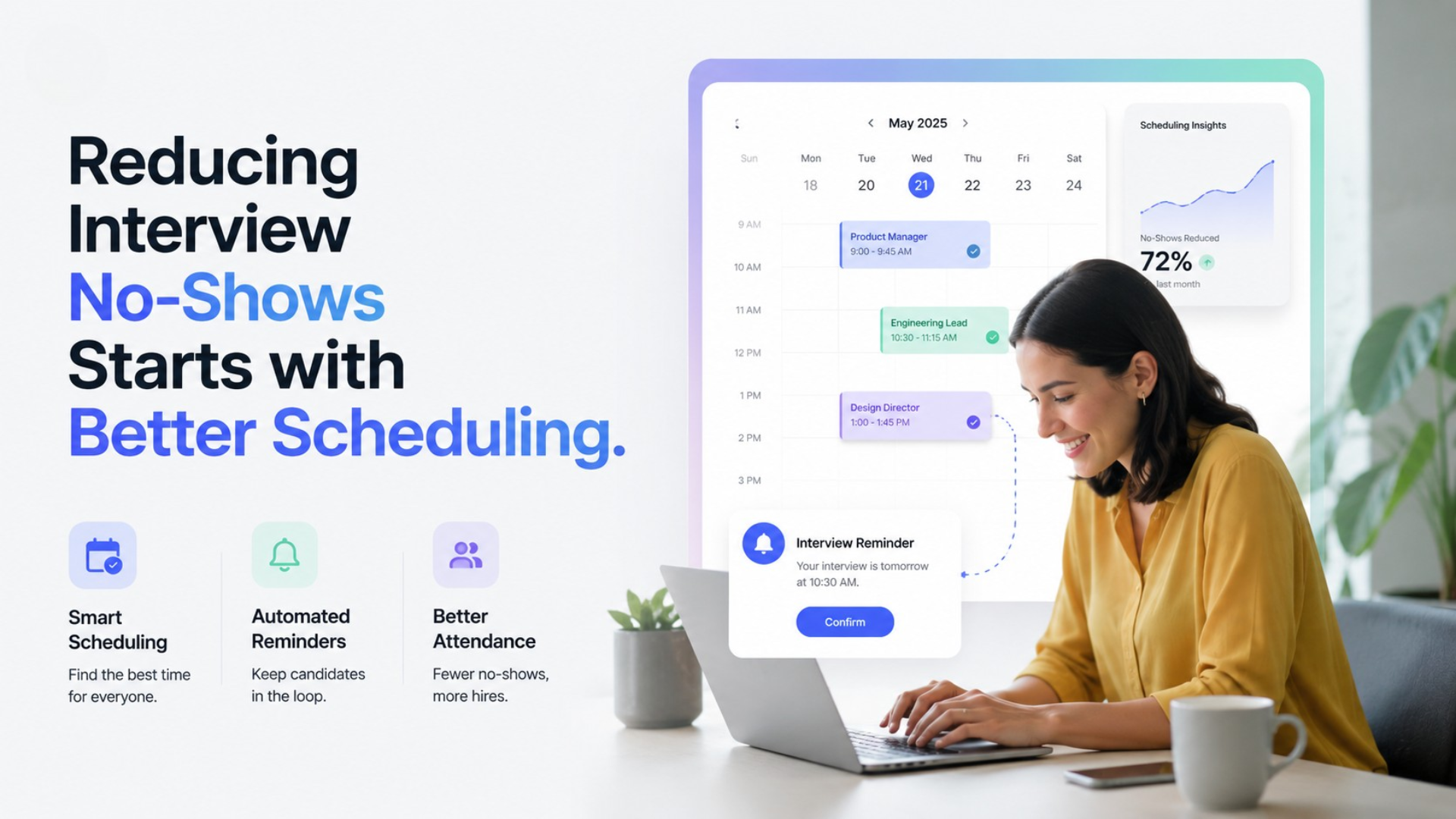
but by preventing the conditions that cause them. The first prevention mechanism is speed. AI scheduling systems that connect to real-time calendar data and optimize across multiple participants can propose and confirm interview slots within hours of candidate engagement rather than days or weeks. This speed eliminates the decay period during which candidate commitment erodes and competing opportunities emerge. According to LinkedIn talent solutions research, organizations that implement AI scheduling with average time-to-schedule under three business days report no-show rates of five to seven percent, compared to fifteen to twenty percent for organizations with average scheduling times of ten days or more. The difference is not attributable to candidate quality or role attractiveness. It is entirely attributable to the speed with which the scheduling process converts candidate interest into a confirmed, imminent interview that the candidate is unlikely to forget or deprioritize.
The second prevention mechanism is candidate-controlled scheduling. When candidates can view available time slots and select the option that works best for their schedule, they develop a stronger sense of commitment to the appointment because they chose it themselves rather than having it assigned. This psychological principle, known as the endowment effect, has been well documented in behavioral economics and applies directly to interview scheduling. Candidates who self-schedule are significantly less likely to no-show than candidates who are assigned a time by a recruiter, even when the actual time slot is identical. The practical implication is that scheduling systems should offer candidate-facing interfaces that present validated options and allow the candidate to confirm or propose alternatives without requiring a round of back-and-forth communication. This capability is particularly valuable when managing follow-up scheduling between interview rounds, because the time pressure is higher and the candidate engagement level is a critical variable in whether the candidate continues in the process. Research on why referrals outperform cold outreach has found that the same principle of candidate autonomy and respect applies across the entire hiring journey: when candidates feel that the process respects their time and preferences at every touchpoint, their commitment to completing the process strengthens rather than erodes.
The third prevention mechanism is intelligent rescheduling that removes the stigma and friction from changing an interview time. Many no-shows are not intentional abandonments. They are last-minute conflicts that the candidate could have communicated if rescheduling were easy and penalty-free. When a candidate has a sudden work emergency, a child care disruption, or a technology failure, and the only option is to call the recruiter, explain the situation, and request a new time, many candidates simply do not follow through because the process feels awkward and burdensome. AI scheduling systems that offer one-click rescheduling, available twenty-four hours a day, eliminate this friction entirely. The candidate can reschedule at eleven in the evening when they realize they have a conflict the next morning, without needing to wait for business hours or compose an explanation. The system automatically evaluates new availability across all panelists and confirms the new time. This capability transforms what would have been a no-show into a rescheduled interview, preserving the candidate relationship and the recruiting investment. The distinction between systems that automate scheduling and systems that intelligently prevent no-shows through speed, autonomy, and friction-free rescheduling is the same distinction explored in analyses of the difference
between AI sourcing and AI recruiting, where the most impactful tools are those that proactively optimize outcomes rather than reactively executing tasks.
Building a Low No-Show Scheduling Process
Building a scheduling process that systematically minimizes no-shows requires attention to four design elements. The first is scheduling speed, which means reducing the average time from candidate engagement to confirmed interview slot to five business days or less. This requires real-time calendar integration, multi-participant availability optimization, and automated conflict resolution. For organizations evaluating scheduling solutions, guidance on how to evaluate an AI sourcing tool before buying recommends measuring time-to-schedule as a primary evaluation criterion, because it is the single strongest operational lever on no-show rates. Organizations should set explicit targets, such as scheduling ninety percent of first-round interviews within five business days of candidate engagement, and measure performance against those targets weekly. According to Gartner research on recruiting process optimization, organizations with formal scheduling speed targets and weekly performance measurement achieve thirty to forty percent lower no-show rates than organizations without formal targets, because the measurement creates accountability and drives continuous process improvement.
The second design element is candidate communication cadence. Every scheduled interview should trigger an automated sequence of touchpoints: immediate confirmation with interview details and logistics, a preparation guide sent three to five days before the interview that includes panelist names and roles, interview format description, and suggested preparation topics, a reminder twenty-four hours before with parking or video-conferencing instructions, and a same-day check-in one to two hours before the interview. Each touchpoint serves a dual purpose: it provides the candidate with useful information that reduces anxiety and improves preparation, and it reinforces the commitment to attend by keeping the interview top of mind. The third design element is friction-free rescheduling. Candidates should be able to reschedule through a self-service interface at any time without penalty or awkwardness. The system should handle all panelist coordination automatically and confirm the new time instantly. When rescheduling is easy, candidates use it instead of no-showing, which preserves the recruiting investment and maintains the candidate relationship. Many organizations have attempted to reduce no-shows by adding more tools to the communication stack, such as separate reminder services or SMS notification platforms. While these tools provide marginal improvement, they are far less effective than an integrated scheduling system that embeds communication cadence and rescheduling capability into the core scheduling workflow rather than layering additional point solutions on top of a fragmented process.
The fourth design element is data-driven no-show analysis. Organizations should track no-show rates by role type, seniority, scheduling interval, time of day, day of week, and recruiter. This data reveals patterns that enable targeted interventions. If no-show rates are higher for interviews scheduled on Monday mornings, the organization can adjust its scheduling policies. If no-show rates are higher when the scheduling interval exceeds seven days, the
organization can prioritize speed for those role types. If a specific recruiter has higher no-show rates, the data may reveal a need for improved communication or engagement practices. This analytical capability transforms no-show reduction from a reactive, anecdotal exercise into a systematic, evidence-based improvement process. A common concern among recruiting leaders is whether investing in scheduling technology to reduce no-shows is worthwhile when no-shows seem like an unavoidable cost of doing business. Research on whether recruiters should worry about AI replacing their jobs consistently demonstrates that the opposite concern is more relevant: recruiting teams that fail to adopt intelligent scheduling tools will find their effectiveness declining as candidates increasingly expect the fast, seamless scheduling experience that AI-powered competitors provide. No-shows are not inevitable. They are a symptom of scheduling processes that have not kept pace with candidate expectations.
The Business Case for No-Show Reduction
The business case for investing in no-show reduction is straightforward and compelling. The direct cost of no-shows, as calculated earlier, includes wasted interviewer time, lost preparation effort, and extended hiring timelines. For an organization hiring two hundred people per year with a twelve percent no-show rate, the annual direct cost typically ranges from one hundred to two hundred thousand dollars. AI scheduling technology that reduces no-show rates by fifty to seventy percent, which is consistent with documented results from organizations that have implemented intelligent scheduling, recovers fifty thousand to one hundred and forty thousand dollars annually in direct cost savings. These savings typically exceed the total cost of the scheduling technology by a significant margin, producing a strong positive return on investment within the first year of deployment. Deloitte analysis of recruiting process ROI has found that no-show reduction is one of the highest-ROI investments available in talent acquisition, because the costs being reduced are pure waste with no offsetting benefit, and the technology required to reduce them is relatively modest in cost compared to other recruiting technology investments.
The indirect benefits of no-show reduction are equally significant but less frequently measured. When no-show rates decline, hiring velocity improves because fewer interviews need to be rescheduled. Hiring manager satisfaction increases because their time is no longer wasted on candidates who fail to appear. Candidate experience scores improve because the scheduling process feels fast, respectful, and professional. Recruiter morale improves because they spend less time chasing ghost candidates and more time on high-value engagement activities. These indirect benefits compound over time as the organization develops a reputation for efficient, respectful hiring that attracts higher-quality applicants and improves offer acceptance rates. EY research on candidate experience impact has found that organizations with the lowest no-show rates and fastest scheduling processes also have the highest candidate satisfaction scores and the strongest employer brand perceptions among active job seekers, because candidates talk to each other about their hiring experiences and the organizations that deliver the smoothest processes benefit from positive word-of-mouth that reduces sourcing costs and improves candidate quality over time.
For Sarah, the talent acquisition lead who sat in an empty conference room while three busy professionals waited for a candidate who never appeared, the case for better scheduling was personal before it was financial. She had spent two weeks building a relationship with that candidate. She had answered questions about the role, the team, and the company culture. She had invested her professional credibility with the hiring manager by recommending this candidate for the final round. When the candidate failed to appear, that investment was wasted, her credibility was damaged, and the hiring manager questioned whether her screening process was rigorous enough. The candidate did not no-show because Sarah did a bad job. The candidate no-showed because the scheduling process created a ten-day gap between confirmation and interview, offered no flexibility, and sent only a single calendar invitation as communication. Better scheduling would have meant confirming the interview within three days, offering the candidate a choice of times, sending a structured communication sequence, and making rescheduling effortless. The technology to deliver all of these capabilities exists today. Organizations that deploy it will stop losing candidates to a problem that was never about the candidates. It was always about the process.