Priya Mehta, a senior director of product at a Series C fintech startup, needed to hire a principal engineer to lead the platform team. She designed a five-person panel that included herself, the VP of engineering, a staff engineer, the data science lead, and the head of infrastructure. The candidate, a senior backend architect at a competing firm, had given two weeks notice and was available for interviews immediately. Priya emailed the panel on Monday morning with a proposed time that Thursday. The VP of engineering had a board prep session. The staff engineer was traveling to a conference in Austin. The data science lead had a customer demo. The infrastructure head was available but only before ten in the morning, which did not work for the candidate who was on Pacific time. Priya spent the next nine days coordinating eighteen individual emails across five panelists and one candidate. By the time she found a slot that worked for everyone, the following Wednesday, the candidate had accepted an offer from another company that had completed its entire interview process in five days. Priya did not lose this hire because of compensation, role scope, or culture fit. She lost it because calendar coordination consumed the precise window of opportunity she had to make the hire.
Why Multi-Panel Interviews Are Worth the Effort
Priya Mehta, a senior director of product at a Series C fintech startup, needed to hire a principal engineer to lead the platform team. She insisted on a five-person panel: herself, the VP of engineering, a staff engineer, a data science lead, and the head of infrastructure. Her reasoning was sound. Principal engineers at this level touch every layer of the technology stack, and the decision required alignment across all five stakeholders. But coordinating five senior leaders for a single interview slot proved to be a logistics nightmare that consumed more than two weeks of back-and-forth emails and ultimately lost her the strongest candidate. Research published by SHRM on structured hiring processes confirms that multi-panel interviews consistently produce better hiring outcomes than single-interviewer formats, particularly for senior and cross-functional roles. Panel interviews reduce individual interviewer bias, provide
diverse perspectives on candidate capability, and create a more comprehensive evaluation than any single conversation can achieve. The challenge is not whether to use multi-panel interviews. The challenge is how to schedule them without the coordination overhead defeating the purpose.
The strategic value of multi-panel interviews extends beyond individual hiring decisions. When multiple senior leaders participate in interviews, they develop a shared understanding of the talent landscape, the skills available in the market, and the competitive realities of the roles they are trying to fill. This shared understanding improves not only the immediate hiring decision but also future workforce planning, compensation benchmarking, and team composition strategy. Panel interviews also create a more consistent candidate experience because every candidate is evaluated against the same set of perspectives and criteria. However, these benefits are only realized when the panels are well-constructed and properly scheduled. A panel that takes three weeks to coordinate has already undermined the candidate experience it was designed to enhance. This is precisely where an agentic AI recruiting platform transforms the equation: by autonomously handling the coordination complexity, it makes the strategic benefits of multi-panel interviews accessible without the logistical costs that have historically made them impractical for all but the largest and most patient organizations.
The competitive pressure to adopt multi-panel interviews has intensified as the talent market has become more challenging. Candidates, particularly senior technologists and specialized professionals, increasingly evaluate potential employers based on the quality and professionalism of the hiring process. A well-organized multi-panel interview signals that the organization values thorough evaluation and respects the candidate time. A chaotic, rescheduled, weeks-delayed panel interview signals the opposite. In competitive talent markets, the difference between a well-orchestrated panel process and a disorganized one can be the difference between attracting a top-tier hire and settling for a compromise candidate. Organizations that master the logistics of multi-panel interviews gain a measurable competitive advantage in talent acquisition, not because they evaluate candidates differently, but because they are able to execute the evaluation process faster and more professionally than competitors who are still fighting with calendar conflicts and email threads.
The Coordination Problem That Destroys Hiring Timelines
The mathematics of multi-panel scheduling are deceptively complex. Consider a panel of five interviewers who each have an average of eight available one-hour slots per week. The probability that all five interviewers share a common available slot in any given week is remarkably low, particularly when you account for time-zone differences, recurring meetings, travel schedules, and the natural variability of knowledge-worker calendars. When you add the candidate availability to the equation, the combinatorial challenge grows further. Research from McKinsey on hiring process efficiency has documented that multi-panel interviews with more than three participants take an average of twelve to eighteen business days to schedule using traditional manual coordination methods, compared to two to four days for single-interviewer formats. For organizations hiring at scale, this delay compounds across dozens or hundreds of
open roles, creating a systemic bottleneck that affects the entire talent acquisition pipeline.
The human cost of this coordination problem is equally significant. Recruiters who manage multi-panel scheduling manually report that it is one of the most time-consuming and frustrating aspects of their work. Each scheduling attempt requires identifying candidate availability, polling each panelist, comparing results, identifying conflicts, proposing alternatives, handling exceptions, and repeating the cycle until a consensus is reached. This process can involve ten or more individual communications for a single interview, and it must be repeated for every round of every role. For niche or technical roles where the pool of qualified panelists is small and their schedules are particularly demanding, the coordination burden is even more severe. Recruiters working on technical hiring frequently report spending more time on scheduling than on candidate engagement, sourcing, or any other single activity. This allocation of recruiter time is not just inefficient. It is strategically harmful, because it redirects recruiter attention from the relationship-building and candidate-assessment activities that actually determine hiring outcomes.
The organizational impact extends beyond recruiters and hiring managers to the broader business. When multi-panel interview scheduling takes weeks, the entire hiring timeline extends proportionally. Roles that should be filled in thirty days take sixty or ninety. Teams that need additional headcount to meet product deadlines or revenue targets operate under capacity for extended periods. The cascading effect of scheduling delays on business performance is one of the most significant and least visible costs in talent acquisition. Many organizations have attempted to solve this problem by adding more tools to their recruiting technology stack, but the result is typically increased complexity rather than improved coordination. The fundamental issue is that most scheduling tools are designed for single-participant meetings and cannot handle the multi-variable optimization required for multi-panel interviews. When scheduling systems rely on outdated candidate or interviewer data to propose panel slots, the problem compounds further because the proposed times are often invalid before they are even presented to participants, forcing the entire coordination cycle to restart.
How AI Eliminates Multi-Panel Scheduling Chaos
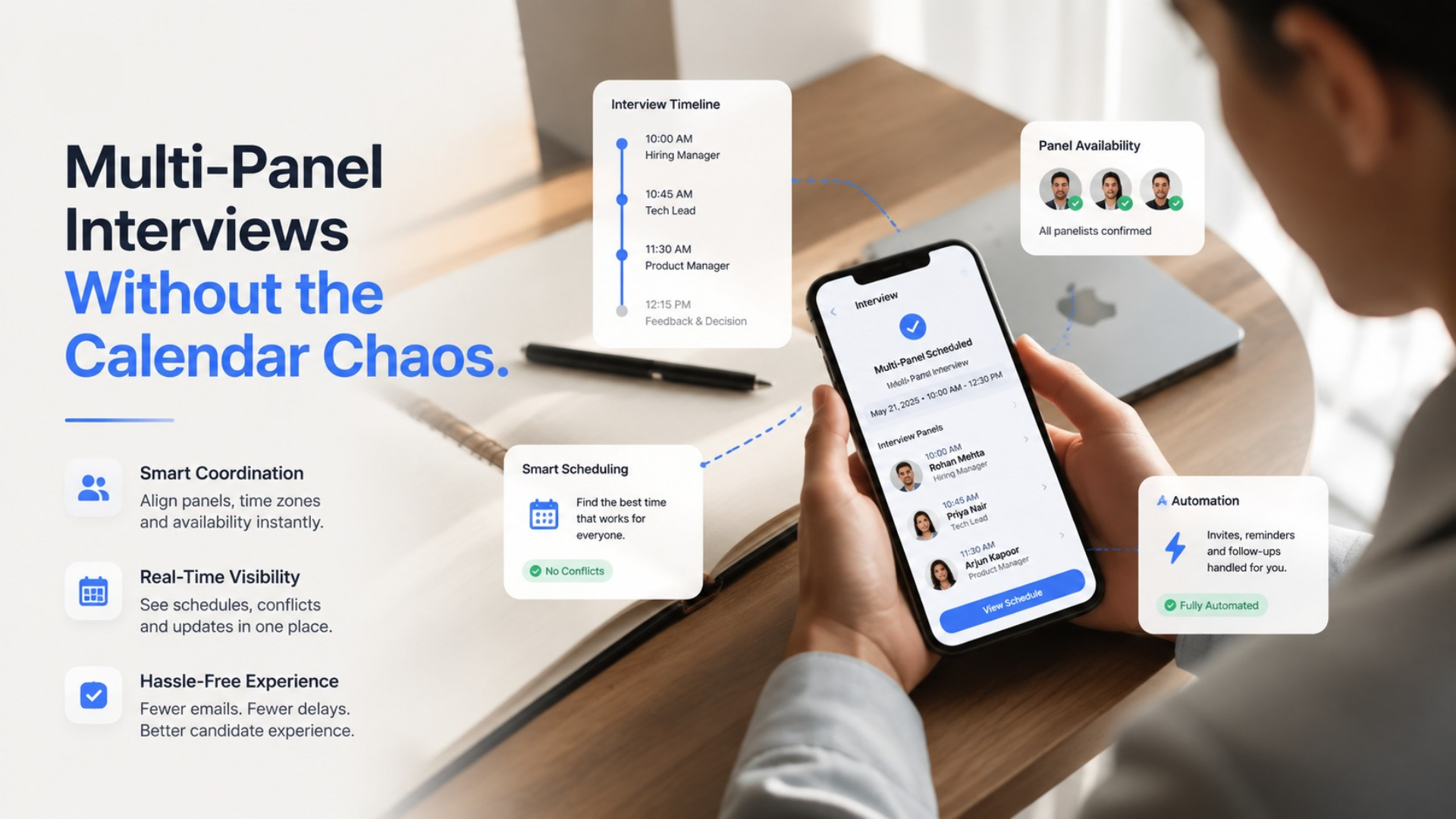
Artificial intelligence transforms multi-panel scheduling from a manual coordination exercise into an automated optimization problem. The core capability is calendar-aware availability matching across multiple participants in real time. Instead of a recruiter polling each panelist individually and manually comparing results, the AI system connects to each participant calendar, evaluates overlapping availability windows, accounts for organizational policies such as minimum notice periods and buffer times between interviews, and presents validated options that work for all participants simultaneously. This capability eliminates the single largest source of scheduling delay: the sequential communication cycle where each panelist responds on their own timeline, conflicts are identified after the fact, and alternatives must be proposed and re-confirmed. According to LinkedIn talent solutions research, organizations that deploy AI-powered scheduling for multi-panel interviews reduce average scheduling time from twelve to eighteen business days to one to three business days, an improvement of
eighty to ninety percent that has a transformative effect on overall hiring velocity.
Beyond basic availability matching, advanced AI scheduling systems handle the dynamic complexity that makes multi-panel coordination so challenging in practice. Panelists change their availability between the time a slot is proposed and the time it is confirmed. Candidates receive competing offers and request accelerated timelines. Hiring managers have conflicts arise that require panel recomposition. An effective AI scheduling system monitors all of these variables in real time and automatically adjusts proposed slots as conditions change, rather than requiring manual intervention to restart the coordination cycle. This dynamic capability is particularly important when managing follow-up scheduling after initial interviews, because the window between rounds is often compressed and candidate patience is limited. The system handles rescheduling as a continuous optimization rather than a crisis, proposing alternatives instantly when conflicts arise and maintaining candidate engagement throughout the process. Research on why referrals outperform cold outreach has shown that the speed and professionalism of the scheduling process is one of the strongest predictors of candidate engagement and offer acceptance, because candidates interpret scheduling efficiency as a signal of organizational competence and respect for their time.
The most sophisticated AI scheduling systems also optimize panel composition and interview format based on the specific requirements of the role and the availability of qualified panelists. If the ideal panelist for a technical assessment is unavailable during the proposed slot, the system can identify an equally qualified alternative rather than forcing a delay. If timezone differences make a live panel impractical for all participants, the system can propose a hybrid format where some panelists attend live and others submit asynchronous assessments. This level of intelligent orchestration transforms the scheduling system from a passive coordination tool into an active hiring workflow engine that optimizes not just for calendar alignment but for the overall quality and efficiency of the interview process. The distinction between simple automation and this type of intelligent orchestration is explored in depth in discussions about the difference between AI sourcing and AI recruiting, because the same principle applies across the entire recruiting workflow: the most impactful tools are those that make intelligent decisions within complex, multi-stakeholder processes rather than simply automating individual tasks in isolation.
Designing Multi-Panel Processes That Scale
Scaling multi-panel interviews across an organization requires more than a scheduling tool. It requires a deliberate process design that balances evaluation rigor with scheduling efficiency. The first design principle is panel size optimization. Research consistently shows that panels of three to five interviewers provide the best balance between evaluation quality and scheduling feasibility. Panels larger than five become exponentially harder to schedule without proportional improvements in evaluation quality, while panels smaller than three fail to provide the diverse perspectives that justify the multi-panel format. The second principle is role-based panel templates. Rather than assembling ad hoc panels for each interview, organizations should define standard panel compositions based on role type, seniority, and function. A
standard panel template for a senior engineering hire might include a peer engineer, a cross-functional partner, a senior leader, and a culture-fit assessor. Templates reduce the coordination burden by narrowing the pool of potential panelists and enabling the scheduling system to optimize within a known, stable set of participants. According to Gartner research on scalable hiring processes, organizations that implement role-based panel templates in combination with AI scheduling reduce average scheduling time by an additional thirty to forty percent beyond the improvement from scheduling technology alone.
The third principle is flexible interview formats that reduce scheduling constraints without reducing evaluation quality. Not every panelist needs to participate in a live, synchronous interview for every candidate. Some assessment dimensions can be evaluated through asynchronous formats such as recorded video responses, written technical exercises, or structured written feedback on portfolio materials. By decoupling some evaluation components from the live interview schedule, organizations can significantly reduce the number of participants who must be present at the same time, which dramatically improves scheduling feasibility. For organizations exploring these hybrid approaches, guidance on how to evaluate an AI sourcing tool before buying recommends prioritizing tools that support both synchronous and asynchronous interview formats within a unified scheduling workflow, because the ability to mix formats based on panelist availability is one of the most powerful levers for reducing multi-panel scheduling complexity without compromising evaluation standards.
The fourth principle is continuous process measurement and optimization. Organizations should track scheduling metrics such as average time-to-schedule, rescheduling rate, candidate withdrawal during scheduling, and panelist satisfaction. These metrics reveal where the process is working well and where friction remains. Over time, the data enables targeted improvements such as adjusting panel templates, expanding the pool of trained interviewers, or modifying scheduling policies that create unnecessary constraints. The connection between measurement and improvement is well established in talent acquisition, and it applies directly to multi-panel scheduling. Organizations that measure their scheduling performance systematically are able to identify and eliminate bottlenecks that organizations relying on anecdotal feedback cannot even detect. A common concern among recruiting leaders is whether AI scheduling will reduce the human element of the hiring process or make interviews feel impersonal to candidates. Research on whether recruiters should worry about AI replacing their jobs consistently finds the opposite: candidates rate their experience higher when scheduling is fast and seamless, because they interpret logistical efficiency as a signal that the organization values their time and takes the hiring process seriously. The human connection happens during the interview itself. The scheduling process is logistics, and logistics should be invisible.
Building a Chaos-Free Multi-Panel Interview Program
Implementing a chaos-free multi-panel interview program requires a phased approach that builds organizational confidence and demonstrates value incrementally. The first phase should focus on the highest-priority roles where multi-panel interviews are most critical and
scheduling friction is most damaging. For most organizations, this means senior technical roles, leadership positions, and cross-functional hires where multiple stakeholders must align on the decision. Start with a single team or function and measure the impact of AI scheduling on time-to-schedule, candidate experience, and panelist satisfaction. The data from this initial deployment serves two purposes: it validates the ROI of the approach and it identifies process adjustments needed before broader rollout. Deloitte analysis of talent acquisition transformation programs has found that phased deployments with clear measurement frameworks are three to five times more likely to achieve successful enterprise-wide adoption than big-bang implementations, because they allow organizations to learn and adapt before committing to full-scale change.
The second phase extends the program to additional roles and functions while refining the process based on learnings from the initial deployment. This phase should include panelist training on the new scheduling workflow, candidate communication templates that set expectations for the multi-panel process, and integration with existing applicant tracking systems to ensure seamless data flow. The key success factor in this phase is panelist adoption. If senior leaders and interviewers find the scheduling process easier and less time-consuming than the manual approach they used before, adoption will be rapid and organic. If the new system introduces friction or complexity, adoption will stall regardless of the organizational mandate. EY research on technology adoption in hiring organizations has consistently found that the single strongest predictor of adoption success is whether the new tool reduces the daily effort required of its users, not whether it improves organizational metrics that users do not directly experience. For interview panelists, the relevant question is simple: does this make scheduling easier for me? If the answer is yes, adoption follows naturally.
The third phase focuses on optimization and continuous improvement. Once AI scheduling is operational across multiple roles and functions, the organization can begin leveraging the scheduling data to optimize panel composition, interview format, and process policies. Which panel templates produce the highest-quality hires? Which interview formats generate the most useful candidate signals? Which scheduling policies create the most unnecessary friction? These questions can only be answered with data from a mature, scaled scheduling process. For Priya, the senior director who lost her strongest candidate to a scheduling debacle, a chaos-free multi-panel program would have meant the difference between making the hire and watching a top engineer join a competitor. Her experience illustrates a truth that every recruiting leader understands intuitively: the quality of the hiring process is not determined solely by the quality of the evaluation criteria or the caliber of the interviewers. It is determined by the logistics that connect the candidate to the panel. When those logistics are fast, seamless, and invisible, the organization can focus its energy on the decisions that matter. When those logistics are chaotic, the logistics become the story, and the best candidates move on to organizations that have solved the problem.