Marcus Rivera, a talent acquisition lead at a fast-growing fintech startup, watched his best candidate accept a competing offer last Thursday. The reason was not salary, not role fit, and not culture mismatch. It was scheduling. His team had taken six business days to coordinate three interview rounds across four time zones, and by the time they sent the final confirmation, the candidate had already signed elsewhere. Marcus spent that weekend reviewing every step of the process and realized something uncomfortable: the scheduling itself consumed more calendar time than the actual interviews combined. His recruiters were spending an average of forty-five minutes per candidate just on back-and-forth emails, and hiring managers were self-serving their own calendars without any visibility into team-wide availability. The experience was frustrating for everyone involved, and it was costing the company the very people they most wanted to hire.
Why Scheduling Still Takes Days When It Should Take Minutes
The fundamental reason interview scheduling drags on is that most teams are still using methods designed for a single calendar owner to coordinate meetings that involve three, four, or even six participants across different departments and time zones. A hiring manager blocks two hours for interviews on Wednesday, but the senior engineer who needs to be in the panel is only free Thursday morning, and the candidate is in London while the team is in Chicago. Resolving these conflicts through email or Slack takes multiple exchanges, each introducing a delay of hours or even a full business day. According to research published by SHRM, recruiters at midsize and large companies report that scheduling a single multi-participant interview round takes an average of two to four business days from the initial invitation to a
confirmed slot. That delay is not a rare exception caused by unusually complex scenarios; it is the standard operating procedure for most hiring teams. The problem is structural: when coordination depends on sequential human responses rather than parallel automated resolution, every additional participant multiplies the waiting time.
Another major factor is the lack of a single source of truth for availability. Interviewer calendars live in Outlook, candidate availability is tracked in an applicant tracking system or scattered across email threads, and conference room bookings are managed in a separate reservation tool. Hiring managers update their calendars sporadically, candidates respond to availability requests on their own schedules, and nobody has real-time visibility into the combined picture. Reconciling these fragmented data sources manually is where the majority of time is lost. Platforms like Huntlo address this by treating scheduling as part of an agentic workflow where the system ingests all availability data in real time and resolves conflicts without human intervention. The result is a process that completes in minutes rather than days because the machine does not wait for each person to respond in sequence.
The Real-World Impact of Slow Interview Coordination
Slow scheduling does not just waste recruiter time; it actively damages hiring outcomes in ways that compound throughout the recruiting funnel. The longer the gap between a candidate initial expression of interest and the first interview, the more likely that candidate is to disengage, accept another offer, or simply lose the enthusiasm that made them a strong prospect in the first place. Research from McKinsey has shown that the elapsed time between initial contact and first interview is one of the strongest predictors of whether a candidate will complete the process. Every additional day of scheduling delay increases the probability that the candidate will either lose interest or receive and accept an offer from a competitor. For senior and specialized roles where the talent pool is small, this effect is magnified dramatically. A single week of scheduling delay can mean the difference between hiring an exceptional candidate and settling for whoever is still available.
The impact extends beyond individual hires to broader employer brand perception. Candidates who experience slow, disorganized scheduling share that experience on Glassdoor, Blind, and in their professional networks, creating a negative narrative that deters future applicants. In competitive talent markets, this reputational damage can be extremely costly and difficult to reverse. In contrast, a scheduling process that feels fast and seamless sends a powerful positive signal about organizational competence. Tools built for niche and technical roles understand that top-tier candidates evaluate the entire hiring journey, and scheduling is one of the earliest and most visible components of that journey. A company that cannot coordinate a meeting efficiently is perceived, fairly or not, as a company that struggles with execution more broadly.
Referral candidates are not protected from these dynamics either. Even when a trusted employee makes a warm introduction, the referred candidate still has to navigate the same scheduling gauntlet as everyone else. Studies exploring why referrals outperform cold outreach consistently find that the conversion advantage of referrals depends on a smooth
end-to-end experience. When scheduling introduces friction early in the process, it undermines the trust and enthusiasm that the referral was supposed to generate, and the candidate begins to question whether the organization is worth their time.
What AI Scheduling Actually Looks Like in Practice
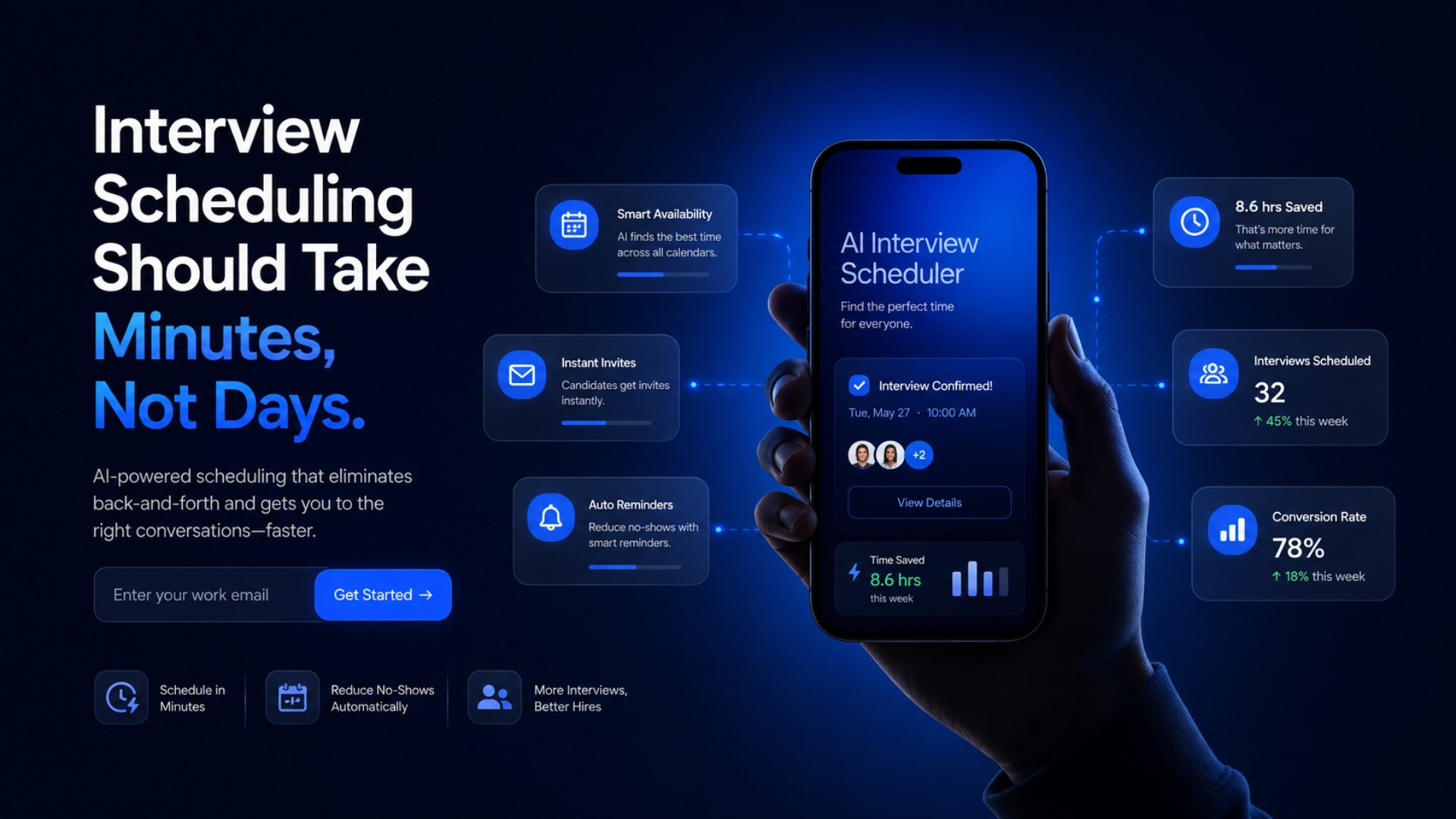
An AI-powered scheduling system does not simply automate email sending. It analyzes the calendars, preferences, and constraints of every participant simultaneously, identifies optimal time windows, accounts for timezone differences, enforces buffer policies between interviews, and sends personalized invitations to each participant within minutes of receiving the scheduling request. Unlike manual coordination, which processes each participant response sequentially, an AI system evaluates all possible combinations in parallel and returns the best available slot almost instantly. The candidate receives a single message with proposed times, the interviewer receives a calendar invitation pre-checked against their existing commitments, and the recruiter sees the entire process logged in their dashboard without having sent a single manual email.
According to LinkedIn, hiring teams that have adopted AI scheduling report reducing coordination time from an average of three days to under fifteen minutes for standard interview rounds. That is not a marginal improvement; it is a transformation in how the recruiting function operates. Recruiters who previously spent hours each day on scheduling can now redirect that time toward sourcing, relationship building, and strategic planning. However, it is important to note that simply adding more tools without addressing the underlying fragmentation will not deliver these results. The gains come from having a single intelligent system that replaces multiple disconnected coordination steps.
AI scheduling also handles the cases that cause the most pain in manual workflows: reschedules and cancellations. When an interviewer falls ill or a candidate needs to move a slot, the AI system immediately identifies alternative times, contacts all affected participants simultaneously rather than sequentially, and re-confirms the interview without requiring the recruiter to manually coordinate a new round of availability checks. This capability alone can save teams several hours per week for organizations that frequently deal with last-minute changes. Research into how many follow-ups one hire actually needs reveals that a significant portion of recruitment follow-up volume is driven by scheduling logistics rather than genuine evaluation decisions, meaning that smarter scheduling can compress the entire hiring cycle substantially.
How Faster Scheduling Transforms Your Hiring Metrics
When scheduling moves from days to minutes, the effects cascade across every major hiring metric. Time-to-hire drops because the coordination phase, which previously accounted for thirty to forty percent of total hiring duration, shrinks to a negligible fraction. Offer acceptance rates improve because candidates experience a responsive, professional process from the very first interaction. Recruiter productivity increases because the hours previously spent
on calendar management are reallocated to higher-value activities like candidate engagement and pipeline analysis. Teams that measure these metrics before and after implementing AI scheduling consistently report improvements across the board within the first two months of adoption.
The quality-of-hire impact is less obvious but equally important. Faster scheduling means candidates are interviewed while their interest and enthusiasm are at their peak, leading to more genuine and engaged conversations. It also means hiring managers can see candidates sooner after the sourcing stage, when their assessment is sharpest. A platform that maintains fresh, accurate candidate data ensures that the scheduling system is always working with current information, preventing the kind of stale-data rescheduling loops that plague tools relying on outdated records. When scheduling intelligence is powered by real-time data, every metric in the hiring funnel benefits, from faster first-interview times to higher candidate satisfaction scores and stronger offer acceptance rates.
The connection between scheduling speed and broader recruiting strategy is often overlooked. Scheduling is not an isolated task; it is the bridge between sourcing and evaluation. As discussions about the difference between AI sourcing and AI recruiting make clear, the most effective platforms are those that maintain momentum across every phase of the pipeline. When scheduling is fast, candidates move from initial contact to final decision without the gaps that cause drop-off. Gartner has reported that organizations with integrated, AI-driven hiring processes see measurably faster pipeline velocity and higher recruiter satisfaction than those relying on fragmented point solutions. These organizations also report lower candidate dropout rates and stronger hiring manager engagement throughout the process.
Steps to Cut Your Scheduling Time Down to Minutes
The first step is auditing your current scheduling workflow end to end. Map every handoff, every tool, and every waiting period between the decision to interview a candidate and the confirmed calendar invite. Most teams discover that the actual decision-making takes only minutes, while the coordination introduces days of latency. This audit often reveals that recruiters are spending five to ten hours per week on scheduling alone, time that could be redirected toward sourcing, screening, and relationship building with candidates. Once you have that map, identify the longest delays and evaluate whether an AI scheduling tool can eliminate them. Guidance on how to evaluate an AI sourcing tool before buying applies equally to scheduling solutions: look for real-time calendar integration, multi-participant conflict resolution, timezone handling, and seamless connectivity with your existing applicant tracking system.
The second step is addressing a common concern: will AI scheduling make recruiters redundant? The evidence strongly suggests the opposite. By automating the mechanical coordination work, AI frees recruiters to invest their time in the human elements of hiring that truly drive outcomes, such as building candidate relationships, coaching hiring managers on interview technique, and making strategic decisions about pipeline prioritization and workforce planning. The question of whether recruiters should worry about AI replacing their jobs has
been studied extensively, and the consistent finding is that AI amplifies recruiter effectiveness. Scheduling automation is a prime example of a task where removing the human intermediary actually improves both speed and satisfaction for all parties.
The third step is measuring the impact and iterating. Implement the scheduling tool with one team or one role type, track the reduction in scheduling duration and the effect on time-to-hire and candidate feedback scores, and use those results to build organizational confidence before expanding across the broader recruiting organization. Celebrate early wins publicly so that other teams can see the tangible benefits and become advocates for adoption. Deloitte research on talent acquisition efficiency shows that organizations that measure scheduling performance as a distinct metric achieve faster improvements than those that treat it as an invisible administrative cost. Meanwhile, EY has found that companies investing in technology-enabled hiring processes report stronger employer branding and higher offer acceptance rates, creating a competitive advantage that compounds with every hire made.